

Written by: Dr. Akash Chandawarkar, Board Certified Plastic Surgeon, Mirror Plastic Surgery
Key Takeaways
- Non-surgical tummy tuck alternatives use FDA-cleared technologies like cryolipolysis, radiofrequency, and HIFEM to reduce fat, tighten skin, and modestly improve muscle tone without surgery.
- Abdominal contour depends on three independent layers, which are subcutaneous fat, skin laxity, and diastasis recti, and each technology targets only specific issues.
- EmSculpt Neo shows the strongest evidence for mild diastasis improvement (18.8%), while Morpheus8 leads for mild-to-moderate skin tightening with 23% improvement after three sessions.
- Significant skin overhang or large diastasis recti cannot be corrected non-surgically and require surgical evaluation for the most reliable functional and aesthetic outcomes.
- Schedule your personalized anatomy assessment at Mirror Plastic Surgery to determine the best treatment plan for your goals.
How Your Abdomen’s Three Layers Affect Non-Surgical Results
Abdominal contour depends on three independent anatomical layers, and a treatment that improves one layer may have no effect on the others.
Subcutaneous fat is the compressible fat layer located between the skin and the abdominal muscle fascia. It is the only fat layer accessible to external energy-based devices. Mesenteric or visceral fat stored below the muscle layer cannot be reached by any non-surgical contouring technology.
Skin laxity refers to the loss of dermal collagen and elastin that causes the abdominal skin envelope to sag or wrinkle. Pregnancy, significant weight fluctuation, age, genetics, and stretch marks all worsen laxity. Non-surgical interventions yield roughly 15–25% improvement in mild-to-moderate laxity but cannot reverse severe skin excess.
Diastasis recti is the separation of the two rectus abdominis muscles along the midline linea alba. Exercise can improve core activation in mild cases but cannot reliably restore significantly thinned and widened linea alba connective tissue to its original tensile strength or permanently close a large midline gap under real-life load.
How Five Leading Technologies Address Fat, Skin, and Muscle
Cryolipolysis (CoolSculpting-style devices) uses controlled cooling to destroy subcutaneous fat cells permanently. Multiple clinical studies confirm 20–25% fat-thickness reduction per treated abdominal area per session.1 It provides limited skin tightening and no meaningful effect on diastasis recti. It is suitable for pinchable subcutaneous belly fat and love handles but is not indicated for significant skin laxity.
EmSculpt Neo combines high-intensity focused electromagnetic stimulation (HIFEM+) with synchronized radiofrequency in a single 30-minute session. MRI-based clinical data show an average 25% increase in muscle mass and 30% reduction in subcutaneous fat after four sessions.1 A multicenter MRI study of 41 patients reported 18.8% improvement in diastasis recti at three months,1 which represents a modest functional benefit. Physical therapy remains first-line and significant functional diastasis requires surgical repair.
truSculpt 3D / radiofrequency (RF) devices deliver monopolar or bipolar RF energy to heat the fat layer and stimulate dermal collagen. RF devices achieve approximately 22–24% fat-thickness reduction in the abdomen with additional skin-tightening benefits via collagen stimulation.1 Most patients need 4–6 sessions.
Morpheus8 (RF microneedling) combines fractional microneedling with radiofrequency energy delivered to a depth of 7 mm, reaching the subdermal fat layer. It is the most evidence-supported non-surgical option for post-pregnancy abdominal skin laxity, typically requiring 3 sessions. A randomized controlled trial of RF microneedling in patients with mild-to-moderate abdominal laxity found a 23% improvement in skin laxity scores at 6 months after three sessions, with no benefit observed in severe laxity cases defined as more than 5 cm of overhanging skin.1
HIFU (High-Intensity Focused Ultrasound) delivers focused ultrasound energy to the SMAS layer and deep dermis to stimulate collagen contraction and remodeling. A study of HIFU showed an 18% improvement in skin laxity scores at 6 months for patients with mild laxity after weight loss, with no benefit demonstrated in severe cases.1 Pilot studies show approximately 13–16% fat-thickness reduction measured at four to eight weeks after treatment.1
Schedule your anatomy-first device assessment to identify which technology, or combination, fits your specific concerns.
2026 Efficacy Comparison Table
The following table summarizes clinical performance data for each technology so you can compare fat reduction, treatment course, and result timing at a glance.
20–25%30% fat reduction; 25% muscle increase22–24% fat-thickness reductionImproved skin laxity in mild–moderate cases13–16% fat-thickness reduction; mild skin tightening
| Technology | Avg. Fat Reduction per Session | Sessions Required | Timeline to Full Results |
|---|---|---|---|
| Cryolipolysis | 1–3 per area | 12–16 weeks post-series | |
| EmSculpt Neo | 4–6 over 2–3 weeks | Visible at 3 months | |
| truSculpt 3D / RF | 4–6 sessions | 8–12 weeks post-series | |
| Morpheus8 (RF microneedling) | 3 sessions | 3–6 months post-series | |
| HIFU | 1–3 treatments | 6 months post-treatment |
Why CoolSculpting Has Declined and Combination Plans Are Growing
Noninvasive fat reduction procedures dropped 40% year-over-year in 2024, from 745,967 procedures in 2023 to 447,581, per the American Society of Plastic Surgeons annual report. Several factors drive this decline.
Paradoxical adipose hyperplasia (PAH) after cryolipolysis is a known risk and has prompted updated informed consent requirements. Single-modality fat reduction also fails to address skin laxity or muscle tone, which leaves many patients with contour changes that still do not match their goals. Combination protocols that treat fat, skin, and muscle together now play a larger role in comprehensive abdominal contouring.
Decision Matrix: Matching Technology to Your Anatomy
| Primary Concern | Fat Reduction | Skin Tightening | Muscle / Diastasis Improvement |
|---|---|---|---|
| Localized subcutaneous fat, good skin elasticity | Cryolipolysis or RF (truSculpt 3D) | Not primary indication | Not indicated |
| Mild-to-moderate skin laxity, near ideal weight | RF or HIFU (modest benefit) | Morpheus8 or HIFU | Not indicated |
| Reduced muscle tone, mild fat, near ideal weight | EmSculpt Neo (secondary benefit) | EmSculpt Neo RF component (mild) | EmSculpt Neo (modest improvement in mild cases) |
| Multiple concerns: fat + laxity + tone | Combination protocol | Combination protocol | EmSculpt Neo component; surgical evaluation if diastasis is significant |
| Significant skin excess, apron overhang, or large diastasis recti | Surgery required | Surgery required | Surgical plication required |
When Non-Surgical Treatments Are Not Enough
Two anatomical presentations consistently exceed what any non-surgical technology can address.
The first is significant diastasis recti. Diastasis recti separation of the rectus abdominis muscles after pregnancy or weight gain cannot be corrected by exercise, physiotherapy, or any non-surgical method and requires surgical muscle repair during abdominoplasty to restore core stability. Untreated, it produces persistent midline bulging, reduced waist definition, lower back pain, and compromised core function. These are functional consequences that extend beyond aesthetics.
The second is apron-like skin excess. No non-surgical treatment can remove significant redundant skin such as apron-like overhanging skin after pregnancy or substantial weight loss. As noted in the Morpheus8 data above, severe laxity exceeding 5 cm of overhang falls outside the effective range of any RF-based treatment.
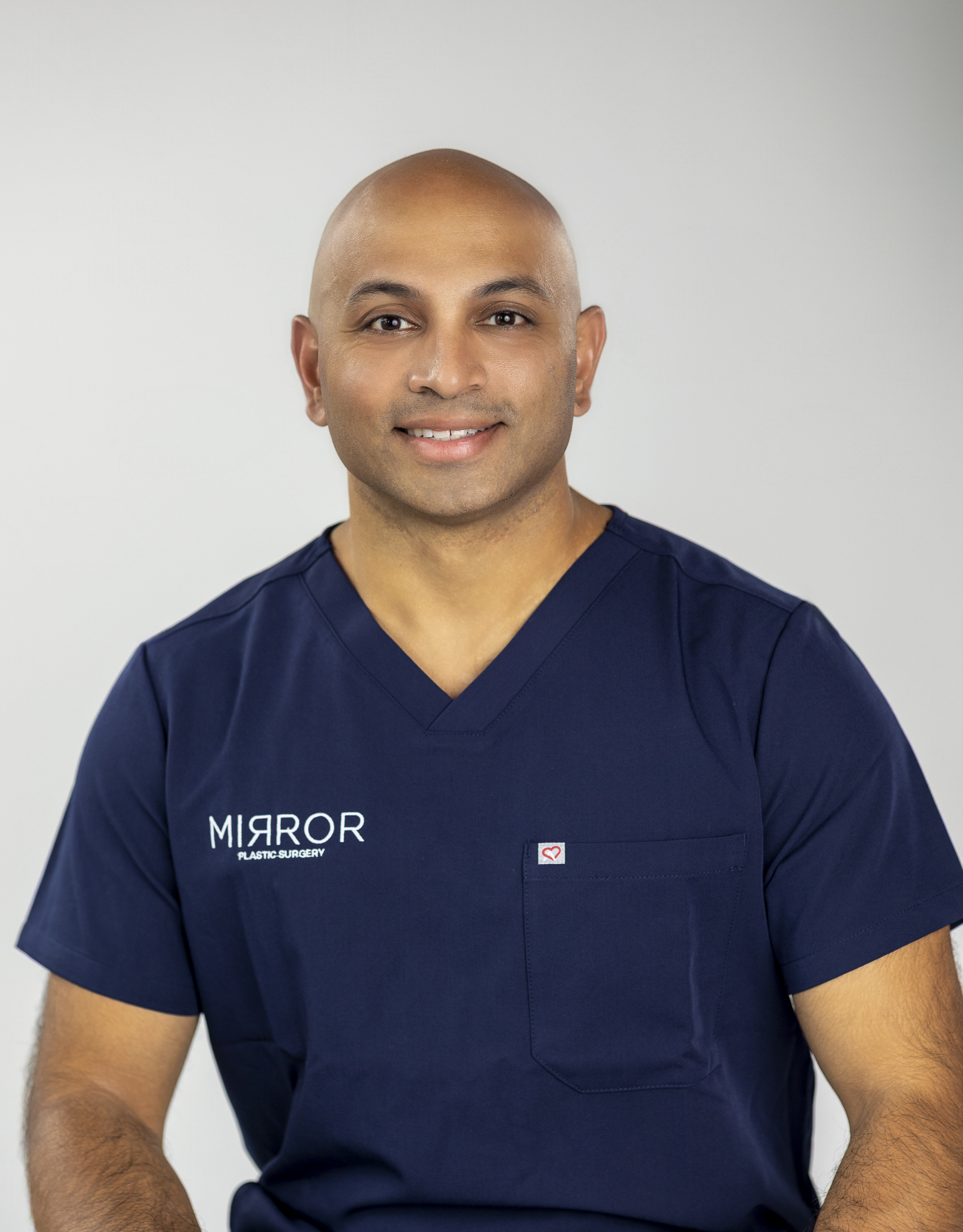
At Mirror Plastic Surgery, Dr. Akash, named to Newsweek’s America’s Best Plastic Surgeons list for two consecutive years, including 2025, approaches abdominoplasty as a functional restoration procedure, which is why his technique addresses the entire abdominal musculature from chest to pubic region rather than just the lower abdomen. This comprehensive approach allows him to repair diastasis recti with internal corset plication while removing skin excess in a single, precisely planned operation. The technique reflects Mirror’s core hierarchy: safety first, function second, aesthetics third.
Schedule your surgical evaluation to determine whether your anatomy is best served by a non-surgical protocol, surgery, or a staged combination of both.
Frequently Asked Questions
Are non-surgical abdominal contouring treatments safe?
FDA-cleared technologies such as cryolipolysis, RF microneedling, HIFEM, and HIFU have well-established safety profiles when qualified providers treat appropriate candidates. The most clinically significant risk associated with cryolipolysis is paradoxical adipose hyperplasia, a condition in which the treated fat hardens and enlarges rather than reducing. Updated clinical data place this risk considerably higher than earlier manufacturer estimates, which makes informed consent and provider expertise critical.
RF and HIFU devices carry risks of burns or uneven heating when settings are not calibrated to the patient’s tissue. A board-certified plastic surgeon can evaluate your anatomy, review your medical history, and identify whether any contraindications apply before recommending a technology.
Who is an ideal candidate for non-surgical abdominal contouring?
Ideal candidates are adults who are at or near their stable goal weight, have a BMI generally under 30, possess good baseline skin elasticity, and have localized subcutaneous fat deposits or mild-to-moderate skin laxity that persists despite diet and exercise. Patients with significant skin overhang, a clinically meaningful diastasis recti, or large-volume fat excess are unlikely to achieve satisfying outcomes from non-surgical technologies alone and should be evaluated for surgical options.
Post-pregnancy patients should wait until weight has stabilized and breastfeeding has ended before starting treatment.
Can non-surgical treatments fix diastasis recti after pregnancy?
Non-surgical options can produce modest functional improvement in mild diastasis recti. EmSculpt Neo, for example, has demonstrated an average 18.8% improvement in diastasis recti in multicenter MRI studies at three months. This benefit remains limited to mild separation and does not restore the structural integrity of the linea alba connective tissue.
Physical therapy is the appropriate first-line intervention for mild cases. When diastasis recti is significant and produces a visible midline bulge, core weakness, lower back pain, or functional impairment, surgical plication during abdominoplasty is the only method that reliably restores midline tension and muscle integrity.
How many sessions are typically required, and when will results be visible?
Session requirements vary by technology. Cryolipolysis typically requires 1–3 sessions per area. RF devices require 4–6 sessions. EmSculpt Neo requires 4–6 sessions over 2–3 weeks. Morpheus8 requires approximately 3 sessions. HIFU requires 1–3 treatments.
Initial changes from device-based treatments are typically visible around 3–4 weeks after treatment, with full results appearing between 3 and 6 months after the final session. A comprehensive combination protocol addressing fat, laxity, and tone can take 6–9 months to reach its full visible outcome.
What red flags should prompt a surgical evaluation rather than a non-surgical treatment?
Several presentations indicate that non-surgical technologies are unlikely to meet a patient’s goals. These include visible skin overhang or apron-like excess that does not retract when standing upright and a palpable or visible midline bulge that worsens when the core is engaged, which suggests significant diastasis recti.
Additional red flags include skin that has permanently lost elasticity and does not spring back when gently pinched, prior non-surgical treatments that produced no meaningful improvement, and post-bariatric or post-GLP-1 weight loss involving large total weight reduction where skin contraction has not kept pace with fat loss. In these situations, a consultation with a board-certified plastic surgeon provides the anatomical clarity needed to make an informed decision.
Next Step: Personalized Assessment at Mirror Plastic Surgery
The St. Petersburg and Tampa Bay area has many clinics that offer individual non-surgical devices. Far fewer practices pair those tools with a board-certified plastic surgeon who can evaluate all three layers, which are fat, skin, and muscle, and then provide an unbiased recommendation that may include non-surgical treatment, surgery, or a staged combination of both.
Dr. Akash, a Harvard Medical School graduate and Johns Hopkins-trained plastic surgeon with consecutive Newsweek Best Plastic Surgeons recognitions, dedicates up to an hour to each initial consultation. Mirror Plastic Surgery performs one to two surgeries per day, not five to ten, which ensures that every patient receives the focused, individualized attention their anatomy and goals require. The practice’s supplier-neutral position means technology recommendations are driven by evidence and your specific anatomy, not by device quotas.
Start your personalized assessment at Mirror Plastic Surgery, located at 780 4th Ave S, St. Petersburg, FL 33701, or reach the practice by phone or text at 727-361-6515.
1 Results may vary from person to person. Editorial content, before and after images, and patient testimonials do not constitute a guarantee of specific results.


