

Written by: Dr. Akash Chandawarkar, Board Certified Plastic Surgeon, Mirror Plastic Surgery | Last updated: July 4, 2026
Key Takeaways
- Hip dips are a normal skeletal feature that exercise alone cannot remove, so professional evaluation is essential for patients near Tampa.
- Choosing a board-certified plastic surgeon with aesthetic fellowship training, low surgical volume, and ultrasound-guided technique improves safety and long-term results.1
- Autologous fat transfer and structural adipose fillers each offer specific benefits, recovery timelines, and risk profiles that you should review during consultation.
- Standardized before-and-after photos, accredited facilities, and board-certified anesthesiologists signal a practice’s commitment to patient safety and natural-looking outcomes.
- Patients ready to explore personalized hip dip correction options can schedule their candidacy evaluation with Dr. Akash at Mirror Plastic Surgery to review treatment plans tailored to their anatomy.
Hip Dip Anatomy and Your Correction Options
The visible hollow of a hip dip reflects how the iliac crest, lateral gluteal fascia, and subcutaneous fat sit over the greater trochanter. Correction strategies focus on this soft-tissue deficit rather than changing the underlying bone.
Two primary categories of correction are available. Autologous fat transfer harvests fat from donor sites with liposuction, processes it, and grafts it into the hip dip zone in multiple tissue planes. Structural adipose fillers, such as processed allograft adipose tissue, are injected subcutaneously under local anesthesia as an in-office procedure, without general anesthesia or an accredited surgical facility. Each approach has its own risk profile, recovery course, and longevity expectations.
Hip Dip Surgery in Tampa: Key Decision Factors
Surgeon selection for hip dip correction should follow clear criteria rather than relying on marketing claims.
Board certification. Board certification in plastic surgery by the American Board of Plastic Surgery is the baseline safety standard for any surgeon performing fat grafting or gluteal contouring procedures. Patients should verify this credential before considering other factors.
Fellowship training. Completion of an accredited aesthetic surgery fellowship beyond residency signals advanced, focused training in body contouring techniques and complex contour refinements.
Daily surgical volume. Practices that limit themselves to one or two surgeries per day maintain concentrated team focus on each patient. This contrasts with high-volume environments that perform five to ten procedures daily and divide staff attention across multiple cases.
Ultrasound guidance. Post-Multi-Society Task Force safety guidelines for fat grafting recommend subcutaneous-only injection, ultrasound-assisted technique where appropriate, and strict cannula control. Intraoperative ultrasound imaging confirms cannula position and allows the surgeon to observe fat placement in real time, which improves precision and safety.
Multi-plane technique. Successful hip dip correction fills the deeper supporting trench below the visible hollow first, then layers fat more superficially. Superficial fat that lacks this structural foundation may shift or resorb more easily.
How Practice Models Compare for Hip Dip Evaluation
The following table shows how key evaluation criteria differ between high-volume practices and concierge models, helping you identify which approach aligns with evidence-based safety standards.
| Evaluation Criterion | High-Volume Practices | Concierge Model | Evidence Note |
|---|---|---|---|
| Board Certification (ABPS) | Variable, not always plastic surgery–specific | Required baseline standard | ABPS certification is the baseline, not a bonus |
| Aesthetic Surgery Fellowship | Uncommon | Completed post-residency | Advanced body contouring training beyond 7-year residency |
| Daily Surgical Volume | 5–10 procedures/day | 1–2 procedures/day | Lower volume supports concentrated pre-, intra-, and post-operative focus |
| Ultrasound Guidance | Not consistently used | Used for pre-operative assessment and intraoperative precision | Multi-Society Task Force guidelines recommend ultrasound assistance where appropriate |
| Long-Term Outcome Focus | Single-procedure throughput | Multi-visit, individualized care plan | Fat retention and contour durability depend on technique, aftercare, and stable weight |
Fat Retention Expectations After Hip Dip Fat Transfer in Tampa
Average fat graft survival rates for hip dip correction range from 60% to 80%, with 20% to 40% of transferred fat potentially resorbed.1 A separate clinical description notes that traditional fat grafting commonly results in 30%–70% reabsorption, which highlights the variability across techniques and patient factors.
Final contour and fat graft retention usually become apparent at 3 to 6 months, with most retained fat plateauing by six months after the procedure.1 Factors that influence longevity include fat quality and handling during processing, placement depth, non-smoking status, stable body weight, and adherence to aftercare instructions. Some patients may benefit from a second fat transfer at about one year to reach stable, longer-lasting results.1
Fat placed with a multi-plane approach, where the surgeon backfills the deeper trench first to maximize contact with well-vascularized tissue before layering more superficially, tends to integrate more reliably. This strategy reduces the chance of resorption related to gravity or movement.
Risk Profiles for Surgical and Injectable Hip Dip Treatments
Autologous fat transfer carries risks associated with any procedure that uses general anesthesia and liposuction. These include infection, fat necrosis, embolism, anesthesia-related complications, and several weeks of surgical downtime. These risks make facility and personnel credentials critical safety factors rather than optional features. Performing fat grafting in an AAAHC-accredited facility with a board-certified physician anesthesiologist directly addresses anesthesia and emergency response risks. Hospital privileges for the operating surgeon add another safety layer in the rare event of complications.
Structural adipose filler is administered as an in-office procedure under local anesthesia through small cannula injections. The product is processed under regulated allograft protocols with donor tissue screening and sterilization and does not contain viable cells. Potential complications include cystic or nodule formations, pain, infection, hematoma, allergic or immune responses, and skin discoloration at the procedure site. Structural adipose filler is contraindicated for patients with severe allergen sensitivities, a history of anaphylaxis, or active infection.
For injectable approaches that include biostimulators, the technique of an experienced, board-certified plastic surgeon is essential. Non-dissolvable products require precise placement to reduce the risk of nodule formation and other contour irregularities.
Recovery Timelines and Aftercare
Autologous fat transfer (surgical). Immediate swelling and bruising are expected in both the donor and recipient sites. Most patients return to light activity within two weeks, and compression garments are worn for four to six weeks. Strenuous activity and direct pressure on the hip dip area are restricted for six weeks. Final results should be evaluated after 3 to 6 months, once swelling has resolved and fat integration has stabilized.1
Structural adipose filler (in-office). Swelling usually improves within 3 to 7 days, and mild bruising, temporary redness, or itchiness typically resolve in the same time frame. Temporary firmness can last 1 to 4 weeks as the area settles, which represents a normal part of the healing sequence. Return to normal daily activity is generally rapid, while strenuous exercise is paused briefly based on provider guidance.
How to Review Before-and-After Hip Dip Photos
Standardized photography is the objective benchmark for assessing a surgeon’s outcomes. Consistent lateral and posterior photos captured at consultation, before each session, and at follow-up visits allow objective measurement and support realistic expectations.
When you review a surgeon’s portfolio, confirm that images use consistent lighting, identical camera distance, and matched posterior and lateral angles across all time points. Natural contour blending, where the corrected hip dip transitions smoothly into the waist above and the thigh below, signals technically sound fat grafting. Asymmetric results, visible step-offs, or overfilled contours suggest technique limitations that you should discuss directly with the surgeon.
High-Volume Practices Compared With Concierge Models
The number of procedures a surgeon performs each day affects the attention available to each patient before, during, and after surgery. Practices that perform five to ten surgeries daily distribute team focus across multiple simultaneous cases. A concierge model limited to one or two procedures per day keeps the entire surgical team, including the anesthesiologist, scrub technician, and nursing staff, dedicated to a single patient during the operation and immediate recovery.
This difference continues outside the operating room. Longer pre-operative consultations allow for detailed anatomical assessment, honest discussion of realistic outcomes, and individualized surgical planning. Post-operative follow-up in a low-volume practice tends to be more consistent and is less likely to be delegated entirely to non-physician staff.
Dr. Akash’s Credentials and Hip Dip Approach
Dr. Akash offers a training background that is uncommon in aesthetic surgery. He completed his medical degree through the Harvard-MIT Division of Health Sciences and Technology, graduating from Harvard Medical School with Honors. His seven-year integrated plastic and reconstructive surgery residency at Johns Hopkins University included rotations at the R Adams Cowley Shock Trauma Center and the Curtis National Hand Center. He then completed an aesthetic surgery fellowship at the Manhattan Eye, Ear and Throat Hospital (MEETH), one of the most competitive programs in the country for advanced body contouring and facial rejuvenation.
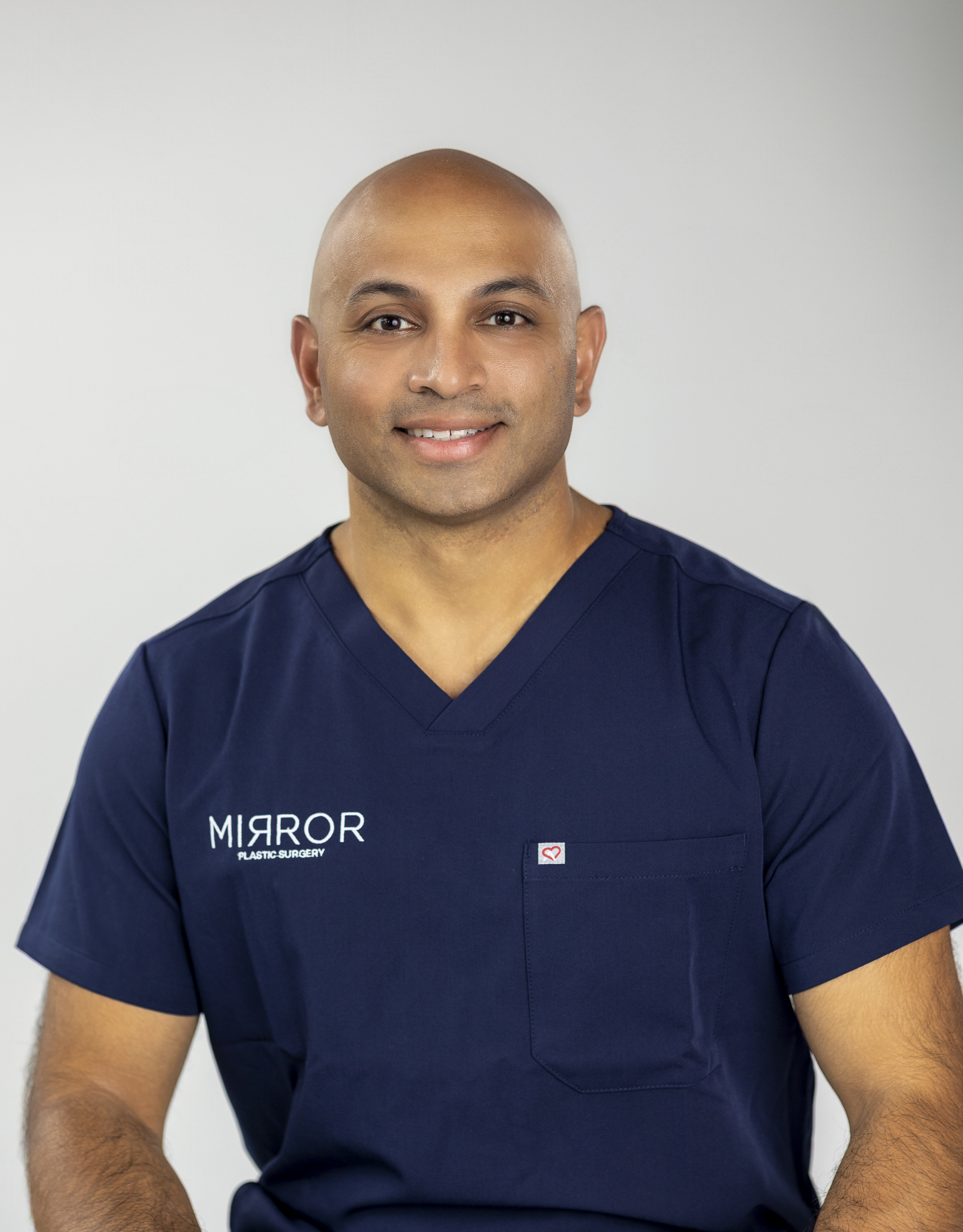
Dr. Akash is board certified by the American Board of Plastic Surgery and holds hospital privileges, which provide a critical safety backstop in the rare event of a surgical complication. He serves on the advisory board for Tiger Aesthetics, the company behind structural adipose filler, giving him direct access to the clinical evidence base and technique refinements for this product.
Mirror Plastic Surgery’s operating philosophy, summarized as safety first, function second, aesthetics third, guides every hip dip correction plan. Pre-operative ultrasound assessment, accredited facility use, and board-certified physician anesthesiologists are standard elements of care.
Request your anatomical assessment to receive a thorough evaluation and personalized hip dip correction plan from Dr. Akash.
BBL-Style Procedures Versus Targeted Hip Dip Correction
Many patients researching hip dip correction encounter Brazilian Butt Lift procedures in their search results, yet these are distinct interventions with different anatomical targets. Understanding this difference helps you choose the procedure that addresses your specific contour concern.
A Brazilian Butt Lift (BBL) transfers fat primarily to the central and upper buttock to increase overall gluteal projection and roundness. Hip dip correction is a targeted procedure that focuses on the lateral hollow between the iliac crest and greater trochanter, which a standard BBL may not adequately fill.
When a patient’s main concern is the lateral hip hollow rather than overall buttock volume, targeted fat grafting to the hip dip zone, or structural adipose filler injection for patients who are not surgical candidates or prefer a non-surgical approach, is more anatomically appropriate than a full BBL. Structural adipose fillers such as AlloClae meet FDA standards for human tissue products and are used for body contouring including hip-dip correction, but they are not FDA-approved for those specific indications. The filler is administered subcutaneously in localized areas where adipose tissue naturally exists. It is not a stem cell treatment and does not carry the systemic risks associated with general anesthesia.
The appropriate procedure depends on the patient’s anatomy, available donor fat, candidacy for general anesthesia, and desired longevity of results. These factors are reviewed in detail during a comprehensive consultation.
Frequently Asked Questions
Who is a good candidate for hip dip correction?
Strong candidates are adults at a stable body weight who have realistic expectations about the degree of correction achievable. Non-smoking status, consistent sleep, and absence of active infection or immunosuppression improve outcomes for both surgical and injectable approaches. Patients on anticoagulant therapy, those with a history of anaphylaxis, or those who are pregnant or breastfeeding require individualized risk assessment before any procedure. A thorough consultation, including a review of all medications and supplements, remains the most important step in determining candidacy safely.
How long do hip dip correction results last?
Autologous fat transfer results are considered durable long-term when the retained fat, typically 60–80% of the initial graft as discussed earlier, is maintained with stable body weight and proper technique.1 Structural adipose filler, as a structural allograft filler, is designed to provide long-lasting results, although individual outcomes vary.1 Biostimulatory fillers such as Sculptra typically last 18 to 24 months, while Radiesse results last about 14 to 18 months, and both require maintenance.1 The longevity of any approach depends on technique quality, patient anatomy, and lifestyle factors including weight stability.
What is the difference between structural adipose filler and traditional fat transfer for hip dips?
Traditional autologous fat transfer harvests the patient’s own fat, processes it, and grafts it into the hip dip zone. This surgical procedure requires general anesthesia, liposuction donor sites, and an accredited operating facility. As noted in the risk profiles section, structural adipose filler is an in-office procedure performed under local anesthesia, which makes it suitable for patients who are not surgical candidates, lack sufficient donor fat, or prefer a non-surgical option. Both approaches have distinct risk profiles, recovery timelines, and longevity expectations that you should review in detail with a board-certified plastic surgeon.
What should I ask a surgeon before hip dip correction?
Key questions include: Are you board certified by the American Board of Plastic Surgery? Have you completed a fellowship in aesthetic surgery? How many hip dip correction procedures do you perform, and how many surgeries do you perform per day? Do you use ultrasound guidance for fat grafting? Where is the procedure performed, and is the facility accredited? Who administers anesthesia, and are they a board-certified physician anesthesiologist? What are your documented complication rates, and how do you manage complications if they arise? Reviewing standardized before-and-after photographs with consistent lighting and angles is also essential before committing to a surgeon.
What is the recovery timeline for surgical hip dip fat transfer?
Patients typically experience swelling and bruising at both the donor liposuction sites and the hip dip recipient area for the first one to two weeks. Light daily activity usually resumes within two weeks. Compression garments are worn for four to six weeks. Strenuous exercise and direct pressure on the treated area are restricted for six weeks. Visible improvement appears immediately, but final contour results, which reflect true fat retention, are not accurately assessed until three to six months after the procedure, once swelling has resolved and fat integration has stabilized.
Conclusion: Choosing the Right Surgeon for Your Goals
Hip dips are a normal anatomical feature, and correction is elective. The decision to pursue treatment should follow a thorough, unhurried consultation that addresses your specific anatomy, realistic outcome expectations, candidacy for each available approach, and the full risk-benefit profile of surgical versus non-surgical options.
The criteria that most reliably predict safe, lasting outcomes, including board certification by the American Board of Plastic Surgery, aesthetic surgery fellowship training, accredited facility use, board-certified physician anesthesiologists, ultrasound guidance, and a low daily surgical volume, are all verifiable before you commit to any procedure. Prioritizing these factors over price or convenience aligns with the current evidence on safe hip dip correction.
Mirror Plastic Surgery and Dr. Akash serve Tampa Bay patients from their St. Petersburg location, offering both surgical fat transfer and AlloClae structural filler for hip dip correction within a concierge model that limits procedures to one or two per day.
Begin your individualized evaluation with Dr. Akash at Mirror Plastic Surgery — 780 4th Ave S, St. Petersburg, FL 33701 — to explore your hip dip correction options in detail.
1 Results may vary from person to person. Editorial content, before and after images, and patient testimonials do not constitute a guarantee of specific results.


