
Written by: Dr. Akash Chandawarkar, Board Certified Plastic Surgeon, Mirror Plastic Surgery
Key Takeaways for Tampa Men Considering Hair Restoration
- Elite hair restoration relies on a board-certified plastic surgeon who performs every critical surgical step, with fellowship training and tightly controlled daily volume.
- Physician-led practices consistently achieve higher graft survival rates than high-volume clinics that depend on technicians and rapid case turnover.1
- Reviewing ABPS board certification, aesthetic fellowship training, and documented research involvement helps you separate qualified specialists from marketing-driven providers.
- Responsible graft limits, precise technique, and direct physician supervision protect long-term donor reserves and create natural, lasting results for male pattern baldness.
- Schedule your personalized consultation at Mirror Plastic Surgery to explore physician-led surgical and non-surgical hair restoration options tailored to your goals.
Comparing Tampa Hair Transplant Credentials: Physician-Led vs High-Volume Clinics
Selecting a hair restoration specialist starts with credentials you can verify, not advertising claims. The comparison below highlights a clear divide: physician-led practices like Mirror Plastic Surgery limit daily volume to maintain quality, while high-volume clinics trade individualized care for speed and throughput. This difference affects graft survival, donor preservation, and long-term naturalness.1 The table compares these two models across four criteria that determine whether your procedure feels like a medical treatment or an assembly-line transaction.
| Credential Criterion | Physician-Led (Mirror Plastic Surgery) | High-Volume Clinic Model | Why It Matters |
|---|---|---|---|
| Fellowship Training | Aesthetic surgery fellowship (MEETH/Lenox Hill), Johns Hopkins plastic surgery residency | Variable, often no formal fellowship in aesthetic or hair surgery | Critical steps such as recipient-site creation and FUT strip excision demand direct physician expertise |
| Board Certification | American Board of Plastic Surgery (ABPS) | May be absent or from non-core boards | Accurate diagnosis and planning depend on a surgeon with recognized board credentials |
| Daily Surgery Volume | Deliberately limited case volume with full surgeon involvement | 5–10+ cases per day | High-volume mills prioritize throughput over individualized care, which raises graft failure and donor overharvesting risk |
| Research Involvement | Peer-reviewed publications, editorial board role with Aesthetic Surgery Journal, FDA testimony on implant safety | Rarely documented research output | The ISHRS notes that every surgical step should be physician-directed to reduce misdiagnosis and complications |
Schedule your credential-focused consultation with Dr. Akash to review candidacy, donor capacity, and a tailored treatment plan.
FUE vs FUT for Male Pattern Baldness: Technique Tradeoffs That Affect Results
FUE and FUT use different methods to move hair, and those differences shape scarring, recovery, and graft numbers. Follicular Unit Excision (FUE) removes individual follicular units through small circular punches, which avoids a linear scar and allows faster recovery. This advantage comes with a tradeoff, because FUE is more time-intensive and usually yields fewer grafts per session than the alternative. Follicular Unit Transplantation (FUT) removes a strip of scalp, which allows larger graft numbers per session at a lower per-graft cost, but it leaves a linear donor scar that may show with short hairstyles.
These technical differences matter less than the outcome they create: graft survival. A 2,000-graft case at 90% survival yields 1,800 growing follicles, while 65% survival produces only 1,300. That 500-follicle gap directly affects visible density and naturalness.1 Graft survival depends on out-of-body time, storage solution and temperature, handling technique, and precise implantation depth and angle. A qualified physician who performs or closely supervises each step controls these variables and protects your result.1
Long-term donor stewardship protects your options as you age. Responsible surgeons cap FUE sessions at roughly 2,000–3,000 grafts to avoid overharvesting the permanent donor supply of about 6,000–8,000 grafts.1 Overharvesting can create a patchy donor appearance that is difficult to correct. A result that exhausts donor reserves at 35 leaves few or no corrective options at 50.
Surgeon vs Technician Involvement: Protecting Safety and Natural Hairlines
Natural results depend on who actually performs each step of your procedure. Creating recipient sites, extracting an FUT strip, and suturing require a doctor’s direct medical expertise, while graft harvesting must occur under close physician supervision to protect the donor area. When clinics hand these steps to undertrained technicians, patients face higher risks of unnatural hairline angles, folliculitis, and permanent donor-zone damage.
This delegation is not a rare exception. It represents the standard operating model at many high-volume clinics, where financial pressure to maximize daily case counts makes full physician involvement in every critical step unrealistic. The ISHRS 2025 Practice Census does not report medical tourism growth since 2019 or Turkey’s annual procedure volume, but it highlights the rise of high-volume centers that rely heavily on technicians.
The consultation experience offers a clear warning sign you can assess yourself. High-pressure sales tactics signal a transaction, not a medical evaluation. A qualified physician focuses on education and realistic expectations, without urgency to commit. At Mirror Plastic Surgery, consultations can run up to an hour, which allows time for questions, scalp evaluation, and thoughtful planning.
Non-Surgical Secretome Therapy: Early-Stage Option Before Committing to Surgery
The credential framework above focuses on surgical hair restoration, yet not every man with hair thinning qualifies for immediate surgery. A careful clinic sometimes declines surgery and instead orders scalp biopsies or blood panels when hair loss may reflect an undiagnosed medical condition. In these situations, staged approaches or medical therapies provide safer first steps.
Mirror Plastic Surgery offers hair restoration with Acorn Biolabs Secretome, a non-surgical therapy delivered by injection or topical application. Secretome-based treatments provide an evidence-informed option for men in early hair-loss stages or those who want to improve the scalp environment before or after surgery. Clinics that combine adjunctive biologic therapies with FUE often raise graft take-rates by more than 10% on average.1 A physician-led consultation that reviews donor density, hair-loss trajectory, and overall health determines whether secretome therapy, surgery, or a combined plan fits your situation.
Explore your non-surgical and surgical options with Dr. Akash to decide whether secretome therapy, surgical restoration, or a combined approach aligns with your hair-loss stage and goals.
Costs, Celebrity Examples, and Setting Realistic Expectations
Hair restoration pricing varies based on graft count, technique, and provider credentials. Each patient at Mirror Plastic Surgery receives a personalized quote during consultation that reflects anatomy, graft requirements, and the agreed treatment plan.
Online speculation about celebrity hair restoration, including public figures such as Elon Musk and Donald Trump, does not provide a useful benchmark for your case. Individual anatomy, Norwood-Hamilton stage, donor density, and long-term hair-loss trajectory determine the appropriate graft count and technique for each person. Surgeons with focused training, recognized board credentials, and ISHRS involvement usually charge more because they deliver higher graft survival, more natural hairlines, and lower complication risk. That cost difference reflects measurable outcomes rather than marketing alone.
Repair surgery for unsatisfactory prior work often requires 1,000–2,000 or more grafts. A low-cost procedure abroad followed by corrective surgery in the United States can match or exceed the cost of a single high-quality domestic procedure while consuming additional donor hair.
Dr. Akash’s Training and Recognition in Aesthetic and Hair Restoration Surgery
Dr. Akash earned his medical degree through the Harvard-MIT Division of Health Sciences and Technology and graduated from Harvard Medical School with Honors. He completed a seven-year integrated plastic and reconstructive surgery residency at Johns Hopkins University, followed by an aesthetic surgery fellowship at Manhattan Eye, Ear and Throat Hospital (MEETH)/Lenox Hill Hospital, one of the most competitive aesthetic fellowships in the country. He also completed the Stanford University Biodesign Innovation Fellowship, which focuses on physician-led medical device development.
Dr. Akash serves as Next Generation Editor for the Aesthetic Surgery Journal, has testified before the FDA on implant safety, and sits on advisory boards for companies developing aesthetic technologies. He has been named to Newsweek’s America’s Best Plastic Surgeons list for two consecutive years, including 2025. At Mirror Plastic Surgery, he maintains a deliberately low daily surgical volume so he can remain involved in every phase of each patient’s care.
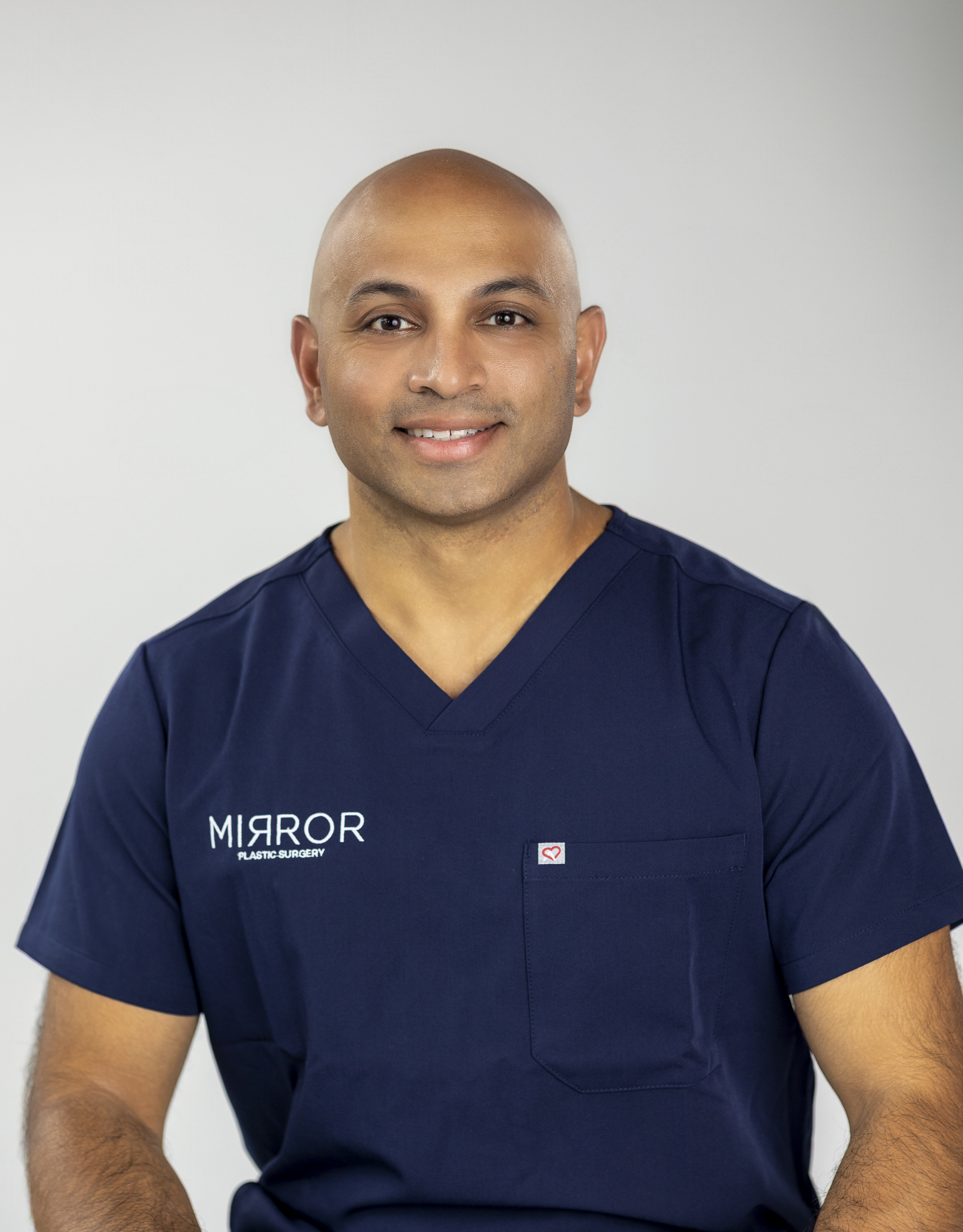
Begin your physician-led evaluation with Dr. Akash and experience the standard of care that distinguishes fellowship-trained, low-volume hair restoration from high-volume alternatives.
Frequently Asked Questions
Am I a candidate for hair transplant surgery?
Ideal surgical candidates have stable hair loss, adequate donor density at the back and sides of the scalp, realistic expectations, and a commitment to post-surgical medical therapy to protect non-transplanted hair. Men with rapidly progressing hair loss, scarring alopecia, or limited donor supply may not qualify for immediate surgery. A physician-led consultation at Mirror Plastic Surgery includes a full scalp evaluation, review of hair-loss trajectory using the Norwood-Hamilton Scale, and, when needed, blood work or scalp biopsy to rule out underlying medical causes before any treatment is recommended.
What is the recovery timeline after a hair transplant?
Most patients return to desk work within a few days after an FUE procedure.1 Transplanted hairs usually shed within the first two to four weeks, which represents a normal part of the follicular cycle. Visible regrowth typically begins between three and six months, with full density reached between twelve and eighteen months.1 Patients receive detailed guidance on post-operative care, activity restrictions, and adjunctive therapies during consultation and follow-up visits.
How do I compare hair restoration providers in Tampa?
Focus on four criteria when comparing providers. Verify ABPS certification or an equivalent core board credential. Confirm fellowship training in aesthetic or hair restoration surgery. Ask about daily surgical volume, since concierge-level attention usually involves far fewer cases per day than high-volume models. Review documented research or professional society involvement, such as ISHRS membership. Also confirm that the physician, not a technician or sales representative, conducts your consultation, creates recipient sites, and directly supervises all extraction steps. Request continuous video documentation of results rather than relying only on still photographs, which can be edited.
Is ongoing maintenance required after a hair transplant?
Ongoing maintenance remains essential even after a successful transplant. Transplanted follicles resist the hormonal changes that drive androgenetic alopecia, but native hairs continue to thin over time. Long-term planning rests on three pillars: strategic graft placement that preserves donor hair for future needs, proactive prevention with therapies such as Minoxidil or secretome therapy, and strict donor preservation through limited extraction per session. Men who stop medical maintenance after surgery risk continued thinning in untreated areas, which can undermine the overall aesthetic result.1
What are the complication risks, and how are they minimized?
Complications such as folliculitis, donor-site scarring, graft failure, and unnatural hairlines relate closely to technique quality, hygiene standards, and the level of physician involvement. High-volume clinics that delegate critical steps to technicians and prioritize speed carry higher complication profiles than low-volume, physician-led practices. At Mirror Plastic Surgery, Dr. Akash’s ABPS certification provides hospital access in the rare event of a surgical complication, which technician-led or non-physician-operated clinics cannot match. Thorough pre-operative evaluation, accredited surgical facilities, and a tightly limited daily case load work together to reduce risk at every stage of care.
Conclusion: Why Thorough Evaluation Protects Your Long-Term Result
Choosing a hair restoration specialist is a long-term medical decision with effects that extend decades beyond the procedure date. Evidence consistently links credentialed, low-volume, fellowship-trained practices to higher graft survival, lower complication rates, and more natural long-term outcomes than high-volume, technician-driven models. For Tampa-area men, the credential comparison, technique data, and provider evaluation criteria in this guide offer a practical framework for making that choice.
Start your comprehensive hair-loss evaluation with Dr. Akash at Mirror Plastic Surgery to review your hair-loss stage, donor capacity, and the full range of surgical and non-surgical options available to you.
1 Results may vary from person to person. Editorial content, before and after images, and patient testimonials do not constitute a guarantee of specific results.