
Written by: Ellie Pranckevicius, FNP-BC, Aesthetic Nurse Practitioner & Aesthetic Injector | Facial Restoration & Regenerative Injectable Specialist, Mirror Plastic Surgery
Key Safety Takeaways for BBL in Florida
- BBL mortality has declined significantly since 2017 thanks to subcutaneous-only injection techniques and real-time ultrasound guidance, but serious risks remain when safety protocols are ignored.
- Board certification by the American Board of Plastic Surgery, verified annual BBL volume, and hospital privileges are the most critical surgeon qualifications to confirm before booking.
- Florida law now requires intraoperative ultrasound for every BBL. Patients should also verify accredited facilities, board-certified anesthesia providers, and daily case limits of three or fewer procedures.
- Pre-operative health preparation, including nicotine cessation, stable weight, and cardiac screening, along with strict post-op positioning rules, directly affects fat graft survival and complication rates.1
- For patients seeking lower-risk gluteal enhancement, Mirror Plastic Surgery offers non-surgical BBL options performed by Ellie Pranckevicius. Schedule a consultation with Ellie to explore the safest pathway for your goals.
Step 1: Verify Board Certification and Specialized Training
Surgeon credentials are the single most controllable variable in BBL safety. Physicians from non-plastic surgery specialties have performed BBLs with fatal outcomes, making board certification by the American Board of Plastic Surgery (ABPS), verifiable at abplasticsurgery.org, the primary surgeon qualification recommended.
Use this checklist before booking a surgical BBL consultation:
- Start by confirming ABPS certification at abplasticsurgery.org, which verifies completion of an accredited plastic surgery residency.
- Next, verify ASAPS fellowship or equivalent aesthetic surgery training, showing focused expertise beyond general plastic surgery.
- Once you confirm core credentials, ask the surgeon to disclose annual BBL volume, personal complication rates, and before-and-after results of patients with similar body types.
- Then confirm the surgeon maintains hospital privileges at an accredited facility, which signals peer-reviewed competence and accountability.
- Finally, verify that BBL is a core, regularly performed procedure rather than an occasional add-on.
At Mirror Plastic Surgery, surgical BBL procedures fall under the care of Dr. Akash Chandawarkar, MD, a Harvard-educated physician, Johns Hopkins-trained plastic surgeon, fellowship-trained aesthetic surgeon at the Manhattan Eye Ear & Throat Hospital (MEETH)/Lenox Hill Hospital, and medical device innovation-trained at Stanford University. His credentials match the depth of training this checklist recommends.
For patients exploring both surgical and non-surgical options, consultations with Ellie Pranckevicius, FNP-BC, provide a comprehensive assessment of which pathway best suits your anatomy, goals, and risk tolerance, with direct access to Dr. Chandawarkar’s surgical expertise when your goals require it. Schedule a consultation to determine your safest, most effective path forward.
Step 2: Require Ultrasound-Guided, Subcutaneous-Only Technique
Intraoperative ultrasound guidance lets the surgeon visualize the cannula tip in real time and confirm that fat remains above the muscle fascia in the subcutaneous plane. This advancement is the most direct safeguard against fatal fat embolism.
The 2022 multi-society Practice Advisory on Gluteal Fat Grafting from ASPS, ASAPS, and ISAPS highlighted key safety techniques for BBL procedures. Florida now mandates ultrasound guidance for all BBL procedures under HB 1471.
Use this technique verification checklist during your consultation:
- Confirm real-time intraoperative ultrasound is used during fat injection, not only for pre-operative marking.
- Verify subcutaneous-only fat placement and reject any surgeon who describes or defends intramuscular injection.
- Confirm use of blunt-tipped cannulas of 4 mm or larger, which lower the chance of vessel penetration.
- Confirm the surgeon avoids Luer-Lock syringes, prefers intergluteal or sacral incision sites, maintains the cannula angle upward or parallel to the skin, and injects only while the cannula stays in continuous motion.
- Ask whether the procedure is documented per Florida’s HB 1471 mandate, including ultrasound use.
Step 3: Choose an Accredited Facility with Real Emergency Readiness
A 2023 study analyzing BBL deaths in South Florida found that 92 percent occurred at high-volume, budget clinics rather than properly accredited facilities. Facility accreditation directly affects mortality, not just convenience.
Use this facility decision checklist:
- Confirm accreditation through AAAASF, AAAHC, or a state-licensed ambulatory surgical center.
- Verify that anesthesia is administered by a board-certified anesthesiologist or certified nurse anesthetist.
- Confirm the surgeon limits BBL procedures to three or fewer per day, since data associate lower complication rates with this volume.
- Ask about on-site emergency protocols, staff training, and resuscitation equipment such as crash carts and defibrillators.
- Walk away from any practice performing five or more surgeries daily, because that volume signals divided attention and rushed care.
Mirror Plastic Surgery performs one to two surgeries per day by design. That limit reflects a safety and quality commitment that aligns with the evidence above.
Step 4: Prepare Your Health Before Surgery
Pre-operative patient screening for BBL should include a complete medical history review, blood tests, evaluation of heart and lung health, medication and supplement review, and discussion of past surgeries to identify risk factors before proceeding.
Follow this pre-operative preparation checklist with your care team:
- Stop all nicotine products at least four weeks before surgery. Nicotine impairs blood flow and delays healing, which directly threatens fat graft survival.
- Reach and maintain a stable body weight. Major recent weight changes elevate risk and compromise long-term contour.
- Complete full cardiac and pulmonary screening if you have any history of DVT, PE, or clotting disorders.
- Disclose all blood thinners and supplements and confirm a safe cessation or adjustment plan with your surgeon.
- Confirm diabetes is well-controlled, since uncontrolled blood sugar impairs wound healing and increases infection risk.
- Confirm adequate donor fat to yield at least 500–800 cc of purified fat per side, because very lean patients face higher harvesting risk and weaker outcomes.
Step 5: Follow Strict Post-Operative Positioning and Recovery Rules
Transferred fat cells lack an independent blood supply for the first weeks after BBL and rely on inosculation and neovascularization. Direct pressure, shear force, or inadequate blood flow during this period can cause fat necrosis, volume loss, or asymmetrical contours. Recovery compliance largely determines how much transferred fat survives.1
Use this post-operative recovery checklist:
- Avoid sitting directly on the buttocks for at least 2–3 weeks, using a BBL pillow positioned under the thighs if sitting cannot be avoided.
- Sleep prone, on the stomach, and allow side sleeping only with pillows behind the back and between the knees to prevent rolling onto the buttocks.
- Wear compression garments 24/7 for the first 3–6 weeks, removing them only for showering, then 12 hours daily up to 3 months.
- Take gentle 5–10 minute walks several times daily starting in week 1 to promote circulation and reduce DVT risk.
- Watch for fat embolism warning signs such as sudden shortness of breath, chest pain, rapid heartbeat, confusion, or feeling faint, and seek emergency care immediately if any appear.
- Monitor for infection signs. Fever above 38.5°C (101.3°F), foul odor from incisions, spreading redness, warmth, or thick yellow or green pus require immediate contact with your surgical team.
If the five-step surgical safety protocol above feels overwhelming, or if your risk tolerance, anatomy, or goals do not align with the demands of surgical BBL, you still have another option to consider before committing to surgery.
Step 6: Consider Non-Surgical BBL as a Lower-Risk Alternative
Surgical BBL is not the only route to gluteal enhancement. Non-surgical BBL using biostimulatory fillers, specifically Radiesse and AlloClae, offers meaningful contouring with a substantially reduced risk profile, including no general anesthesia, no liposuction, no fat embolism risk, and no weeks of strict positioning restrictions.
At Mirror Plastic Surgery, non-surgical BBL is performed by Ellie Pranckevicius, FNP-BC, an Aesthetic Nurse Practitioner whose background includes 600 hours of hands-on esthetics training, a Master’s in Nursing from the University of South Florida, and four years in the Neuroscience ICU at Tampa General Hospital. That clinical foundation, which is rare among injectors, gives Ellie a precise understanding of subdermal anatomy that supports safe, accurate filler placement.
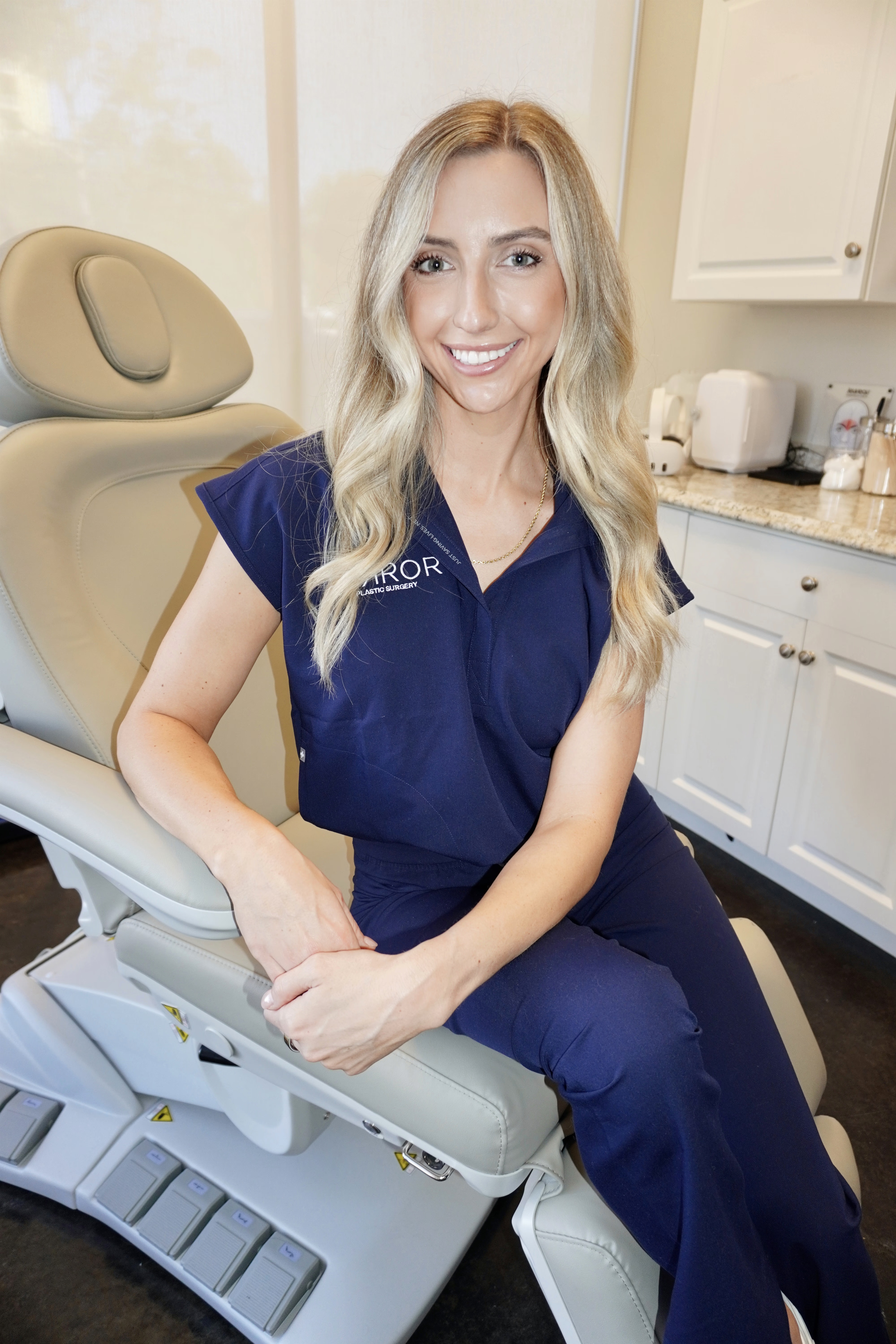
Her approach targets volume, hip dips, cellulite texture, stretch mark appearance, and symmetry, tailored to each patient’s anatomy and goals rather than a standardized protocol. Explore non-surgical BBL options with Ellie during a personalized consultation.
Whether you choose surgical or non-surgical BBL, the same principle applies. Your provider’s approach to safety, transparency, and education reveals their priorities. The following red flags apply mainly to surgical consultations, yet many also signal problems in any aesthetic setting.
Red-Flag Checklist: Warning Signs of Unsafe BBL Practices
The following signals indicate a practice that prioritizes volume over safety. Leave any consultation where you observe these patterns:
- Pressure to book immediately or same-day before a thorough anatomical discussion occurs.
- No mention of ultrasound guidance, cannula technique, or injection plane during the surgical consultation.
- Opaque product choices, including an inability or unwillingness to name the specific filler, its mechanism, or why it suits your anatomy.
- Daily surgical case volumes of five or more procedures.
- No established patient-surgeon relationship prior to surgery day.
- No discussion of your personal medical history, DVT risk, or pre-operative screening requirements.
Frequently Asked Questions
How do you prevent fat embolism during a BBL?
Fat embolism occurs when fat enters the gluteal veins, which run within and beneath the gluteal muscle. Prevention relies on the subcutaneous-only technique and real-time ultrasound guidance described in Step 2. Beyond those core safeguards, controlled manual injection rather than high-pressure pump delivery and limiting injection to small volumes per pass further reduce risk.
Florida requires ultrasound guidance by law for all BBL procedures. Choosing a board-certified plastic surgeon who performs this technique routinely, in an accredited facility with a board-certified anesthesia provider, addresses most embolism risk.
How long should I avoid sitting after a BBL?
Direct sitting on the buttocks should be avoided for a minimum of two to three weeks after surgery. During this period, use a BBL pillow placed under the thighs, not the buttocks, when sitting is unavoidable.
Controlled sitting with surgeon approval may begin in weeks three through six, with gradual return to normal sitting after week seven once the surgeon confirms fat graft stability. Back sleeping remains prohibited for at least six to eight weeks.
These restrictions exist because transferred fat cells depend on surrounding tissue for blood supply during the first weeks, and pressure or shear force during this window can cause fat necrosis and volume loss.
How do non-surgical BBL results compare to surgical BBL results?
Surgical BBL uses the patient’s own harvested fat to add volume, which allows larger, more dramatic augmentation, often 500 cc or more per side, with long-lasting results once the fat stabilizes at around three months.1 Non-surgical BBL using biostimulatory fillers like Radiesse and AlloClae produces more subtle, gradual contouring by stimulating the body’s own collagen production and adding targeted volume.1
Non-surgical BBL works best for patients seeking refined shape, hip dip correction, cellulite smoothing, or modest enhancement without surgery, anesthesia, or extended recovery. It carries no fat embolism risk, requires no donor site liposuction, and involves minimal downtime.
At Mirror Plastic Surgery, Ellie Pranckevicius tailors the non-surgical approach to each patient’s anatomy and goals, and surgical options with Dr. Akash Chandawarkar are available when the desired change requires fat transfer.
What are the latest 2026 BBL mortality statistics?
BBL mortality has declined substantially from the 2017 peak of approximately 1 in 3,000 procedures. The mortality decline noted earlier resulted from widespread adoption of improved injection techniques and stricter safety standards.
Credentialed surgeons using current safety protocols maintain strong safety records for BBL.1 The data consistently show that mortality and complication risk concentrate in high-volume, unaccredited settings rather than in properly credentialed, accredited practices that follow modern technique standards.
Conclusion: Put BBL Safety Ahead of Everything Else
Reducing BBL risk depends on verification, not luck. Confirm your surgeon’s ABPS certification and annual BBL volume. Require real-time ultrasound guidance and subcutaneous-only technique.
Select an AAAASF- or AAAHC-accredited facility with a daily case limit of one to three procedures. Prepare your health before surgery and follow post-operative positioning protocols without exception. When surgical BBL carries more risk than your goals require, non-surgical BBL with biostimulatory fillers performed by a clinically trained injector offers a credible, lower-risk alternative.
Mirror Plastic Surgery follows this framework: safety first, function second, aesthetics third. Every consultation, surgical or non-surgical, begins with a thorough, hour-long assessment, honest risk education, and a personalized plan grounded in anatomy rather than volume targets.
Disclaimer: Results may vary from person to person. Editorial content, before and after images, and patient testimonials do not constitute a guarantee of specific results.
1 Results may vary from person to person. Editorial content, before and after images, and patient testimonials do not constitute a guarantee of specific results.