
Written by: Dr. Akash Chandawarkar, Board Certified Plastic Surgeon, Mirror Plastic Surgery | Last updated: July 5, 2026
Key Takeaways
- Concierge plastic surgery limits daily volume to one or two cases, which allows hour-long consultations and direct surgeon access that high-volume practices cannot match.
- Thorough anatomical assessment, including chest wall measurements, tissue evaluation, and 3-D imaging, guides implant selection instead of standardized sizing sessions.
- Board certification by the American Board of Plastic Surgery, hospital privileges, and advanced training at institutions such as Harvard Medical School and Johns Hopkins provide independent verification of a surgeon’s qualifications.
- 2026 implant data show low rupture rates for highly cohesive silicone devices, and routine 10-year replacement is no longer considered necessary when proper monitoring protocols are followed.1
- Patients seeking concierge-level breast augmentation in Florida can schedule a personalized consultation at Mirror Plastic Surgery to experience anatomy-first planning and dedicated post-operative support.
How Concierge Care Changes the Breast Augmentation Experience
Concierge care in plastic surgery is a practice model in which the surgeon limits daily surgical volume to one or two procedures, dedicates up to one hour per consultation, maintains direct post-operative communication with each patient, and bases all treatment decisions on individualized anatomical assessment rather than standardized protocols. This model prioritizes depth of attention over throughput.
This distinction matters for breast augmentation because implant selection, pocket placement, and incision planning are all anatomy-dependent decisions. A rushed consultation cannot match the quality of pre-operative assessment that comes from a visit structured around thorough tissue evaluation, patient education, and shared decision-making. Practices performing five to ten surgeries daily distribute surgeon attention across a much larger patient load, which compresses the time available for each individual case.
What Concierge Breast Augmentation Looks Like in Practice
- Consultation length: Initial appointments run up to one hour, which allows time for a complete anatomical assessment, review of imaging findings, discussion of implant options, and patient education on risks and realistic outcomes.
- Pre-operative assessment tools: Advanced in-office diagnostics, including ultrasound, support precise tissue characterization before surgery. Three-dimensional imaging technology helps patients visualize how different implant sizes, shapes, and profiles would appear on their specific anatomy before any decision is finalized.
- Surgical volume limits: This daily limit ensures that the entire clinical team, including surgeon, anesthesiologist, and nursing staff, maintains full focus on each patient before, during, and after the procedure. High-volume environments divide team attention across many simultaneous or back-to-back cases.
- Post-operative access: Patients have direct access to their surgeon throughout recovery, rather than a rotating staff of nurses or physician assistants who may not know the specifics of the case.
- Supplier neutrality: Evidence-based practices select implants and techniques based on clinical data rather than manufacturer quotas or financial incentives, so recommendations reflect each patient’s anatomy and goals.
At Mirror Plastic Surgery in St. Petersburg, Florida, this model is the operational standard, not a marketing claim. By maintaining this volume limit, the practice can structure every consultation around the safety-function-aesthetics hierarchy that guides all clinical decisions.
Schedule a consultation with Dr. Akash to experience what a thorough, anatomy-first breast augmentation evaluation looks like.
Key Questions to Ask Your Breast Augmentation Surgeon
Patients who arrive at consultations with specific questions are better positioned to evaluate whether a practice meets concierge-level standards. These questions help reveal how a surgeon thinks about safety, anatomy, and long-term outcomes.
- How long is the initial consultation? A meaningful anatomical assessment requires time. Consultations shorter than 30 minutes rarely allow for comprehensive tissue evaluation, implant education, and informed consent discussion.
- How many surgeries do you perform per day? The answer shows how surgical attention is distributed. One to two procedures per day reflects a fundamentally different commitment to each patient than five to ten.
- What is your revision policy? Clear policies on complications, size changes, and implant-related issues before surgery provide insight into long-term accountability.
- How do you assess my anatomy before selecting an implant? Surgeons who practice anatomy-driven planning describe chest wall measurements, tissue thickness evaluation, skin elasticity assessment, and nipple-to-fold distance calculations, not a generic sizing session.
- Are you board certified by the American Board of Plastic Surgery? The American Board of Plastic Surgery (ABPS) is the only board recognized by the American Board of Medical Specialties (ABMS) to certify surgeons in the full spectrum of plastic surgery, including breast augmentation. Verification through the ABMS online directory confirms active certification status.
- Do you have hospital privileges? Hospital privileges require formal credentialing review of a surgeon’s training history, licensure, and professional standing. This process provides an independent verification layer and a practical safety net if complications require hospital-level resources.
How to Check Surgeon Credentials and Training
Evaluating credentials works best when you look beyond a surgeon’s website. The following hierarchy of verification steps reflects the standards used by accreditation bodies and professional societies.
- Board certification: The ABPS certification pathway requires graduation from an accredited medical school followed by at least six years of surgical training, with a minimum of three years dedicated specifically to plastic and reconstructive surgery residency. Surgeons must pass both written and oral examinations and maintain certification through continuing medical education and periodic re-certification.
- Residency and fellowship pathways: Integrated plastic surgery residency programs accept fewer than 200 residents annually nationwide, which makes the specialty one of the most competitive in medicine. Fellowship training in aesthetic surgery adds a focused layer of specialization beyond residency.
- Hospital privileges: Hospital privileges require formal credentialing review of a surgeon’s training history, licensure status, and professional standing. This process gives patients an independent verification layer beyond website information.
- Professional roles and publications: Surgeons who publish peer-reviewed research, serve on editorial boards, hold FDA advisory roles, or teach at academic institutions show ongoing engagement with evolving safety standards and techniques.
Dr. Akash at Mirror Plastic Surgery holds credentials that satisfy every tier of this evaluation framework. His education began at MIT in neuroscience and nuclear engineering, followed by acceptance into the highly selective Harvard-MIT Division of Health Sciences and Technology program, from which he graduated from Harvard Medical School with Honors.
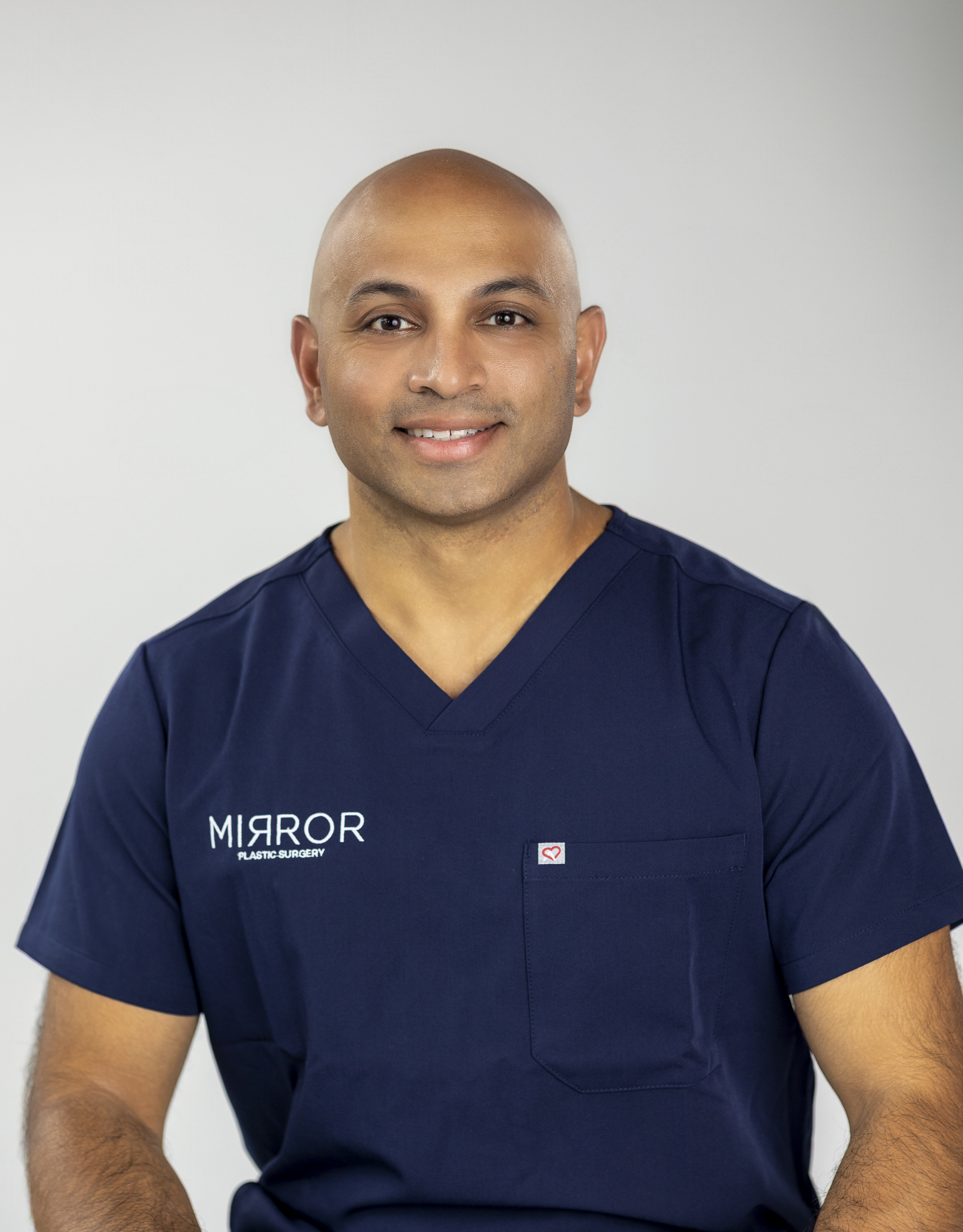
His surgical training took place during a seven-year integrated plastic and reconstructive surgery residency at Johns Hopkins University, one of the world’s most rigorous training programs, with rotations at the Johns Hopkins Hospital, the R Adams Cowley Shock Trauma Center, and the Curtis National Hand Center. He then completed an aesthetic surgery fellowship at the Manhattan Eye, Ear and Throat Hospital (MEETH), which represents the highest level of specialization in cosmetic surgery. He also completed the Stanford University Biodesign Innovation Fellowship, training in medical device development alongside engineers and clinicians in Silicon Valley.
Dr. Akash was selected to testify before the U.S. Food and Drug Administration on breast implant safety, which reflects both his clinical expertise and his standing within the specialty. He serves as Next Generation Editor for the Aesthetic Surgery Journal, sits on multiple international committees within The Aesthetic Society, and has been named to Newsweek’s America’s Best Plastic Surgeons list for two consecutive years. He is board certified by the American Board of Plastic Surgery and holds hospital privileges that provide an independent safety net for every patient.
Anatomy-First Education and Planning
Anatomy-driven planning treats the chest wall, overlying tissue, and skin envelope as the primary variables in implant selection, not patient preference alone. Key anatomical factors include chest wall width and curvature, sternal notch-to-nipple distance, nipple-to-inframammary fold distance, tissue thickness and quality, and the degree of existing ptosis or asymmetry. These measurements determine which implant profile, volume, and placement plane will produce proportional, durable results for a specific patient.
Placement decisions, including subglandular, subfascial, or submuscular, carry distinct implications for long-term outcomes. Submuscular placement beneath the pectoralis muscle may reduce certain stress factors on the implant shell compared to subglandular placement, although placement decisions also depend on aesthetic goals, tissue coverage, and patient activity level. Patients with thin tissue coverage may benefit from submuscular or dual-plane placement to reduce implant visibility and palpability, while those with adequate tissue may be candidates for other approaches.
Lifestyle goals, including athletic activity levels, occupational demands, and breastfeeding intentions, factor into every planning decision at Mirror Plastic Surgery. The practice’s commitment to the safety-function-aesthetics hierarchy means that structural and functional considerations are addressed before aesthetic preferences are finalized.
Breast Implant Options and Safety Data for 2026
As of 2026, highly cohesive silicone gel breast implants remain the dominant choice in the United States, offering improved safety profiles with lower rupture risks. The four FDA-approved breast implant manufacturers are Mentor, Allergan, Sientra (now a Tiger Aesthetics brand), and Ideal Implant.
Clinical data from the Motiva IDE pivotal study has shown low rates of device rupture. Motiva’s sixth-generation implants have been associated with low capsular contracture rates, representing an improvement over the rates historically seen with traditional smooth silicone implants, and Motiva implants have a worldwide rate of reoperation due to rupture lower than 0.2%.1
Rupture rates vary significantly by manufacturer and model according to research data. Routine 10-year replacement of highly cohesive silicone gel implants is no longer considered necessary in many cases as of 2026, though monitoring via MRI and high-resolution ultrasound remains advised. The FDA recommends initial MRI screening 5 to 6 years after silicone breast implant placement, followed by imaging every 2 to 3 years thereafter.
The dominant 2026 trend centers on smaller implant sizes in the 250–325cc range, natural-looking results, and hybrid procedures combining implants with autologous fat transfer. This shift reflects a preference for proportional enhancement and anatomy-first planning. Informed consent discussions cover potential risks including capsular contracture, rupture, and the rare condition BIA-ALCL.
Dr. Akash serves on the advisory board for Motiva, among other technology companies, and brings direct familiarity with the clinical data underlying these implant systems to every patient consultation.
Recovery Milestones and Warning Signs
- Initial healing phase: Most patients feel largely back to normal after the first month, with final results becoming clear between 3 and 6 months post-surgery as implants drop and settle into their final position.1
- Activity restrictions: No lifting over 5 pounds, no overhead reaching, and no strenuous movement are standard for the first weeks. Desk-job workers typically need 1 to 2 weeks off, while physically demanding careers require 3 to 4 weeks.1
- Swelling timeline: Swelling typically peaks on days 3–5 and may take 3–6 months to fully resolve. Temporary asymmetry during this period is common as one breast may settle faster than the other.1
- Bra requirements: Patients must wear a surgical bra 24/7 for the first 1 to 2 weeks and possibly up to 6 weeks. Underwire bras should be avoided for at least six weeks.
- Red flags requiring immediate attention: Fever above 101°F, severe one-sided pain, sudden swelling or hardness in one breast, red streaks from incisions, foul drainage, or excessive bleeding may indicate infection or hematoma and require immediate medical evaluation.
- Long-term monitoring: Breast implants should be evaluated by a surgeon at the 10–15 year mark regardless of symptoms, with FDA-recommended imaging at defined intervals.
Florida-Specific Factors for Concierge Breast Augmentation
Patients searching for concierge-level breast augmentation in Florida will find that the Tampa Bay and St. Petersburg market includes both high-volume practices and smaller, patient-centered alternatives. Florida requires that outpatient surgical facilities meet state licensure standards and that surgeons operating in those facilities hold appropriate credentials and hospital privileges. Verifying that a surgeon operates in an accredited facility, whether accredited by the American Association for Accreditation of Ambulatory Surgery Facilities, the Accreditation Association for Ambulatory Health Care, or The Joint Commission, provides an independent safety verification layer beyond the surgeon’s individual credentials.
Mirror Plastic Surgery is located at 780 4th Ave S, St. Petersburg, FL 33701, and serves patients throughout the Tampa Bay region. The practice’s concierge model, which includes one to two surgeries per day, hour-long consultations, board-certified physician anesthesiologists, and advanced in-office ultrasound, reflects the operational standards that distinguish anatomy-first care from high-volume alternatives.
Schedule your personalized assessment with Dr. Akash to see how the safety-function-aesthetics hierarchy applies to your unique anatomy.
Frequently Asked Questions
Am I a candidate for breast augmentation?
Most healthy adults who have completed breast development and maintain realistic expectations are potential candidates. A thorough pre-operative evaluation, including tissue assessment, chest wall measurements, and a review of medical history, determines candidacy on an individual basis. Factors such as tissue thickness, skin elasticity, existing asymmetry, and lifestyle goals influence whether augmentation alone, augmentation with a lift, or an alternative approach is most appropriate. At Mirror Plastic Surgery, this evaluation takes place during a dedicated hour-long consultation with Dr. Akash.
How do I prepare for a breast augmentation consultation?
Preparation works best when you arrive with a clear sense of your aesthetic goals, any previous breast imaging results, a list of current medications and supplements, and specific questions about the surgeon’s credentials, daily surgical volume, and anatomical planning process. Photographs of results you find appealing can help communicate aesthetic preferences, although the final plan will be based on your individual anatomy rather than any external reference point.
How long do modern breast implants last?
Modern highly cohesive silicone gel implants frequently last 15 to 20 years or longer without complications, and routine replacement at a fixed interval is no longer considered necessary in many cases as of 2026.1 Implants are not lifetime devices, however, and should be monitored through FDA-recommended MRI screening beginning 5 to 6 years after placement, followed by imaging every 2 to 3 years thereafter. Rupture rates vary by manufacturer and model, which makes implant selection an important clinical decision rather than a purely aesthetic one.
What is the difference between submuscular and subglandular implant placement?
Submuscular placement positions the implant beneath the pectoralis major muscle, which can provide additional tissue coverage and may reduce certain stress factors on the implant shell. Subglandular placement positions the implant above the muscle but below the breast gland, which can offer a different aesthetic profile and may involve a shorter recovery for some patients. The appropriate plane depends on tissue thickness, chest wall anatomy, aesthetic goals, and activity level. These decisions require individualized assessment rather than a standardized recommendation.
What are the warning signs of a complication after breast augmentation?
Fever above 101°F, severe or worsening pain localized to one breast, sudden asymmetric swelling or hardness, red streaks extending from incisions, foul-smelling drainage, or excessive bleeding are all signs that require immediate medical evaluation. Capsular contracture, which is a tightening of scar tissue around the implant, may develop gradually and presents as progressive firmness or shape distortion. Any new breast changes, including lumps or persistent pain, should be evaluated promptly regardless of how long the implants have been in place.
Conclusion
Concierge breast augmentation care in Florida is defined by measurable operational standards such as extended consultations, strict surgical volume limits, anatomy-driven implant planning, and direct surgeon access throughout recovery. These standards create the conditions that support individualized, predictable, and durable outcomes. Evaluating a surgeon’s credentials, practice model, and approach to anatomical planning before committing to a procedure remains the most reliable way to identify a provider whose priorities align with long-term patient well-being rather than throughput.
Dr. Akash at Mirror Plastic Surgery brings Harvard-MIT education, Johns Hopkins residency training, MEETH aesthetic fellowship specialization, Stanford Biodesign innovation experience, and FDA testimony on breast implant safety to every patient encounter. With this national recognition and his extensive training background, he practices within a concierge model that limits daily surgical volume to one or two procedures and structures every consultation around the safety-function-aesthetics hierarchy.
Book a consultation with Dr. Akash at Mirror Plastic Surgery in St. Petersburg, Florida, and begin your breast augmentation journey with a thorough, evidence-based anatomical assessment.
1 Results may vary from person to person. Editorial content, before and after images, and patient testimonials do not constitute a guarantee of specific results.