
Written by: Dr. Akash Chandawarkar, Board Certified Plastic Surgeon, Mirror Plastic Surgery
Key Takeaways
- BBL revision surgery is technically demanding because scar tissue, altered anatomy, and disrupted blood supply make it very different from a first-time BBL.
- Common post-BBL complications include asymmetry, contour irregularities, fibrosis, and shelf deformity, and each problem requires a tailored correction strategy.
- Florida requires real-time ultrasound guidance for all gluteal fat grafting, including revisions, to lower fat embolism risk and confirm safe cannula placement.
- Choosing a revision specialist means confirming board certification, revision-specific experience, ultrasound use, and accredited facility standards instead of relying on primary BBL volume alone.
- Patients seeking expert BBL revision care in the Tampa area can schedule a personalized consultation at Mirror Plastic Surgery with Dr. Akash to review safe, individualized correction options.
Why BBL Revision Requires Different Skills Than a First-Time BBL
A primary BBL involves harvesting fat through liposuction, processing it, and grafting it into the gluteal region. Revision surgery takes place in anatomy that has already been changed. Scar tissue from prior liposuction alters tissue planes, restricts fat movement, and makes cannula passage more difficult. Previously grafted fat that has partially resorbed or migrated creates irregular contours that must be mapped carefully before any corrective grafting or removal. The vascular architecture of the region has also been disrupted, which affects how newly transferred fat integrates and survives.
These factors mean that experience with primary BBL procedures does not automatically qualify a surgeon to perform revisions. Effective revision planning relies on detailed pre-operative imaging, a clear understanding of how prior surgery has changed the anatomy, and the technical ability to address several deformities in one operation while maintaining safety.
Common Post-BBL Problems: Asymmetry, Irregular Contours, Fibrosis, and Shelf Deformity
Asymmetry refers to a measurable difference in volume, projection, or shape between the two buttocks after surgery. Minor asymmetry is common in any fat grafting procedure because fat survival varies. Significant asymmetry that affects silhouette or clothing fit usually requires surgical correction.
Contour irregularities describe uneven surface texture or shape. These often result from uneven fat distribution during the original procedure, different rates of fat resorption, or liposuction irregularities in the donor sites that distort the surrounding anatomy.
Fibrosis is the formation of dense, fibrous connective tissue in response to surgical trauma. After BBL, fibrosis can develop in both donor liposuction sites and grafted areas, creating firmness, restricted movement, and visible surface irregularities. Releasing fibrotic tissue calls for specialized instruments and technique to avoid creating new deformities.
Shelf deformity is a specific contour issue where an abrupt, ledge-like transition appears at the upper border of the buttock, usually where grafted fat meets ungrafted tissue. It often results from fat placement that is too superficial, too concentrated in one zone, or not well blended into the surrounding anatomy. Correcting a shelf deformity often involves targeted liposuction, fat redistribution, and precise re-grafting.
[Placeholder: De-identified clinical images illustrating fibrosis release and ultrasound-guided grafting correction of shelf deformity]
Florida Ultrasound Rules and How They Shape Safer BBL Revisions
Addressing these complications safely requires strict attention to evolving safety standards. Florida has been at the forefront of BBL safety regulation in the United States. After a period of elevated mortality rates linked to fat embolism during gluteal fat grafting, the Florida Board of Medicine created requirements that directly affect how BBL procedures, including revisions, are performed in the state.
Current Florida standards require surgeons performing gluteal fat grafting to use real-time ultrasound guidance to confirm cannula placement and avoid intramuscular or intravascular injection, which are the main mechanisms of fatal fat embolism. This rule applies to both primary and revision cases. In revision surgery, where scarring and altered tissue planes make landmarks less reliable, ultrasound guidance becomes a critical safety tool that lets the surgeon see tissue depth and cannula position in real time.
When you evaluate a revision specialist, confirming that the practice has ultrasound equipment in the operating suite and that the surgeon is trained in intraoperative ultrasound interpretation is a key step. The Aesthetic Society and the American Society of Plastic Surgeons both support ultrasound-guided fat grafting as a standard of care for gluteal augmentation.
Credentials That Signal True BBL Revision Expertise
Board certification by the American Board of Plastic Surgery is the baseline credential for any surgeon performing BBL revision in Florida. Beyond certification, the depth and focus of training separate surgeons who can manage complex revision cases from those whose experience centers on primary procedures.
Dr. Akash at Mirror Plastic Surgery in St. Petersburg holds a medical degree from Harvard Medical School through the highly selective Harvard-MIT Division of Health Sciences and Technology program. He completed a seven-year integrated plastic and reconstructive surgery residency at Johns Hopkins University, a rigorous program that includes complex reconstruction, trauma, and microsurgery. He then completed an aesthetic surgery fellowship at the Manhattan Eye, Ear and Throat Hospital (MEETH), a program recognized for advanced training in body contouring and facial surgery. A Biodesign Innovation Fellowship at Stanford University further shapes his approach to technology use in surgical planning.
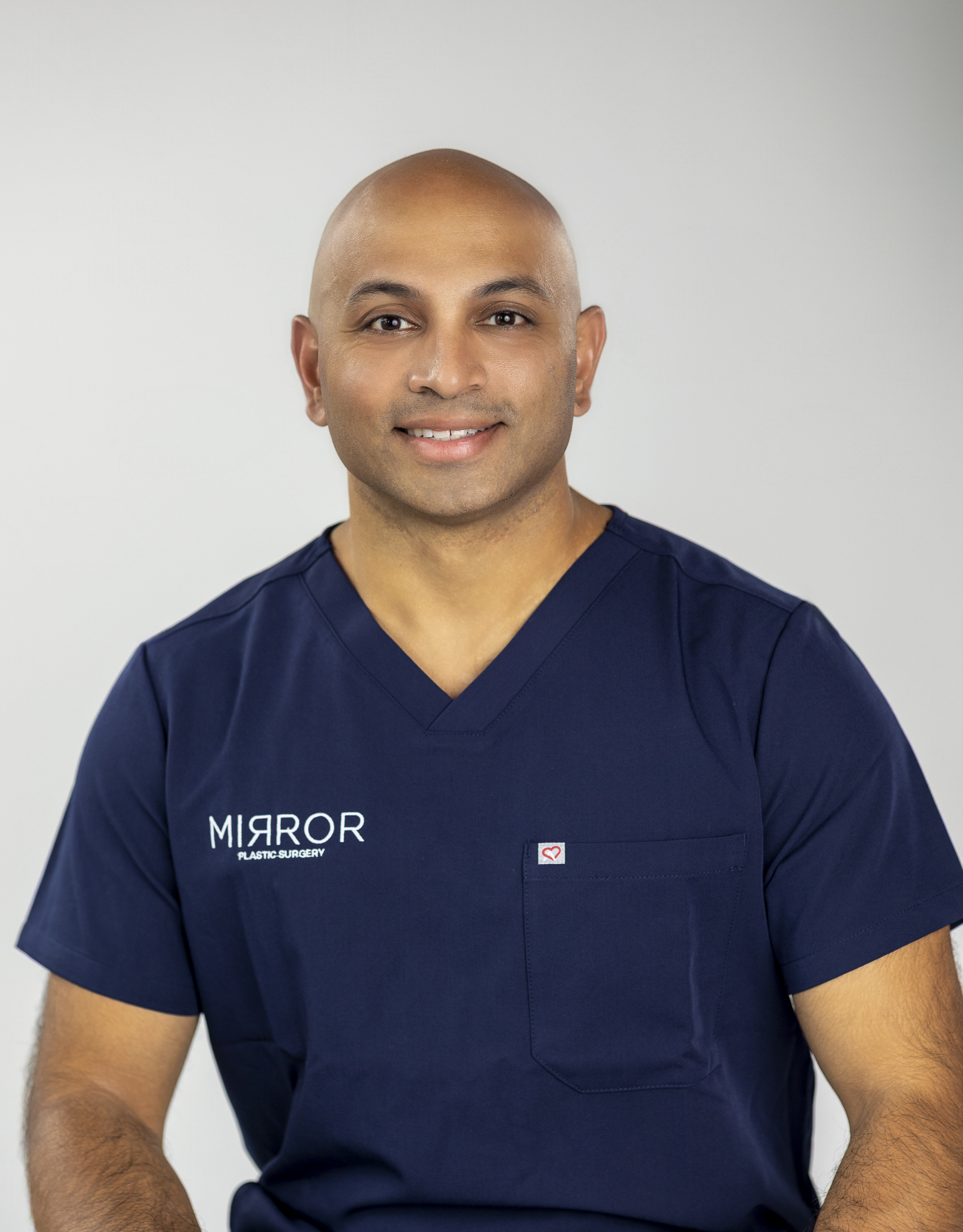
Dr. Akash has been named in America’s Best Plastic Surgeons 2025 by Newsweek for two consecutive years, based on peer nominations and patient outcomes. He serves on the Next Generation Editorial Board of the Aesthetic Surgery Journal and has testified before the U.S. Food and Drug Administration on breast implant safety, reflecting his engagement with regulatory and evidence-based aspects of plastic surgery.
Mirror Plastic Surgery limits its surgical schedule to one to two procedures per day. This structure allows the surgical team to focus fully on each patient throughout the perioperative period and contrasts with high-volume practices that perform many surgeries daily.
Key Decision Factors When Choosing Your Revision Surgeon
Beyond a surgeon’s credentials and practice model, you can review several practical factors that directly affect revision outcomes. Patients evaluating BBL revision specialists should use these points as a structured checklist during research and consultations.
First, assess technical expertise specific to revision. Ask how many BBL revision cases the surgeon performs each year, not just primary BBL volume, because revision experience is a separate metric. Confirm that intraoperative ultrasound guidance is available and routinely used in the operating suite, since this tool supports safe, accurate fat placement in altered anatomy.
Next, review safety infrastructure. Procedures should take place in an accredited surgical facility with board-certified physician anesthesiologists. Ask about hospital privileges and written protocols for managing rare but serious complications, so you understand how emergencies would be handled.
Finally, clarify expectations for recovery and long-term results. Revision cases usually involve longer and more variable recovery than primary procedures because of prior scar tissue and the complexity of correction. Discuss how the surgeon plans for long-term maintenance, including how fat grafting results may evolve over time and what follow-up care they recommend.
Revision Techniques: Ultrasound-Guided Grafting, Scar Release, and Implants
Ultrasound-guided fat grafting is the most common revision approach for patients with asymmetry, volume deficits, or shelf deformities. Real-time ultrasound lets the surgeon place fat at specific tissue depths, avoid intramuscular planes linked to embolic risk, and achieve controlled volume enhancement in targeted zones.
Scar-tissue release treats fibrosis in both donor and recipient sites. Using specialized cannulas or instruments, the surgeon disrupts fibrous bands that cause surface irregularities or restrict contour. In some cases, scar release is performed alone. In others, it is combined with re-grafting to fill the released space and smooth the contour.
Implant-based augmentation is considered when there is not enough donor fat for grafting or when prior fat grafting has created issues that cannot be corrected with re-grafting alone. Gluteal implants in revision settings require careful pocket planning to account for prior surgical changes to the tissue. Because implant placement in previously operated anatomy carries distinct risks, the decision to use implants instead of fat grafting must prioritize safety and functional restoration before cosmetic goals.
The choice among ultrasound-guided grafting, scar release, or implant augmentation depends on the specific deformities present, available donor fat, tissue quality, and the patient’s anatomy.
Clearing Up Common Myths About BBL Revision
Many patients believe that any surgeon who performs primary BBL procedures can safely manage revisions. Prior surgery creates scarring, altered tissue planes, and disrupted blood supply, which require a different skill set and a different planning process. Revision surgery is a distinct operation, not a simple repeat of the first procedure.
Another frequent belief is that waiting as long as possible after a primary BBL always improves revision outcomes. A minimum waiting period is necessary for tissue stabilization, usually six to twelve months. Beyond that window, indefinite delay does not improve results and may allow fibrosis to mature and become harder to release. Patients with significant functional or aesthetic concerns benefit from evaluation by a qualified revision specialist instead of waiting without a clear medical reason.
Patients also sometimes assume that non-surgical treatments such as massage or radiofrequency devices can correct structural deformities like shelf deformity or marked asymmetry. These treatments may support recovery and help with mild surface irregularities. They do not correct underlying fat distribution problems or release established fibrosis.
Frequently Asked Questions About BBL Revision
What is the Florida ultrasound mandate for BBL procedures, and does it apply to revision surgery?
Florida requires surgeons performing gluteal fat grafting to use real-time ultrasound guidance to monitor cannula placement and reduce the risk of intramuscular or intravascular fat injection. This requirement applies to both primary and revision cases. In revision surgery, where scarring makes tissue planes less predictable, ultrasound guidance becomes especially important for safe fat placement.
How can I tell whether a surgeon has real BBL revision experience?
Ask how many revision BBL cases the surgeon performs each year and request before-and-after examples specific to revision, not just primary procedures. Confirm that the surgeon is board certified by the American Board of Plastic Surgery. Inquire about their complication management protocols and whether they hold hospital privileges for emergency care.
What is a realistic healing timeline for BBL revision surgery?
Revision cases usually involve longer recovery than primary BBL procedures. Initial swelling and bruising often improve over four to six weeks.1 Final results, especially after fibrosis release or significant re-grafting, may take six to twelve months to appear fully.1 Patients should plan for a more variable recovery course than they experienced with their original procedure.
What should I expect during a BBL revision consultation at Mirror Plastic Surgery?
Consultations at Mirror Plastic Surgery are structured as comprehensive, hour-long assessments. Dr. Akash reviews prior surgical records when available, performs a detailed anatomical evaluation, explains the specific deformities present and their causes, and outlines the revision approach that fits the patient’s anatomy and goals. Pricing is discussed individually so each patient receives a personalized plan.
Can fibrosis after BBL be corrected surgically?
Yes. Established fibrosis can often be treated through surgical scar-tissue release using specialized instruments. The degree of correction depends on how mature and widespread the fibrotic tissue is. In many cases, scar release is combined with targeted fat grafting to restore volume and smooth contour in the treated area. Results vary based on the severity of fibrosis and the patient’s tissue response.1
Conclusion: Making an Informed BBL Revision Choice
BBL revision requires specific expertise, adherence to safety regulations, and a surgical model that puts patient safety ahead of volume. Patients in Tampa and the broader St. Petersburg area who have experienced unsatisfactory outcomes benefit from a thorough, evidence-based evaluation by a surgeon whose training and practice structure match the complexity of revision cases. Reviewing credentials, ultrasound capability, revision-specific volume, and facility standards before scheduling surgery supports a more informed decision.
Mirror Plastic Surgery’s concierge approach, which combines the limited surgical schedule described earlier with hour-long consultations and a safety-first philosophy, is designed for patients who need this level of attention. Dr. Akash’s Harvard-MIT, Johns Hopkins, and MEETH training, along with his consecutive Newsweek recognition, positions him as a qualified resource for complex BBL revision evaluation in the Tampa Bay area.
1 Results may vary from person to person. Editorial content, before and after images, and patient testimonials do not constitute a guarantee of specific results.