
Written by: Dr. Akash Chandawarkar, Board Certified Plastic Surgeon, Mirror Plastic Surgery | Last updated: July 24, 2026
Key Takeaways
- AlloClae is a ready-to-use structural adipose filler made from screened donor fat tissue. Processing preserves the extracellular matrix while removing donor DNA and cells.
- It acts as a natural scaffold that adds immediate volume. The patient’s own cells and blood vessels grow into the matrix over several months to form new adipose tissue.
- AlloClae is suited to small, localized body contouring refinements such as hip dips, gluteal hollows, breast contour tweaks, and post-liposuction irregularities, not large-volume augmentation.
- Current evidence suggests results may last several years. Long-term published data are limited, and partial resorption or touch-up treatments may be required.1
- Patients considering AlloClae should meet with Mirror Plastic Surgery for an evidence-based review of candidacy, risks, and realistic goals.
AlloClae as a Donor-Fat Structural Filler
AlloClae is an allograft adipose matrix launched by Tiger Aesthetics in early 2025 and processed by Tiger BioSciences. Unlike synthetic fillers or biostimulatory injectables, AlloClae comes from donated human adipose tissue sourced exclusively through accredited tissue banks. The processing protocol removes viable cells, free lipids, and donor DNA while preserving the extracellular matrix, structural proteins, and growth factors that give fat its three-dimensional architecture.
AlloClae is regulated by the FDA as a Human Cells, Tissues, and Cellular and Tissue-Based Product (HCT/P) under Section 361 of the Public Health Service Act and 21 CFR Part 1271, which is the same regulatory framework used for many surgical allografts. It is not treated as a drug or medical device that requires premarket approval. AlloClae is supplied in 12.5 cc, 25 cc, 50 cc, and 100 cc vials for body-contouring procedures.
How AlloClae Behaves in the Body
AlloClae contains no viable living cells and serves as a natural scaffold that adds immediate volume while supporting gradual ingrowth of the patient’s own cells and blood vessels. Laboratory and animal studies show that host cells and vasculature migrate into the matrix over several months. New adipose tissue then forms within this scaffold.
Results develop gradually through tissue remodeling rather than a single, permanent fill at the time of injection.1 Surgeons inject AlloClae with a blunt-tip cannula in small droplets across the subcutaneous or intramuscular plane, using a layering technique similar to autologous fat grafting but without liposuction harvest. Understanding how this behavior compares with traditional fat transfer helps patients and surgeons decide which option fits a specific goal.
AlloClae Compared With Traditional Fat Transfer
The table below compares AlloClae and autologous fat transfer across four clinically relevant factors.
| Factor | AlloClae | Autologous Fat Transfer |
|---|---|---|
| Source | Screened donor human adipose tissue, no liposuction required | Patient’s own fat harvested via liposuction the same day |
| Reported volume retention1 | High retention reported in early clinical experience | Variable retention over time, depending on live cell survival and vascularization |
| Reversibility | Not reversible, integrates as a biologic matrix, which makes correction of undesired outcomes more complex | Not reversible, surgical revision required for correction |
| Long-term data | Limited long-term published data available | Decades of published clinical data across multiple anatomic sites |
AlloClae functions as a refinement tool for small, localized volume correction rather than a replacement for autologous fat grafting when large volumes are needed. Autologous fat transfer remains the standard for high-volume body contouring and has a far longer evidence base. This distinction sets the stage for how surgeons apply AlloClae to specific body areas.
Common AlloClae Treatment Areas
Surgeons use AlloClae for targeted body areas such as hip dips, breasts, and correction of deformities from liposuction. Documented applications across published clinical experience include:
- Hip dips and outer thigh contouring, typically 15–25 cc per side
- Gluteal hollowing or reshaping, typically 25–50 cc per side
- Breast contouring for targeted volume, asymmetry correction, implant rippling, and post-explant restoration
- Post-liposuction hollows and contour irregularities in the abdomen, flanks, and lower back
- Volume loss after aging, significant weight loss, or GLP-1 medications such as Ozempic or Wegovy
AlloClae is currently indicated for body contouring applications. Before moving forward with any of these uses, patients should understand the product’s regulatory status and safety profile so they can weigh it against other options.
Safety Profile and FDA Status
Under its HCT/P classification, AlloClae must meet requirements for donor screening, serological testing, and sterility standards. The product is sterilized to meet these regulatory benchmarks. It is not classified as a drug or medical device and has not gone through FDA premarket approval.
A prospective clinical study of allograft adipose matrix reported no immune reactions or systemic complications, and a 2024 study found minimal inflammatory response and no significant capsule formation. These findings align with current clinical experience, where the most commonly reported side effects are mild, localized, and temporary, such as swelling, bruising, and tenderness. The manufacturer’s safety information lists a broader set of possible adverse events, including cyst or nodule formation, pain, infection, bruising, and allergic or immune responses, and advises avoiding the product in patients with severe allergies, a history of anaphylaxis, or active infection.
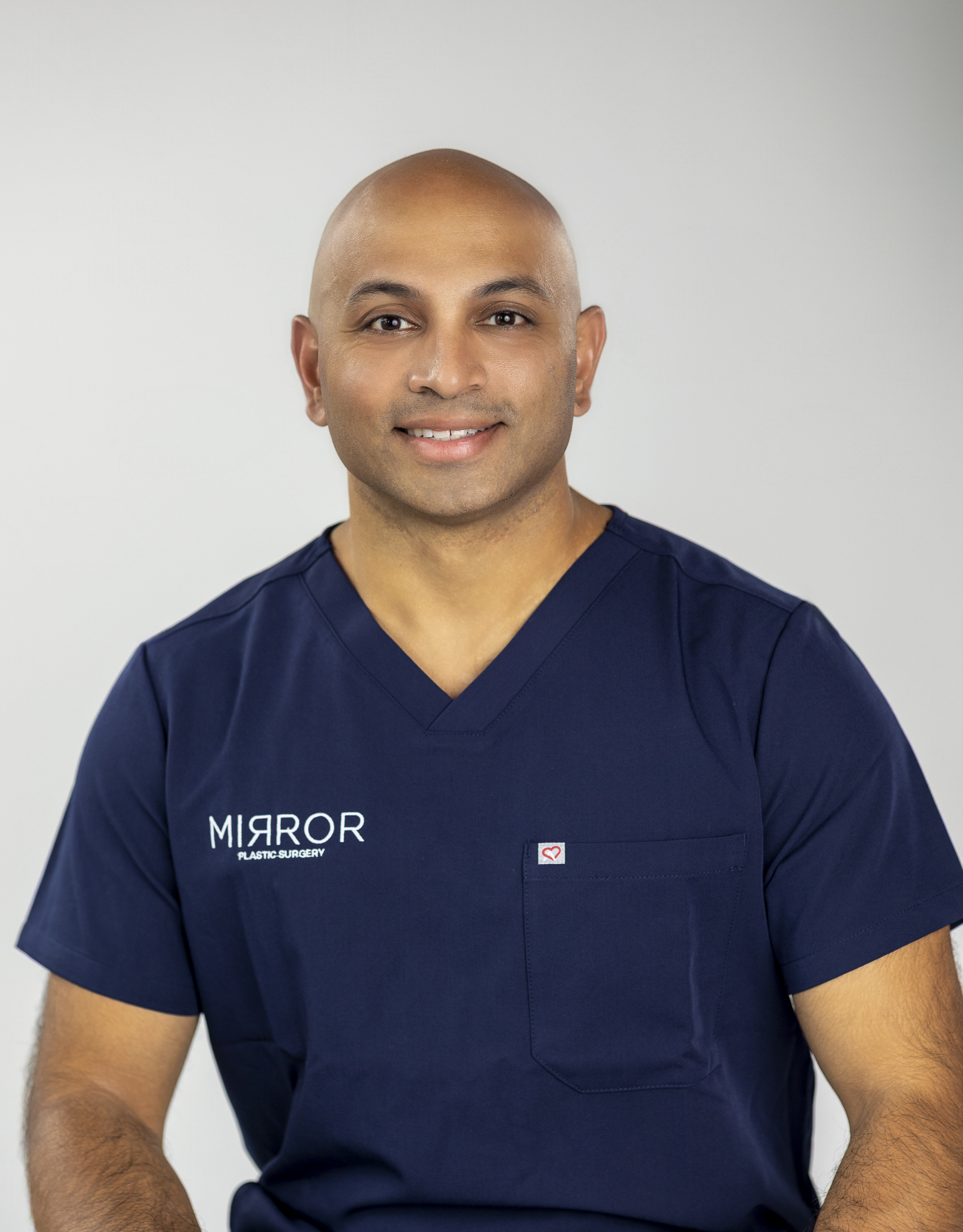
At Mirror Plastic Surgery, every AlloClae candidacy decision follows the practice’s Safety-Function-Aesthetics hierarchy. Dr. Akash, named to Newsweek’s America’s Best Plastic Surgeons list for two consecutive years and trained at Harvard-MIT, Johns Hopkins, MEETH, and Stanford, serves on the advisory board of the manufacturer of AlloClae. This role gives him direct insight into the material’s properties, processing standards, and appropriate clinical use. Safety receives priority through rigorous pre-operative evaluation, including in-office ultrasound when indicated, before any aesthetic objective is considered.
AlloClae Longevity and Touch-Up Needs
Reported longevity for AlloClae can extend to several years, though long-term data remain limited. Results vary by treatment area, patient biology, and volume used.1
Specifically, no published human data exist on AlloClae outcomes at 3, 5, or 10 years post-treatment, including retention rates, resorption patterns, palpability, nodularity, calcification, asymmetry, or revision surgery outcomes across different anatomic sites. Current evidence does not support claims of permanent results from a single treatment, and partial volume retention with possible touch-up is expected.
Patients at Mirror Plastic Surgery receive a direct explanation of what the evidence supports and where knowledge gaps remain. This approach reflects the practice’s commitment to evidence-based, unbiased communication about longevity and maintenance.
Who Typically Qualifies for AlloClae
Candidacy for AlloClae depends on anatomy, treatment goals, and a detailed pre-procedural assessment. AlloClae may be appropriate for patients who:
- Have a lower BMI and lack sufficient autologous fat for traditional fat transfer harvest
- Want correction of small to moderate contour irregularities, depressions, or asymmetry rather than large-volume augmentation
- Are experiencing volume loss from aging, significant weight loss, or GLP-1 medication use
- Seek breast contour refinement, symmetry improvement, or post-explant volume restoration without implants
- Prefer a minimally invasive, in-office procedure under local anesthesia with minimal downtime
AlloClae is not suitable for patients with severe allergies, a history of anaphylaxis, or active infection at the treatment site. For thin patients, anatomical assessment is especially important because subcutaneous tissue depth, skin quality, and soft tissue coverage determine whether AlloClae can be placed safely and still look natural. Mirror Plastic Surgery’s hour-long initial consultations are structured to evaluate these factors thoroughly before any treatment plan is proposed.
Limitations and Realistic Expectations With AlloClae
Several limitations of AlloClae matter for informed decision-making:
- Unlike hyaluronic acid fillers, AlloClae integrates with surrounding tissue as a biologic matrix, which makes reversal more complex in cases of undesired outcomes, delayed reactions, or contour irregularities.
- AlloClae injected into the breast may create imaging changes that require review by experienced radiologists to distinguish from malignancy.
- An ongoing multicenter clinical study includes about 50 patients, which is too small to detect uncommon or delayed complications in a product that may be used in thousands of individuals.
- Outcomes vary with patient anatomy, injector technique, and individual biology, so integration and final volume are less predictable than with autologous fat transfer.1
- AlloClae cannot match the dramatic volume restoration or recontouring achievable with surgical autologous fat grafting and is not intended for areas that require sharp definition.1
Patients who recognize these limitations can better compare AlloClae with alternatives such as autologous fat transfer, implant-based augmentation, or choosing no intervention. Mirror Plastic Surgery keeps this conversation direct and evidence-grounded, without quota-driven upselling, so patients can decide based on their own anatomy and comfort with risk.
Frequently Asked Questions
Is AlloClae safe?
AlloClae is processed under FDA HCT/P regulations that include donor screening, serological testing, and sterility standards. Published clinical studies of allograft adipose matrix have reported no immune reactions or systemic complications, and the most common side effects are mild and temporary. However, the product has not undergone FDA premarket approval as a drug or medical device, and long-term human safety data are limited. Patients with severe allergies, a history of anaphylaxis, or active infection are not candidates. A thorough pre-procedural evaluation, including medical history review and in-office ultrasound when appropriate, is essential before treatment.
How long does AlloClae last?
Current clinical experience suggests results can last several years, depending on treatment area, metabolism, lifestyle, and volume used.1 Peer-reviewed studies with long-term follow-up remain limited. Partial resorption is expected, and many patients will need touch-up treatments. Patients should treat longevity claims that extend beyond the existing evidence base with healthy skepticism.
Can AlloClae be used on the face?
AlloClae is currently indicated primarily for body contouring applications. Patients seeking facial volume restoration should discuss alternatives such as autologous fat transfer, hyaluronic acid fillers, or biostimulatory injectables with their surgeon during a comprehensive consultation.
What is AlloClae’s FDA classification?
As explained earlier, AlloClae is classified as an HCT/P under 21 CFR Part 1271, which governs donor screening, processing standards, and sterility requirements but does not constitute drug or device approval. This distinction helps patients understand how AlloClae’s regulatory standing differs from that of other injectable products.
Who is not a good candidate for AlloClae?
The contraindications noted earlier, including severe allergies, a history of anaphylaxis, and active infection, are absolute. Beyond these, AlloClae is not suited for patients seeking large-volume augmentation, dramatic recontouring, or results in areas that require sharp anatomical definition. Thin patients need careful anatomical assessment to confirm adequate soft tissue coverage for safe placement and a natural result. Patients with breast implants who are considering AlloClae for breast contouring should discuss the potential for imaging changes with both their surgeon and their radiologist before proceeding.
Informed decision-making about AlloClae involves weighing its real advantages, such as off-the-shelf availability, no donor-site morbidity, and suitability for lean patients, against its evidence limitations, irreversibility, and lack of long-term outcome data. At Mirror Plastic Surgery, Dr. Akash applies the same Safety-Function-Aesthetics framework to AlloClae candidacy as to every other procedure, ensuring that anatomy, goals, and risk tolerance are fully understood before any recommendation. His advisory role with the manufacturer of AlloClae provides direct insight into the product’s development and clinical application, and his training at Harvard-MIT, Johns Hopkins, MEETH, and Stanford supports the anatomical rigor brought to every assessment.
1 Results may vary from person to person. Editorial content, before and after images, and patient testimonials do not constitute a guarantee of specific results.