
Written by: Ellie Pranckevicius, FNP-BC, Aesthetic Nurse Practitioner & Aesthetic Injector | Facial Restoration & Regenerative Injectable Specialist, Mirror Plastic Surgery
Key Takeaways
- Subcutaneous peptide injections deliver 70–100% bioavailability by bypassing the skin barrier, while topical peptides reach only 2–8% absorption.1
- GHK-Cu has the strongest human evidence base for skin outcomes, and that evidence comes primarily from topical studies.
- BPC-157 and TB-500 show promising tissue-repair data in preclinical models, yet lack robust human RCTs for cosmetic skin use.
- Topical peptides work well for localized surface goals, while supervised injections are reserved for systemic reach or larger molecular weight peptides.
- Patients seeking personalized peptide protocols should book a consultation with Ellie at Mirror Plastic Surgery for lab-guided treatment planning.
How Injection and Topical Peptides Differ in Real Skin
The main difference between injectable and topical peptide delivery is the skin barrier. The stratum corneum blocks most peptide molecules from reaching the viable dermis where fibroblasts live. Even copper tripeptide-1 (GHK-Cu) at 342 daltons shows limited transdermal absorption, and larger peptides like BPC-157 at 1,419 daltons reach full systemic concentration only through injection. The 500 Dalton rule proposed by Bos and Meinardi (2000) states that molecules above roughly 500 Da face major passive penetration barriers through intact skin.
Subcutaneous injection bypasses that barrier completely. TB-500 injected subcutaneously reaches peak plasma levels within minutes, and patients often report early improvements in skin texture and healing within 7–14 days.1 Injectable BPC-157 speeds wound closure, while topical BPC-157 at 0.1–0.5% concentration shows similar improvements only after 3–4 weeks.1
The bioavailability advantage of injection does not automatically create better skin-specific outcomes. No human study has directly compared injectable GHK-Cu with topical GHK-Cu for any skin endpoint. Topical GHK-Cu has several human randomized controlled trials in photoaging cohorts, while well-designed RCTs of injectable GHK-Cu for general human anti-aging are scarce and rely mostly on laboratory, cell-culture, and animal research. Injection offers systemic reach, while topical use has a stronger human evidence record for skin-focused results.
Given these trade-offs between injection’s systemic reach and topical application’s established evidence base, microneedling offers a middle path that may capture benefits of both approaches. Microneedle pretreatment enabled substantial GHK-Cu permeation (134 ± 12 nmol peptide in 9 h) versus essentially zero through intact skin, which allowed the peptide to reach the dermis. A 2015 Franz diffusion cell study with intact ex vivo human skin also found essentially zero permeation of GHK-Cu under passive application.
Comparing GHK-Cu, BPC-157, and TB-500 for Skin
Among the three peptides most often combined in skin-focused protocols, GHK-Cu, BPC-157, and TB-500 differ in evidence strength, mechanism, and expected timeline by route and target tissue. The table below compares them on the factors most relevant to supervised clinical use.
Book an appointment with Ellie to review your lab results and choose the peptide or stack that fits your skin goals and health profile.
What to Expect When You Stop Peptide Injections
Peptide therapy does not create permanent structural changes that last forever after treatment stops. Peptides act as biological signals that prompt the body to increase collagen synthesis, reduce inflammation, or stimulate growth hormone release, and that signaling fades once the peptide is no longer present.
For growth hormone peptides such as CJC-1295 and ipamorelin, GH and IGF-1 levels return to baseline within 1–2 weeks after stopping, while body-composition benefits may reverse over 2–4 months.1 For skin-focused protocols, injectable GHK-Cu for wound healing or anti-aging is usually limited to 4–8 week courses, and maintenance decisions follow based on clinical response.
This pattern raises a key question about durability. Some peptide-driven improvements can persist beyond active treatment. One notable topical example supports this idea. Topical copper-GHK peptide increased collagen production by 70% in treated skin areas, with improvements maintained for 6 months after treatment stopped.1 according to research in the International Journal of Cosmetic Science. This suggests that collagen already synthesized during treatment can remain even after the signaling effect ends.
The practical takeaway is straightforward. Patients who achieve meaningful results during a supervised protocol usually need a maintenance phase to preserve those outcomes. Ellie structures protocols at Mirror Plastic Surgery with this in mind and builds in reassessment points instead of open-ended continuous dosing.
How Ellie Decides Between Topical and Injectable Peptides
The choice between topical and injectable delivery depends on the patient’s goals, baseline skin condition, and comfort with procedures. The criteria below guide that decision at Mirror Plastic Surgery.
Topical peptides are appropriate when:
- Goals focus on surface-level improvements in hydration, fine lines, and texture in a defined area.
- The target peptide has a molecular weight near or below 500 Da and is formulated with penetration enhancers such as liposomes, nanoparticles, or hyaluronic acid carriers, since unmodified peptides show poor passive membrane permeability across the skin barrier.
- The patient has no systemic inflammatory condition that requires whole-body peptide signaling.
- The patient is in the early stages of photoaging and has not yet fully used topical actives such as retinoids.
- Microneedling-assisted delivery is available to significantly increase peptide penetration compared with passive application, as shown in the microneedling research discussed earlier.
Medically supervised subcutaneous injections are justified when:
- The target peptide exceeds 500 Da and cannot reach meaningful dermal concentrations through topical use. BPC-157 at 1,419 daltons is the clearest example.
- The patient needs systemic anti-inflammatory effects beyond what localized topical application can provide.
- Lab panels show hormonal, metabolic, or inflammatory markers that support a systemic protocol.
- The patient has had limited results from at least 12 weeks of consistent, well-formulated topical peptide use.
- The patient is post-surgical and needs accelerated tissue repair across a broader anatomical area.
- The patient accepts a higher adverse-event profile. Injectable peptides cause injection-site reactions in 15–25% of patients and systemic effects in 3–5%, compared with topical side-effect rates below 2%.
In all injection cases, strict sourcing standards protect patient safety. Roughly one-third of peptide products analyzed by Finnrick laboratory in 2025–2026 failed basic quality checks for identity, purity below 98%, or stated quantity. Injectable-grade peptides require HPLC purity at or above 98% and endotoxin levels below 1 EU per mg, which most gray-market vendors do not meet.
Ellie Pranckevicius, FNP-BC: Your Peptide and Aesthetics Partner
Ellie Pranckevicius, FNP-BC, leads peptide therapy and non-surgical aesthetics at Mirror Plastic Surgery. She holds a Bachelor’s in Health Science from Boston University, completed an aesthetics licensure program, and earned both her Bachelor’s and Master’s in Nursing from the University of South Florida. This dual track gives her deep knowledge of skin physiology and advanced clinical science.
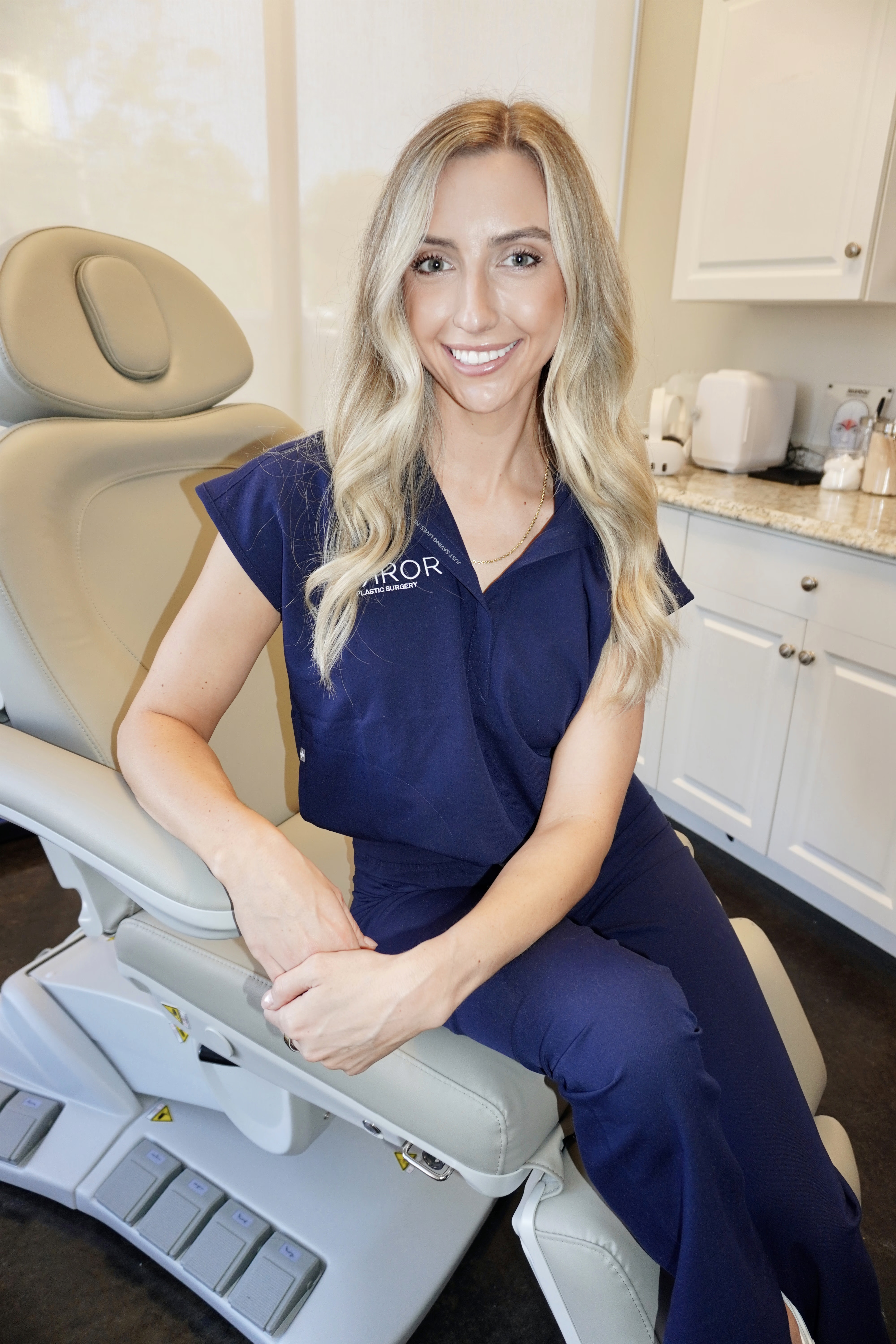
Four years in the Neuroscience ICU at Tampa General Hospital strengthened her understanding of metabolic health, systemic physiology, and the body’s recovery capacity in complex cases. Ellie’s approach centers on education and transparency. She explains the mechanism behind every protocol in plain language, tells patients when a therapy is not yet warranted, and provides direct access throughout the treatment course.
Book an appointment with Ellie for a comprehensive lab-guided consultation at Mirror Plastic Surgery’s St. Petersburg, Florida practice or remotely across the United States.
Safety, Regulation, and Sourcing for Peptide Therapy
The regulatory landscape for injectable cosmetic peptides changed significantly in 2026. In July 2026, an FDA advisory panel voted 8–6 to recommend that BPC-157, TB-500, and KPV be placed on the FDA’s list of substances considered safe for pharmacy compounding, which would ease restrictions on injectable versions for wellness use. That vote does not equal FDA approval. FDA staff scientists reviewing BPC-157 found only one clinical trial with 17 patients who received BPC-157 mixed with a second peptide, and FDA regulators found no human studies on TB-500.
For GHK-Cu specifically, no published controlled human trials establish a safe dose or adverse-event profile for injectable GHK-Cu, and human safety data for injectable or systemic use is essentially absent. A July 2026 evidence review by Macrene Alexiades, MD, PhD, highlights unstudied concerns including hepatotoxicity, pro-oxidant Fenton-type radical generation, and possible contributions to neurodegeneration with systemic GHK-Cu administration.
Topical peptides show a much cleaner safety record. A 2026 review in the International Journal of Molecular Sciences reported a favorable safety profile for topical cosmetic peptides. The Cosmetic Ingredient Review has also evaluated copper tripeptide-1 (GHK-Cu) for topical cosmetic use.
Quality concerns for injectables are real and documented. A March 2026 FDA warning letter to Gram Peptides confirmed that injectable peptide products pose heightened public health risks because they are delivered directly into the body and bypass key defenses against toxins and microorganisms. Mirror Plastic Surgery sources only from suppliers with documented batch testing and HPLC verification, and Ellie reviews lab panels before starting any injectable protocol.
Frequently Asked Questions
Are peptide injections FDA-approved for anti-aging skin use?
No injectable peptide currently holds FDA approval for cosmetic skin improvement. BPC-157, GHK-Cu outside approved topical formulations, and TB-500 remain research compounds that the FDA has not approved for human cosmetic use. Sermorelin is available off-label through licensed compounding pharmacies under physician supervision. In July 2026, an FDA advisory panel recommended that BPC-157, TB-500, and KPV be considered for the compounding-safe list, but this recommendation does not equal approval, and the clinical evidence base for these peptides in skin aging remains limited. At Mirror Plastic Surgery, all injectable peptide protocols occur under medical supervision with batch-tested, HPLC-verified sourcing, and patients receive a full informed-consent discussion of regulatory status and evidence gaps before any protocol begins.
How long does it take to see results from injectable peptides for skin?
Timeline varies by peptide and by the outcome measured. For wound closure and acute tissue repair, injectable BPC-157 can show measurable acceleration within the first week.1 For collagen-driven skin quality improvements, which are more common cosmetic goals, injectable GHK-Cu follows a slower fibroblast-mediated timeline. Early texture changes are usually discussed at four to six weeks, and more meaningful firmness and density improvements are assessed at three to six months.1 Topical GHK-Cu often produces early hydration and texture changes within two weeks of twice-daily use, with statistically measurable collagen-related improvements around weeks six to twelve.1 Results differ by individual physiology, baseline skin condition, protocol adherence, and whether the peptide is used alone or as part of a stack.
What is the risk of buying peptides online without medical supervision?
The main risks involve product quality, dosing accuracy, and the lack of pre-treatment screening. About one-third of peptide products tested by an independent laboratory in 2025–2026 failed basic quality checks for identity, purity, or stated quantity. Injectable-grade peptides must reach HPLC purity at or above 98% and endotoxin levels below 1 EU per mg, standards that most gray-market vendors do not meet. Endotoxins from gram-negative bacterial contamination can trigger fever, inflammation, or septic-type responses even at low doses. Beyond product quality, unsupervised use can expose patients to protocols that conflict with existing conditions or medications, which a lab-panel-guided consultation is designed to detect and prevent.
Can topical peptide serums ever match injectable results?
For localized skin-surface goals such as fine lines, texture, hydration, and firmness in a defined area, well-formulated topical GHK-Cu has a stronger controlled human evidence base than its injectable counterpart and a much cleaner safety profile. The gap narrows further with microneedling-assisted delivery, which significantly increases peptide permeation compared with intact skin. Topicals fall short for systemic reach. Peptides above 500 daltons cannot reach meaningful systemic concentrations through the skin, and patients with whole-body inflammatory conditions or goals that require systemic collagen signaling will not meet those goals with a serum alone. Each route addresses overlapping but not identical goals, and the right choice depends on the patient’s specific objectives.
Summary
Subcutaneous peptide injections reach 70–100% bioavailability compared with 2–8% for topical application, which matters most for peptides that require systemic delivery. GHK-Cu holds the strongest human evidence base for skin outcomes among the three peptides reviewed, and that support comes mainly from topical studies. BPC-157 and TB-500 show compelling preclinical tissue-repair data but limited human safety records, while the regulatory environment continues to evolve in 2026. Topical peptides suit surface-level skin goals and carry a well-established safety profile. Supervised injectable protocols are reserved for cases where systemic reach, molecular weight, or lab findings show that topical delivery cannot meet the patient’s goals. In both routes, sourcing quality, medical oversight, and individualized lab-guided dosing most directly shape safety and results.
Book an appointment with Ellie at Mirror Plastic Surgery to receive a personalized, lab-guided peptide protocol based on your goals, health history, and the current evidence, rather than a one-size-fits-all plan.
1 Results may vary from person to person. Editorial content, before and after images, and patient testimonials do not constitute a guarantee of specific results.
Peptide therapy is intended for wellness and optimization purposes and is not prescribed to diagnose, treat, cure, or prevent disease unless specifically stated. Many peptides are not FDA-approved and may be used off-label. Some have limited long-term safety data, with a potential for unknown risks, complications, or desensitization with prolonged use.