
Written by: Ellie Pranckevicius, FNP-BC, Aesthetic Nurse Practitioner & Aesthetic Injector | Facial Restoration & Regenerative Injectable Specialist, Mirror Plastic Surgery
Key Takeaways
- Florida law requires every medical spa performing medical procedures to operate under a licensed MD or DO medical director, although the real-world level of oversight can vary.
- Anyone may own a medical spa, but clinical authority and supervision must rest with a Florida-licensed physician under Chapters 458 and 459.
- Physician supervision involves written protocols, regular chart reviews, on-site visits, and availability for consultation during operating hours.
- Only licensed physicians, ARNPs, or PAs can prescribe and oversee Botox, fillers, and peptide injections. Estheticians and medical assistants cannot perform these treatments.
- Patients who want safe, properly supervised peptide and aesthetic treatments can schedule a consultation at Mirror Plastic Surgery for compliant, individualized care.
Who Really Runs a Florida Med Spa?
Florida treats ownership and clinical authority as separate matters. A nurse, esthetician, or private investor may own the business. Clinical authority is different and follows a stricter standard. Under Chapters 458 and 459 of the Florida Statutes, the medical director must be a Florida-licensed MD or DO with an active, unrestricted license. Nurse practitioners, physician assistants, and registered nurses cannot serve as medical directors.
This distinction matters because Florida Board of Medicine guidance treats injectables and lasers as medical treatment. The state has not decisively classified IV therapy as the practice of medicine under statutes 458, 459, or 464. Every clinical act must trace back to a licensed physician through documented delegation and supervision, regardless of who owns the spa or signs the lease.
What Physician Supervision Looks Like in Florida
A compliant Florida medical director must hold an active Florida MD or DO license, be in good standing with the Florida Board of Medicine, and be actively practicing rather than retired or operating under license restrictions. The role carries specific documented obligations:
- Creating and signing written treatment protocols and standing orders
- Conducting regular chart reviews, with an industry standard of 10–25% of charts monthly
- Remaining available for consultation during operating hours
- Performing periodic on-site facility visits
- Overseeing adverse event reporting and quality assurance
In 2026, AHCA inspectors most frequently cite Florida med spas for medical director oversight failures, including ghost directors and undocumented chart reviews. These “ghost” or “paper” medical directors sign contracts for a fee but provide no real oversight. This arrangement creates the appearance of supervision without the substance. When regulators discover this setup, a routine complaint often escalates into a multi-board action.
Florida does not mandate a specific minimum on-site visit frequency. Florida Statute § 458.348 instead requires supervisory protocols to document how supervision occurs and how often. Practices must keep these records on-site and produce them during AHCA inspections when requested.
Who Can Safely Perform Botox or Peptide Injections?
In Florida, Botox and dermal fillers are prescription medications that only licensed physicians, ARNPs, or PAs can prescribe and oversee. Administration must occur under physician supervision using standing orders or protocols. The delegation hierarchy works as follows:
- ARNPs may inject Botox and dermal fillers under a written collaborative practice agreement with a supervising physician per Florida Statute 464.012. The physician does not need to be on-site but must be available for consultation and provide documented oversight.
- PAs may inject under a supervising physician’s written delegation agreement per Florida Statute 458.347. The same availability and documentation requirements apply.
- RNs may administer injectables only under a specific physician order or standing order protocol. They cannot prescribe these treatments. A good faith exam by a physician, ARNP, or PA must occur before treatment.
- Estheticians, cosmetologists, and medical assistants cannot legally inject Botox or dermal fillers under any circumstances. Doing so constitutes practicing medicine without a license under Florida Statute 456.065.
The same delegation framework applies to peptide injections. Any injectable peptide protocol must be authorized through a licensed prescriber who works under documented physician oversight. If you are considering peptide therapy, choosing a practice that follows these rules keeps your treatment legal and clinically sound.
Schedule a consultation to verify proper delegation and oversight. Review your health history, lab results, and goals with board-certified Family Nurse Practitioner Ellie Pranckevicius, who practices under physician supervision at Mirror Plastic Surgery.
5-Step Checklist to Verify Real Physician Oversight
Use this five-step checklist before committing to any Florida medical spa or peptide provider.
- Verify the medical director’s license and specialty. Look up the physician’s name on the Florida Board of Medicine license search. Confirm the license is active, unrestricted, and in good standing. For remote oversight arrangements, Florida Board of Medicine standards generally require the physician to be board-certified or board-eligible in dermatology or plastic surgery.
- Confirm written protocols exist. Ask whether the practice maintains signed, procedure-specific protocols and standing orders. Confirm that these documents cover the treatments you plan to receive.
- Ask about on-site presence and chart-review frequency. A compliant practice can describe how often the medical director visits, what percentage of charts are reviewed monthly, and how the physician is reached during operating hours.
- Request emergency protocols. A properly supervised practice maintains written vascular occlusion and anaphylaxis protocols, keeps hyaluronidase on-site for hyaluronic acid fillers, and has at least one BLS-trained person present during procedures.
- Confirm peptide sourcing and lab oversight. For peptide therapies, ask whether products come from suppliers with documented batch testing, whether lab panels are reviewed before protocols are created, and whether a licensed prescriber signs off on every protocol.
How Florida Oversight Standards Apply to Peptide Therapies
The five verification steps above apply to all medical spa treatments. Peptide therapies introduce additional oversight considerations because of their unique regulatory status. While the same physician supervision framework governs all injectable treatments, peptides occupy a distinct regulatory space that requires extra scrutiny.
The FDA issued warning letters to peptide suppliers on March 31, 2026, stating that selling research-use-only labeled peptides alongside bacteriostatic water constitutes distribution of unapproved new drugs under the Federal Food, Drug, and Cosmetic Act because the pairing evidences intended human use. This enforcement action highlights why sourcing and supervision matter so much for peptide care.
Proper clinical oversight for peptide therapy includes:
- In-depth lab analysis of thyroid, liver, kidney, diabetes markers, and hormone panels before any protocol is created
- Individualized peptide stacks based on lab results, medical history, and specific health goals rather than a one-size-fits-all approach
- Sourcing from suppliers with documented batch testing for purity and accurate dosage
- Ongoing clinical support and protocol adjustment as the patient’s response is monitored
- A licensed prescriber who authorizes and signs every protocol
Purchasing peptides from unverified online sources removes each of these safeguards. Without third-party quality testing, you cannot confirm what you are injecting. Without individualized dosing based on your labs and medical history, you are guessing at what your body needs. Without a clinical escalation path, you have nowhere to turn if an adverse reaction occurs.
Start your peptide consultation with comprehensive lab review. Ellie will create a custom protocol and provide concierge-level support throughout your therapy at Mirror Plastic Surgery.
How Mirror Plastic Surgery Puts Supervision Into Practice
Understanding what proper supervision looks like in theory is helpful. Seeing how a specific practice applies those standards makes the picture clearer. The peptide therapy program at Mirror Plastic Surgery shows how physician oversight, advanced nursing expertise, and individualized protocols work together in a compliant Florida setting.
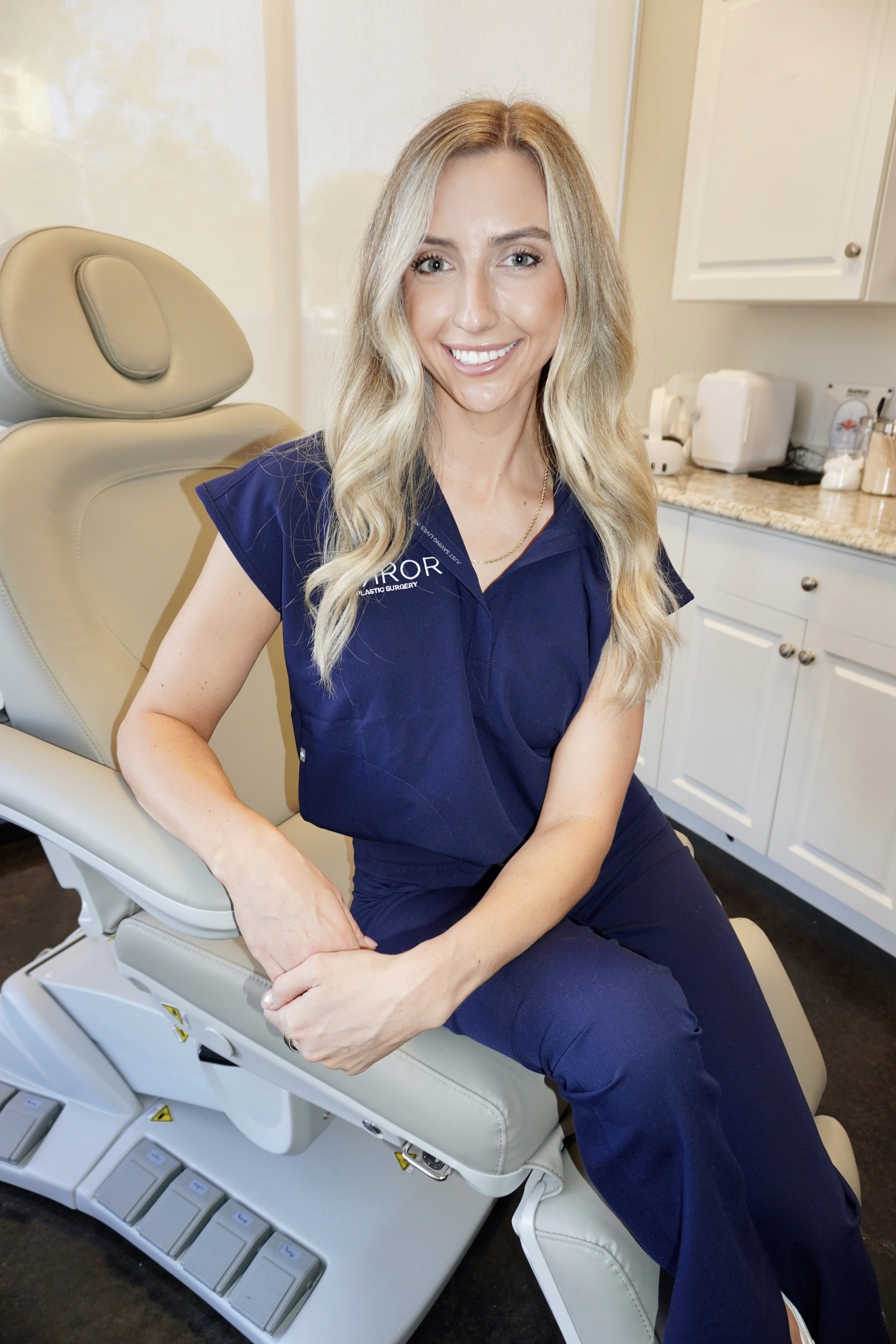
Meet the Practitioner: Ellie Pranckevicius, FNP-BC
Ellie Pranckevicius is a board-certified Family Nurse Practitioner who leads peptide therapies and non-surgical aesthetics at Mirror Plastic Surgery. She holds a Bachelor’s in Health Science from Boston University, completed an aesthetics licensure program, and earned both her Bachelor’s and Master’s in Nursing from the University of South Florida. She built her clinical foundation across four years in the Neuroscience ICU at Tampa General Hospital.
Her combination of esthetician training and advanced nursing expertise means she understands the aesthetic goals patients want and the clinical science required to reach them safely. Ellie’s work is supported by Dr. Akash Chandawarkar, MD, a Harvard-educated physician and Johns Hopkins-trained plastic surgeon who founded Mirror Plastic Surgery. His involvement provides the physician-level supervision that Florida law requires.
Risks When Treatments Lack Real Supervision
Ellie’s credentials and Dr. Chandawarkar’s oversight represent the standard that Florida law envisions. Not every practice meets that standard. Understanding what can go wrong when supervision is weak explains why the verification steps above matter so much.
A peer-reviewed study published in Plastic and Reconstructive Surgery found that many Florida med-spa providers are nonphysicians and that supervision levels vary across clinics.
Florida had the highest number of reported cases (10 of 28) of cosmetic procedures performed by unlicensed individuals in a 2016 review of 2013 U.S. news and lawsuit data published in the Journal of Clinical and Aesthetic Dermatology. In June 2026, a St. Lucie County judge sentenced one individual to 45 years in prison after a conviction for racketeering, aggravated battery, and practicing medicine without a license at a now-closed cosmetic clinic. A separate operator received three years in prison after running an illegal med spa out of a backyard shed that left one victim with facial paralysis.
Two common misconceptions deserve direct correction because they increase these risks:
- “Any med spa has a doctor on-site.” Florida law does not require the physician to be physically present for every injection. Many practices operate with remote or intermittent physician availability. The key question is whether that availability is genuine and documented, not simply assumed.
- “Peptides are only for weight loss.” Peptide therapies address a broad range of conditions, including systemic inflammation, autoimmune conditions, post-surgical recovery, collagen and elastin production, anxiety, energy, and sexual wellness.1 Weight management represents only one application.
A 2023 study in Dermatologic Surgery reported higher incidences of moderate adverse events for cosmetic procedures performed by non-physician providers compared with physician-performed procedures. These findings reinforce why patients should confirm real supervision before proceeding.
Choose properly supervised care in St. Petersburg. Discuss your health goals with Ellie in a concierge-level setting where physician oversight is genuine, not just on paper.
Frequently Asked Questions
Are peptides FDA-approved?
Many peptides are not FDA-regulated as drugs. They are used extensively in clinical and research settings worldwide, with trials spanning more than a decade. The primary risk often comes from obtaining them through unregulated sources that lack third-party quality testing. At Mirror Plastic Surgery, the sourcing and oversight practices described earlier ensure that every peptide protocol is both safe and individualized. The consultation process includes in-depth evaluation and, when indicated, lab panels to guide protocol design.
What happens if I stop taking peptides?
Benefits from peptide therapy usually diminish when therapy stops, similar to pausing any health regimen.1 If a peptide was managing systemic inflammation, that inflammation often returns to its prior state without ongoing treatment.1 Many patients move to a maintenance protocol to sustain results achieved during active therapy. Ellie discusses long-term maintenance planning during the initial consultation so patients know what to expect at every stage.
Will everyone see the same results from peptide therapy?
Results vary significantly based on genetics, diet, lifestyle, existing health conditions, current medications, and the specific peptide protocol used.1 This variation is why Mirror Plastic Surgery conducts a thorough evaluation, including medical history review and, when appropriate, lab panels, before creating any protocol. A personalized approach produces more predictable outcomes than a one-size-fits-all program.1
Can I receive peptide therapy remotely?
Yes. Mirror Plastic Surgery offers consultations, protocol creation, and ongoing support remotely across the United States, including Hawaii and Alaska. The entire process, from initial consultation to prescription and shipping, can occur via telemedicine. Ellie remains available via text or scheduled telemedicine appointments for ongoing support, questions, and refill requests throughout the patient’s journey.
How do I know a Florida med spa’s physician supervision is genuine and not just on paper?
Ask directly. A compliant practice can name its medical director, describe how often that physician reviews charts and visits the facility, explain the written protocols for each procedure type, and confirm the physician’s availability during operating hours. You can independently verify the medical director’s license status and any disciplinary history through the Florida Board of Medicine’s public license search. If a practice cannot answer these questions clearly, treat that as a meaningful warning sign.
Making an Informed Choice About Florida Med Spas
Florida’s regulatory framework for medical spas is more detailed than in many states, yet a wide gap still exists between fully compliant practices and those that only appear compliant. The five-step verification checklist above gives Florida residents a practical tool for evaluating a provider before treatment begins. For peptide therapies, the stakes of inadequate supervision extend beyond aesthetics to metabolic health, immune function, and long-term wellness.
Patients who prioritize active physician oversight, individualized lab-based protocols, and transparent clinical communication place themselves in the strongest position. They can benefit from what properly supervised peptide therapy offers while avoiding the preventable risks that come with poorly supervised or unsupervised care.
1 Results may vary from person to person. Editorial content, before and after images, and patient testimonials do not constitute a guarantee of specific results.
Peptide therapy is intended for wellness and optimization purposes and is not prescribed to diagnose, treat, cure, or prevent disease unless specifically stated. Many peptides are not FDA-approved and may be used off-label. Some have limited long-term safety data, with a potential for unknown risks, complications, or desensitization with prolonged use.