
Written by: Dr. Akash Chandawarkar, Board Certified Plastic Surgeon, Mirror Plastic Surgery
Key Takeaways
- Premium Juvéderm treatment depends on the injector’s anatomical expertise, personalized full-face planning, and correct formula selection, not price alone.
- Juvéderm offers five distinct formulas—Voluma, Vollure, Volbella, Vollex, Volux, and Ultra—each designed for specific facial regions, injection depths, and durations up to two years.1
- Full-face treatment planning starts with a comprehensive consultation that evaluates skeletal, fat-compartment, and ligament changes to create natural, balanced results.
- Risks such as vascular occlusion, Tyndall effect, and facial overfilled syndrome are reduced when a board-certified plastic surgeon maintains on-site hyaluronidase and follows strict safety protocols.
- Schedule your personalized consultation to receive an anatomy-first assessment and a tailored Juvéderm plan from Dr. Akash.
Topic Background And Core Concepts
Hyaluronic acid, the substance used in many dermal fillers, is a naturally occurring polysaccharide found throughout the body’s connective tissue. In dermal filler form, it is cross-linked into a gel that resists enzymatic breakdown and provides structural support when injected into specific facial planes. A neuromodulator, such as Botox or Dysport, is a separate category of injectable that relaxes muscles responsible for dynamic wrinkles. A biostimulatory filler such as Radiesse predominantly provides delayed collagen-mediated tissue remodeling rather than immediate gel volume, though it can also provide structural support depending on dilution and placement.
Facial aging involves changes across multiple tissue layers, not just isolated line formation. Current anatomical research describes facial aging as involving skeletal remodeling, fat-compartment changes, dermal deterioration, and altered relationships among retaining ligaments and mobile soft tissues. These changes extend beyond simple volumetric deflation. The deep medial cheek fat compartment tends to deflate earliest, pulling the midface downward and contributing to nasolabial fold formation. The sub-orbicularis oculi fat (SOOF) descends and contributes to the tear trough. Together, these shifts explain why treating a single fold rarely corrects the underlying cause.
Juvéderm fits into this landscape as a tool for immediate, reversible, contour-specific structural modification. HA gels also have biostimulatory properties, with injection-site biopsy studies demonstrating up to a 12-fold increase in type I procollagen gene expression and collagen fibrils forming dense, well-organized bundles.1 This collagen response provides a secondary benefit beyond immediate volume restoration.
Schedule your anatomy-first consultation to see how full-face treatment planning applies to your specific features.
Juvéderm Filler Types: A Formula-By-Formula Breakdown
Juvéderm is a family name, not a single interchangeable product. In the United States, several named XC fillers span different concentrations, labeled anatomies, and placement contexts. Formula selection should reflect anatomical region, tissue quality, and patient goals. A one-syringe-fits-all approach ignores these differences. The table below summarizes each formula’s primary treatment area, injection depth, and typical duration based on FDA labeling and published clinical data.
| Formula | Primary Treatment Area | Injection Depth | Typical Duration |
|---|---|---|---|
| Juvéderm Voluma XC | Cheeks, chin, temples | Deep subcutaneous and/or supraperiosteal | Up to 2 years in the midface |
| Juvéderm Vollure XC | Nasolabial folds and moderate-to-severe facial wrinkles | Mid-to-deep dermis | Up to 18 months |
| Juvéderm Volbella XC | Lips, perioral lines, undereye hollows | Subcutaneous and/or supraperiosteal (infraorbital); lip-specific plane per indication | Up to 12 months |
| Juvéderm Volux XC | Jawline definition | Subcutaneous and/or supraperiosteal | Up to 12 months for jawline treatment; Juvéderm fillers generally can last 12 to 24 months depending on the product and treatment area |
| Juvéderm Ultra XC | Lip augmentation, moderate-to-severe facial wrinkles and folds | Mid-to-deep dermis for wrinkles; lip-specific plane for augmentation | Approximately 12 months |
Juvéderm Voluma for Cheek and Midface Restoration
Voluma XC is the deepest-injecting, highest-lifting product in the Juvéderm collection, FDA-approved for deep injection in the cheek area to correct age-related volume loss, with results lasting up to two years in the midface.1 Its Vycross cross-linking technology combines high and low molecular weight HA chains into a tightly cross-linked matrix that resists enzymatic breakdown. Voluma is also FDA-approved for chin and temple augmentation. For a detailed comparison of Voluma and Vollure, see Juvéderm Voluma Vs Vollure: A Surgeon’s Guide To Choosing.
Juvéderm Vollure for Nasolabial Folds and Dynamic Lines
Vollure XC is designed for moderate-to-severe nasolabial folds and facial lines, with FDA-approved longevity of up to 18 months.1 Its medium firmness balances structural support with natural expression. This balance makes it well suited to areas where tissue moves dynamically.
Juvéderm Volbella for Lips and Perioral Lines
Volbella XC is the lightest filler in the Juvéderm collection, formulated for lip augmentation, perioral lines, and undereye hollows, with results lasting up to one year.1 Its low G-prime, or stiffness, allows it to integrate naturally into mobile, thin-skinned tissue. In the tear trough, placement depth is critical. The infraorbital skin is approximately 0.5 mm thick, which narrows the therapeutic window for safe and effective periorbital filler injection.
Juvéderm Volux for Jawline and Chin Contouring
Juvéderm Volux XC received FDA approval on July 29, 2022, for subcutaneous and/or supraperiosteal injection to improve jawline definition in adults over 21 with moderate-to-severe loss of jawline definition. It carries the highest HA concentration in the Juvéderm line at 25 mg/mL, which gives it exceptional structural support for Juvéderm jawline contouring. Jawline planning requires assessment in frontal, oblique, and profile views. The plan must account for the relationship between the mandibular angle, mandibular body, and prejowl region as a connected system.
Juvéderm Ultra for Lip Augmentation and Moderate Wrinkles
Ultra XC uses Hylacross technology to produce a softer, more malleable gel. It is FDA-approved for correction of moderate-to-severe facial wrinkles and folds such as nasolabial folds, and separately for lip augmentation in adults over 21. Its flexibility makes it appropriate for areas that require natural movement.
Get a personalized Juvéderm plan to match the right formula to your anatomy and goals.
How Treatment Planning Typically Works
A premium Juvéderm treatment plan begins well before any injection. The consultation phase involves a comprehensive top-to-bottom facial assessment that evaluates the upper, middle, and lower face as a single unit. This process includes reviewing medical history, prior injections, medications, allergies, and goals. The injector then performs physical palpation and multi-view assessment, including frontal, oblique, and profile views, rather than planning from photographs alone.
An international consensus panel of 14 experts recommends that during pre-treatment consultations, physicians help patients set realistic expectations, define treatment goals, and screen for signs of body dysmorphic disorder. The same consensus emphasizes that chasing perfect symmetry or idealized proportions can create unnatural-looking outcomes.
A thorough consultation may take up to an hour and should include education on risks, benefits, and long-term maintenance. Treatment is then sequenced logically. Structural support is addressed first, then surface refinement, followed by reassessment before any additional volume is placed. Follow-up at approximately two weeks allows for assessment of the settled result and minor refinements if needed. For a detailed walkthrough of what to expect, see Juvéderm Consultation St. Petersburg Florida: What To Expect.
Current Industry Standards, Trends, and Innovations
The aesthetic medicine field has shifted away from isolated, single-area injections toward full-face treatment planning. Current literature repositions HA fillers from default volume replacement toward selective, anatomy-guided structural support, with the clinical question shifting from “Where is volume missing?” to “Which anatomical support relationship has failed?”
Biostimulatory fillers, such as Radiesse, are increasingly used alongside hyaluronic acid fillers in comprehensive treatment plans. These products stimulate collagen production over weeks to months and complement the immediate volumizing effect of HA. As noted earlier, biostimulators work through delayed collagen remodeling, which complements the immediate volume from HA fillers. Many advanced plans combine both approaches.
Newer formulas such as Volux for jawline definition have expanded the range of areas that can be addressed non-surgically. Evolving safety protocols, including the use of blunt-tipped cannulas in high-risk vascular zones, microbolus injection technique, and on-site hyaluronidase availability, reflect a maturing understanding of complication prevention and management.
What Is the Downside of Juvéderm?
Juvéderm carries real clinical downsides that every patient deserves to understand before treatment. Commonly reported adverse events from injectable facial fillers include swelling in 60.1% of cases, nodules in 33.7%, and pain in 22.6%. These effects are typically mild and transient. More serious risks include the following:
- Vascular occlusion: Vascular occlusion from filler injection is rare, with reported incidences below 0.1%, but risk is markedly higher in the glabella, forehead, and nose, where vessels anastomose with the ophthalmic artery and occlusion can cause skin necrosis or permanent vision loss.
- Tyndall effect: Bluish discoloration from superficial HA injection is more common in thin-skinned areas like the tear trough, perioral area, and smoker’s lines, and prevention requires deeper injection and smaller quantities of filler.
- Facial overfilled syndrome (FOS): FOS, which appears as “chipmunk” cheeks, “pillow” faces, and distorted contours, is caused by excessive filler volume, filler migration driven by facial movement, and water retention from hydrophilic fillers.
- Granulomas and delayed inflammatory reactions: Histologically confirmed foreign body granulomas from modern HA fillers are rare, with estimated incidences of approximately 0.02%–0.4% for delayed nodules overall, typically manifesting months to years after injection.
- Asymmetry and overcorrection: These are technique-dependent complications that require anatomical knowledge to prevent.
Permanent complications are overwhelmingly caused by insufficient understanding of facial anatomy, wrong filler selection, technique, and poor diagnosis and management. A board-certified plastic surgeon is better equipped to prevent and manage complications because of foundational training in facial and subdermal anatomy.
Does Juvéderm Filler Age You Over Time?
Well-planned, anatomically precise Juvéderm treatment restores balance and does not accelerate aging. The concern about “filler face” comes from a specific pattern of misuse.
Repeated central or medial filling applied to tissues that have already descended may increase surface convexity without improving tissue position or facial proportion, producing a face that appears “fuller but not younger, wider but not better supported, and smoother but not natural”. The problem stems from inappropriate indication, excessive medial filling, poor sequencing, and insufficient analysis of the fat compartment support system, not from HA as a material.
The risk of gel migration or facial overfill syndrome is linked to inadequate anatomical knowledge, suboptimal injection technique, or inappropriate patient selection and counseling. Correctly placed HA fillers stimulate collagen production through mechanotransduction and may improve tissue quality over time instead of degrading it.1
The practical implication is clear. Automatic annual top-ups without fresh assessment carry cumulative risk. Treatment should be based on examination, not a marketing timetable. Adding filler on top of filler that is still present increases the chance of cumulative volume, puffiness, and distorted proportions.
How Many Syringes of Juvéderm Do I Need?
There is no universal syringe number that applies to every face. Any provider who gives a fixed answer without examining you is not offering a clinical response. The number of syringes depends on the areas being treated, the degree of volume loss, tissue quality, skin elasticity, prior treatment history, and patient goals.
Exact injection points, depth, needle or cannula choice, product selection, and volume must be individualized according to patient anatomy, tissue quality, prior procedures, product characteristics, injector experience, and vascular risk. Published area-by-area clinical guidance provides ranges, not prescriptions:
- Mild midface volume loss may require 1–2 syringes; moderate volume loss spanning cheeks and temples may require 2–3 syringes; significant volume loss may require 3–4 syringes, sometimes supplemented with biostimulators across multiple visits.
- According to one clinic’s area-by-area guideline, lip treatment typically uses 0.5–1 cc total, under-eye treatment uses 0.1–0.3 cc per side, and chin augmentation uses 0.5–1 cc or more depending on the E-line and front-to-back balance.
Two syringes may be entirely appropriate for one patient and insufficient for another. A patient with mild midface deflation and no other concerns may achieve a natural result with one syringe of Voluma. A patient pursuing Juvéderm cheek restoration alongside nasolabial fold treatment may require two or more syringes across those areas alone. The number represents the outcome of the assessment, not the starting point for the conversation.
Full-face treatment planning may involve multiple areas treated over one or more sessions. A staged approach across two sessions allows swelling to resolve between visits, enables more precise assessment of the interim result, and reduces the risk of overcorrecting.
Discuss your treatment options with Dr. Akash to receive a top-to-bottom assessment and a personalized syringe plan.
How Long Does One Syringe of Juvéderm Last?
Duration varies by formula, treatment area, and individual metabolism. As summarized in the formula table above, Voluma can last up to two years in the midface, while Vollure, Volbella, and Ultra have shorter labeled durations.
HA gels are biodegradable and temporary, with clinical effects generally lasting 4–18 months depending on product, injection technique, and patient factors. High-motion areas such as the lips metabolize filler faster than structural areas such as the cheeks. Injector technique also influences longevity, because correct plane placement reduces mechanical disruption of the gel. For a formula-by-formula breakdown of longevity, see How Long Does Juvéderm Last? A Formula-By-Formula Guide.
Maintenance planning forms part of premium Juvéderm facial rejuvenation services. Instead of scheduling automatic top-ups, a premium provider reassesses the face at each visit and treats only what has changed.
Juvéderm vs. Botox: What Is the Difference?
Juvéderm and Botox address different problems and are not interchangeable. Juvéderm is a dermal filler that adds volume, restores structure, and contours the face by occupying physical space in the tissue. Botox is a neuromodulator that temporarily relaxes the muscles responsible for dynamic wrinkles, such as lines from squinting or frowning.
A nasolabial fold caused by volume loss in the midface is a filler indication. A forehead line caused by frontalis muscle contraction is a neuromodulator indication. Many patients benefit from both in a coordinated full-face treatment plan. Combining neuromodulators with fillers may extend filler longevity because the neuromodulator prevents the muscle movement that can break down filler faster in high-motion areas.1
The two products work through entirely different mechanisms and should be selected based on the underlying cause of the concern, not used as substitutes for one another.
What Premium Actually Means in Juvéderm Treatment
Premium Juvéderm treatment describes a process, not a price tag. A premium approach starts with deep anatomical expertise and a full-face assessment. The injector studies bone structure, fat compartments, ligaments, and skin quality before suggesting any product.
Premium care also means personalized planning. The provider selects specific Juvéderm formulas, injection depths, and volumes based on your anatomy and goals instead of relying on a standard package. Safety protocols, such as on-site hyaluronidase, vascular occlusion plans, and sterile technique, form another core element of premium treatment.
Finally, premium treatment includes honest guidance about what you do and do not need. A premium injector is willing to recommend staging, combining modalities, or even deferring treatment when that choice best protects your long-term result.
How to Evaluate a Premium Juvéderm Injector
The most important decision a patient makes is who performs the injection. The expanded pool of underqualified providers, non-physicians, and med spa operators offering dermal fillers significantly increases the risk of all complications, including permanent ones. Evaluating a provider requires looking beyond marketing language.
Key criteria for evaluating any Juvéderm injector include:
- Board certification: Verify that the injector holds certification from a recognized specialty board. For plastic surgeons, this means the American Board of Plastic Surgery. See How To Verify a Board Certified Juvéderm Injector in FL.
- Anatomical training: A surgeon’s command of facial and subdermal anatomy develops over years of surgical training, not a brief certificate course.
- Consultation depth: A premium consultation evaluates the whole face, not just the area of chief complaint. It can take up to an hour and includes honest discussion of risks, realistic outcomes, and what you do not need.
- Safety infrastructure: The practice should have hyaluronidase on site, a vascular occlusion protocol, and the clinical judgment to recognize and manage complications.
- Supplier neutrality: A provider tied to a limited product portfolio may not select the most appropriate formula for your anatomy. An evidence-based injector selects the right product for the right patient.
- Philosophy: A premium injector prioritizes safety and long-term facial harmony over short-term volume or sales.
Dr. Akash Chandawarkar at Mirror Plastic Surgery meets each of these criteria. He is board certified by the American Board of Plastic Surgery. His training includes Harvard and Johns Hopkins, followed by a specialized fellowship in aesthetic surgery at Manhattan Eye Ear & Throat Hospital (MEETH)/Lenox Hill Hospital. This background reflects the anatomical foundation described in the criteria above. That foundation is why every neuromodulator and dermal filler at Mirror Plastic Surgery is placed by a physician with a surgeon’s command of facial and subdermal anatomy.
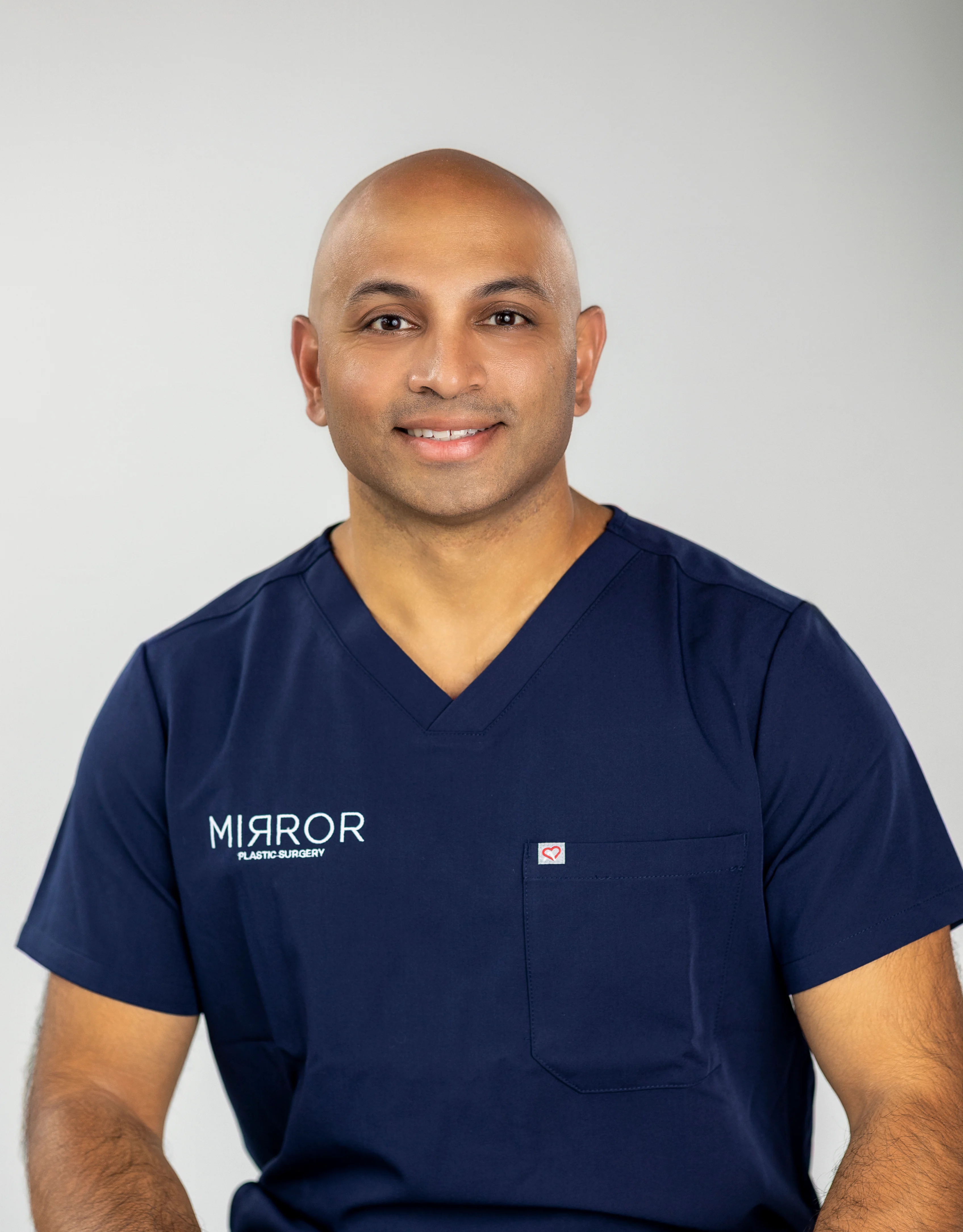
Mirror Plastic Surgery operates on a concierge medicine model. Consultations run up to an hour, assessments are top-to-bottom, and the practice limits itself to one to two procedures per day to ensure undivided focus on each patient. Dr. Akash is supplier-neutral and evidence-based, selecting the most appropriate product for each patient. His philosophy is safety first, function second, aesthetics third.
See what a physician-led consultation looks like and experience an anatomy-first approach to Juvéderm.
Risks, Limitations, And Common Tradeoffs
Every patient considering Juvéderm deserves a complete picture of what can go wrong as well as what can go right. Common side effects such as bruising, swelling, tenderness, and redness at the injection site are typically mild and resolve within days. More significant risks, including vascular occlusion, Tyndall effect, filler migration, and delayed inflammatory reactions, remain rare but serious and require an injector who can recognize and treat them quickly.
*Disclaimer: Results may vary from person to person. Editorial content, before and after images, and patient testimonials do not constitute a guarantee of specific results.
1 Results may vary from person to person. Editorial content, before and after images, and patient testimonials do not constitute a guarantee of specific results.