
Written by: Ellie Pranckevicius, FNP-BC, Aesthetic Nurse Practitioner & Aesthetic Injector | Facial Restoration & Regenerative Injectable Specialist, Mirror Plastic Surgery | Last updated: June 24, 2026
Key Takeaways for Non-Surgical BBL in Tampa
- A personalized non-surgical BBL plan combines detailed anatomical mapping, clear goal setting, and risk assessment to create a tailored injectable protocol using biostimulatory agents.
- Non-surgical BBL uses injectable fillers like Radiesse or alloClae to enhance shape and stimulate collagen without surgery, anesthesia, or liposuction, which makes it accessible to a broader range of patients.
- High-quality plans at Mirror Plastic Surgery include emotional driver exploration, anatomical mapping, severity scaling, goal alignment, product selection based on your anatomy, and maintenance planning.
- Results from biostimulatory fillers develop over several weeks, can last one to two years or longer, and require periodic maintenance sessions to stay consistent.1
- Patients seeking a thorough, evidence-based evaluation in the Tampa area should schedule a consultation with Ellie at Mirror Plastic Surgery.
How Non-Surgical Injectable BBL Compares to Surgical Fat-Transfer BBL
The term “Brazilian butt lift” originally described a surgical procedure in which a board-certified plastic surgeon harvests fat via liposuction from donor areas, typically the abdomen, flanks, or thighs, and transfers it into the gluteal region to increase volume and projection. The surgical approach requires general or regional anesthesia, involves incisions, and has a defined recovery period with candidacy restrictions tied to available donor fat and overall health status.
The non-surgical BBL is a distinct category. It uses injectable biostimulatory fillers placed precisely within and around the gluteal tissue to add contour, reduce the appearance of hip dips and cellulite, and stimulate the body’s own collagen production over time. No incisions, liposuction, or general anesthesia are involved. The two approaches serve overlapping but not identical patient populations. The decision between them depends on anatomy, goals, health history, and the degree of volume change desired.
What Goes Into a High-Quality Personalized BBL Plan
A rigorous personalized plan starts with assessment before product selection. At Mirror Plastic Surgery, Ellie Pranckevicius, FNP-BC, follows a structured consultation framework that keeps your anatomy and goals at the center of every decision.
- Emotional driver exploration. Open-ended conversation clarifies why you are seeking treatment now, which outcomes matter most, and what past experiences, positive or negative, have shaped your expectations.
- Anatomical mapping. Ellie evaluates the gluteal region, hip contour, lateral thigh, and lumbar transition zone for volume distribution, skin laxity, cellulite grade, stretch marks, and symmetry.
- Severity scaling. Structured diagnostic scales quantify hip dip depth, cellulite severity, and volume deficit. These measurements create a baseline for tracking change over time.
- Goal alignment. Ellie distinguishes between patients seeking significant volume augmentation, subtle shape refinement, or correction of specific concerns such as hip dips or surface irregularities, then calibrates the plan to match those priorities.
- Product selection rationale. Ellie selects between Radiesse and alloClae based on your anatomy and goals rather than inventory quotas or commission structures. Product choice supports the specific contour and tissue changes you want to see.
- Maintenance planning. A realistic timeline for follow-up sessions and long-term upkeep is outlined before the first treatment so you understand the full commitment.
Ellie’s dual background, which includes 600 hours of hands-on esthetics training followed by a Master’s in Nursing from the University of South Florida and four years in the Neuroscience ICU at Tampa General Hospital, gives her a layered understanding of both surface skin physiology and the deeper anatomical structures relevant to safe injectable placement.
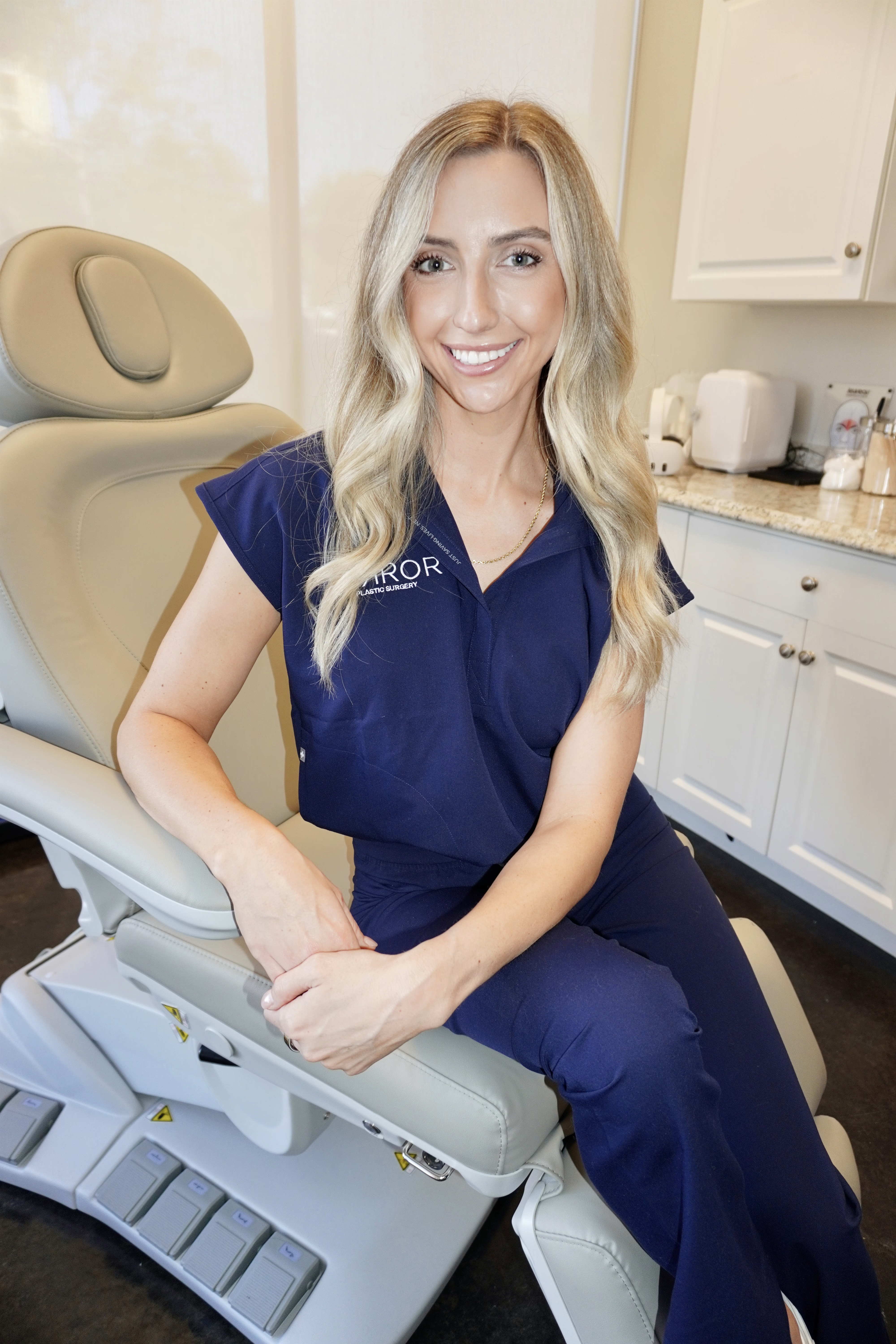
Schedule your personalized assessment with Ellie to begin a top-to-bottom evaluation tailored to your anatomy and goals.
Surgical vs. Non-Surgical BBL: Key Considerations
Understanding the core differences between surgical and non-surgical BBL helps you match the approach to your lifestyle, anatomy, and desired level of change.
| Factor | Surgical Fat-Transfer BBL | Non-Surgical Injectable BBL |
|---|---|---|
| Invasiveness | Requires liposuction and fat injection under anesthesia, with incisions involved | Needle-based injections with no incisions or anesthesia |
| Recovery | Weeks of restricted sitting, with compression garments required | Minimal downtime, with brief, provider-specific activity restrictions |
| Longevity | Transferred fat that survives grafting can be long-lasting, with survival rate influenced by technique and anatomy | Biostimulatory results develop over weeks to months, and maintenance sessions extend duration1 |
| Candidacy Restrictions | Requires adequate donor fat, with BMI and cardiovascular health thresholds; not suitable for very lean patients | Broader candidacy range, with BMI and skin quality assessed but no donor fat requirement |
| Maintenance | Generally lower maintenance once fat has integrated, though weight fluctuations affect results | Periodic touch-up sessions recommended to sustain collagen stimulation and volume |
Longevity of Non-Surgical BBL Results
Biostimulatory fillers such as Radiesse provide an immediate volumizing effect and also trigger the body’s collagen synthesis cascade. The collagen that forms is your own tissue, so results continue to develop for several weeks after treatment and can persist beyond the filler’s direct presence.1 alloClae, a regenerative allograft product, supports tissue integration and structural improvement through a different but complementary biological pathway.
Several interconnected factors influence how long results last for each person. Baseline skin quality and collagen density shape how strongly your body responds to biostimulatory agents. Patients with healthier collagen infrastructure often see more durable results. Proper aftercare then supports that response. Adherence to post-treatment instructions, including activity modifications and compression, affects how smoothly the product integrates.
Metabolic rate and body composition changes over time can speed up or slow down the breakdown of results. The interval and consistency of maintenance sessions should match your physiology and lifestyle. Product selection and precise placement technique set the foundation for all of these variables, because the right product in the right plane tends to behave more predictably in your tissue.
Patients who view non-surgical BBL as an ongoing maintenance program, rather than a one-time event, consistently achieve more durable and natural-looking outcomes.1 Ellie often compares this to dentistry. Professional treatments create measurable change, and long-term results depend on understanding the plan and following through.
BMI and Body Composition in Non-Surgical BBL Planning
Non-surgical BBL does not require donor fat, so very lean patients who are not candidates for surgical fat transfer may still qualify. BMI and body composition still matter, because they influence how product behaves in your tissue and what type of change looks proportional.
- Skin laxity. Higher BMI can correlate with greater skin laxity in the gluteal region, which affects how filler integrates and how much structural support is needed.
- Injection depth and safety. Subcutaneous tissue depth guides needle placement decisions and the volume of product that is appropriate for each session.
- Realistic outcome expectations. Patients with very low body fat may see more visible contouring changes per unit of product. Patients with more tissue often need a different strategy to achieve balanced enhancement.
- Vascular anatomy. Body composition affects the proximity of vascular structures, so detailed anatomical knowledge and precise technique remain essential at every BMI.
A thorough in-person assessment is the only reliable way to determine individual candidacy. No online tool or general guideline can replace direct anatomical evaluation by a qualified provider.
Get your candidacy evaluation with Ellie at Mirror Plastic Surgery’s St. Petersburg location.
Age Ranges and 2026 Trends in Non-Surgical BBL
Non-surgical BBL is generally appropriate for adults whose gluteal anatomy has fully matured, with most providers treating patients from their mid-twenties onward. The 35 to 55 age range often responds especially well. Collagen density remains sufficient for a strong response to biostimulatory agents, while age-related volume and contour changes create clear treatment targets.
Several trends are shaping non-surgical gluteal contouring in 2026.
- Biostimulatory-first protocols. The field now favors collagen-stimulating agents over simple volumizers, so plans focus on tissue quality and shape at the same time.
- Regenerative adjuncts. Products like alloClae bring regenerative medicine principles into body contouring and support tissue integration instead of only displacing existing structures.
- Subtle, anatomy-respecting enhancement. Patients increasingly request proportional, natural-looking results rather than dramatic augmentation, which rewards providers with strong assessment skills.
- Hip dip and cellulite correction. Targeted treatment of lateral gluteal depressions and surface irregularities now drives many consultations, even when overall volume goals are modest.
- Combination approaches. Many providers pair injectable biostimulators with energy-based skin tightening to address structural volume and surface quality within a single treatment plan.
Risks, Limitations, and Trade-Offs With Non-Surgical BBL
Non-surgical BBL generally carries a lower risk profile than surgical fat-transfer BBL, yet every candidate should understand the specific considerations involved. These factors relate to safety, predictability, and the level of commitment required.
Vascular safety. The gluteal region contains significant vascular structures, so precise anatomical knowledge and correct injection technique are essential. This focus reduces the risk of intravascular injection, which represents the most serious potential complication for any injectable procedure in this area.
Individual anatomy variability. Results vary from patient to patient. Skin thickness, tissue density, existing asymmetry, and collagen response all influence outcomes in ways that cannot be fully predicted, even with careful planning.
Product selection. Not all injectable products are appropriate for gluteal use. Mirror Plastic Surgery uses a combination of biostimulatory fillers, including Radiesse and alloClae, selected to match your anatomy and treatment goals.
Aftercare adherence. Post-treatment protocols directly affect how product integrates and how long results last. Patients who do not follow aftercare guidance may experience diminished or uneven outcomes.
Volume limitations. Non-surgical BBL does not replace surgical fat transfer for patients who want dramatic volume increases. Clear goal alignment during consultation helps prevent dissatisfaction and unnecessary repeat sessions.
Maintenance commitment. Results from biostimulatory fillers require periodic reinforcement. Patients who prefer a one-time intervention benefit from an honest discussion of alternatives during their initial assessment.
Frequently Asked Questions About Personalized Non-Surgical BBL
How long do non-surgical BBL results typically last?
Results from biostimulatory fillers like Radiesse develop over several weeks as collagen production increases and can persist for one to two years or longer, depending on skin quality, metabolism, and maintenance habits.1 alloClae follows a regenerative timeline that varies by patient. Most providers recommend periodic touch-up treatments to sustain and build on initial outcomes.
Is there a BMI cutoff for non-surgical BBL?
There is no universal BMI cutoff for non-surgical BBL comparable to surgical procedures. BMI and body composition are still assessed because they affect skin laxity, subcutaneous tissue depth, and realistic outcome expectations. The only reliable way to determine candidacy is an in-person anatomical assessment with a qualified provider.
What is the difference between Radiesse and alloClae for gluteal contouring?
Radiesse is a calcium hydroxylapatite-based biostimulatory filler that provides immediate volume and also stimulates your body’s collagen production over time. alloClae is a regenerative allograft that supports tissue integration and structural improvement through a biological mechanism. The two products are not interchangeable. The appropriate choice depends on your anatomy, goals, and the specific areas being treated, and a thorough assessment guides whether one or a combination is most suitable.
At what age is non-surgical BBL most appropriate?
Non-surgical BBL is generally appropriate for adults whose anatomy has fully matured, typically from the mid-twenties onward. Patients between 35 and 55 often respond particularly well because collagen infrastructure is still present and responsive, while age-related volume and contour changes create clear treatment targets. Older patients can also be good candidates when skin quality and overall health support safe treatment.
How is a personalized non-surgical BBL plan different from a standard med-spa package?
A personalized plan begins with a comprehensive anatomical assessment, explicit goal alignment, and a risk discussion before any product is chosen. Standard packages often apply a fixed protocol regardless of individual anatomy or goals. The personalized approach accounts for asymmetry, skin quality, hip dip depth, cellulite grade, and your specific aesthetic priorities, which results in a treatment protocol built around you rather than applied to you.
Choosing a Personalized Non-Surgical BBL Plan in Tampa Bay
Personalized non-surgical BBL treatment planning in Tampa depends on the quality of the assessment that comes before any injection. Anatomical mapping, honest goal alignment, product selection tailored to your tissue, and a clear maintenance framework distinguish a well-constructed plan from a generic procedure. Adults in the Tampa and St. Petersburg area who want a thorough, evidence-based evaluation benefit from working with a provider whose training and philosophy center on individual anatomy and long-term outcomes.
Start your journey with Ellie at Mirror Plastic Surgery, located at 780 4th Ave S, St. Petersburg, FL 33701, or reach the practice by phone or text at 727-361-6515.
Disclaimer: Results may vary from person to person. Editorial content, before and after images, and patient testimonials do not constitute a guarantee of specific results.
1 Results may vary from person to person. Editorial content, before and after images, and patient testimonials do not constitute a guarantee of specific results.