
Written by: Ellie Pranckevicius, FNP-BC, Aesthetic Nurse Practitioner & Aesthetic Injector | Facial Restoration & Regenerative Injectable Specialist, Mirror Plastic Surgery | Last updated: July 3, 2026
Key Takeaways for Your Botox Consultation
- High-volume clinics often rush Botox appointments in fifteen minutes or less, which leads to standardized dosing that ignores individual facial anatomy.
- A personalized Botox consultation at Mirror Plastic Surgery can last up to sixty minutes and includes emotional dialogue, full-face anatomical assessment, and evidence-based treatment planning.
- Booking a dedicated consultation before any injection allows for thorough assessment without time pressure and gives the provider room to recommend against treatment when appropriate.
- Evaluating providers works best when you check credentials, consultation length, supplier neutrality, and surgical oversight, which separates concierge practices from high-volume mills.
- Patients seeking a personalized Botox treatment plan consultation near St. Petersburg or Tampa can schedule a consultation at Mirror Plastic Surgery to begin their anatomy-first assessment.
What a Personalized Botox Consultation Includes at Mirror
A true personalized Botox consultation functions as a structured clinical encounter, not a sales conversation. At Mirror Plastic Surgery, the initial consultation can run up to sixty minutes and follows a top-to-bottom assessment framework that evaluates the full face before any treatment recommendation.
The consultation starts with open-ended dialogue. The provider explores the emotional drivers behind the patient’s interest in treatment, including what they see in the mirror, what they want to preserve, and what they want to change. This conversation directly shapes the treatment plan. A patient who wants to look more rested receives a different plan than someone focused on jaw tension or a hyperactive brow.
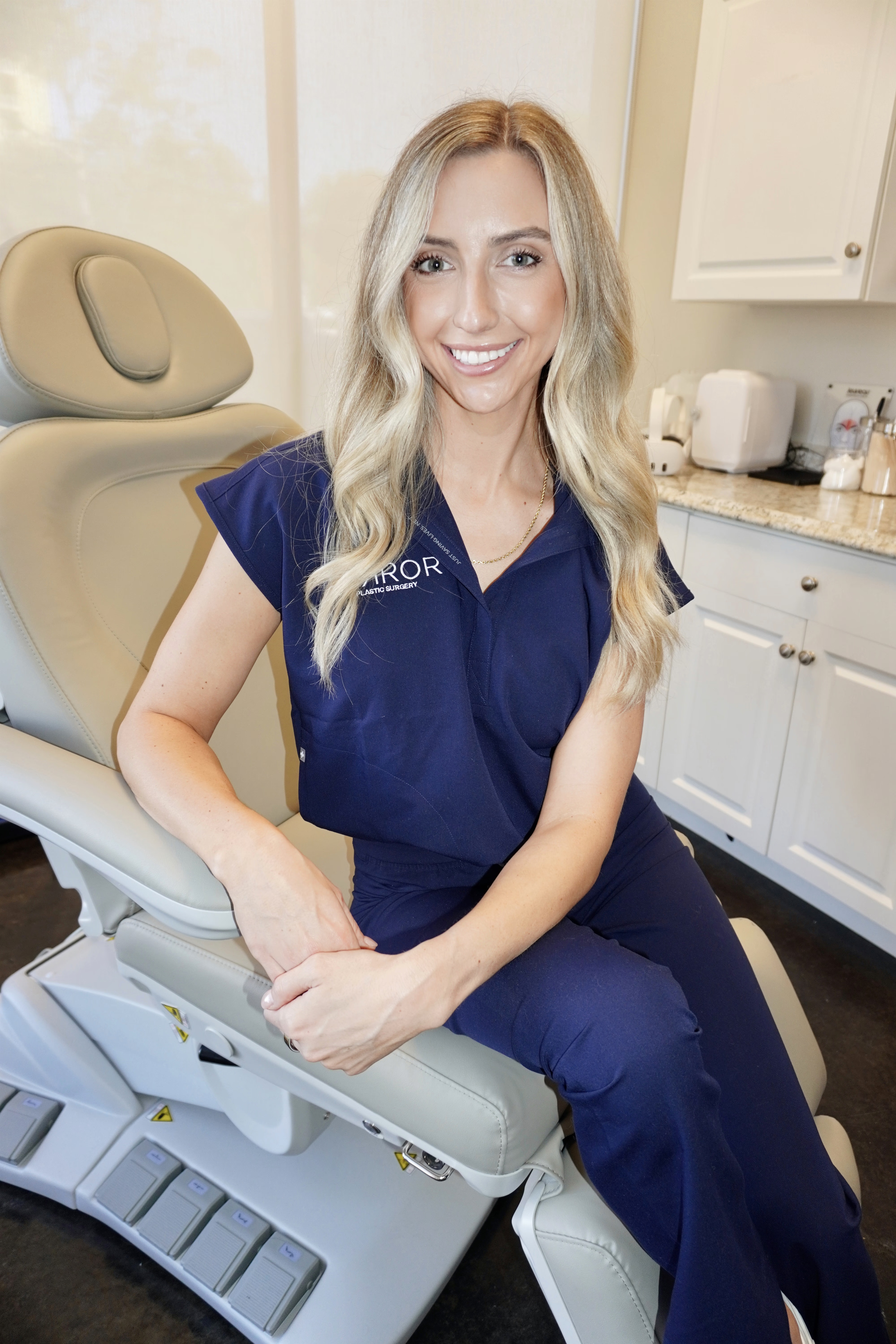
The physical assessment comes next. Ellie Pranckevicius, FNP-BC, Mirror’s lead injector, evaluates surface and subdermal anatomy across all facial regions, including upper, middle, and lower face, using structured diagnostic criteria. She assesses areas such as temporal hollowing, brow position, masseter hypertrophy, and platysmal banding both individually and in relation to one another. This full-face perspective helps prevent the common error of treating one zone in isolation, which can create imbalance elsewhere.
Evidence-based treatment planning closes the consultation. The provider presents a tailored recommendation, explains the rationale behind each proposed neuromodulator or adjunct treatment, and sets realistic expectations for timing and maintenance. Patients leave with a clear understanding of what will be done, why it is recommended, and what to expect, rather than a vague promise of improvement.
Understanding what happens during the consultation naturally leads to the next step, which is deciding when to schedule that first visit.
Why You Should Book a Consultation Before Botox
Booking a dedicated consultation before any injection appointment is the correct sequence, and that distinction affects outcomes more than most patients realize.
A same-day consultation-and-injection model compresses two separate clinical processes into one visit, which shortens the assessment phase. When a provider expects to inject that day, the consultation often becomes a formality instead of a true diagnostic exercise. Time pressure shapes clinical judgment, and that pressure rarely benefits the patient.
A standalone consultation serves a different function. It creates space for the provider to assess anatomy without the implicit pressure to proceed immediately. It allows the patient to ask questions, review before-and-after examples, and make an informed decision without feeling committed the moment they sit down.
This structure also gives the provider room to recommend against a procedure when the anatomy or timing does not support it. High-volume practices rarely have the incentive or time to make that recommendation.
At Mirror Plastic Surgery, the consultation forms the foundation of the treatment relationship. Ellie’s approach, which she likens to dentistry, treats aesthetic medicine as an ongoing care model rather than a series of one-off procedures. The consultation establishes the baseline from which future treatments are planned and evaluated.
Schedule your initial assessment with Ellie to begin your personalized Botox evaluation at Mirror Plastic Surgery in St. Petersburg.
How to Vet Botox Providers in St. Petersburg and Tampa
Identifying a qualified Botox provider in the St. Petersburg/Tampa area works best when you apply objective criteria instead of relying only on proximity or price. The following standards help distinguish concierge-level practices from high-volume alternatives.
Credentials: The injector should hold advanced clinical training, either as a board-certified plastic surgeon or a board-certified nurse practitioner with specialized aesthetics training. Ellie Pranckevicius holds a Master’s in Nursing from the University of South Florida, which provided foundational clinical training. She then completed extensive hands-on aesthetics training to develop injection-specific skills. Before joining Mirror Plastic Surgery, she spent four years as a neuroscience ICU nurse at Tampa General Hospital, experience that sharpened her understanding of complex anatomy and high-stakes clinical decision-making. This combination of advanced education, aesthetics training, and critical care experience supports safer injection technique and strong anatomical judgment.
Time allotted: Ask how long the initial consultation lasts. Anything under thirty minutes rarely allows for a full-face anatomical assessment. Mirror’s standard allows up to sixty minutes for this first visit.
Supplier neutrality: Providers tied to a single product line may feel financial pressure to recommend that product, even when it is not the best fit. Mirror Plastic Surgery is supplier-neutral, offering neuromodulators across multiple brands, including Botox, Dysport, Xeomin, Daxxify, and Jeuveau, and selecting based on individual patient factors rather than commission structures.
Surgical oversight: Non-surgical treatments at Mirror are performed under the oversight of Dr. Akash Chandawarkar, a Harvard-educated physician and Johns Hopkins-trained plastic surgeon with fellowship training at Manhattan Eye Ear & Throat Hospital. That level of surgical expertise in the background of a non-surgical practice remains uncommon and clinically meaningful.
10 Smart Questions to Ask During Your Botox Consultation
- How long is this consultation, and does it include a full-face anatomical assessment?
- What is your clinical background and specific training in neuromodulator injection?
- Are you affiliated with or incentivized by any particular product brand?
- Which neuromodulator brands do you carry, and how do you decide which to use?
- How do you assess muscle depth and movement patterns before recommending dosing?
- Will you evaluate areas I have not specifically asked about if you identify a concern?
- What does your long-term maintenance plan look like, and how do you track results over time?
- Under what circumstances would you recommend against proceeding with treatment?
- Who provides oversight for your injectable treatments, and what is their surgical background?
- How do you approach full-face harmonization to avoid an isolated or overdone result?
A provider who answers these questions directly and without hesitation usually operates from a position of clinical confidence. Evasive or vague answers to any of them also provide useful information.
Warning Signs of High-Volume Botox Mills
High-volume aesthetic practices often share a recognizable set of characteristics that signal a focus on throughput over patient outcomes. Recognizing these indicators before booking protects both safety and investment.
Consultations under fifteen minutes. A provider cannot assess full-face anatomy, discuss emotional drivers, review medical history, and present an evidence-based treatment plan in fifteen minutes. When consultation time is this compressed, assessment is being skipped rather than briefly summarized.
Same-day injection pressure. Practices that push patients toward same-day injections during a first visit remove the deliberative space that informed consent requires. This model benefits the clinic’s schedule, not the patient’s outcomes.
Standardized unit packages. Fixed-unit packages such as “20 units for the forehead” ignore the reality that muscle mass, depth, and movement vary significantly between individuals. Standardized dosing produces standardized results on faces that are anything but standard.
Single-zone focus. Providers who treat only the area a patient requests, without evaluating adjacent zones, risk creating imbalance. Treating the brow without assessing the forehead, or the masseter without considering the lower face, often produces results that look correct in isolation and wrong in context.
No follow-up protocol. A practice that does not schedule or recommend follow-up after treatment has no mechanism for tracking outcomes, adjusting dosing, or building a long-term care relationship. This pattern signals a transactional model.
Why Mirror Uses a Top-to-Bottom Anatomical Assessment
Full-face harmonization, the idea that each facial zone should be evaluated in relation to every other zone, forms the clinical foundation of Mirror Plastic Surgery’s injection philosophy. Ellie’s approach starts with restoring inherent facial characteristics before considering any volume augmentation. This sequence helps prevent layered corrections that can accumulate into an unnatural appearance over time.
The top-to-bottom assessment framework evaluates the upper face, including brow position, forehead dynamics, and temporal volume. It then examines the mid-face, including cheek structure, under-eye transition, and nasolabial context. Finally, it reviews the lower face, including jawline definition, masseter volume, platysmal bands, and the lip-chin relationship, as an integrated system. Treatment recommendations grow from this systemic view rather than from the patient’s stated concern alone.
Supplier neutrality supports this approach. Because Mirror is not tied to any single product line, Ellie can match each patient’s muscle characteristics and treatment goals to the most appropriate neuromodulator without brand-driven bias. The same clinical logic applies to adjunct treatments, and energy-based skin tightening, resurfacing, or dermal fillers enter the plan only when the anatomical assessment supports them.
This model produces more than a better Botox result. It creates a treatment relationship in which each appointment builds on documented baseline data, adjustments are made with precision, and the patient’s face is managed as a long-term project rather than a recurring transaction.
Experience Mirror’s anatomy-first approach by booking your Botox consultation in St. Petersburg.
What Happens After Your Botox Consultation
After a comprehensive consultation at Mirror Plastic Surgery, patients receive a written treatment plan that documents the anatomical findings, the recommended neuromodulator, the dosing rationale, and the proposed treatment sequence. This documentation serves as the baseline for future appointments.
If treatment proceeds, Ellie schedules a follow-up to assess results, confirm symmetry, and make any needed adjustments. Patients receive direct access to the practice via call, text, or email, which reflects Mirror’s concierge medicine model and extends attentiveness beyond the appointment itself.
For patients whose goals extend beyond neuromodulators, Ellie’s work can be complemented by Dr. Akash Chandawarkar in the surgical realm, creating a seamless continuum of care within a single practice. This integration, which remains rare in the St. Petersburg/Tampa market, means that non-surgical and surgical options are evaluated by providers who share a common anatomical philosophy and communicate directly with one another.
The first step is the consultation. The quality of that initial assessment shapes everything that follows.
Take the first step toward personalized treatment at Mirror Plastic Surgery, located at 780 4th Ave S, St. Petersburg, FL 33701. Reach the practice by phone or text at 727-361-6515, or by email at hello@mirrorplasticsurgery.com.
Frequently Asked Questions
Is Botox safe, and how does the provider’s background affect safety?
Botox is an FDA-approved neuromodulator with a well-established safety profile when a qualified provider administers it. The injector’s anatomical knowledge functions as the primary safety variable. Providers with advanced clinical training, particularly those with backgrounds in nursing, medicine, or surgery, understand vascular anatomy, injection depth, and complication management at a level that less credentialed practitioners may not. At Mirror Plastic Surgery, Ellie Pranckevicius brings neuroscience ICU nursing experience and specialized aesthetics training to every appointment, and her work is performed under the oversight of a Johns Hopkins-trained plastic surgeon.
How long does Botox last, and what affects the duration?
Most patients see results that last three to six months, although individual variation is significant.1 Factors that influence duration include the specific neuromodulator used, the dose administered, the muscle mass and activity level of the treated area, and the patient’s metabolism. A personalized treatment plan accounts for these variables. Ellie selects from multiple neuromodulator brands, including Botox, Dysport, Xeomin, Daxxify, and Jeuveau, based on each product’s onset, spread, and duration profile in relation to the patient’s anatomy and goals. Daxxify, for example, is associated with longer duration in many patients and may suit those who want extended intervals between appointments.1
What is the difference between a neuromodulator and a dermal filler, and do I need both?
Neuromodulators such as Botox temporarily relax targeted muscles to reduce dynamic wrinkles and address concerns like brow position, masseter hypertrophy, or platysmal banding.1 Dermal fillers restore or add volume to areas affected by structural loss, including cheeks, temples, lips, and jawline.1 Whether a patient benefits from one or both depends on their anatomy and goals, not on a standard protocol. Ellie’s top-to-bottom assessment identifies which modality addresses each concern most effectively. She frequently advises patients when an additional treatment is not yet warranted, which builds trust and helps prevent unnecessary procedures.
How many units of Botox will I need?
No universal answer exists for unit counts. Requirements vary based on muscle mass, depth, and activity, the specific neuromodulator selected, the treatment areas involved, and the patient’s desired outcome. Standardized unit packages, common in high-volume practices, do not account for this variability and often result in under- or over-treatment. At Mirror Plastic Surgery, dosing is determined after the anatomical assessment and explained to the patient with full transparency before treatment begins. Pricing is personalized accordingly and discussed during the consultation.
Can Botox be combined with other treatments in the same visit?
Combination treatments are common and often clinically appropriate, but the decision to combine should follow the anatomical assessment rather than precede it. Ellie evaluates the full face before recommending any adjunct treatment, whether energy-based skin tightening, resurfacing, or dermal fillers. Treatments are sequenced to support one another and to avoid compounding corrections that can produce an unnatural result. Patients are not pressured to add services, and recommendations appear only when the assessment supports them.
Disclaimer: Results may vary from person to person. Editorial content, before and after images, and patient testimonials do not constitute a guarantee of specific results.
1 Results may vary from person to person. Editorial content, before and after images, and patient testimonials do not constitute a guarantee of specific results.