
Written by: Ellie Pranckevicius, FNP-BC, Aesthetic Nurse Practitioner & Aesthetic Injector | Facial Restoration & Regenerative Injectable Specialist, Mirror Plastic Surgery | Last updated: July 4, 2026
Key Takeaways
- Natural Botox results soften dynamic wrinkles while preserving facial movement, emotional expression, and a rested appearance without obvious change.1
- Neuromodulators like Botox, Dysport, and Xeomin relax targeted muscles. Full results peak at 10–14 days and usually last 3–4 months.1
- A thorough anatomical assessment and full-face treatment plan help prevent asymmetry, over-treatment, and compensatory muscle movement.
- Before-and-after photos should use consistent lighting, expressions, and timing. Natural outcomes preserve brow lift, eye crinkles, and balanced facial thirds.
- Schedule a consultation with Ellie at Mirror Plastic Surgery to receive a personalized, anatomy-first assessment and discuss your goals.
How Neuromodulators Work: Key Terms and Timelines
Botox and other FDA-approved neuromodulators, including Dysport, Xeomin, Daxxify, and Jeuveau, temporarily block the nerve signals that cause targeted muscles to contract. This relaxation softens dynamic wrinkles, which form from repeated movement, such as forehead lines, crow’s feet, and glabellar lines. Static wrinkles, which are present at rest, respond more gradually and may need complementary treatments.
Initial effects appear within 3 to 7 days, with shallower lines beginning to soften in the first 24 to 72 hours.1 Full results peak at 10 to 14 days, the standard clinical endpoint for evaluating outcomes. Duration usually ranges from 3 to 4 months, depending on metabolism, treatment area, and dosing strategy.1
Ellie’s Four-Step Botox Treatment Planning Framework
A structured treatment plan at Mirror Plastic Surgery follows four steps. These include a comprehensive consultation, an anatomical assessment of muscle depth and movement patterns, a dosing strategy tailored to the individual, and a follow-up appointment to evaluate results. Each step builds on the previous one. Skipping the anatomical assessment, which often happens in high-volume settings, is the most common reason outcomes look uneven or overdone.
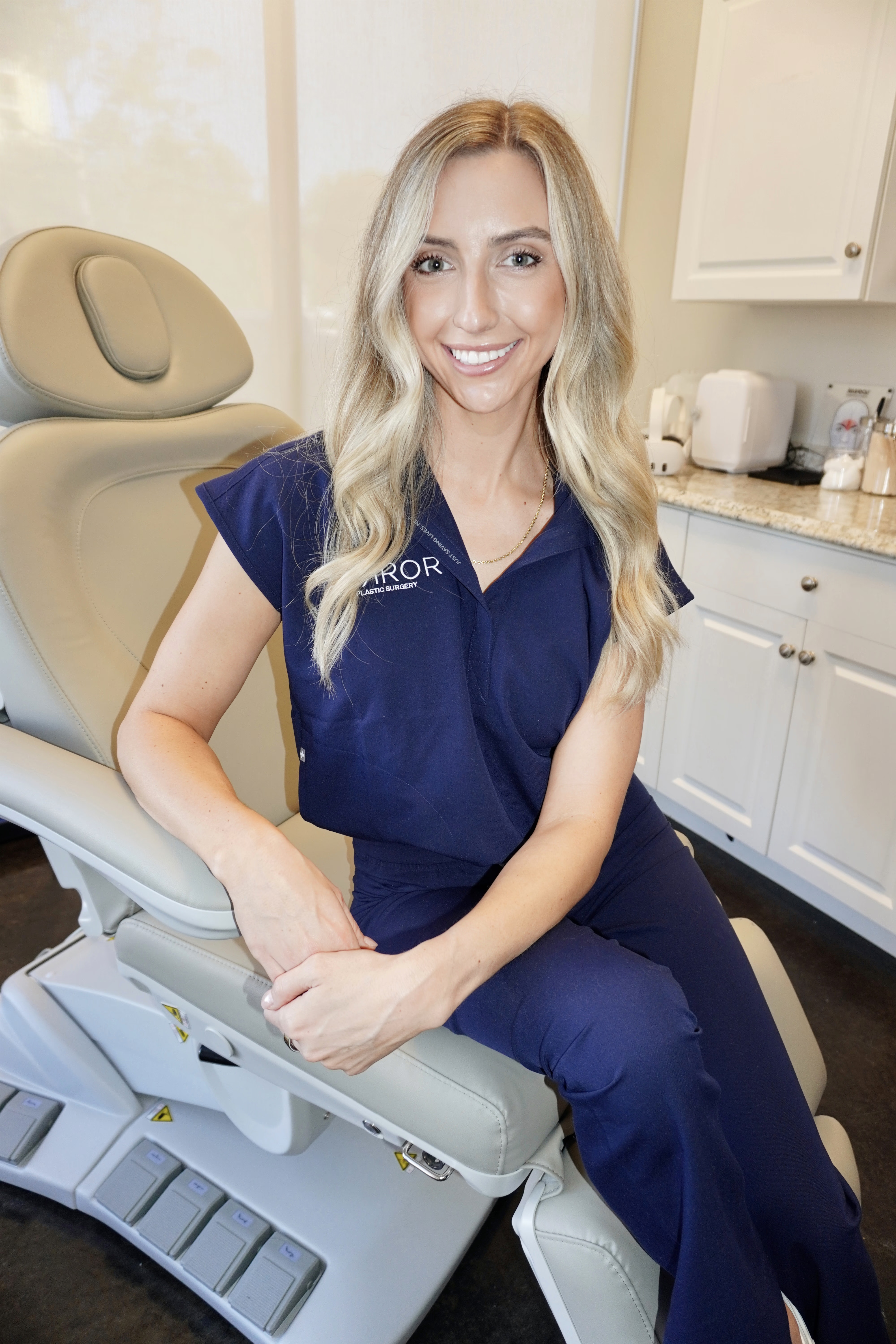
At Mirror Plastic Surgery, Ellie Pranckevicius spends up to an hour on a top-to-bottom assessment before any injection. This process maps the upper, middle, and lower face as a connected system instead of isolated zones. That approach helps prevent asymmetry and expression loss that can result from single-area treatment.
How Mirror’s Approach Aligns With Current Industry Standards
This individualized, anatomy-first method aligns with current industry standards for natural outcomes. The FDA has approved multiple neuromodulator formulations for cosmetic use, each with distinct onset profiles and diffusion characteristics. Placement technique has advanced significantly, and current best practice emphasizes conservative dosing, precise anatomical targeting, and muscle preservation rather than broad paralysis.
Final results and patient satisfaction are usually similar across FDA-approved neurotoxin products by two weeks after treatment. This pattern reinforces that provider technique matters more than brand selection. Waiting a full two weeks before evaluating results or making adjustments helps prevent overcorrection. Realistic expectations focus on gradual softening, not instant erasure of every line.
Key Considerations Before Your Botox Treatment
- Provider credentials: Confirm board certification, advanced training in facial anatomy, and supervised injection experience.
- Photographic documentation: Before-and-after photos should use the same angle, lighting, and facial expression, ideally both at rest and during movement.
- Longevity and maintenance: Most patients see results lasting three to four months, though individual metabolism rates vary.1 A consistent maintenance schedule helps avoid over-treating after long gaps between visits.
- Full-face context: Treating one area in isolation without considering adjacent muscle groups increases the risk of compensatory movement and asymmetry.
Risks, Limitations, and Trade-Offs
Minor swelling, redness, soreness, and small bruises at injection sites are common and usually resolve within a few days. More significant risks include brow heaviness or ptosis from diffusion into the levator muscle, asymmetry from uneven dosing, and a flattened expression from over-treating the forehead.
The “frozen” look is not an inevitable side effect. It reflects a dosing and placement error. When injected by a trained and experienced provider, Botox should not make a patient look frozen or overdone.1 Conservative initial dosing with a planned follow-up is the safest approach, particularly for first-time patients, and matches what most people want: gradual improvement that preserves natural facial movement instead of a sudden, dramatic change.
Full-Face Botox Planning Versus Spot Treatment
Targeted-area treatment focuses on a single zone, such as the forehead, glabella, or crow’s feet, without accounting for how adjacent muscles compensate. This approach can create localized results that look out of sync with the rest of the face or cause untreated muscles to overwork and deepen surrounding lines.
A full-face approach maps the relationship between the upper, middle, and lower facial thirds. Treating the forehead in context with brow position, the glabella in context with lateral canthal lines, and the perioral area in context with the masseter and mentalis creates a balanced, cohesive result. The precision-over-volume approach treats for movement rather than against it, which forms the foundation of Ellie’s full-face philosophy at Mirror Plastic Surgery.
How to Read Botox Before-and-After Photos
This checklist helps you evaluate any provider’s clinical photography. Each point reflects whether the injector prioritized anatomy and movement preservation.
Photo Consistency Checklist
- Identical expressions in both images: Both photos should show the same facial position, either fully at rest or during the same movement, such as smiling or raising brows. Mixed expressions make results hard to judge accurately.
- Consistent lighting and angle: Shadows and camera angles can dramatically change how wrinkles appear. Look for matched overhead lighting and a straight-on or three-quarter view in both images.
- No heavy filtering or post-processing: Smoothing filters hide texture and mask the true degree of wrinkle reduction.
- Standardized timing: After photos should be taken at peak effect, using the 10–14 day window mentioned earlier, not immediately after treatment when swelling may temporarily hide lines.
Anatomical Outcome Checklist by Treatment Area
- Forehead lines: Lines soften at rest and during expression, but the brow still elevates when the patient raises it. A dropped brow or heavy upper lid in the after photo signals the over-treatment discussed in the risks section.
- Glabella (11 lines): The vertical furrows between the brows smooth without eliminating all movement. The brow shape stays symmetrical and naturally arched.
- Crow’s feet: Lines soften during smiling, not only at rest. If the after photo shows a smile with no lateral eye movement, the result is over-treated. Look for softened, not erased, lines during expression.
- Downturned mouth: The corners of the mouth lift subtly at rest. The smile remains full and symmetrical. Asymmetric lip pull or a flat smile in the after photo suggests incorrect placement in the depressor anguli oris.
- Full-face results: The upper, middle, and lower face appear balanced. No single zone looks dramatically different from adjacent areas. The patient looks like themselves, simply more rested.
- Age-specific markers (30s): Preventive dosing shows minimal change at rest with preserved full movement. The goal is slowing wrinkle formation, not eliminating expression.
- Age-specific markers (40s): Expect moderate softening of established dynamic lines with maintained brow lift and lateral eye movement during smiling.
- Age-specific markers (50s): Deeper lines at rest reduce visibly, while forehead movement and symmetrical brow position remain. Static lines may stay partially visible, which is expected and appropriate.
- Lip flip: A small amount of neuromodulator injected into the orbicularis oris relaxes inward pull, allowing the upper lip to roll outward subtly without adding volume. The after photo should show a slightly fuller-appearing upper lip at rest and during smiling, with normal speech and drinking.
Note: Mirror Plastic Surgery’s before-and-after photo library is available for review during your consultation. All images are taken under standardized conditions with matched expressions and lighting.
Questions to Ask Your Botox Injector
- What is your training in facial anatomy, and how does it guide your injection placement?
- Will you assess my full face before recommending a treatment area, or do you treat only the area I request?
- How do you document my baseline anatomy before treatment, and can I see before-and-after photos taken under consistent conditions?
- What is your dosing philosophy, and do you start conservatively and adjust or use a standard unit count?
- What is your follow-up protocol if I have concerns at the two-week mark?
- Which neuromodulator brand do you recommend for my anatomy, and why?
- How will this treatment interact with other areas of my face I may want to address later?
Schedule your assessment and bring this checklist. Ellie will answer every question before a single unit is placed.
Frequently Asked Questions
How do I know if I am a good candidate for Botox?
Most adults with dynamic wrinkles, meaning lines that appear during facial movement, qualify for neuromodulator treatment. Ideal candidates are in good general health, have realistic expectations about gradual improvement rather than complete line removal, and are not pregnant or breastfeeding. Patients with certain neuromuscular conditions or sensitivities to botulinum toxin are not candidates. A thorough consultation with a full facial assessment offers the only reliable way to determine candidacy, because muscle depth, skin quality, and movement patterns all influence whether and how treatment should proceed.
What is the difference between first-time Botox and maintenance treatment?
First-time Botox usually uses a conservative dose to see how an individual’s muscles respond to the neuromodulator. Results may appear slightly less dramatic than later treatments because the muscles have not yet been conditioned by repeated relaxation cycles. Over time, with consistent maintenance every three to four months, the targeted muscles often weaken gradually, which can extend the interval between treatments and reduce the dose needed for the same outcome. First-time patients should plan a two-week follow-up to assess results before any touch-up.
Why do some before-and-after photos look unnatural, and how can I spot red flags?
Unnatural results in photos usually come from over-treatment, inconsistent photo conditions, or both. Red flags include a completely immobile forehead in the after image, a brow that sits lower than in the before photo, a smile that looks flat or asymmetrical, or crow’s feet that disappear entirely even during a full smile. Photo red flags include mismatched lighting, different camera angles, or expressions that differ between the before and after images. These factors can make results appear more dramatic than they are. A provider who photographs patients under standardized, reproducible conditions shows a commitment to honest documentation.
How long does it take to see final results, and when should I schedule a follow-up?
Initial softening of shallower lines begins within 24 to 72 hours. Full results peak at 10 to 14 days, which is the right time to evaluate the outcome and decide whether any touch-up is needed. Scheduling a follow-up before the two-week mark risks overcorrection, because the muscles are still relaxing during that period. As noted in the treatment considerations above, results typically last three to four months, and most providers recommend a two-week follow-up for first-time patients or anyone who has changed their treatment area or dose.
What makes Mirror Plastic Surgery’s approach to Botox different from a medical spa or high-volume clinic?
Mirror Plastic Surgery uses a full-face, anatomy-first philosophy instead of a zone-by-zone or unit-count model. Ellie Pranckevicius conducts up to an hour-long assessment before any treatment, mapping how the upper, middle, and lower face interact as a system. This approach helps prevent compensatory muscle overactivity and asymmetry that can result from isolated injections. The practice is supplier-neutral, so product recommendations are based on individual anatomy and goals rather than brand quotas or commissions. Patients receive honest guidance, including being told when a treatment is not yet necessary, which supports long-term trust that high-volume settings rarely have time to build.
Making an Informed Botox Decision
Evaluating natural-looking Botox results calls for the same critical eye used for any medical outcome. Consistent photo conditions, preserved facial movement, balanced expression, and age-appropriate softening signal a provider who prioritizes anatomy over volume. Patients who receive well-executed treatment often describe the result as feeling like themselves, just smoother, with five years of stress lifted from the face rather than a dramatic transformation.1 That outcome reflects a thorough assessment, conservative dosing, and a provider who understands the face as a whole.
Mirror Plastic Surgery’s concierge model, with hour-long consultations, standardized photographic documentation, and Ellie Pranckevicius’s full-face philosophy, is built to create that type of result for Tampa Bay patients who value subtlety, safety, and long-term care over speed.
Start with a comprehensive facial assessment at Mirror Plastic Surgery in St. Petersburg. Ellie will map your unique anatomy before recommending any treatment.
Disclaimer: Results may vary from person to person. Editorial content, before and after images, and patient testimonials do not constitute a guarantee of specific results.
1 Results may vary from person to person. Editorial content, before and after images, and patient testimonials do not constitute a guarantee of specific results.