
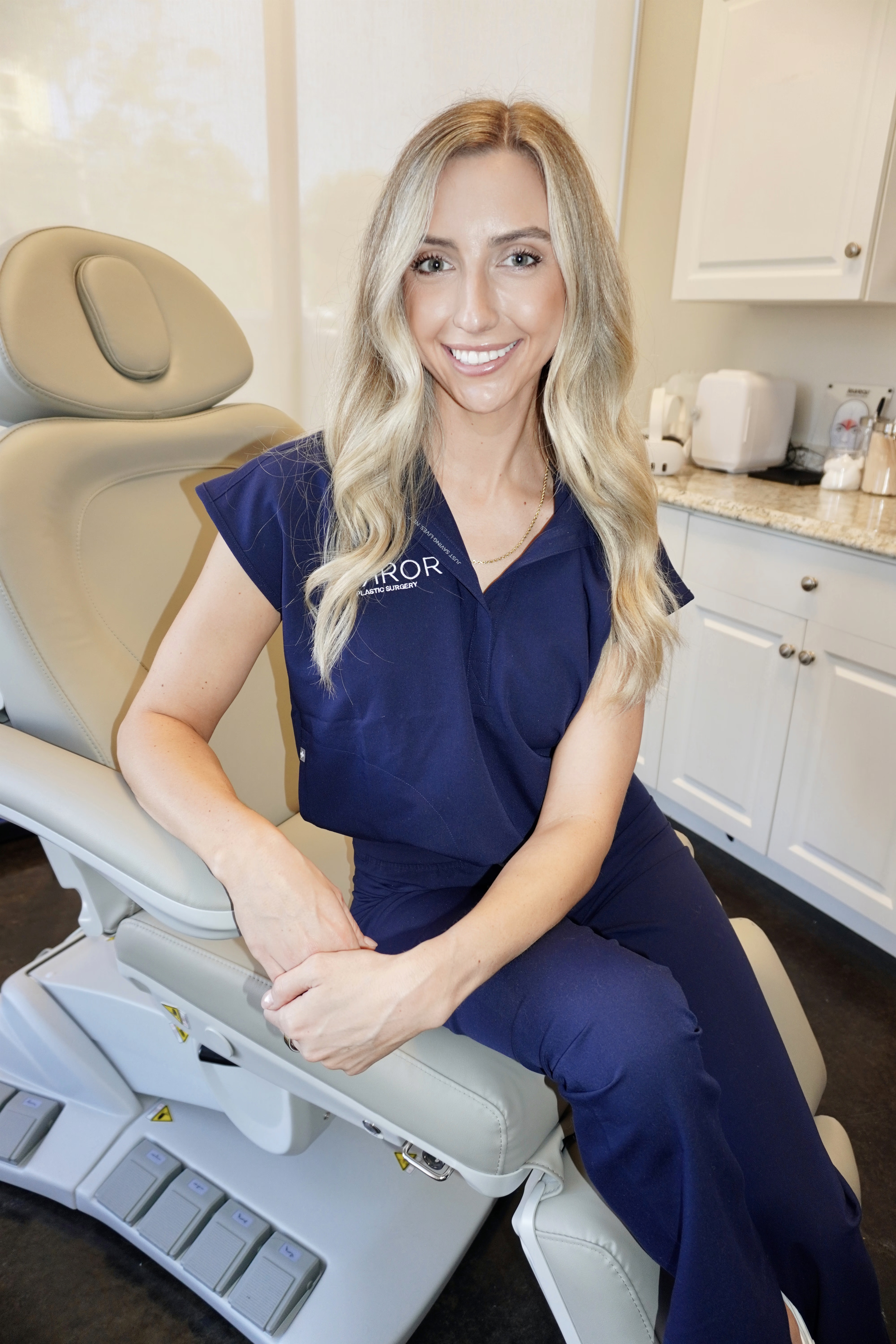
Written by: Ellie Pranckevicius, FNP-BC, Aesthetic Nurse Practitioner & Aesthetic Injector | Facial Restoration & Regenerative Injectable Specialist, Mirror Plastic Surgery | Last updated: August 28, 2026
Key Takeaways for Lip Filler Longevity and Shape
- Lip augmentation produces measurable but temporary projection gains, with only 10–11% of the initial increase persisting at 9 months and responder rates dropping to 46–56% by 12 months.1
- Shape features such as Cupid’s bow definition and philtral column support depend more on injection plane and technique than on volume alone, with superficial subdermal placement providing the most reliable definition.
- Baseline soft-tissue anatomy predicts outcome magnitude more accurately than filler volume, so a detailed pre-treatment assessment is essential.
- Volume and shape degrade at different rates, and a 6‑month check-in supports maintenance before full reversal and helps preserve natural results.
- Patients seeking predictable, anatomy-first lip augmentation can book a consultation with Ellie at Mirror Plastic Surgery to establish a personalized baseline and maintenance plan.
3D-Measured Projection and Vermilion Height Increases
Prospective trials with quantified dimensional data set realistic expectations for lip augmentation outcomes. In a 2026 study of 25 adult females receiving lip augmentation, upper-lip projection increased a mean 1.26 mm relative to the esthetic Ricketts E-Plane and 1.35 mm relative to the subnasale vertical line at two-week follow-up, with lower-lip projection increasing 1.01 mm and 1.44 mm on the same reference planes.1 These gains are statistically significant early post-treatment measurements, recorded before the degradation curve begins.
The table below consolidates dimensional change data from peer-reviewed sources. All figures reflect early post-treatment measurements unless otherwise noted.
| Dimensional Parameter | Early Post-Treatment Change | 12-Month Responder Rate | Source |
|---|---|---|---|
| Upper-lip projection (E-Plane) | +1.26 mm at 2 weeks | Not separately reported | Barakah et al., 2026 |
| Lower-lip projection (E-Plane) | +1.01 mm at 2 weeks | Not separately reported | Barakah et al., 2026 |
| Lip fullness (Allergan Lip Fullness Scale, ≥1-grade improvement) | 79.1% responders at 3 months | 56.4% at 12 months | HYC-24L RCT, n=213 |
| Lip fullness (MLFAS, ≥1-grade improvement) | 91.1% responders at week 8 | Declines over time | FDA PMA P250016 trial (n=220) |
Baseline soft-tissue position proved a stronger predictor of outcome magnitude than injected volume alone, which directly supports anatomy-first treatment planning at Mirror Plastic Surgery.
Book a consultation with Ellie to receive a dimensional baseline assessment before any treatment is planned.
Cupid’s Bow and Philtral Columns: How Depth Shapes Definition
While projection and height create the foundation for lip augmentation outcomes, these volumetric gains need proper shape architecture to look natural. Cupid’s bow definition is driven by height rather than volume, with the double peak best supported by superficial subdermal placement at 1.0–2.5 mm depth. Deeper placement tends to flatten the bow instead of sharpening it. The vermilion border white roll requires intradermal to subdermal product placement at 0.5–2 mm depth to maintain the visible light-catching ridge without vascular risk, because labial arteries usually sit at 4–6 mm depth in the submucosal plane.
Philtral column support follows a similar depth pattern. Linear retroinjection in the subdermal plane uses microdeposits of ≤0.01–0.03 mL per line for border definition, while eversion and projection require vertical linear retroinjection with micro-aliquots of 0.01–0.03 mL spaced 1–2 mm apart. These parameters relate to technique rather than product brand, so injector expertise influences shape persistence more than filler label alone.
Short-Term Peak Versus 9–12-Month Responder Rates
The gap between peak response and long-term retention shapes realistic maintenance planning. In the FDA PMA P250016 approval trial for a cross-linked lip filler (n=220), the peak responder rate of 91.1% occurred at week 8, then declined over time.1 A comparator product showed similar retention, which confirms that the degradation curve reflects tissue-filler interaction rather than a single formulation.
In the multicenter randomized controlled trial of HYC-24L supporting US FDA approval, 79.1% of treated patients achieved ≥1-grade improvement on the Allergan Lip Fullness Scale at 3 months versus 26.1% of controls, with 56.4% maintaining response at 12 months.1 The difference between 79.1% and 56.4% reflects the volume-dependent portion of the result, which is most vulnerable to metabolic breakdown.
These figures explain why patients who enjoy soft, natural-looking fullness at 8 weeks often notice visible softening by month 6 and more pronounced volume loss by month 9–12, even when some shape architecture remains.
Shape Persistence After Subdermal Placement
Long-term shape persistence in lip augmentation depends on injection plane and pattern, with deeper submucosal or subcutaneous deposits providing structural support and projection while superficial subdermal placement targets definition and contour without promoting product displacement or migration. This plane-specific behavior explains why two patients who receive identical volumes can show very different shape outcomes at 12 months.
Superficial vermilion body placement at 1.5–3.0 mm depth supports lip eversion, hydration, and tubercle projection by engaging the pars marginalis of the orbicularis oris, while intramuscular or submucosal planes are rarely indicated for aesthetic shaping. Ellie Pranckevicius’s dual background in esthetics and advanced nursing, including four years in a Neuroscience ICU, supports precise navigation of these tissue planes and an informed understanding of how filler integrates with the orbicularis oris at each depth.
Aging Lips Compared With Post-Augmentation Reversal
Lip aging typically involves progressive loss of vermilion height, flattening of the Cupid’s bow, effacement of philtral columns, and reduced projection. Post-augmentation reversal partially mirrors this pattern as filler degrades, although the rate and distribution vary with individual metabolism, expressive movement, and prior filler history. Metabolism, product rheology, injection technique and depth, baseline lip anatomy, and prior filler history are the main determinants of both longevity and natural appearance after lip augmentation.
Patients with greater baseline volume loss often show more dramatic early gains but also faster apparent reversal, because the treated tissue has less structural support to retain filler. This anatomy-first principle, established earlier in the dimensional data, reinforces the need for a pre-treatment anatomical assessment instead of a volume-first approach.
Measurement Tools and Timing for Reassessing Volume and Shape
Standardized photonumeric scales provide the primary clinical framework for tracking lip fullness over time. The Humedix Lip Fullness Scale demonstrated perfect intra-rater reliability (Cohen’s Kappa = 1.0000) and near-perfect inter-rater reliability (Fleiss’ Kappa = 0.96821) among five dermatologists, which makes it a reproducible tool for serial assessments. It showed strong agreement with the Allergan Lip Fullness Scale (weighted Kappa = 0.9056), confirming cross-scale validity.
Three-dimensional stereophotogrammetry adds objective projection and height data beyond what photonumeric scales capture. 3D stereophotogrammetry confirmed that the lip-flip procedure produces temporary upper-lip eversion through selective neuromuscular modulation rather than volumetric augmentation. This finding illustrates how 3D tools separate shape change from volume change in ways that visual assessment alone cannot match.
Clinically, a 6‑month reassessment allows early detection of volume decline and supports maintenance before the patient returns fully to baseline. Many patients then schedule maintenance sessions around 6 months and again near 1 year, adjusted to their individual response.
Book a consultation with Ellie to establish your dimensional baseline and a structured maintenance timeline.
How Individual Anatomy Guides Product Choice and Injection Depth
A 2026 systematic review of 16 studies involving 3,692 patients found that no single technique or instrument has been proven definitively superior; favorable outcomes depend on appropriate product selection and technique matched to individual anatomy. This evidence supports Mirror Plastic Surgery’s supplier-neutral philosophy. Ellie selects from multiple filler brands based on each patient’s tissue quality, movement profile, and dimensional goals, not on quotas or commissions.
The same product can perform differently in longevity and appearance depending on tissue quality, movement profile, and baseline lip structure. High-mobility lips with strong orbicularis oris activity tend to break down filler faster than lower-mobility lips, so staged conservative volumes usually work better than single large-volume sessions. Volume-building plans that add larger amounts quickly can increase short-term visibility but may compromise long-term shape stability and natural appearance if progression is not staged conservatively.
Mirror’s top-to-bottom assessment, which typically lasts up to an hour, evaluates lip anatomy within the full facial context before any product or volume is selected. This comprehensive evaluation enables Ellie to prioritize foundational restoration before volume augmentation, so shape architecture is established before projection is layered on top.
Common Misconceptions About Shape Versus Volume Longevity
Many patients assume lip augmentation creates a permanent or semi-permanent shape change that simply fades slowly. Clinical data show a more layered picture, where volume and shape degrade at different speeds and through different mechanisms.
Volume, meaning the bulk projection of the vermilion body, is the most time-sensitive component. Responder rates on validated fullness scales drop from over 90% at 8 weeks to under 50% by 11–12 months, so more than half of treated patients lose clinically meaningful fullness within a year. Shape features such as Cupid’s bow definition, philtral column sharpness, and vermilion border clarity can last somewhat longer when placed in the correct subdermal plane, although they still remain temporary.
A second misconception links more volume with better or longer-lasting shape. Hydration-focused lip treatments often maintain a natural appearance longer when volume pressure stays low, while definition-focused work may soften earlier in high-mobility lips. Overfilling compresses tissue planes, distorts natural anatomy, and can make reversal appear more abrupt when filler breaks down unevenly.
Frequently Asked Questions
Am I a good candidate for lip augmentation at Mirror Plastic Surgery?
Ellie determines candidacy through a comprehensive top-to-bottom assessment rather than a simple checklist. She evaluates your baseline lip anatomy, vermilion height, philtral column definition, tissue quality, and overall facial proportions before recommending any treatment. Patients who understand the time-dependent nature of volume and shape changes and who commit to a structured maintenance plan usually achieve the most satisfying long-term outcomes. Patients who are pregnant, breastfeeding, or have active oral infections or autoimmune conditions affecting the perioral area generally wait until those conditions resolve.
How long do lip augmentation results realistically last?
Volume and shape changes follow different timelines. Fullness gains usually peak around 6–8 weeks after treatment and then decline, with roughly 46–56% of patients maintaining a clinically meaningful improvement at 12 months on validated photonumeric scales.1 Shape features such as Cupid’s bow definition and philtral column support can persist somewhat longer when placed in the appropriate subdermal plane, although they do not become permanent. Individual factors such as metabolism, lip mobility, baseline anatomy, and prior filler history create meaningful variation between patients. A 6‑month reassessment allows Ellie to decide whether volume maintenance is appropriate before full reversal occurs.
What is the difference between volume augmentation and shape augmentation?
Volume augmentation increases the three-dimensional bulk of the vermilion body and produces measurable projection gains on 3D imaging. Shape augmentation focuses on specific architectural features such as Cupid’s bow definition, philtral column height, vermilion border clarity, and lip eversion. These goals require different injection depths and micro-aliquot sizes. Shape work usually sits in the superficial subdermal plane at 0.5–2.5 mm depth, while volume work engages deeper tissue planes. The two goals can be combined, but they call for distinct technique decisions. Ellie’s anatomy-first approach builds shape architecture first, then layers volume, which reduces the risk of an overdone look and supports more natural long-term results.
How often will I need maintenance treatments?
Most patients benefit from a reassessment at 6 months and a maintenance session between 6 and 12 months, depending on how their anatomy responds. Ellie structures maintenance intervals around your individual degradation rate rather than a rigid schedule, so some patients maintain results longer than others. The goal is to support shape architecture continuously instead of allowing full reversal and retreating from baseline each time, which often requires more product over the long term.
Is lip augmentation safe, and what are the most common side effects?
When an experienced injector with precise anatomical knowledge performs the procedure, lip augmentation has an acceptable safety profile. The most common adverse events are transient and localized, including swelling, bruising, and tenderness that typically resolve within 7–14 days. Serious complications such as vascular occlusion are rare but require immediate recognition and management. In these situations, Ellie’s four years of Neuroscience ICU experience and advanced nursing training are directly relevant. Mirror Plastic Surgery’s supplier-neutral approach means product selection is based on tissue compatibility and safety data rather than commercial relationships, and Ellie’s conservative, staged volume philosophy reduces the risk of overcorrection or tissue distortion.
Conclusion and Next Steps With Mirror Plastic Surgery
Lip augmentation produces quantifiable changes in projection, vermilion height, and shape architecture, and those changes remain time-dependent and anatomy-specific. Volume gains peak at 6–8 weeks and decline to roughly 46–56% responder rates by 12 months. Shape features last longer when placed in the correct subdermal plane, yet they still require staged maintenance to stay clinically meaningful. The magnitude of any dimensional change depends more on baseline soft-tissue anatomy than on injected volume, which makes a thorough pre-treatment assessment the most critical step.
At Mirror Plastic Surgery, Ellie Pranckevicius conducts a comprehensive top-to-bottom evaluation of your lip anatomy, facial proportions, and long-term goals before any product or volume is selected. Her dual background in esthetics and advanced nursing, combined with Mirror’s supplier-neutral, evidence-based philosophy, supports predictable, natural-looking outcomes with a structured maintenance plan tailored to your individual degradation rate.
Book a consultation with Ellie at Mirror Plastic Surgery in St. Petersburg, Florida, and receive a dimensional baseline assessment grounded in the same clinical evidence reviewed in this guide.
Disclaimer: Results may vary from person to person. Editorial content, before and after images, and patient testimonials do not constitute a guarantee of specific results.
1 Results may vary from person to person. Editorial content, before and after images, and patient testimonials do not constitute a guarantee of specific results.