
Written by: Ellie Pranckevicius, FNP-BC, Aesthetic Nurse Practitioner & Aesthetic Injector | Facial Restoration & Regenerative Injectable Specialist, Mirror Plastic Surgery | Last updated: July 6, 2026
Key Takeaways
- Non-surgical BBL and hip dip fillers using biostimulatory products like PLLA (Sculptra) and CaHA (Radiesse) can last from 12 months up to 2–3 years, with results building gradually through collagen stimulation.1
- PLLA fillers typically require 2–3 initial sessions spaced 4–6 weeks apart, while CaHA often achieves results in a single session with optional touch-ups.1
- Metabolic rate, exercise intensity, weight changes, and daily mechanical stress from sitting and movement all influence how long results last.1
- Biostimulatory fillers offer a safer profile for large-volume gluteal injections than hyaluronic acid, which carries higher vascular risk and is not recommended for this area.
- Schedule your personalized consultation at Mirror Plastic Surgery for an anatomy-driven assessment and a tailored maintenance plan.
How PLLA and CaHA Compare for Longevity
The two primary biostimulatory fillers used for non-surgical BBL and hip dip correction follow different timelines for building and maintaining results. This comparison helps you plan both your initial series and your long-term upkeep.
| Filler Type | Average Duration | Typical Initial Sessions | Maintenance Frequency |
|---|---|---|---|
| Poly-L-Lactic Acid (PLLA / Sculptra) | up to 2-3 years | 2–3 sessions, 4–6 weeks apart | Every 1–2 years |
| Calcium Hydroxylapatite (CaHA / Radiesse) | 12–18 months | 1 session, optional touch-up at 4–6 weeks | Every 12–18 months |
Note: Hyaluronic acid (HA) fillers are excluded from this comparison as a recommended option for gluteal and hip dip procedures. While HA fillers are reversible and provide immediate volume, the safety profile for large-volume gluteal HA injections is not consistent with current best practices. This is addressed in detail in the safety section below.
Why Some Bodies Hold Filler Longer Than Others
Several patient-specific variables influence how long non-surgical BBL and hip dip filler results last. Metabolic rate plays a major role. People with faster metabolisms process injectable materials more quickly, which shortens the effective duration of both PLLA and CaHA products. Exercise frequency compounds this effect. High-intensity training increases circulation and tissue turnover in the gluteal region, which accelerates product breakdown.
Weight fluctuation compounds these metabolic effects by changing the structural foundation itself. Significant weight gain or loss alters the fat distribution and tissue architecture surrounding the filler, which can distort contour or reduce apparent volume. Beyond metabolic and compositional factors, the gluteal region faces a unique mechanical challenge. Constant loading from sitting, walking, and movement creates ongoing tissue pressure that differs from facial injection sites and must be considered during placement.
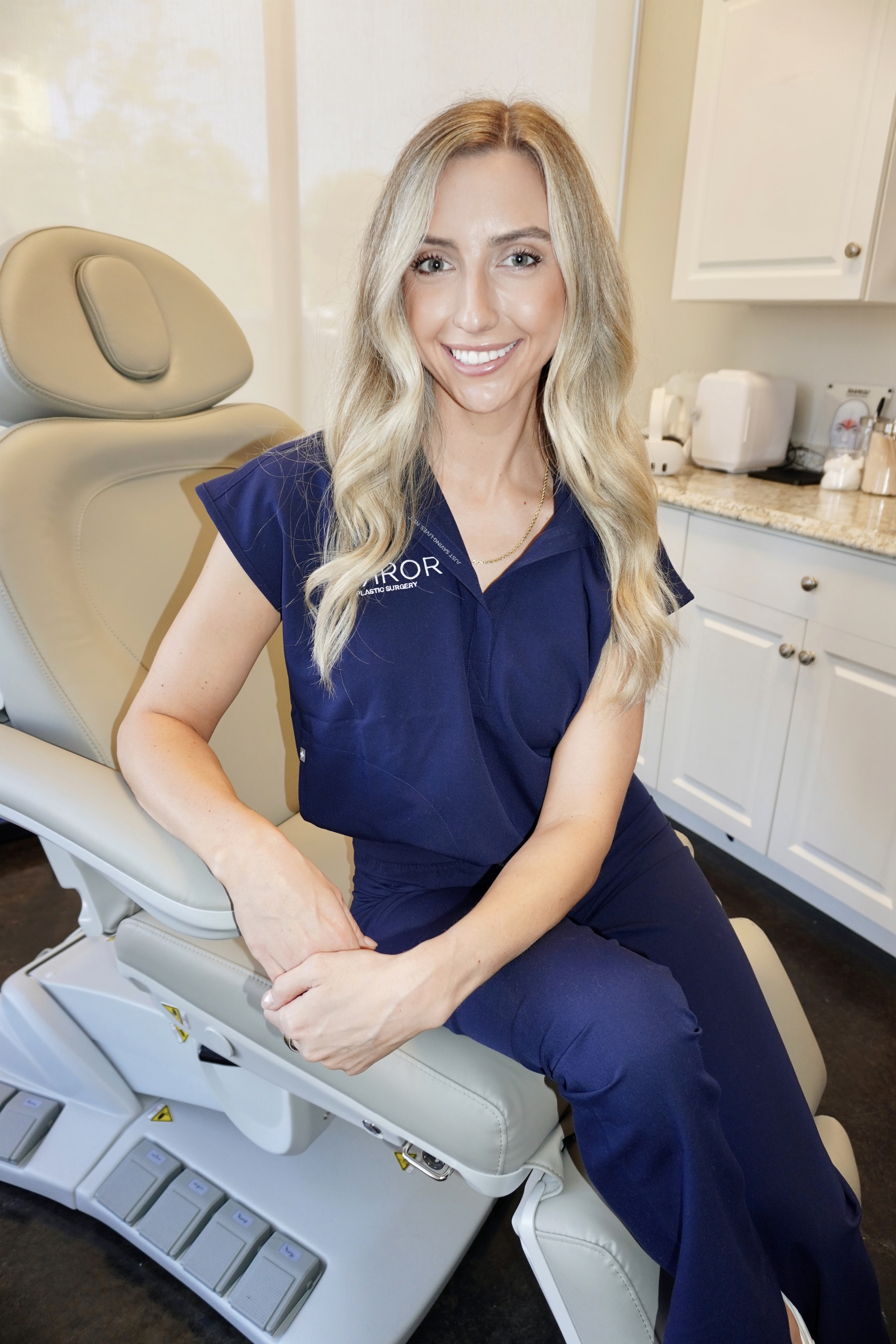
At Mirror Plastic Surgery, Aesthetic Nurse Practitioner Ellie Pranckevicius begins each non-surgical BBL and hip dip consultation with a detailed anatomical assessment before recommending any product. Her dual background in esthetics and advanced nursing, combined with four years of critical care experience, guides a product selection process that accounts for tissue quality, body composition, and lifestyle. Ellie chooses the biostimulatory filler that best matches each patient’s anatomy and long-term goals, which supports more predictable and durable results.
Schedule your personalized assessment to receive an anatomy-driven evaluation and a customized maintenance plan.
Planning Your Maintenance Timeline
Effective maintenance planning starts at the first consultation, not after results fade. For PLLA-based treatments, maintenance sessions every 1–2 years are common after the initial series. These visits usually require fewer syringes than the first course because existing collagen scaffolding is reinforced rather than created from scratch. CaHA follows a similar rhythm, with touch-ups typically scheduled within its 12–18 month window.
Ellie approaches aesthetics the way a dentist approaches oral health. Professional treatments create change, and consistent maintenance preserves it. Patients who commit to scheduled maintenance visits, instead of waiting until results fully dissipate, enjoy more stable contour, need less product per session, and build a smoother, more natural collagen foundation over time.
How Many Sessions Non-Surgical BBL Usually Takes
Before planning maintenance, you need a clear picture of the baseline treatment protocol. Session requirements differ meaningfully between product types. PLLA works through gradual neocollagenesis. PLLA microparticles injected into the deep dermis trigger a foreign-body response that activates fibroblasts to produce Type I collagen. This mechanism requires multiple staged sessions to build adequate volume. Hip dip treatment with Sculptra typically requires 2–3 sessions spaced 4–6 weeks apart. Full results from Sculptra typically emerge around 4–6 weeks after the procedure, developing gradually across a series of treatments.1 Patients should expect a progressive change rather than an overnight transformation.
CaHA (Radiesse) provides an immediate structural lift upon injection and also stimulates collagen over time. Treatment goals are often reached in a single session, with an optional touch-up 4–6 weeks later if needed.1 Regardless of product, a typical non-surgical gluteal treatment uses an average of 10 or more total syringes. That volume is distributed across sessions instead of being placed in one visit, which has direct safety benefits.
Safety With Large-Volume Gluteal Injections
The gluteal region carries a distinct risk profile compared to facial injection sites. Blood vessels in this area are larger and deeper, and the consequences of vascular compromise are more severe. Vascular occlusion in the gluteal region is a medical emergency. Failure to restore blood flow can result in tissue necrosis.
Hyaluronic acid fillers carry documented risks in this anatomical zone that make them unsuitable for large-volume gluteal use. High-volume HA injections in the buttocks increase tissue pressure, which can impair circulation and raise the risk of vascular occlusion. Cases of Purtscher-like retinopathy following gluteal dermal filler injections have been documented, showing that arterial occlusion risk is not confined to the face. Gravity and tissue movement can cause HA filler to migrate in large-volume buttock treatments, leading to asymmetry that often requires dissolving large amounts of product to correct. Many reputable clinics have stopped performing large-volume HA butt lifts because of serious complications including embolism and vascular events. HA fillers are not considered safe practice for gluteal augmentation.
Biostimulatory fillers such as PLLA and CaHA offer a more favorable safety profile for this use, but they still carry risk. Nodule formation, infection, and improper placement remain concerns with any large-volume injection. Spreading total volume across multiple sessions, instead of injecting all product in a single visit, is a standard risk-mitigation strategy.
Choosing a Qualified Injector for Gluteal Fillers
Injector selection is the most consequential safety factor in non-surgical gluteal enhancement. The gluteal anatomy, including the superior and inferior gluteal arteries, sciatic nerve proximity, and variable fat compartment depth, requires an injector with documented anatomical training, not just general filler experience.
Ellie Pranckevicius offers a rare combination of qualifications for this work. She holds esthetics licensure with 600 hours of hands-on training, a Master’s in Nursing from the University of South Florida, and four years in the Neuroscience ICU at Tampa General Hospital. Her clinical judgment in high-acuity settings informs her approach to complication recognition and risk management during aesthetic procedures. At Mirror Plastic Surgery, she practices within a clinic led by Dr. Akash Chandawarkar, a Harvard-educated, Johns Hopkins-trained plastic surgeon, which provides an institutional safety framework that most standalone injection clinics cannot match.
Ellie’s supplier-neutral approach means product recommendations are based on patient anatomy and evidence, not brand relationships or volume quotas. This approach stands out in a market where injectors are often incentivized to favor specific products regardless of patient suitability.
Request an anatomy-first consultation at Mirror Plastic Surgery in St. Petersburg, FL, to discuss your non-surgical BBL or hip dip goals.
When Surgery Makes More Sense Than Fillers
Non-surgical BBL and hip dip fillers work best for moderate, natural-looking enhancement. Patients who want dramatic volume increases, major projection changes, or structural reshaping that exceeds what biostimulatory fillers can safely provide are better served by a surgical consultation. The traditional surgical BBL uses autologous fat transfer. This method has its own risk profile but can deliver a degree of volume and permanence that injectable fillers cannot match.
At Mirror Plastic Surgery, Ellie’s non-surgical work pairs with Dr. Akash Chandawarkar’s surgical expertise. Patients who arrive for a non-surgical BBL consultation and turn out to be stronger surgical candidates receive that guidance clearly and without pressure. This unbiased, patient-first approach reflects the practice’s concierge medicine model.
Your Next Step With Mirror Plastic Surgery
Clear expectations about filler longevity, session planning, and safety form the basis of a confident decision about non-surgical gluteal enhancement. The next step is a personalized assessment that considers your anatomy, lifestyle, and goals. Mirror Plastic Surgery’s consultation process dedicates up to an hour to this evaluation, which allows for a level of detail that one-size-fits-all protocols cannot provide.
Book your consultation with Ellie at Mirror Plastic Surgery, located at 780 4th Ave S, St. Petersburg, FL 33701. You can also reach the practice by calling or texting 727-361-6515.
Frequently Asked Questions
How long does filler for hip dips last?
Hip dip filler longevity depends on the product used. Poly-L-lactic acid (PLLA) biostimulatory fillers such as Sculptra produce results that can last up to 2-3 years because they stimulate the body’s own collagen production rather than simply adding volume. Calcium hydroxylapatite (CaHA) fillers such as Radiesse provide both immediate structural lift and collagen stimulation, with results typically lasting 12–18 months.1 Factors including metabolic rate, exercise frequency, and weight fluctuation influence how quickly any product is processed by the body. Most patients schedule maintenance visits every 1–2 years after their initial treatment plan.
How many sessions are needed for a non-surgical BBL?
The number of sessions depends on the filler type and the degree of enhancement desired. PLLA-based treatments follow the multi-session protocol described earlier, with results building gradually. CaHA-based treatments often achieve the treatment goal in a single session, with an optional touch-up 4–6 weeks later. In both cases, total product volume is spread across visits, a practice that supports safety and natural-looking outcomes. Maintenance sessions are then planned every 1–2 years to sustain results.
Are non-surgical BBL fillers safe?
Safety in non-surgical gluteal enhancement ties directly to product selection and injector expertise. Biostimulatory fillers such as PLLA and CaHA have a more favorable safety profile for this region than hyaluronic acid fillers. Large-volume HA injections in the buttocks carry documented risks including vascular occlusion, tissue necrosis, filler migration, and delayed inflammatory nodules, and are not considered safe practice for gluteal augmentation. Even with biostimulatory fillers, the gluteal region contains large, deep blood vessels that require precise anatomical knowledge to navigate safely. Choosing an injector with advanced clinical training, strong anatomical understanding, and access to a surgical safety framework is the most important risk-mitigation step a patient can take.
What is the difference between Sculptra and Radiesse for non-surgical BBL?
Both Sculptra (PLLA) and Radiesse (CaHA) are biostimulatory fillers used for non-surgical gluteal enhancement, but they work differently and suit different goals. Sculptra stimulates collagen production gradually over several months, requires 2–3 sessions to build full volume, and produces results lasting up to 2-3 years. It suits patients who prioritize longevity and a gradual, natural-looking outcome. Radiesse provides immediate structural lift upon injection while also stimulating collagen over time, often reaches treatment goals in a single session, and lasts 12–18 months. It may be preferred when a faster visible result is a priority. The right choice depends on individual anatomy, lifestyle, and goals, which Ellie Pranckevicius reviews during a comprehensive consultation at Mirror Plastic Surgery.
When should I consider surgery instead of non-surgical BBL fillers?
Non-surgical BBL and hip dip fillers work well for patients seeking moderate, natural-looking enhancement, subtle contouring, or improvement in skin texture and cellulite appearance. Patients who want dramatic volume increases, significant projection changes, or structural reshaping beyond what injectable fillers can safely provide are generally better candidates for surgical options such as a traditional BBL using autologous fat transfer. At Mirror Plastic Surgery, both Ellie Pranckevicius and Dr. Akash Chandawarkar guide patients toward the most appropriate pathway based on their anatomy and goals, without bias toward either surgical or non-surgical options.
Disclaimer: Results may vary from person to person. Editorial content, before and after images, and patient testimonials do not constitute a guarantee of specific results.
1 Results may vary from person to person. Editorial content, before and after images, and patient testimonials do not constitute a guarantee of specific results.