
Written by: Ellie Pranckevicius, FNP-BC, Aesthetic Nurse Practitioner & Aesthetic Injector | Facial Restoration & Regenerative Injectable Specialist, Mirror Plastic Surgery | Last updated: July 11, 2026
Key Takeaways for Hip Dip Fillers
- No dermal filler currently holds FDA approval specifically for hip dip correction. Every use for this purpose is off-label.
- Biostimulatory fillers such as Radiesse and AlloClae are the most clinically appropriate non-surgical options when a qualified provider injects them.
- Patients should verify exact product names, labeled indications, and off-label status directly from the FDA’s official list before any procedure.
- Red-flag practices include vague marketing claims, rushed consultations, and high-volume scheduling that prioritizes speed over individualized care.
- Schedule a personalized consultation at Mirror Plastic Surgery for an anatomy-first assessment and clear guidance on hip dip correction options.
Step 1: Confirm Current FDA Status Directly
The authoritative starting point is the FDA’s official list of approved dermal fillers. Each entry lists the exact product name, manufacturer, labeled anatomical indication, and approved injection depth. A filler approved for nasolabial folds or facial lipoatrophy is not approved for the hip or gluteal region. Approval does not transfer across body sites.
When reviewing the list, match three elements against any planned procedure:
- The exact product name (not just the active ingredient category)
- The labeled anatomical indication and injection depth
- The patient population for which the product was studied
This three-point verification shows whether the FDA has evaluated that specific product for your specific use. If those three elements do not align with hip dip correction, the use is off-label, regardless of how a clinic’s marketing frames it.
Step 2: Understand Product Types and Off-Label Realities
Among available fillers, biostimulatory agents offer the most clinically appropriate non-surgical approach to hip dip correction when a qualified provider administers them. Radiesse (calcium hydroxylapatite) delivers immediate volume and also stimulates collagen production. AlloClae, offered at Mirror Plastic Surgery, is another biostimulatory option used for buttocks, hip dips, and breast contouring. Both are used off-label for this indication, and limited large-scale safety data exists for these applications, a fact any reputable provider will state clearly.
This off-label status exists within a broader regulatory context that patients need to understand. The FDA explicitly recommends against using dermal fillers for body contouring, including increasing buttock size or correcting hip dips, and strongly warns against unapproved injectable silicone, which carries extreme risks and is not approved for any aesthetic procedure. Knowing the off-label status of any recommended product supports informed decisions and justifies a higher standard for provider qualifications and consent.
Step 3: Build a Provider Question Checklist
A focused pre-consultation checklist quickly filters out providers who cannot answer with clear, specific details:
- What is the exact product name, lot number, and manufacturer for the filler you plan to use?
- Can you confirm this product’s FDA-labeled indication and explain why its use here is off-label?
- How many hip dip or non-surgical BBL cases have you personally performed with biostimulatory fillers?
- What is your dilution protocol and injection depth strategy for this anatomical area?
- How do you assess symmetry and volume distribution across the full hip-to-gluteal region?
- What is your nodule management protocol if one develops post-treatment?
- What are the realistic maintenance intervals and cumulative cost expectations over two to three years?
A provider who deflects, rushes, or cannot answer these questions with clinical specificity is a provider to avoid.
Schedule your consultation to experience what a thorough, anatomy-first assessment actually looks like.
Step 4: Spot Red-Flag Language and High-Volume Clinics
Certain phrases and practice patterns signal that safety and individualization sit low on the priority list:
- “FDA-approved hip dip filler” stated without qualification (no such approval exists)
- Same-day booking with no prior assessment or medical history review
- Package pricing based on vial count rather than anatomical need
- Consultations lasting under fifteen minutes
- Providers performing five or more body-contouring procedures per day
- No discussion of off-label status or informed consent documentation
- Pressure to book immediately or claims that a “deal” expires
High-volume practices focus on throughput and speed. Biostimulatory body contouring requires anatomical precision and time, so these two models rarely align safely.
Step 5: Choose Tampa-Area Providers with the Right Background
Applying the prior steps in Tampa and St. Petersburg means seeking practices that combine surgical-level anatomical knowledge with non-surgical injection expertise under one roof. Ellie Pranckevicius, FNP-BC, brings a dual background in esthetics and advanced nursing, including four years in the Neuroscience ICU at Tampa General Hospital, to every non-surgical BBL assessment. Her consultations take place with the oversight of Dr. Akash Chandawarkar, a Harvard-educated, Johns Hopkins-trained plastic surgeon with fellowship training at Manhattan Eye Ear & Throat Hospital.
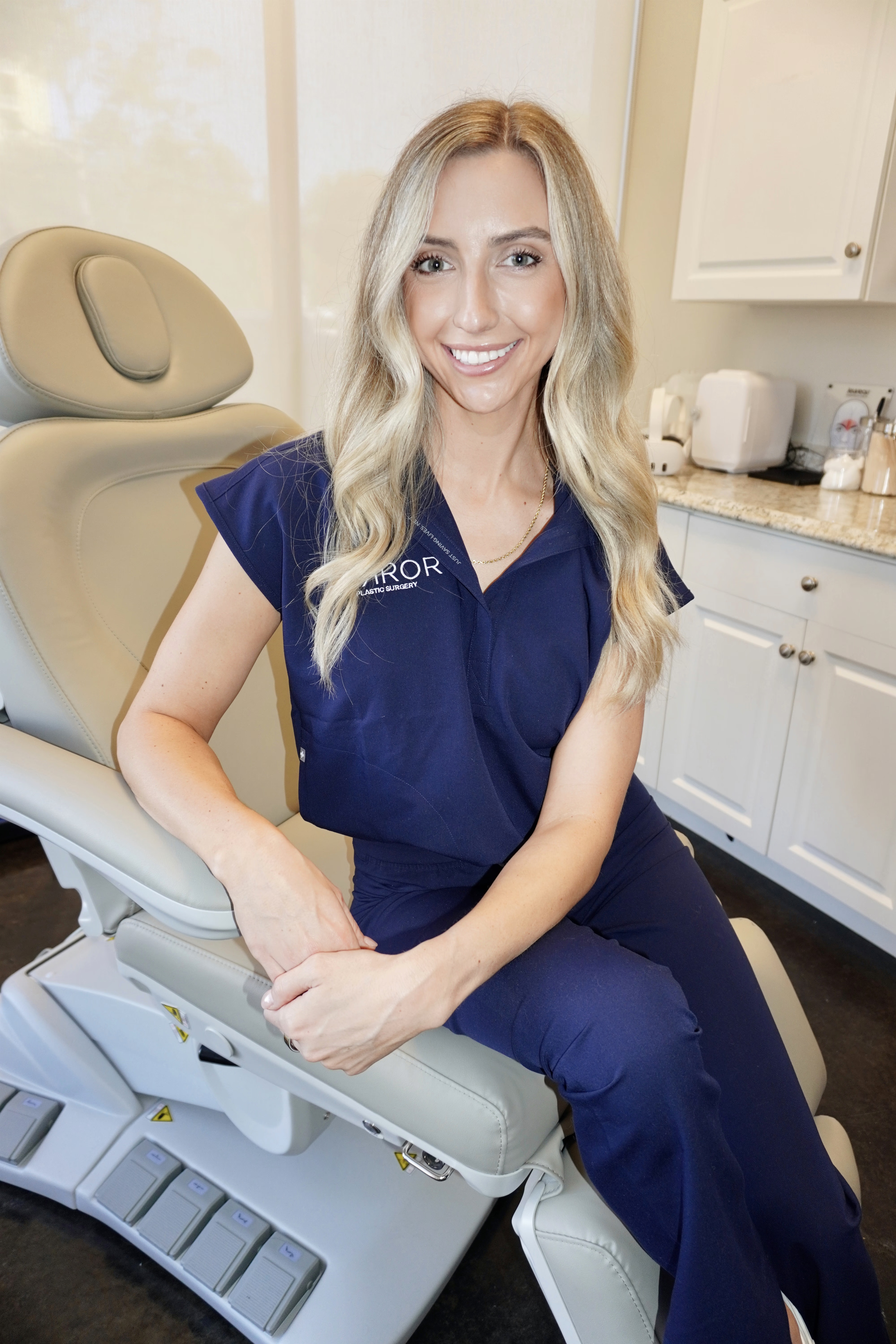
Mirror Plastic Surgery’s initial consultations can last up to an hour and include a top-to-bottom anatomical assessment. The practice follows a supplier-neutral model, so product recommendations reflect patient anatomy and goals, not purchasing agreements or quotas.
Key Decision Factors for Non-Surgical Hip Dip Correction
Before committing to any non-surgical protocol, patients benefit from reviewing three clinical variables that shape suitability and outcomes:
- Injector experience with biostimulatory fillers specifically: Technique, dilution strategy, and injection depth for CaHA or PLLA in the hip region differ substantially from facial filler work.
- Depth of anatomical assessment: Hip dip depth, pelvic bone structure, and overlying soft tissue thickness vary significantly between patients. A full-region assessment, not a single-point injection plan, supports more symmetrical outcomes.
- Realistic maintenance expectations: Radiesse results for hip dip correction last 12–24 months, while biostimulatory PLLA-based results can persist 18–24 months or longer with appropriate maintenance.1 Patients should understand cumulative treatment costs before starting a non-surgical protocol.
Safety and Risks of Off-Label Hip Dip Fillers
Biostimulatory fillers used off-label for hip dips carry a risk of nodule formation, especially when product is injected too superficially into the dermis. Rare infection at the injection site can occur and is usually treatable with antibiotics. These procedures are contraindicated for individuals with relevant allergies, those who are pregnant or breastfeeding, minors, patients with a history of keloid formation, or anyone with active skin infection in the treatment area.
Fillers that are too soft or fluid may migrate from the injection site over time, potentially leading to asymmetry or the need for corrective procedures. Unlike some other injectables, biostimulatory fillers cannot be dissolved after placement, so provider selection, conservative dosing, and careful post-treatment aftercare become non-negotiable.
The FDA regulates dermal fillers as medical devices and has not approved any injectable filler for body contouring. A professional top-to-bottom assessment by a clinician with deep anatomical knowledge remains the primary risk-mitigation tool for patients considering this procedure.
Get an honest evaluation of whether non-surgical hip dip correction fits your anatomy and goals.
Practical Steps Before, During, and After Consultation
Before your consultation:
- Review the FDA’s approved dermal filler list and note that no entry covers hip dip correction.
- Prepare your provider-question checklist (see Step 3).
- Document your hip dip depth, symmetry concerns, and volume goals with photos.
- Research the injector’s specific experience with biostimulatory body contouring, not just facial filler work.
During your consultation:
- Ask for the exact product name, lot number, and off-label disclosure in writing.
- Request a full-region assessment, not a single-point injection plan.
- Confirm the maintenance schedule and realistic cumulative cost before proceeding.
- Verify that informed consent documentation clearly addresses off-label use.
After treatment:
- Follow all post-treatment massage and aftercare protocols precisely.
- Report any nodule formation, asymmetry, or unusual firmness promptly.
- Schedule maintenance appointments within the recommended interval to preserve the collagen framework.
Non-Filler Options and Long-Term Body-Contouring Planning
Fat transfer (fat grafting) is the most reliable option for meaningful, lasting correction of hip dips in suitable candidates. It provides immediate and significant volume from donor sites such as the abdomen, flanks, or inner thighs. Approximately 60–80% of transferred fat survives long-term, with surviving fat generally permanent after three to six months.1 Surgeons can perform fat transfer alongside a Brazilian Butt Lift in the same surgical session.
Surgical outcomes usually last longer than non-surgical protocols, though they involve higher upfront cost, anesthesia, and two or more weeks of recovery with no direct pressure on treated areas.1 Targeted exercises such as squats, lunges, glute bridges, fire hydrants, and clamshells can reduce the visible appearance of hip dips by building gluteal muscle but cannot change the underlying pelvic bone structure.
Hip dip correction planning works best when it considers the full body-contouring picture. At Mirror Plastic Surgery, Ellie’s non-surgical work and Dr. Chandawarkar’s surgical expertise exist under one roof, so patients receive unbiased recommendations across the full spectrum of options.
Frequently Asked Questions
What fillers can I get to fill my hip dips?
The most clinically appropriate non-surgical options for hip dip correction are biostimulatory fillers, specifically calcium hydroxylapatite (Radiesse) and AlloClae. These agents provide immediate structural support and longer-term collagen stimulation, which suits the volume demands of the hip region better than many other filler categories. All uses of these products for hip dip correction are off-label, meaning the FDA has not evaluated or approved them for this specific indication. A qualified injector with demonstrated experience in biostimulatory body contouring should conduct a full anatomical assessment before recommending any product.
Which fillers are FDA approved?
The FDA maintains an official list of approved dermal fillers, each with a specific labeled indication, anatomical site, and injection depth. Radiesse holds FDA approval for subdermal implantation to correct moderate to severe facial wrinkles and folds such as nasolabial folds and for restoration of facial fat loss in HIV patients. As noted earlier, no dermal filler holds FDA approval for gluteal body-contouring use. The FDA also explicitly warns against injectable silicone for any aesthetic purpose. Verifying a product’s approval status means checking the exact product name against the FDA’s device records, not relying on a clinic’s marketing language.
Is it safe to get fillers in your hip dip?
Off-label biostimulatory filler use in the hip region carries a defined risk profile that provider expertise can meaningfully reduce but not eliminate. The primary risks include nodule formation when product is injected too superficially, rare infection, temporary swelling and bruising, and possible asymmetry if dosing is aggressive. Because biostimulatory fillers cannot be dissolved after placement, conservative dosing, precise injection depth, and strict post-treatment aftercare are essential. Safety closely tracks with injector experience, anatomical knowledge, and the depth of the pre-treatment assessment. Patients should receive explicit informed consent documentation acknowledging the off-label nature of the procedure before treatment begins.
What is the longest lasting hip dip filler?
Among non-surgical options, biostimulatory fillers offer the longest duration of results for hip dip correction. Poly-L-lactic acid (PLLA)-based products produce results that typically last 18–24 months, with some clinical data suggesting durability up to five years depending on individual biology, vial count, and maintenance adherence. Radiesse (calcium hydroxylapatite) results for hip dip correction last 12–24 months.1 Both require periodic maintenance treatments to sustain the collagen framework built during the initial series. For patients seeking permanent or near-permanent correction, surgical fat transfer, where 60–80% of transferred fat survives long-term, represents the most durable outcome, though it involves surgical recovery and higher upfront cost.1
Conclusion: Use This Framework to Vet Hip Dip Fillers
The five steps above, confirming FDA status directly, identifying appropriate off-label product categories, preparing a provider checklist, recognizing red-flag practices, and applying local selection criteria, create a repeatable framework for any patient considering hip dip correction. The off-label reality outlined in Step 1 remains unchanged. What changes with rigorous verification is the quality of the provider, the depth of the assessment, and the honesty of the informed consent process.
This verification framework is exactly what Mirror Plastic Surgery’s concierge model delivers. The hour-long assessments and supplier-neutral approach described in Step 5 help ensure that recommendations serve patient anatomy, not practice economics.
Book a consultation with Ellie at Mirror Plastic Surgery’s St. Petersburg location to receive a personalized, anatomy-first evaluation of your hip dip correction options.
Disclaimer: Results may vary from person to person. Editorial content, before and after images, and patient testimonials do not constitute a guarantee of specific results.
1 Results may vary from person to person. Editorial content, before and after images, and patient testimonials do not constitute a guarantee of specific results.