
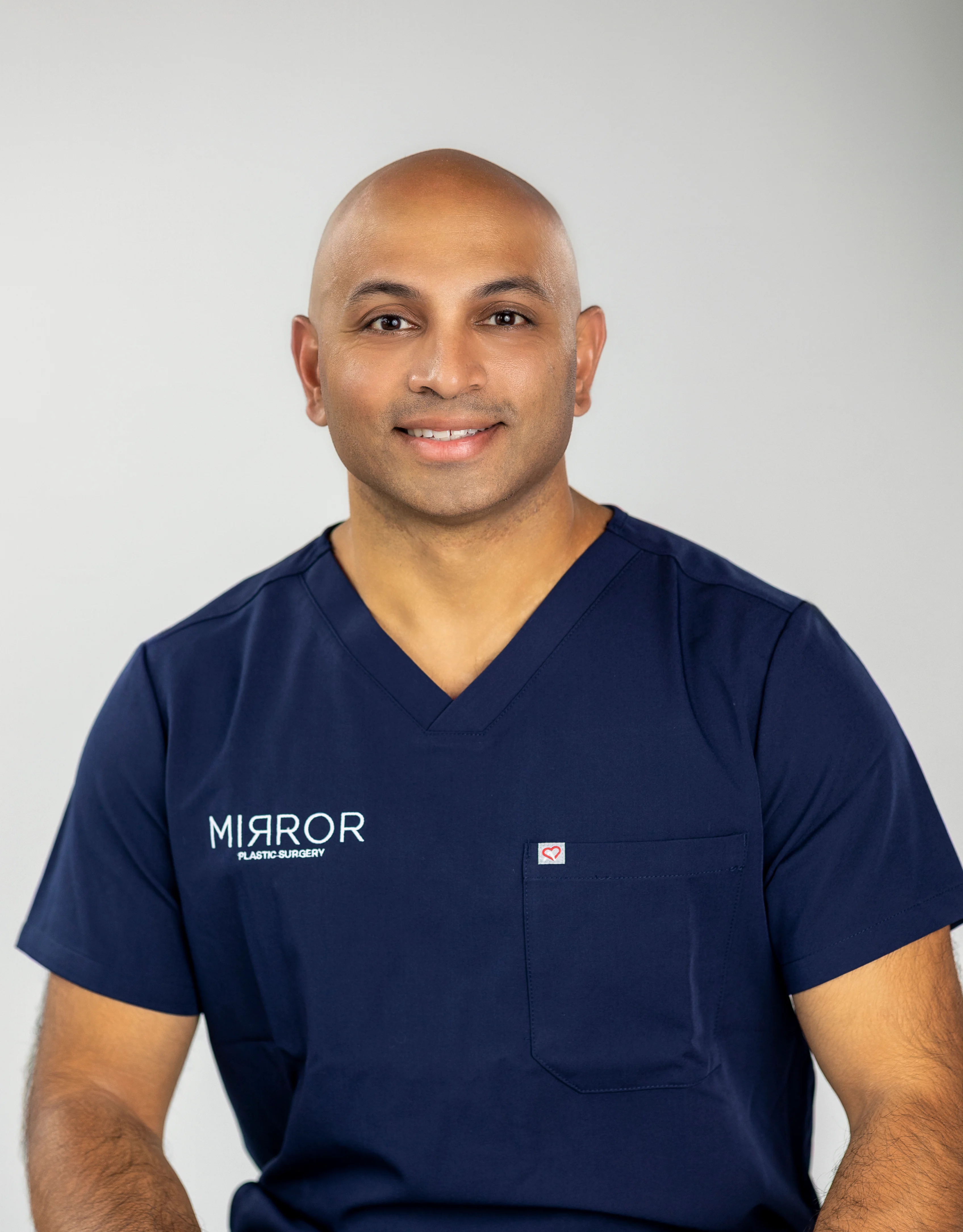
Written by: Dr. Akash Chandawarkar, Board Certified Plastic Surgeon, Mirror Plastic Surgery | Last updated: September 9, 2026
Key Takeaways
- Hip dips reflect normal skeletal structure and do not change with diet or exercise. Injectable biostimulatory fillers are the only non-surgical way to smooth this contour.
- Safety and results depend on provider expertise. Board-certified plastic surgeons with body-contouring training should perform hip dip filler using products such as Sculptra, Radiesse, or AlloClae.
- A proper consultation includes extended anatomical assessment, honest candidacy evaluation, and a personalized treatment plan instead of a brief sales-focused visit.
- Clinical data shows low adverse-event rates when hip dip filler is placed correctly in the subcutaneous plane with blunt cannulas, which makes it significantly safer than surgical BBL.
- Schedule your personalized assessment at Mirror Plastic Surgery near St. Petersburg to explore safe, evidence-based hip dip filler options with Dr. Akash Chandawarkar.
Hip Dip Anatomy And Why Fillers Actually Work
Hip dips come from bone structure, specifically the relationship between the iliac crest and the greater trochanter of the femur. They do not result from weight, posture, or fitness level. Diet, exercise, and body-contouring technologies such as CoolSculpting cannot change bone width or the skeletal gap that creates this depression.
The lateral trochanteric depression sits in an area with naturally thin subcutaneous fat. Targeted exercises cannot selectively add fat there. Dermal fillers or surgical fat grafting are the only physical methods that can smooth the lateral contour. Injectable filler is the only non-surgical correction method. It works by adding volume to the subcutaneous layer above the muscle fascia, which restores a smoother, more continuous silhouette from hip to thigh.
Safe Hip Dip Treatment Options And Products To Avoid
Only certain fillers are appropriate for the hip dip area. No filler currently holds FDA approval for cosmetic volume in the hips or buttocks in the United States, so all use in this region is off-label. Experienced board-certified providers rely on biostimulatory fillers that stimulate the body’s own collagen production instead of simply displacing tissue with gel. Large-volume use of standard hyaluronic acid fillers is not considered safe practice for nonsurgical BBL, including the hip region.
Mirror Plastic Surgery offers three evidence-based options for hip dip correction:
- Sculptra (Poly-L-Lactic Acid): Sculptra is the most popular non-surgical option for hip dips. It stimulates the body’s own collagen production over 3–6 months. Results develop gradually and typically last 2–3 years.1 Proper dilution protocols are essential to minimize nodule risk. Dr. Akash follows these protocols rigorously.
- Radiesse (Calcium Hydroxylapatite): Radiesse provides immediate volume from its gel carrier and also stimulates collagen. Results usually last 12–18 months.1 Providers often use it in a hyperdilute form for body-contouring applications.
- AlloClae (Adipose-Derived Filler): AlloClae uses donated human fat tissue to encourage natural fat cell regeneration. This option works particularly well for hip dip correction in patients who want a regenerative, tissue-compatible approach.
Critically, dangerous products such as illegal silicone, PMMA, and unregulated “hydrogel” shots can migrate and cause chronic inflammation, hardened lumps, and serious infection. Therefore, any provider offering these substances should be avoided entirely.
Dr. Akash serves on advisory boards for Merz Aesthetics (Radiesse) and Tiger Aesthetics (AlloClae), which gives him firsthand expertise with these products at the clinical development level. His recommendations always follow your anatomy and goals rather than sales targets.
Schedule a hip dip filler consultation to discuss which product best matches your anatomy and goals.
What A Hip Dip Filler Consultation Looks Like At Mirror Plastic Surgery
A hip dip consultation at Mirror Plastic Surgery follows a safety-first, education-focused format that differs from many high-volume med spas. Once you understand the product options, the next step is a consultation to determine which one fits your anatomy.
- Extended Consultation Time: Appointments last up to one hour, which allows thorough discussion of every concern before any treatment decision.
- Top-To-Bottom Anatomical Assessment: Dr. Akash evaluates overall anatomy, including waist, hips, buttocks, and thighs, to plan balanced, harmonious results that complement your full body contour.
- Honest Candidacy Evaluation: If filler does not match your anatomy or goals, Dr. Akash explains why and may recommend against treatment or suggest alternative options.
- Product Education: You receive clear explanations of why specific products suit your tissue type, along with a direct discussion of risks, benefits, and expected timelines.
- Personalized Treatment Planning: Number of sessions, product selection, and expected results are mapped to your unique anatomy. Each plan is customized rather than standardized.
This approach reflects Mirror Plastic Surgery’s core philosophy of concierge medicine. The practice limits daily procedures so the clinical team can focus fully on each individual patient instead of moving quickly from room to room.
Request your personalized hip dip assessment at Mirror Plastic Surgery in St. Petersburg.
The Safety Science Behind Hip Dip Fillers
Hip dip filler safety concerns deserve clear, evidence-based answers. Current clinical data supports a favorable safety profile when trained providers use correct technique.
A 2026 multicenter retrospective study of 498 patients treated with Sculptra (PLLA) in non-facial areas across nine U.S. aesthetic clinics reported treatment-related adverse events in only 6.6% of subjects, mostly mild bruising, with no serious adverse events. The gluteal region, including hip dips, was the most commonly treated area and represented 60.3% of all sessions.
The vascular anatomy of the lateral hip is favorable for injection compared with the deep gluteal region. The lateral hip contains tiny superficial vessels that average under 0.9 millimeters in diameter. In contrast, the inferior gluteal vein in deep muscular planes can reach 13.65 millimeters. This difference explains why surgical BBL carries higher risk than lateral hip filler when both are performed correctly.
This safety advantage depends on precise anatomical knowledge and proper technique. Safe hip dip filler requires placement strictly in the subcutaneous fat layer above the muscle fascia. Providers use a long blunt-tipped cannula that pushes blood vessels aside instead of puncturing them. Dr. Akash’s surgical training gives him detailed command of subdermal anatomy, which supports safer injection planning and execution.
Hip Dip Filler Vs. BBL For St. Petersburg Patients
Many patients near St. Petersburg weigh hip dip filler against Brazilian Butt Lift surgery. Given the safety advantages of filler over surgery, it helps to compare both options side by side before deciding.
| Factor | Hip Dip Filler | Surgical BBL |
|---|---|---|
| Invasiveness | Non-surgical injection, no incisions or general anesthesia | Surgery under general anesthesia, typically 3–4 hours |
| Downtime | Most patients return to normal activity within 1–2 days | Return to light activity in 2–3 weeks, sitting restrictions for up to 6 weeks |
| Results Timeline | Sculptra results develop gradually over 3–6 months | Visible early, with final results at 3–6 months |
| Longevity | Results last 1–3 years depending on product, with maintenance sessions1 | About 60–70% of transferred fat survives permanently1 |
| Candidacy | Works well for lean patients who lack sufficient donor fat for surgery | Requires adequate donor fat; BMI below 20–21 often excludes patients |
| Mortality Risk | No surgical mortality risk when performed correctly in the subcutaneous plane | Historically estimated at 1 in 3,000 to 1 in 15,000 due to pulmonary fat embolism |
Hip dip filler offers minimal downtime and avoids surgical mortality risk, while BBL can provide permanent volume changes at the cost of longer recovery and higher risk. Dr. Akash performs both non-surgical hip dip filler and surgical body-contouring procedures. During consultation, he helps each patient determine which approach fits their anatomy, goals, and risk tolerance.
Discuss filler versus BBL with Dr. Akash and choose the approach that aligns with your priorities.
How To Choose A Qualified Hip Dip Filler Provider
Provider selection is the most important safety decision you will make. Use the following checklist before committing to any injector for hip dip filler in or near St. Petersburg:
- Board Certification: Verify ABPS certification. The American Board of Plastic Surgery is the only board recognized by the American Board of Medical Specialties (ABMS) for plastic surgery. Confirm at abplasticsurgery.org. The title “cosmetic surgeon” does not guarantee specific training.
- Specialized Body-Contouring Training: Skill with lip filler does not automatically translate to safe hip dip injection. Ask about specific body-contouring training and case volume.
- Product Selection: Confirm that the provider uses biostimulatory fillers such as Sculptra or Radiesse, or regulated products like AlloClae, and avoids unregulated silicone, PMMA, or “hydrogel” substances.
- Facility Standards: Procedures should take place in a medical facility accredited by AAAASF, AAAHC, or the Joint Commission, with clear emergency protocols.
- Red Flags To Avoid: Extremely low prices, high-pressure sales tactics, unverifiable credentials, vague answers about technique, and procedures offered in non-medical settings all signal elevated risk.
Dr. Akash meets every criterion on this list. His ABPS board certification and training at Harvard, Johns Hopkins, and MEETH/Lenox Hill provide the surgical understanding of anatomy that safe hip dip filler requires. His medical innovation training at Stanford supports thoughtful adoption of new technologies. His previously mentioned advisory roles with Merz Aesthetics and Tiger Aesthetics further underscore his product expertise. His practice philosophy, described earlier, ensures you receive unhurried, individualized attention.
Verify your provider’s credentials in person by scheduling a consultation with Dr. Akash.
Frequently Asked Questions About Hip Dip Filler In St. Petersburg
How Much Does Hip Dip Filler Cost In St. Petersburg?
Cost depends on the number of vials, the product selected, and your unique anatomy. Shallower depressions require fewer vials, while deeper or wider dips require more. During your consultation at Mirror Plastic Surgery, you receive a personalized quote based on a thorough anatomical assessment. Pricing reflects the right amount of the right product for your anatomy rather than volume-based upselling.
Is Hip Dip Filler Painful?
Most patients describe mild discomfort during injection rather than significant pain. Dr. Akash uses blunt-tipped cannulas, which push tissue aside instead of puncturing it, and this approach minimizes trauma. Numbing agents further support comfort throughout the procedure. Many patients describe the sensation as pressure.
How Long Does A Consultation Take?
Consultations at Mirror Plastic Surgery typically last up to one hour, which is longer than the industry standard. This time allows for a detailed anatomical assessment, a full discussion of your goals and concerns, an honest candidacy evaluation, and a personalized treatment plan. You leave with clear answers and a specific roadmap.
When Will I See Results?
With Sculptra, early changes usually appear at approximately 4–6 weeks.1 Results continue to build and reach full effect at 3–6 months after treatment.1 AlloClae, which uses donated human fat tissue to encourage fat cell regeneration, may follow a different timeline. During consultation, Dr. Akash explains the expected course based on your chosen product and treatment plan.
How Many Sessions Will I Need?
Most patients need 1–3 sessions depending on hip dip depth, product choice, and desired outcome.1 The initial consultation includes a thorough anatomical assessment that informs this plan. Before any treatment begins, Dr. Akash maps out the number of sessions and expected intervals so you understand the full process.
Your Next Step Toward Confident Hip Contours
Hip dip filler can safely smooth the lateral hip contour when a qualified, board-certified provider uses appropriate biostimulatory products and precise anatomical technique.1 In St. Petersburg, Mirror Plastic Surgery offers a highly credentialed injector, a concierge consultation experience, and a safety-first philosophy that prioritizes your well-being.
Some patients benefit most from Sculptra, Radiesse, or AlloClae, while others may be better served by surgical or alternative approaches. Dr. Akash provides honest, evidence-based guidance tailored to your anatomy and goals, without pressure to pursue a specific procedure.
Schedule your hip dip filler consultation at Mirror Plastic Surgery in St. Petersburg.
Book Your Hip Dip Filler Consultation In St. Petersburg
Patients ready to explore hip dip filler with one of St. Petersburg’s most qualified injectors can request a consultation online at Mirror Plastic Surgery. Call or text 727-361-6515 to schedule your appointment. Visit the practice at 780 4th Ave S, St. Petersburg, FL 33701.
Disclaimer: Results may vary from person to person. Editorial content, before and after images, and patient testimonials do not constitute a guarantee of specific results.
1 Results may vary from person to person. Editorial content, before and after images, and patient testimonials do not constitute a guarantee of specific results.