Written by: Ellie Pranckevicius, FNP-BC, Aesthetic Nurse Practitioner & Aesthetic Injector | Facial Restoration & Regenerative Injectable Specialist, Mirror Plastic Surgery | Last updated: July 8, 2026
Key Takeaways for BBL in Tampa
- Expert BBL pricing in Tampa reflects provider credentials, facility accreditation, liposuction volume, fat-processing technology, and compliance with Florida’s ultrasound-guidance mandate.
- Published price ranges vary widely because each patient’s anatomy, goals, and treatment plan are unique. A personalized consultation is the only reliable way to obtain an accurate quote.
- Surgical BBL costs typically range from $8,000 to $15,000+ at expert-level practices.1 Non-surgical options using Radiesse or alloClae are priced according to product volume and session count.
- Choosing a provider solely on price increases the risk of complications. Board certification, accredited facilities, and ultrasound guidance are non-negotiable safety standards.
- At Mirror Plastic Surgery, every BBL inquiry, surgical or non-surgical, begins with a comprehensive anatomical assessment. Schedule a consultation with Ellie to receive a personalized treatment plan.
Why Expert BBL Tampa Prices Vary
The phrase “expert BBL Tampa prices” covers a wide spectrum because true expertise increases cost. The 2022 ASPS/ASAPS/ISAPS Practice Advisory on Gluteal Fat Grafting established subcutaneous-only injection with real-time ultrasound guidance as the standard of care. Surgeons who follow this standard invest in ultrasound equipment, advanced training, and accredited facilities, and those investments appear in their fees. Suspiciously low prices often signal inadequate safety standards, unqualified staff, or non-accredited facilities rather than genuine value.
Florida raised the safety bar further. In July 2023, Florida became the first state to legally mandate ultrasound guidance for all BBL procedures under HB 1471. Providers who comply with this law carry additional operational costs that appear in their pricing. That compliance directly protects patient safety and should never be optional.
At Mirror Plastic Surgery, every surgical BBL inquiry receives a top-to-bottom anatomical assessment before any treatment plan or quote. Schedule your initial evaluation with Ellie to explore non-surgical options or to be directed to the appropriate surgical pathway.
BBL Tampa Cost Breakdown
Cost structures for surgical BBL in Tampa mirror national patterns with some regional variation. Florida’s average BBL cost closely matches the national average, with a typical range of $3,000 to $12,000. Expert-level providers in competitive markets often charge above that range. The surgeon’s fee usually represents the largest single line item and rises with board certification, experience, and reputation.
The component breakdown for a surgical BBL generally includes:
- Surgeon fee, which is the largest variable and ties directly to credentials and case volume
- Accredited facility fee, since reputable practices use centers that meet rigorous safety standards
- Anesthesia, typically administered by a board-certified anesthesiologist or CRNA
- Supplies, compression garments, and post-operative care
- Advanced technology premiums, because VASER liposuction carries a per-area premium over traditional tumescent liposuction and is preferred for BBL due to better fat cell viability
Facility type is the biggest cost driver for BBL because outpatient centers often charge 30–50% less than hospitals. However, that price difference means little if the facility lacks proper accreditation. Accreditation status, not price alone, separates safe settings from unsafe ones.
Non-Surgical BBL Tampa Price 2026
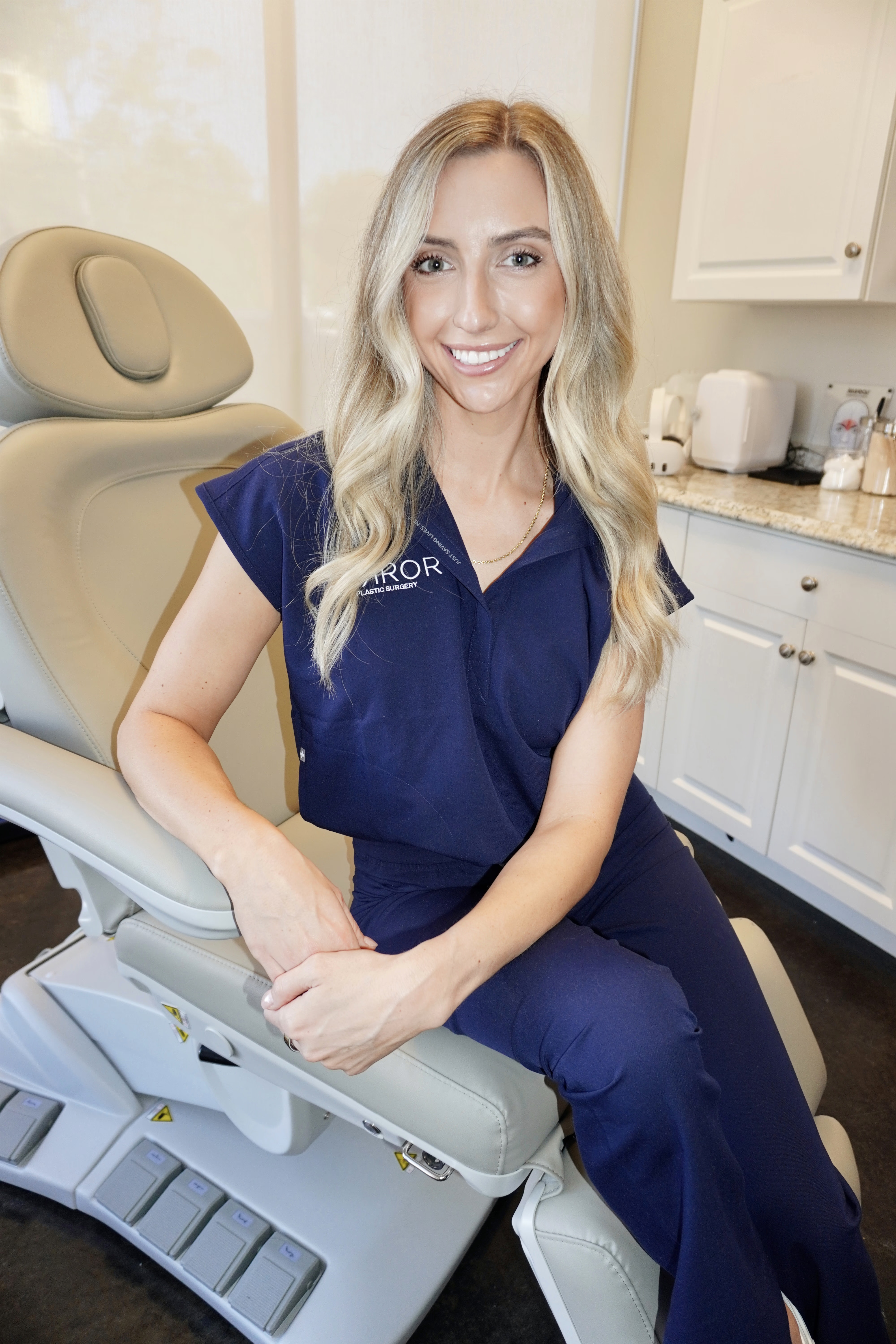
Many patients want gluteal enhancement without surgery, anesthesia, or extended recovery, so non-surgical BBL offers a separate pathway with its own pricing structure. Non-surgical BBL in Tampa uses biostimulatory injectables, primarily Radiesse and alloClae, to reshape, volumize, and smooth the gluteal region without liposuction, general anesthesia, or extended downtime.1 At Mirror Plastic Surgery, Ellie Pranckevicius, FNP-BC, performs this service exclusively. Her dual background in esthetics and advanced nursing gives her a layered understanding of surface and subdermal anatomy that is uncommon among injectors.
Ellie holds a Bachelor’s in Health Science from Boston University, completed a 600-hour hands-on aesthetics licensure program, and earned both her Bachelor’s and Master’s in Nursing from the University of South Florida. Four years in the Neuroscience ICU at Tampa General Hospital sharpened her clinical judgment and physiological insight before she transitioned fully into aesthetic medicine. Her non-surgical BBL approach uses regenerative medicine principles and adapts to each patient’s anatomy and goals.
Key variables that shape a non-surgical BBL quote include:
- Total product volume required based on anatomy and desired outcome
- Number of sessions, since a typical treatment plan uses multiple sessions spaced weeks apart
- Specific concerns addressed, such as hip-dip correction, cellulite smoothing, symmetry refinement, or overall projection
- Maintenance cadence, because biostimulatory filler results last 2–3 years and maintenance sessions extend longevity1
AlloClae, an FDA-registered injectable made from donor-derived adipose tissue, is performed in-office under local anesthesia in 30 to 60 minutes, and most patients return to normal activity within one to two days. Radiesse, a calcium hydroxylapatite biostimulator, triggers the body’s own collagen production for gradual, natural-looking volume. Neither product requires a donor fat harvest, so patients without sufficient fat for surgical liposuction can still pursue gluteal enhancement.
Because product volume, session count, and anatomy differ for every patient, no published figure can accurately represent individual cost. Get your personalized non-surgical BBL assessment from Ellie to receive a precise quote.
BBL Revision Cost in Tampa
Revision BBL ranks among the most technically demanding procedures in body contouring. BBL revision surgery must address scar tissue and altered anatomy from prior procedures, and costs are often higher than the initial procedure. Scar tissue disrupts normal tissue planes, compromises fat viability, and reduces the predictability of fat survival, which increases complexity and cost.
Common reasons revisions become necessary include:
- Inadequate initial fat survival due to poor technique or non-ultrasound-guided placement
- Contour irregularities from uneven liposuction or asymmetric fat grafting
- Volume loss from significant weight fluctuation after surgery
- Complications from procedures performed at non-accredited facilities by under-credentialed providers
The South Florida data referenced earlier, which showed that most BBL fatalities occurred at budget clinics, highlights the value of choosing a qualified provider from the start. An anatomy-first approach with proper credentialing, ultrasound guidance, and individualized planning offers the strongest protection against future revision. At Mirror Plastic Surgery, ultrasound-guided, subcutaneous-plane fat injection represents the 2026 baseline standard, not a paid upgrade.
How Much Does a BBL Cost in Tampa Florida
Patients searching “how much does a BBL cost in Tampa Florida” encounter a wide range, from budget-clinic figures to expert-level all-inclusive quotes. In 2026, Brazilian butt lift procedures in comparable markets typically range from $8,000 to $15,000+, with pricing driven by fat transfer volume and the number of combined liposuction areas. The lowest advertised figures rarely reflect the full cost of a safely performed procedure by a board-certified surgeon in an accredited facility.
Tampa has seen a 13.4% year-over-year increase in BBL search volume, so more providers with varying qualifications now compete for that demand. Price alone cannot filter quality. Credential verification, facility accreditation, and consultation depth provide more reliable ways to evaluate options.
Comparing Surgical and Non-Surgical BBL Paths
The table below compares key variables across surgical and non-surgical BBL pathways. Dollar figures are not included because individual quotes depend on anatomy, goals, and provider assessment.
| Variable | Surgical BBL | Non-Surgical BBL (Radiesse / alloClae) |
|---|---|---|
| Liposuction Volume | 300–1300 cc of fat transferred per cheek for surgical BBL, with averages often 500–1000 cc depending on surgeon and patient factors1. Donor-site count directly increases operating time and cost. | No liposuction required, which makes this suitable for patients without adequate donor fat. |
| Facility Fees | Accredited surgical facility required, which adds meaningfully to total cost. | Performed in-office under local anesthesia, with no surgical facility fee. |
| Provider Credentials | ABPS board certification and ASPS membership are the primary safety predictors. | Advanced nursing credentials, anatomical training, and injector-specific expertise, such as an FNP-BC with dual esthetics and nursing background. |
| Product Type | Patient’s own purified fat, with a 60–70% fat survival rate at one year1. | Radiesse, a calcium hydroxylapatite biostimulator, or alloClae, an FDA-registered donor-derived adipose injectable. |
| Number of Sessions | Single surgical procedure, and results stabilize at 3–6 months1. | Typically 2–3 sessions spaced weeks apart, with maintenance every 1–3 years depending on product. |
Surgical BBL delivers dramatic volume transformation, while non-surgical options focus on moderate, natural-looking enhancement1. Neither pathway fits every patient. The right choice depends on anatomy, candidacy, goals, and risk tolerance, which your provider evaluates during a thorough consultation.
Concierge Care Versus High-Volume BBL Clinics
The difference between a concierge practice and a high-volume clinic affects safety and outcomes, not just experience. Mirror Plastic Surgery limits surgical procedures to one or two per day so the full clinical team can focus on each patient before, during, and after surgery. High-volume practices may perform five to ten surgeries daily, which divides attention and increases fatigue.
Data shows surgeons performing three or fewer BBLs per day have lower complication rates, while high-volume budget surgeons performing more than three to four per day had the worst outcomes in South Florida data. Limiting daily volume allows the team to maintain focus, avoid fatigue-related errors, and devote adequate time to each patient’s anatomy. The concierge model functions as a safety architecture built on that principle.
Consultations at Mirror Plastic Surgery can last up to one hour and include a comprehensive top-to-bottom assessment that covers anatomy, emotional motivations, long-term goals, and realistic outcomes. Patients leave with a treatment plan grounded in evidence rather than a sales script. Non-surgical patients working with Ellie receive the same depth of engagement, and she often advises patients to delay or decline treatment when it does not serve their goals.
Long-Term BBL Results and Maintenance
Long-term results for both surgical and non-surgical BBL depend on weight stability, lifestyle, and maintenance habits. Body contouring results remain long-lasting when patients maintain stable weight, because removed fat cells do not regenerate, although significant weight gain or natural aging can change outcomes over time.1
For non-surgical patients, Ellie treats maintenance like a dentist treats oral health. Professional treatments create the foundation, and consistent at-home care preserves results. She explains the physiology behind each treatment so patients can decide on the timing and frequency of maintenance sessions with confidence. The 2026 trend toward wellness-integrated aesthetic planning, which treats procedures as part of an overall self-care plan, aligns directly with Mirror Plastic Surgery’s philosophy.
BBL After 40: Age and Candidacy
Age alone does not disqualify a patient from BBL, whether surgical or non-surgical. Skin quality, tissue laxity, fat availability for surgical candidates, overall health, and realistic goals matter more than birth year. The 2026 body-contouring aesthetic favors anatomy-preserving results that look unmistakably like the patient’s own body, simply more refined. Providers can achieve that look across a wide age range when they individualize their approach.
Patients in their 40s and 50s often notice volume loss, skin texture changes, or hip-dip concerns. Non-surgical biostimulatory options like Radiesse and alloClae can address these issues without the recovery demands of surgery. A thorough consultation evaluates candidacy based on anatomy and health rather than age alone.
Risks of Choosing BBL Based Only on Price
Unqualified surgeons working in high-volume, heavily discounted centers have caused a significant number of BBL fatalities and complications, more than nearly any other cosmetic procedure. The mechanism is well documented. Fat injected into the muscle rather than the subcutaneous layer can enter the bloodstream and cause life-threatening fat embolism.
Price-driven decision-making introduces specific risks:
- Non-accredited facilities that lack emergency protocols and qualified staff
- Providers without ABPS certification or equivalent credentials performing complex fat-transfer procedures
- Excessive daily surgical volume that reduces per-patient attention and increases fatigue-related error (as discussed in the concierge medicine section)
- Absence of ultrasound guidance, which Florida law now mandates
- Higher revision likelihood, which carries its own elevated cost and complexity
Safety-first pricing ensures that sterile techniques are followed, medication is formulated correctly, and any complications receive professional management.
How to Evaluate True BBL Expertise
Evaluating a BBL provider requires more than scanning before-and-after galleries. A structured credential review should include:
- Board certification: ABPS certification is the only ABMS-recognized credential for plastic surgery and requires a minimum of 3 years of Plastic Surgery Training for Independent programs and 6 years for Integrated programs. Verify status at abplasticsurgery.org.
- Facility accreditation: BBL procedures should take place in facilities accredited by AAAHC, Quad A, The Joint Commission, or the Institute of Medical Quality.
- Ultrasound guidance compliance: Florida law mandates ultrasound guidance for all surgical BBL procedures. Ask directly whether the practice uses and documents it.
- Daily surgical volume: Practices that limit themselves to one to two procedures per day show a structural commitment to per-patient safety.
- Consultation depth: A provider who spends less than 15 minutes with a new patient before complex body contouring does not practice at an expert level.
- Injector credentials for non-surgical care: Advanced nursing licensure, anatomical training, and documented experience with biostimulatory injectables serve as key markers.
At Mirror Plastic Surgery, Dr. Akash Chandawarkar oversees surgical procedures. He is a Harvard-educated physician, Johns Hopkins-trained plastic surgeon, and fellowship-trained aesthetic surgeon at Manhattan Eye Ear & Throat Hospital/Lenox Hill Hospital. Ellie Pranckevicius, FNP-BC, performs non-surgical BBL and brings experience in ICU nursing, esthetics licensure, and advanced injector training.
Frequently Asked Questions
What is the difference between a surgical BBL and a non-surgical BBL?
A surgical BBL uses liposuction to harvest fat from donor areas of the patient’s own body, processes that fat, and injects it into the gluteal region under general or IV sedation in an accredited surgical facility. Results can be dramatic and remain long-lasting once fat cells vascularize, although a portion of transferred fat naturally reabsorbs in the months after surgery.1 A non-surgical BBL uses biostimulatory injectables, at Mirror Plastic Surgery this means Radiesse and alloClae, to add volume, smooth cellulite, correct hip dips, and improve symmetry without liposuction, incisions, or general anesthesia. Non-surgical results are more moderate and require periodic maintenance, but involve far less downtime and no surgical risk.1 Candidacy for each pathway depends on anatomy, available donor fat, health status, and individual goals, which your provider reviews during a personalized consultation.
Why does BBL pricing vary so much between providers?
BBL pricing reflects provider credentials, facility accreditation, liposuction volume and donor-site count, fat-processing technology, geographic market, and daily surgical volume limits. A board-certified provider who operates in an accredited facility, uses ultrasound guidance, and limits daily case volume invests more in each patient’s safety, and that investment appears in the fee. Providers advertising prices far below market norms often work in non-accredited settings, lack appropriate board certification, or perform high daily volumes that reduce per-patient attention. For non-surgical BBL, pricing varies based on total product volume, number of sessions, and the injector’s training and anatomical expertise.
How do I know if I am a candidate for non-surgical BBL with Radiesse or alloClae?
Non-surgical BBL candidacy is determined during a comprehensive consultation with Ellie Pranckevicius. Ideal candidates want moderate, natural-looking enhancement such as volume addition, hip-dip correction, cellulite smoothing, or symmetry improvement without surgical recovery. Patients who lack sufficient donor fat for liposuction also fit well with the non-surgical pathway. Ellie uses an anatomy-first approach and evaluates each patient’s gluteal structure, skin quality, and goals before recommending any product, volume, or session plan. She declines or postpones treatment when it does not match a patient’s anatomy or timeline.
What is alloClae and how does it differ from Radiesse for non-surgical BBL?
AlloClae is an FDA-registered injectable derived from donor adipose tissue and designed for body contouring of the buttocks, hip dips, and breasts. Providers perform this treatment in-office under local anesthesia, and most patients return to normal activity within one to two days. Results last one to three years, as noted earlier, with touch-up treatments extending longevity.1 Radiesse is a calcium hydroxylapatite biostimulatory filler that triggers the body’s own collagen production and delivers gradual, structural volume improvement over weeks to months. Both products are available at Mirror Plastic Surgery as part of Ellie’s individualized non-surgical BBL approach, and the choice between them, or a combination, depends on anatomy, goals, and treatment timeline.
How does Mirror Plastic Surgery approach BBL consultations differently from high-volume practices?
Mirror Plastic Surgery follows a concierge medicine model in which consultations can last up to one hour and include a comprehensive top-to-bottom anatomical assessment. The practice limits surgical procedures to one or two per day so the team can focus fully on each patient. Ellie Pranckevicius brings the same depth to non-surgical consultations, taking time to understand emotional motivations, long-term goals, and anatomical realities before suggesting any treatment. The practice remains supplier-neutral, so product recommendations follow patient needs rather than vendor relationships or volume quotas. Patients are encouraged to ask questions and receive direct, honest answers, including clear guidance when a procedure is not appropriate.
Next Steps Toward Personalized BBL Pricing
Expert BBL pricing in Tampa cannot be quoted accurately without a thorough review of your anatomy, goals, and candidacy. Whether you are considering surgical fat transfer, non-surgical biostimulatory injectables with Radiesse or alloClae, or simply deciding which pathway fits you best, a personalized consultation offers a more reliable starting point than a price list.
Mirror Plastic Surgery is located at 780 4th Ave S, St. Petersburg, FL 33701. You can reach the practice by calling or texting 727-361-6515, or by emailing hello@mirrorplasticsurgery.com.
Start with a consultation with Ellie to receive a personalized, anatomy-first evaluation and a transparent treatment plan built around your goals, not a template.
Disclaimer: Results may vary from person to person. Editorial content, before and after images, and patient testimonials do not constitute a guarantee of specific results.
1 Results may vary from person to person. Editorial content, before and after images, and patient testimonials do not constitute a guarantee of specific results.