

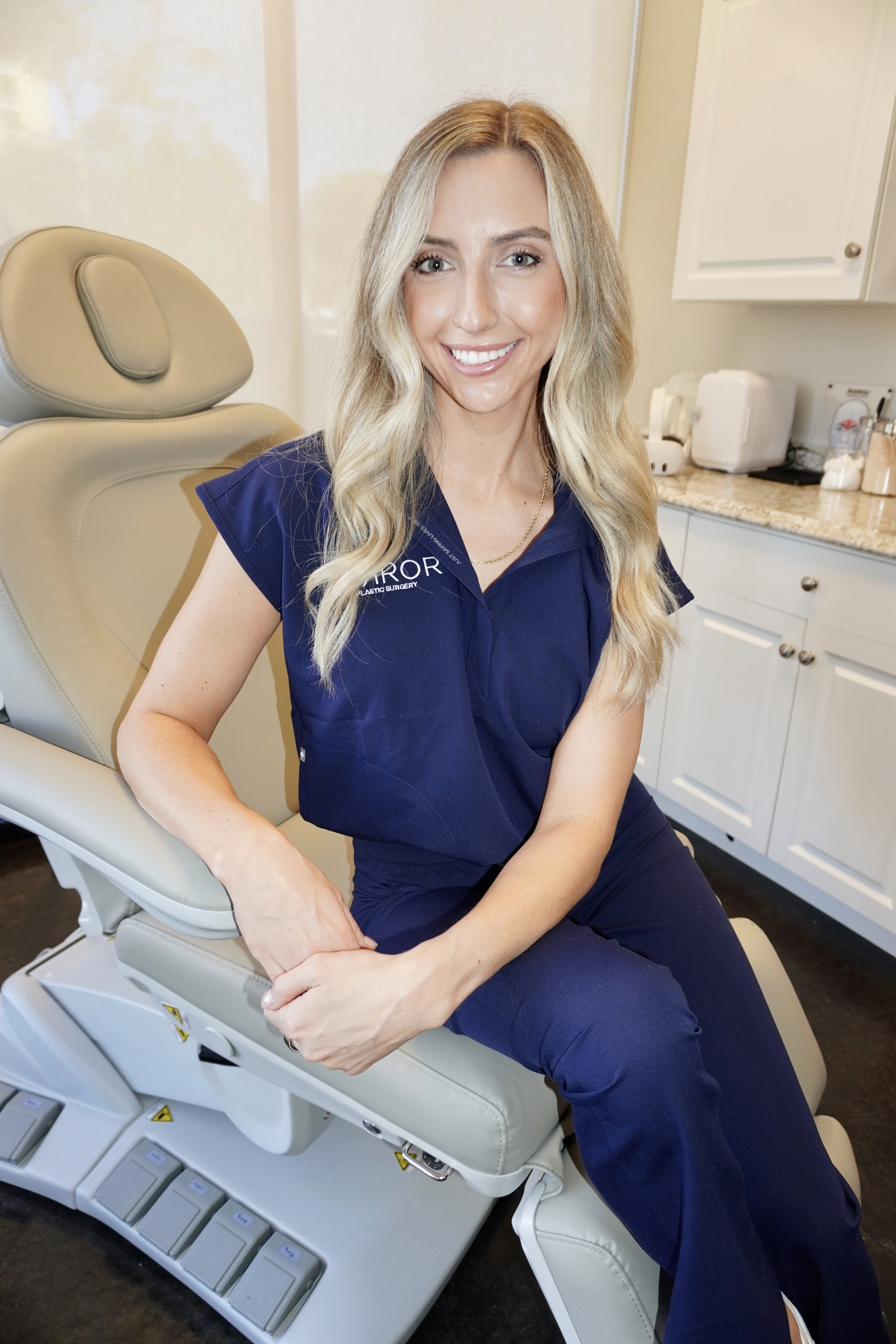
Written by: Ellie Pranckevicius, FNP-BC, Aesthetic Nurse Practitioner & Aesthetic Injector | Facial Restoration & Regenerative Injectable Specialist, Mirror Plastic Surgery | Last updated: July 5, 2026
Key Takeaways
- Florida law requires physician oversight and written protocols for all non-physician injectors of Botox and dermal fillers, and unlicensed individuals are prohibited from performing these procedures.
- Evidence-based neuromodulator selection should match patient anatomy and clinical goals, since all six FDA-approved products show similar safety in trials.
- Biostimulatory fillers like Radiesse stimulate collagen in addition to adding volume, which supports both facial rejuvenation and non-surgical body contouring.1
- Patients should confirm provider credentials, product sourcing from legitimate distributors, and the presence of emergency protocols before any injectable treatment to reduce compliance and safety risks.
- Schedule a personalized assessment at Mirror Plastic Surgery with board-certified injector Ellie Pranckevicius, FNP-BC, under the direct supervision of Dr. Akash Chandawarkar for compliant, anatomy-first care.
Legal Injector Hierarchy in Florida
Florida law establishes a clear hierarchy of injectable authority, and your injector’s place in that hierarchy determines whether your treatment is legally compliant. The table below maps each provider type to their legal scope, supervision requirements, and prescribing authority so you know exactly what to confirm before booking.
| Provider Type | Scope for Injectables | Supervision Requirement | Prescribing Authority | Governing Statute |
|---|---|---|---|---|
| MD / DO | Full independent authority: evaluate, prescribe, inject, delegate | None required | Independent | Florida Statute 458 / 459 |
| ARNP / NP | Evaluate, prescribe, and inject within authorized scope under written protocol with supervising physician | Written protocol with supervising physician, physician need not be on-site but must be available | Under protocol | Florida Statute 464.012 |
| PA | Inject under written delegation agreement that specifically authorizes neuromodulators/fillers | Written supervising physician agreement, documented ongoing oversight required | Under delegation | Florida Statute 458.347 |
| RN | Administer only, cannot prescribe or independently diagnose | Physician order or standing order protocol required, physician must examine patient and write the order | None | Florida Statute 464.003 |
Ellie Pranckevicius holds FNP-BC board certification and operates under a written protocol with Dr. Akash Chandawarkar, which satisfies the ARNP requirements under Florida Statute 464.012. Her dual background includes 600 hours of aesthetics licensure training, a Master of Science in Nursing from the University of South Florida, and four years in the Neuroscience ICU at Tampa General Hospital. This combination places her clinical judgment well above the statutory minimum.
How Ellie Chooses Among FDA-Approved Neuromodulators
Six botulinum toxin type A products currently hold FDA approval for aesthetic use. Clinical trials and FDA-reviewed data demonstrate similar safety and efficacy profiles across all six when appropriate dosing and injection technique are used.
- Botox (onabotulinumtoxinA): The longest-established product, with onset typically within several days and duration of 3–4 months for glabellar lines per FDA prescribing information.1
- Dysport (abobotulinumtoxinA): May have a faster onset for glabellar lines, with broadly similar duration at 3–4 months.1
- Xeomin (incobotulinumtoxinA): Formulated without accessory proteins (naked toxin), with efficacy and duration comparable to other type A products at 3–4 months.1
- Daxxify (daxibotulinumtoxinA): Pivotal trials reported a median duration of approximately six months for glabellar lines at 40 units, using a proprietary peptide stabilizer at roughly double the common Botox dose.1
- Jeuveau (prabotulinumtoxinA): Demonstrated efficacy and safety for glabellar lines consistent with the neuromodulator class, with typical duration of 3–4 months.1
All six carry a very low immunogenicity risk per their FDA prescribing information and published literature. Product choice should follow your anatomy, treatment area, and desired duration rather than brand loyalty or supplier incentives. Mirror Plastic Surgery uses a supplier-neutral model, so Ellie selects from the full range of FDA-approved neuromodulators based on patient-specific clinical factors.
Why Mirror Uses Biostimulatory Fillers for Non-Surgical BBL
Traditional fillers work by physically occupying volume and attracting water molecules. Their primary advantage is reversibility, which makes them well-suited for facial areas where precise, adjustable volume is the goal. For body contouring applications, particularly the gluteal region, traditional fillers are not considered safe practice because of volume requirements and vascular anatomy.
That safety limitation has driven the shift toward biostimulatory fillers for non-surgical body contouring. Radiesse (calcium hydroxylapatite) stimulates the body’s own collagen production in addition to providing immediate structural support, which produces results that last beyond the product’s physical presence.1 This collagen-induction mechanism makes Radiesse effective for facial volumization, hand rejuvenation, décolleté, and non-surgical gluteal contouring.1 For non-surgical BBL applications, Radiesse and AlloClae represent the supported and safe options at Mirror Plastic Surgery.
Ellie’s non-surgical BBL approach uses biostimulatory fillers to refine shape, smooth cellulite, reduce the appearance of stretch marks, and address hip dips.1 Treatment plans adjust to whether a patient wants significant volume, subtle enhancement, or asymmetry correction. This anatomy-first methodology, grounded in regenerative medicine principles, mirrors the full-assessment philosophy she applies to facial treatments.
Red Flags When Choosing a Florida Med Spa
The rapid expansion of the med spa industry has created environments where compliance and clinical rigor vary significantly. A 2023 study of Chicago med spas found more than 80% did not have a doctor on-site, and as of April 18, 2024, CDC reported 22 people from 11 states had harmful reactions after receiving botulinum toxin injections from unlicensed providers or counterfeit products, with some patients requiring hospitalization.
The following checklist shows specific practices that should prompt further scrutiny before you proceed with injectable treatment:
- No documented physician oversight. Any injectable program without a named medical director and written supervision protocols violates Florida law.
- Injector credentials not disclosed upfront. Patients have the right to know whether their injector is an MD, ARNP, PA, or RN, and what supervision structure is in place.
- Consultation under 15 minutes. Adequate anatomical assessment, medical history review, and informed consent cannot occur in a rushed encounter.
- Pressure to purchase multiple syringes or units immediately. Individualized treatment planning should guide dosing, and quota-driven upselling raises compliance and safety concerns.
- No discussion of vascular occlusion risk or emergency protocol. A compliant practice administering HA fillers maintains an emergency protocol for vascular occlusion.
- Products sourced outside legitimate distributors. Gray-market or foreign-sourced products have led to patient hospitalizations and federal criminal charges in Florida.
- No before-and-after documentation or lot-number tracking. Both are required elements of a compliant Florida injectable program.
- “Botox parties” at non-medical locations. These events are a documented trigger for Florida Department of Health investigations.
Mirror Plastic Surgery’s hour-long top-to-bottom assessment, supplier-neutral product sourcing, documented emergency protocols, and physician-led oversight structure address every item on this checklist by design.
Planning Injectables in Tampa and St. Petersburg
Florida’s subtropical climate shapes practical decisions about injectable treatment planning. High ambient temperatures and UV exposure accelerate skin aging and can influence post-treatment recovery timelines. Swelling and bruising after filler treatments may be more pronounced during summer months when patients are more physically active outdoors. Year-round sun exposure in the Tampa Bay area makes consistent SPF use and skin-quality maintenance a clinical priority alongside injectable scheduling.
Mirror Plastic Surgery’s concierge follow-up model, accessible by call, text, or email, supports patients through seasonal treatment cycles and helps time maintenance appointments appropriately instead of around promotions. Ellie’s approach, which she likens to dentistry, emphasizes that lasting outcomes require understanding and consistent maintenance, not one-off procedures.
Step-by-Step Framework for Choosing a Provider
Patients can translate regulatory and clinical data into a clear provider evaluation by following four connected steps.
- Verify credentials and supervision structure before booking. Confirm the injector’s license type and ask for the name of the supervising or collaborating physician, which establishes whether the practice meets Florida’s legal baseline.
- Confirm product sourcing once you have verified legal compliance. Ask whether products are purchased from legitimate U.S. distributors and whether lot numbers are recorded in patient charts, since gray-market products have caused hospitalizations even with licensed injectors.
- Assess the consultation process during your visit. A compliant practice will complete a thorough medical history review, anatomical assessment, and informed consent discussion before any product is selected, which signals clinical rigor rather than sales pressure.
- Evaluate product selection rationale as the final step. Apply the supplier-neutral principle described earlier, and expect the practice to explain product choice based on your anatomy instead of promotional incentives.
How Individual Factors Affect Injectable Results
Individual outcomes with injectables vary based on anatomy, skin quality, muscle mass, metabolic rate, and healing response. Neuromodulator duration often runs shorter in patients with high muscle activity or faster metabolism.1 Biostimulatory filler results depend on the patient’s baseline collagen production capacity, which declines with age.1 No clinical trial data or provider expertise removes this biological variability, which is why individualized assessment remains a clinical necessity rather than a marketing differentiator.
Why Florida’s Med Spa Rules Matter to Patients
The U.S. medical spa industry is projected to garner as much as $20 billion in revenue in 2023, with rapid growth in cosmetic injectables. This growth has intensified regulatory scrutiny. Florida’s Department of Health has increased med spa enforcement actions, and a 2023 Florida Board of Nursing declaratory statement clarified RN authority to administer neuromodulators under physician delegation. Patients who understand these regulatory dynamics are better positioned to select practices that meet the legal and clinical standard and to recognize those that do not.
Frequently Asked Questions
Who can legally inject Botox and dermal fillers in Florida?
Florida permits MDs, DOs, ARNPs, PAs, RNs, and dentists to administer Botox and dermal fillers, each under specific conditions. MDs and DOs have full independent authority. ARNPs operate under the written protocol requirement described earlier (Florida Statute 464.012). PAs may inject under a written delegation agreement per Florida Statute 458.347. RNs may administer only under a physician order or standing order protocol per Florida Statute 464.003 and cannot prescribe. Estheticians, cosmetologists, LPNs, medical assistants, and unlicensed individuals cannot inject under any circumstances, and unlicensed practice of a health care profession in Florida is subject to administrative fines of $500–$5,000 per day under Florida Statute 456.065 and may constitute a felony in some cases under other statutes.
Are med spas regulated in Florida?
Yes. Florida classifies injectable treatments, laser procedures, deep chemical peels, and medical-grade microneedling as medical procedures subject to Florida Department of Health oversight. Med spas must operate under a licensed physician medical director, and Florida requires that director to be board-certified in dermatology or plastic surgery. Non-physicians may own a med spa, but clinical oversight must remain under a licensed physician. Injectable products should be sourced from legitimate distributors, and compliant programs require documented supervision protocols, emergency protocols for potential complications, procedure-specific informed consents, and lot-number tracking in patient charts.
What is the difference between biostimulatory fillers and traditional fillers for body contouring?
Traditional fillers provide immediate volume by physically occupying space and attracting water, and they are reversible and well-suited for precise facial applications. For body contouring, particularly the gluteal region, traditional fillers are not considered safe practice because of the volume requirements and vascular anatomy involved. Biostimulatory fillers such as Radiesse work by stimulating the body’s own collagen production in addition to providing structural support, which produces results that extend beyond the product’s physical presence. For non-surgical BBL applications, Radiesse and AlloClae are the supported and safe options. The appropriate choice depends on treatment area, patient anatomy, and clinical goals, which requires individualized assessment.
How do I evaluate whether a Florida injectable provider meets the legal and clinical standard?
Start by confirming the injector’s license type and the name of the supervising or collaborating physician. Ask whether products are purchased from legitimate U.S. distributors and whether lot numbers are documented. Assess whether the consultation includes a thorough medical history review, anatomical assessment, and informed consent discussion covering vascular occlusion risk before any product is selected. A compliant practice will explain product selection based on your specific anatomy rather than promotional incentives. Red flags include rushed consultations, pressure to purchase multiple units immediately, no disclosed physician oversight, and inability to confirm product sourcing.
Conclusion
Florida’s regulatory framework for injectables is specific, enforceable, and directly relevant to patient safety. The evidence base for FDA-approved neuromodulators and biostimulatory fillers is well-established, yet clinical outcomes depend on provider credentials, anatomical expertise, product sourcing, and individualized assessment, which vary widely across the expanding med spa landscape. Mirror Plastic Surgery’s physician-led, concierge model in St. Petersburg is structured to meet every statutory requirement while delivering the depth of anatomical assessment and transparent communication that evidence-based injectable care requires.
Disclaimer: Results may vary from person to person. Editorial content, before and after images, and patient testimonials do not constitute a guarantee of specific results.
1 Results may vary from person to person. Editorial content, before and after images, and patient testimonials do not constitute a guarantee of specific results.



