
Written by: Ellie Pranckevicius, FNP-BC, Aesthetic Nurse Practitioner & Aesthetic Injector | Facial Restoration & Regenerative Injectable Specialist, Mirror Plastic Surgery | Last updated: July 29, 2026
Key Points for St. Petersburg Dermal Filler Patients
- Florida law allows dermal filler injections only by licensed physicians, nurse practitioners, or registered nurses under proper physician supervision, and it explicitly prohibits estheticians from injecting.
- Board certification of the supervising physician in plastic surgery or dermatology, combined with the injector’s active nursing license and CANS credential, creates one of the safest structures for injectable procedures.
- High-volume medspas often lack on-site physician oversight and allow limited consultation time, which increases the risk of complications and overdone results compared with concierge practices.
- Ellie Pranckevicius, FNP-BC at Mirror Plastic Surgery, combines esthetician training, advanced nursing education, and ICU experience to support detailed anatomical assessment and natural-looking outcomes.1
- Patients seeking safe, personalized dermal filler treatment near St. Petersburg should schedule a credential-verification appointment at Mirror Plastic Surgery to confirm every safety protocol before treatment.
How Florida Law Regulates Dermal Filler Injectors
Florida Statutes 464.012 and 464.0123 state that nurse practitioner scope of practice depends on certification, licensure, and autonomous practice registration status. Aesthetic procedures such as dermal fillers fall under physician delegation rules rather than independent nurse practitioner authority. Autonomous practice registration under Statute 464.0123 applies to primary care services only and does not include aesthetic medicine or dermal filler injections.
The hierarchy of legal authority in Florida for injectable procedures works as follows:
- Licensed physicians (MDs and DOs) hold the broadest authority, which includes evaluating patients, prescribing, performing injections, delegating services, and supervising qualified staff.
- Qualified nurse practitioners may administer dermal fillers and develop treatment plans when authorized, as long as they follow all scope-of-practice, prescriptive authority, and supervision requirements.
- Physician assistants may perform cosmetic consultations and filler administration when they practice within their authorized scope under supervisory and practice agreements.
- Registered nurses may perform injections under appropriate supervision and delegation arrangements but cannot independently diagnose or prescribe.
- Estheticians are not licensed to inject dermal fillers, and their scope remains limited to skincare services such as facials and chemical peels.
No single federal standard defines who can inject dermal fillers in the United States, so each state sets its own rules. Florida’s framework places the legal and clinical responsibility on the supervising physician and on the injector’s documented credentials, which means patients must confirm those details before treatment.
Checklist to Verify Your Injector’s Credentials
Patients in the St. Petersburg area can reduce risk by confirming each of the following items before scheduling a dermal filler appointment.
- Board certification of the supervising physician: Confirm certification through the American Board of Plastic Surgery or American Board of Dermatology, which provide the deepest training in facial anatomy and complication management.
- Injector licensure: Confirm that the injector holds an active, unrestricted Florida nursing license (RN or NP). Legitimate dermal filler certification programs require active, unrestricted licensure before enrollment.
- CANS credential: The Certified Aesthetic Nurse Specialist (CANS) credential from the Plastic Surgical Nursing Certification Board requires at least two years of experience with a board-certified physician in plastic surgery, dermatology, or facial plastic surgery, plus a certification exam.
- Reversal agent availability: A clinic that performs filler injections without a reversal agent immediately available cannot manage vascular occlusion, the most time-sensitive complication in aesthetic medicine, and should be considered a hard disqualifier.
- Malpractice history and DEA registration: Request confirmation that the supervising physician holds active malpractice coverage and a valid DEA number that authorizes prescription of injectable medications.
- Supervision model: Direct on-site supervision, where the supervising physician examines the patient, establishes the treatment plan, and remains available to manage complications immediately, represents the gold standard.
High-Volume Med Spas Compared With Concierge Practices
State medical boards now enforce stricter rules on supervision, delegation, and scope of practice for injectables, which increases patient exposure to risk at clinics without clear physician oversight. High-volume practices that perform five to ten procedures daily per injector often shorten consultations, encourage quota-driven product selection, and reduce physician availability for complication management.
Cosmetic procedures performed by nonphysician operators have been linked to higher rates of adverse events compared with physician-performed treatments, yet over 70% of patients believe nonphysician providers are adequately qualified. That gap between perception and reality defines the central safety challenge in the current Tampa Bay market.
Private equity-backed medspa platforms that acquire independent clinics may create margin pressure, which can increase patient volume per provider, shorten appointment times, and reduce personalization. Mirror Plastic Surgery maintains a low-volume schedule for injectable appointments so the clinical team can focus fully on each patient before, during, and after treatment.
Only 6.5% of surveyed US med spas reported on-site medical directorship, and few listed directors had training in dermatology or plastic surgery. At Mirror Plastic Surgery, the supervising physician is Dr. Akash Chandawarkar, a Harvard-educated, Johns Hopkins-trained, fellowship-trained plastic surgeon who remains present and available for every injectable session.
How Practice Models Differ in Credentials, Time, and Follow-Up
| Provider Type | Injector Credentials | Consultation Duration | Follow-Up Protocol |
|---|---|---|---|
| High-volume med spa (RN injector, remote medical director) | Often lacks specialty training in facial anatomy | Typically brief, while a comprehensive initial consultation requires 45–60 minutes and is rarely scheduled at high-volume clinics | Limited, with a transactional visit model that lacks structured long-term care planning |
| Boutique aesthetic practice (NP injector, on-site physician) | NP licensure, with specialty certification that varies by practice | Moderate, depending on practice philosophy | Structured follow-up based on practice protocols |
| Mirror Plastic Surgery (FNP-BC injector, board-certified plastic surgeon on-site) | FNP-BC with dual esthetician and advanced nursing training, supervised by an American Board of Plastic Surgery–certified physician | Up to 60 minutes, including full medical history, facial anatomy assessment, and informed consent as a documented conversation | Personalized long-term maintenance plan with concierge access by call, text, or email |
How Mirror Plastic Surgery Achieves Natural, Not Overdone, Results
Seventy-eight percent of consumers say they want a “natural” look, which reflects a shift toward thoughtful rejuvenation and soft enhancement. Natural outcomes depend on consultation length, anatomical knowledge, and freedom from quota-driven product selection, rather than on the specific filler brand.1
Ellie Pranckevicius, FNP-BC, holds a Bachelor’s in Health Science from Boston University, completed a 600-hour aesthetics licensure program, and earned both her Bachelor’s and Master’s in Nursing from the University of South Florida. Four years in the Neuroscience ICU at Tampa General Hospital sharpened her clinical judgment and understanding of complex physiology before she moved into full-time aesthetic practice. That dual background in esthetics and advanced nursing supports surface-to-subdermal anatomical insight that many single-track injectors do not have.
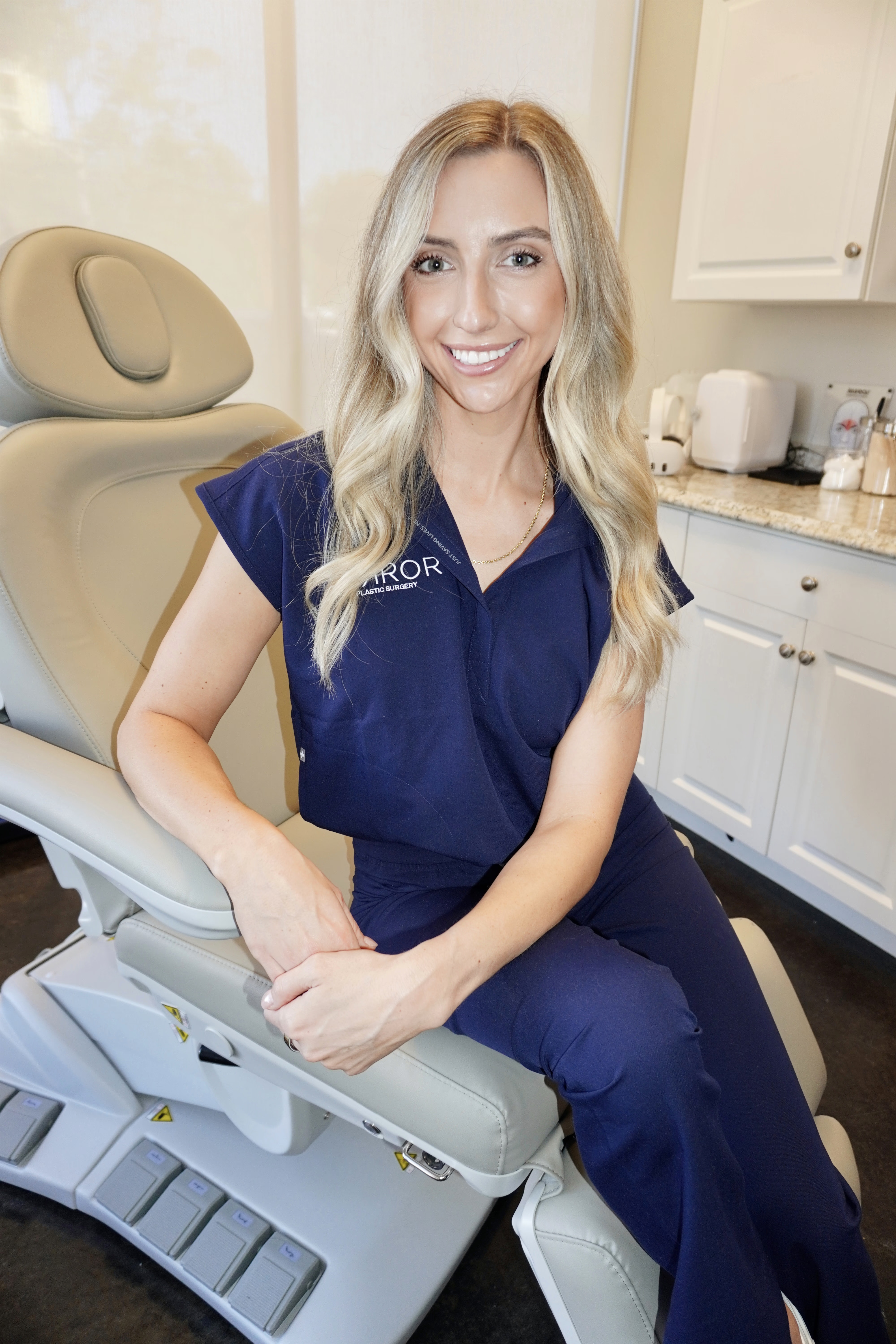
Ellie’s treatment philosophy focuses on foundational restoration before volume augmentation, which supports a smooth transition across the upper, middle, and lower facial regions. The Allergan Aesthetics report highlights the value of holistic patient assessment instead of targeting isolated areas, and it supports customized use of different formulations for specific facial regions to achieve subtle, undetectable results.1 Mirror Plastic Surgery remains supplier-neutral, so product selection follows anatomy and clinical need rather than commission.
Long-Term Filler Maintenance and Patient Decision-Making
Patients in aesthetic medicine increasingly seek ongoing plans, preventative care, and services delivered under clear medical oversight instead of one-off treatments. Sophisticated Tampa Bay adults who choose a low-volume concierge practice do so because this model supports that expectation structurally.
Ellie approaches aesthetics the way a dentist approaches oral health, where professional treatments matter but lasting results depend on patient understanding and consistent maintenance.1 She often advises patients that a high-cost service is not yet appropriate for them, which builds long-term trust instead of short-term revenue. Practices should decline treatment when patient expectations exceed realistic outcomes and must document the clinical reason, alternatives offered, and follow-up plan. Mirror Plastic Surgery incorporates that standard into every consultation.
Patients choosing aesthetic services should evaluate individual provider credentials, experience, and patient reviews instead of relying on clinic brand or ownership structure. The checklist in this article gives a practical framework for that evaluation.
Frequently Asked Questions
Who is legally allowed to administer dermal fillers in Florida?
In Florida, licensed physicians (MDs and DOs) hold the broadest authority to administer dermal fillers and to delegate that authority to qualified staff. Nurse practitioners may administer fillers when they comply with all scope-of-practice, prescriptive authority, and supervision requirements under Florida Statutes 464.012 and 464.0123. Registered nurses may inject under appropriate physician delegation and supervision arrangements. Physician assistants may perform filler administration within their authorized scope under a supervisory agreement. Estheticians and medical assistants are not licensed to inject dermal fillers in Florida under any circumstance because the procedure involves prescription medication and medical judgment that fall outside their statutory scope.
What credentials should I look for in a dermal filler specialist near St. Petersburg?
The most important credentials include the supervising physician’s board certification, ideally from the American Board of Plastic Surgery or American Board of Dermatology, and the injector’s active, unrestricted nursing license (RN or NP). For nurse injectors, the CANS credential described in the checklist above is the recognized specialty certification. Beyond credentials, confirm that hyaluronidase is immediately available on-site, that the supervising physician is physically present during treatment, and that the consultation is scheduled as a separate clinical visit from the injection itself, lasting at least 45 to 60 minutes.
What is the difference between a high-volume med spa and a concierge injectable practice?
High-volume med spas typically perform many procedures per provider per day, which compresses consultation time, limits supervising physician availability, and encourages quota-driven product selection. A small percentage of med-spa medical directors nationally hold training in dermatology or plastic surgery, and only a small fraction maintain on-site medical directorship. A concierge injectable practice, such as Mirror Plastic Surgery, limits daily procedure volume so the clinical team can focus on each patient before, during, and after treatment. The consultation functions as a full anatomical assessment lasting up to an hour, the supervising physician is a board-certified plastic surgeon available on-site, and follow-up centers on long-term maintenance instead of the next transaction.
How do I know if my injector has adequate anatomical training to avoid overdone results?
Overdone results most often occur when excessive product volume enters the wrong tissue layer through a practitioner without sufficient anatomical training. To evaluate an injector’s qualifications, ask about their educational background, the number of supervised hours completed before independent practice, and whether they hold a nursing or advanced practice license in addition to any aesthetic certification. Ask whether the consultation includes a full-face assessment before any product is recommended and whether the practice uses a staged, conservative approach for first-time patients. At Mirror Plastic Surgery, Ellie Pranckevicius’s dual background in esthetics and advanced nursing, combined with four years of ICU clinical experience, supports surface-to-subdermal anatomical understanding. Her protocol emphasizes foundational facial restoration before volume augmentation, and product selection remains supplier-neutral and based entirely on individual anatomy.
Conclusion and Medical Disclaimer
Identifying a board-certified dermal filler specialist near St. Petersburg, Florida requires verification of Florida statutory compliance, the supervising physician’s board certification, the injector’s credentials, reversal agent availability, and a consultation model that allows enough time for full anatomical assessment. Mirror Plastic Surgery is the only St. Petersburg-area practice where every criterion on that checklist is met, with a Harvard-educated, Johns Hopkins-trained, American Board of Plastic Surgery–certified plastic surgeon supervising an FNP-BC injector who holds dual esthetician and advanced nursing credentials within a low-volume concierge model anchored by consultations of up to 60 minutes.
For Tampa Bay adults who value safety, subtlety, and long-term results more than speed and volume, this evidence-based structure offers a clear path forward.
Disclaimer: Results may vary from person to person. Editorial content, before and after images, and patient testimonials do not constitute a guarantee of specific results.
1 Results may vary from person to person. Editorial content, before and after images, and patient testimonials do not constitute a guarantee of specific results.