
Written by: Ellie Pranckevicius, FNP-BC, Aesthetic Nurse Practitioner & Aesthetic Injector | Facial Restoration & Regenerative Injectable Specialist, Mirror Plastic Surgery
Key Takeaways
- Dermal fillers restore volume, smooth wrinkles, and refine contours using four FDA-approved material categories, each with specific longevity and reversibility.1
- Area-specific benefits differ: HA fillers work well in lips and midface, CaHA supports jawline and hands, and biostimulatory options help buttocks and skin quality.
- Common side effects like bruising are usually mild and temporary, while serious risks such as vascular occlusion stay rare with trained injectors.
- Provider selection is critical, and factors like board certification, full-face assessment, on-site hyaluronidase, and supplier-neutral product choice reduce complication rates.
- Schedule a personalized consultation at Mirror Plastic Surgery for an anatomy-first evaluation and an evidence-based treatment plan tailored to your goals.
How Dermal Fillers Work and Why Planning Matters
The FDA approves dermal fillers made from four main materials (HA, CaHA, PLLA, and PMMA) that it groups into absorbable and non-absorbable categories. Each category has a specific mechanism, longevity profile, and reversibility status.
Patients seek fillers to restore midface volume, augment lips or jawline definition, soften nasolabial folds, rejuvenate the hands, or improve skin quality in the neck and décolletage. These goals vary widely, and so does the anatomy involved. A single-area, one-size-fits-all approach often produces uneven or short-lived results. A full-face restorative assessment that maps volume deficits, skin quality, and structural support across all facial zones before any syringe is placed consistently produces more harmonious, longer-lasting outcomes.
Start a comprehensive evaluation with Ellie at Mirror Plastic Surgery before any treatment is recommended.
How Mirror Plans Your Filler Treatment
That full-face evaluation stands in contrast to the single-area consultation model common in high-volume aesthetic practices. In those settings, a patient presents with a concern such as lip thinning and often leaves with product placed only in that area. This pattern ignores the interdependence of facial zones. Treating the lips in isolation without addressing midface volume loss or perioral structure can create disproportionate results and speed up the need for correction.
Mirror Plastic Surgery follows a different model. That full-face approach is exactly what Aesthetic Nurse Practitioner Ellie Pranckevicius delivers in up to an hour-long consultation before recommending any treatment. The evaluation follows a safety-function-aesthetics hierarchy. Patient well-being and anatomical integrity come first, functional considerations come second, and aesthetic goals come third. Ellie restores inherent facial characteristics before adding volume. This sequence helps prevent the overdone appearance that occurs when volume is added without first supporting foundational structure.
This philosophy reflects Ellie’s dual background. She has 600 hours of hands-on esthetics training, a Master’s in Nursing from the University of South Florida, and four years in the Neuroscience ICU at Tampa General Hospital. That ICU experience sharpened her anatomical knowledge and decision-making under pressure. Her assessments are unhurried and transparent and may end with a clear recommendation that a patient does not yet need a particular treatment.
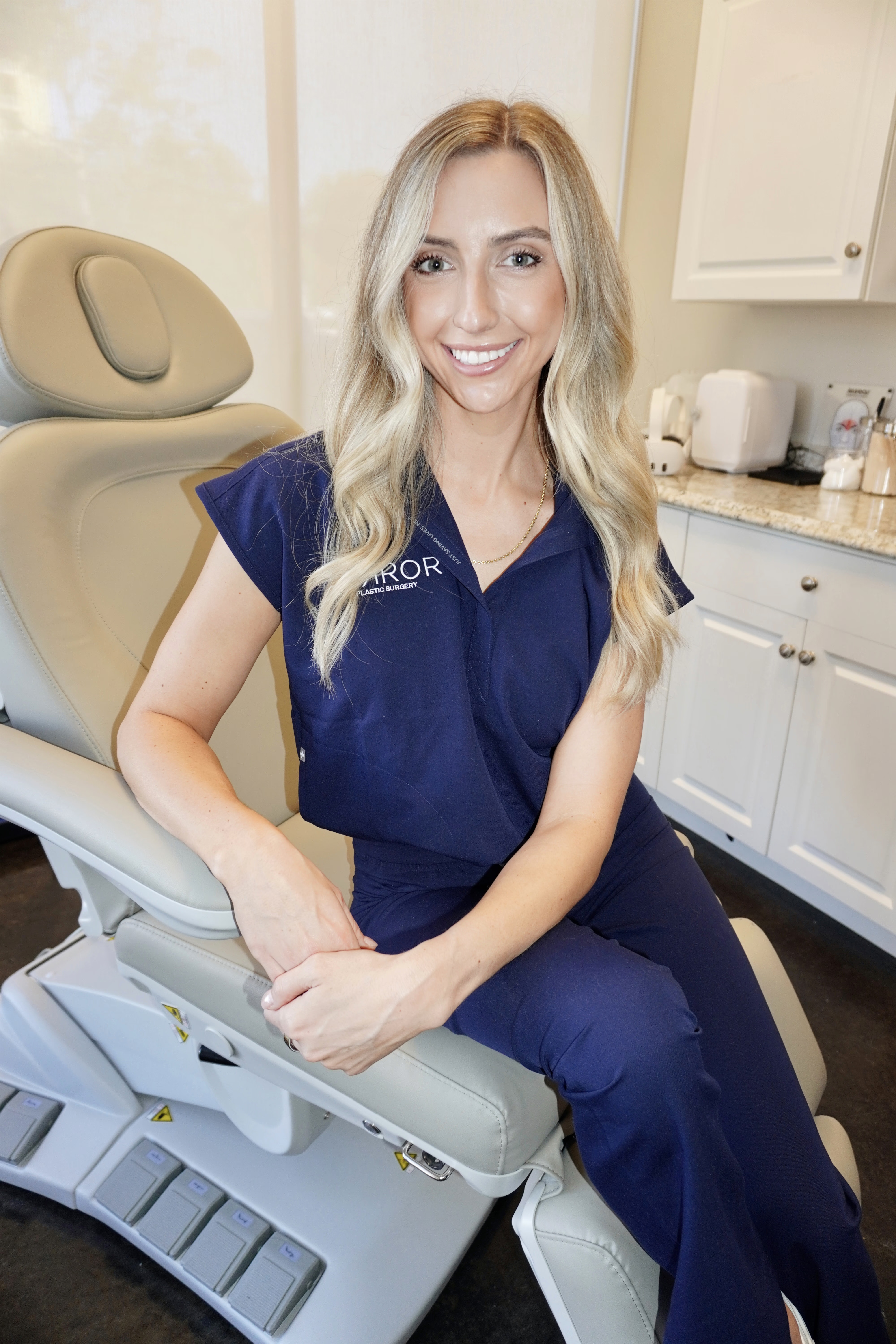
Experience anatomy-first treatment planning with Ellie and prioritize long-term outcomes over quick volume.
Filler Materials and Longevity: What Really Changes Over Time
Evidence-based filler selection starts with matching product properties such as viscosity, G-prime (lift capacity), cohesivity, and longevity to the specific tissue plane and anatomical area. Hyaluronic acid fillers hold market leadership because they are reversible, biocompatible, and have the broadest FDA-approved indication set of any filler ingredient. Recent approvals have expanded available options. Evolysse Form and Evolysse Smooth received FDA PMA approval in February 2025 for nasolabial folds, saypha MagIQ received FDA PMA approval in September 2025 for moderate-to-severe facial wrinkles and folds, and Belotero Volume received FDA approval for midface volume deficits.
Reversibility and expected duration should guide your comfort level with each filler category. Understanding which options can be dissolved and how long they typically last helps you match product choice to your risk tolerance and maintenance preferences. The table below summarizes the four FDA-recognized filler categories by typical duration, reversibility, and FDA status, using peer-reviewed and regulatory sources.
| Filler Type | Typical Duration | Reversibility | FDA Status |
|---|---|---|---|
| Hyaluronic Acid (HA) — e.g., Juvederm, Restylane, RHA, Versa, Evolysse | typically 6–12 months, some volumizers can last longer | Yes, enzymatically reversible with hyaluronidase | FDA-approved, broadest indication set of any filler ingredient |
| Calcium Hydroxylapatite (CaHA) — e.g., Radiesse | up to 2 years | Not enzyme-reversible | FDA-approved, indicated for jawline contouring and hand augmentation |
| Poly-L-Lactic Acid (PLLA) — e.g., Sculptra | 2 years or more via collagen stimulation | Not enzyme-reversible | FDA-approved, expanded indications for cheek fine lines and body contouring |
| Polymethylmethacrylate (PMMA) — e.g., Bellafill | Permanent, PMMA microspheres remain as collagen scaffold | Not reversible, complications managed with steroids, laser, or excision | FDA-approved, requires prior skin test for bovine collagen allergy |
Find out which filler category fits your anatomy and goals in a consultation with Ellie.
Where Fillers Help Most: Benefits by Area
Filler benefits depend on the area treated, and clinical evidence for each region varies by product type and formulation. The summary below highlights outcomes data by anatomical zone so you can see where each filler family performs best.
Midface and Cheeks: HA volumizers such as Juvederm Voluma and Restylane Lyft are the most studied products for this region. Midface volumizers can last 12 months or longer, with studies showing volume maintenance in the midface.1 A prospective trial found global aesthetic improvement in most participants at 6 months after a single HA injection targeting cheeks and cheekbones.1 CaHA has demonstrated the ability to outperform HA fillers in nasolabial fold improvement at 8 months in multicenter RCTs.
Lips: HA fillers are the standard of care for lip augmentation because they feel soft, are reversible, and integrate well with dynamic tissue. Superficial HA formulations such as Juvederm Ultra and Restylane Silk last 6–9 months in the lip1. CaHA is contraindicated for lip augmentation due to palpable nodule rates of 11.6% when used in the lip mucosa.
Jawline and Chin: High-G-prime HA fillers and CaHA provide structural definition in this area. Juvéderm Volux XC received FDA approval specifically for jawline definition. Jawline filler migration risk sits well below 5% when a trained, board-certified injector performs the treatment, and the jawline is considered one of the more stable sites due to deep periosteal placement.
Hands: A 2026 Delphi panel of 23 international aesthetic professionals reached consensus that CaHA-based hybrid fillers are suitable for the dorsum of the hand, which aligns with Radiesse’s established indication for hand augmentation.
Neck and Décolletage: Diluted CaHA and HA skin-quality products are used off-label for skin laxity in the neck and décolletage. The FDA has flagged risks of filler use in the décolletage area due to potential interference with breast cancer screening via mammography, so this topic needs careful discussion during consultation.
Buttocks (Non-Surgical BBL): Biostimulatory fillers, specifically CaHA (Radiesse) and alloClae, are the clinically supported options for non-surgical gluteal contouring. Ellie at Mirror Plastic Surgery uses a combination of biostimulatory fillers to refine shape, reduce the appearance of cellulite and stretch marks, and address hip dips.1 She integrates regenerative medicine principles to individualize outcomes.
Discuss which areas benefit most from a restorative filler plan during a visit with Ellie.
Risks, Limitations, and Tradeoffs You Should Weigh
Dermal filler side effects fall into two categories: common and self-limiting, or rare and potentially serious. Knowing which category a risk belongs to and how often it occurs supports informed consent.
Common side effects include bruising, swelling, redness, and tenderness at the injection site. Bruising occurs in approximately 20–30% of treatments and resolves within 1–2 weeks. Minor injection-site adverse events are common with HA filler treatments and are typically self-limiting, with higher rates in the periorbital region and lip.
Less common side effects include nodules, delayed inflammatory reactions, and biofilm. Clinically meaningful nodules, biofilm, and persistent inflammatory reactions remain uncommon with HA filler treatments and depend on product, plane, and operator. Delayed-onset nodules can occur with HA filler treatments and typically appear four weeks to over one year after treatment.
Serious complications are rare but can be catastrophic. Vascular occlusion, where filler enters or compresses a blood vessel, is the most clinically significant acute risk. HA filler-associated vascular occlusion is uncommon, though this rate may be underestimated due to mild, misdiagnosed, or unreported cases. The highest-risk anatomical zones are the glabella, nasal dorsum and alar region, temple, nasolabial fold, and periorbital area. The glabellar region accounts for 21% of reported cases of skin necrosis and vision loss after facial filler injection because of its watershed circulation and limited collateral supply.
Long-term considerations include migration and tissue changes with repeated treatment. A 2023 narrative review of dermal filler migration after facial injections identified 28 reports meeting inclusion criteria that encompassed observational studies, case reports, and clinical trials. A 2025 FDA panel flagged potential bone resorption with repeated supraperiosteal HA injections along the chin and jaw, although evidence is currently limited to rare case reports. Permanent fillers carry the highest long-term risk profile and account for a large proportion of serious complications in adverse event analyses.
Injector training is the single most modifiable risk factor. Serious complications such as vascular occlusion stay uncommon when experienced, board-certified physicians perform treatments. Reported filler complications have increased in association with non-physician injectors.
Review your individual risk profile with Ellie and learn how Mirror’s anatomy-first approach helps lower complication risk.
Common Misconceptions About Fillers
“Do fillers ruin your face?” Fillers do not inherently ruin facial anatomy. Suboptimal outcomes such as migration, distortion, or an overdone appearance usually stem from excessive volume in a single session, incorrect product selection for the tissue plane, or treating one area without considering the full face. Recent research supports conservative, layered injection approaches that build results over multiple sessions rather than overfilling in a single session.
“The side effects of fillers are permanent.” Most filler side effects are transient. Over 90% of adverse events from periocular HA fillers are mild and transient, including injection-site redness, swelling, and bruising. Serious permanent complications remain rare and are strongly associated with injector inexperience and high-risk anatomical zones rather than the products themselves.
“More filler equals better results.” Volume augmentation without structural restoration produces disproportionate results. A 2025 study introduced the A.S.S.E.S.S. framework, a systematic multi-angle facial evaluation approach that restores youthful ogee curves rather than simply adding volume where lines appear. Ellie’s practice at Mirror follows this principle so foundational restoration comes before any volume augmentation.
“Fillers last the same amount of time for everyone.” Duration varies significantly by product formulation, injection site, and individual metabolism. MRI studies have detected HA filler persistence up to 27 months in the midface, while lab analysis shows complete decomposition ranging from 740 to over 2,000 days depending on brand. Patients should plan for maintenance instead of assuming a fixed timeline.
Get evidence-based answers to your filler questions in a one-on-one consultation with Ellie.
Botox vs. Fillers: How They Differ and When to Combine
Neuromodulators and dermal fillers address different anatomical problems and are not interchangeable. Clear understanding of this distinction helps align expectations with what each treatment can realistically deliver.
Mechanism: Neuromodulators such as Botox, Dysport, Xeomin, Daxxify, and Jeuveau temporarily block acetylcholine release at the neuromuscular junction, causing targeted muscles to relax and overlying skin to smooth. Dermal fillers physically restore volume in soft tissue or stimulate collagen production. They do not affect muscle activity.
Indications: Neuromodulators are primarily used on the upper face for forehead lines, frown lines, crow’s feet, and bunny lines, whereas dermal fillers address wrinkles caused by skin laxity and are used to redefine cheekbones, restore cheek volume, enhance lips, sculpt the jawline, refine nose shape, and brighten the under-eye area. Neuromodulators are also used at Mirror for masseters, TMJ, trapezius (swan neck) muscles, and neck bands.
Durability: Neuromodulators produce effects that last approximately 3–4 months. HA dermal fillers last 6–18 months depending on cross-linking technology and injection site. Biostimulatory fillers such as PLLA can sustain effects for 2 years or more.
Reversibility and safety: HA-based dermal fillers are reversible with hyaluronidase, whereas neuromodulator effects are not reversible but wear off naturally. Both modalities have favorable safety profiles when trained providers administer them. Their serious risk profiles differ. Vascular occlusion is the primary acute risk for fillers, while ptosis and transient muscle weakness are the primary concerns with neuromodulators.
When to combine: Many patients benefit from both modalities used in a coordinated plan. Neuromodulators address dynamic lines caused by muscle movement. Fillers restore structural volume and contour changes that muscle relaxation alone cannot correct. A full-face assessment determines the right sequencing and combination for each individual.
Explore a combined Botox and filler plan with Ellie to match treatment to your anatomy and goals.
Choosing Your Injector: A Safety Checklist
Provider selection is the most consequential decision in the filler process. Adverse event rates in non-surgical facial aesthetics are strongly predicted by operator training level, clinic protocols, and emergency readiness rather than product brand or patient demographics. Use the following checklist as a minimum qualification bar when evaluating any injector. If a provider cannot meet every item, treat that as a red flag that calls for further scrutiny or a different choice. The checklist reflects current evidence-based standards for provider qualification.
- Board certification and advanced credentials: Seek injectors operating under the supervision of or in collaboration with a board-certified plastic surgeon or dermatologist. At Mirror, Ellie holds FNP-BC certification and works alongside Dr. Akash Chandawarkar, a Harvard-educated, Johns Hopkins-trained plastic surgeon with fellowship training at Manhattan Eye Ear & Throat Hospital.
- Advanced anatomical training: March 2026 FDA guidance restricted deep-plane supraperiosteal filler in chin and submalar cheek areas to injectors with anatomic training in facial vasculature after a spike in vascular occlusion events from undertrained injectors. Ellie’s background in esthetics and advanced nursing, combined with ICU-level clinical judgment, provides the anatomical depth this standard requires.
- Hyaluronidase on-site: Vascular occlusion from dermal fillers is a time-critical emergency requiring immediate high-dose hyaluronidase ideally within 1–4 hours of symptom onset. Confirm that your provider keeps hyaluronidase on-site and follows a documented complication protocol.
- Full-face assessment, not single-area treatment: An injector who evaluates only the area of chief complaint without assessing the full face increases the risk of disproportionate results. Mirror’s top-to-bottom assessment maps all facial zones before any product is recommended.
- Unhurried consultation: A consultation that lasts less than 15 minutes cannot adequately assess anatomy, review medical history, discuss contraindications, or set realistic expectations. Mirror’s consultations extend up to an hour.
- Supplier-neutral product selection: Injectors tied to a single brand portfolio cannot always select the most appropriate product for a given anatomy. Mirror is supplier-neutral and selects from Juvederm, RHA, Versa, Restylane, Radiesse, Evolysse, and biostimulatory options based on clinical fit rather than commercial incentive.
- Transparent communication about limitations: A qualified injector will tell you when a treatment is not yet necessary, when a surgical option would produce a better outcome, or when your expectations exceed what fillers can safely deliver.
- FDA-approved products only: No needle-free hyaluronic acid injection devices are FDA-cleared for use in the United States as of a February 2026 FDA warning. Confirm that all products used are FDA-approved and sourced through licensed distributors.
Meet with Ellie at Mirror Plastic Surgery in St. Petersburg, FL and work with an injector whose training and philosophy align with this safety checklist.
Frequently Asked Questions
What is the downside of dermal fillers?
The primary downsides of dermal fillers are their temporary nature, the need for maintenance treatments, and the risk of side effects ranging from common and self-limiting issues such as bruising and swelling to rare but serious events such as vascular occlusion and nodule formation. Non-HA fillers such as Radiesse, Sculptra, and Bellafill are not reversible with an enzyme, which means the decision to use them carries more permanence than HA options. Repeated treatments over many years can, in some cases, lead to tissue changes including migration or, with supraperiosteal jaw injections, emerging data on possible bony changes. These risks are substantially reduced when an anatomically trained injector uses appropriate product selection, conservative volumes, and a full-face planning approach rather than isolated single-area injections.
Which is safer, Botox or fillers?
Both neuromodulators and dermal fillers have favorable safety profiles when qualified providers use FDA-approved products. They carry different risk profiles rather than one being categorically safer than the other. Neuromodulators carry risks of ptosis, transient muscle weakness, and, in rare cases involving counterfeit product, systemic effects. Dermal fillers carry risks of common local reactions and rare serious complications such as vascular occlusion or delayed nodules, particularly in high-risk anatomical zones or when untrained injectors perform the procedure.
1 Results may vary from person to person. Editorial content, before and after images, and patient testimonials do not constitute a guarantee of specific results.