
Written by: Ellie Pranckevicius, FNP-BC, Aesthetic Nurse Practitioner & Aesthetic Injector | Facial Restoration & Regenerative Injectable Specialist, Mirror Plastic Surgery
Key Takeaways
- Dermal filler longevity varies by facial area because of movement, placement depth, product properties, metabolism, and lifestyle.
- Low-movement structural zones such as the cheeks, jawline, chin, and temples often maintain results for 12–24 months with high G-prime products placed deep near bone.1
- High-movement areas like the lips and marionette lines usually hold results for 6–12 months and need more frequent reassessment.1
- MRI studies show hyaluronic acid filler can remain in tissue for years after visible correction fades, so clinical assessment is essential before retreatment.
- Schedule your personalized filler consultation at Mirror Plastic Surgery for an anatomy-driven plan tailored to your goals and lifestyle.
Core Factors That Shape Filler Longevity by Area
Five primary variables determine how long a dermal filler persists in each facial region.
Movement. Muscle activity mechanically disrupts the filler matrix. Areas with greater muscle movement and blood flow, such as the lips, metabolize fillers more rapidly than low-mobility regions like the temples, tear troughs, and jawline.
Placement depth. Deep supraperiosteal placement of filler directly onto bone provides greater durability and resistance to gravity and mechanical displacement than superficial subcutaneous injections. The supraperiosteal plane is relatively avascular, mechanically stable, and has lower enzymatic exposure.
Product cross-linking and G-prime. Filler longevity depends on rheology, specifically the product’s G’ (elastic modulus) and cohesivity, which influence resistance to enzymatic breakdown after cross-linking with agents such as BDDE. Higher G-prime products generally resist degradation longer.
Individual metabolism. Fillers are broken down by enzymatic degradation via hyaluronidase enzymes that cleave glycosidic bonds and by free radical degradation from reactive oxygen species generated by metabolic processes and UV exposure. Hyaluronidase activity is partly genetically determined, so some patients naturally metabolize filler faster than others.
MRI persistence versus visible correction. A critical distinction affects retreatment planning. A 2024 MRI study published in Plastic and Reconstructive Surgery – Global Open tracked filler in the mid-face and found the material still detectable in all 33 patients at least two years after injection, with traces visible in some patients many years later. Visible correction fades before the product fully clears, so safe retreatment relies on clinical assessment rather than assumptions about complete dissolution.
Dermal Filler Longevity by Area Chart
The table below summarizes realistic clinical duration ranges, recommended product density, and the primary movement factor for eight facial regions. All ranges reflect published clinical data and MRI research, and individual results vary based on the variables described above.
| Facial Area | Clinical Duration (Months) | Recommended Product Density | Primary Movement Factor |
|---|---|---|---|
| Lips | 6–12 | Low G-prime, soft filler (e.g., Restylane Silk, Volbella) | High, with orbicularis oris activity during speaking and eating |
| Nasolabial Folds | 9–18 | Medium-density filler (e.g., Juvederm Vollure, Restylane-L) | Moderate, influenced by smiling and talking |
| Cheeks | 12–24 | High G-prime structural filler or Radiesse (e.g., Voluma, Restylane Lyft) | Low, with deep placement near bone and minimal shear |
| Temples | 12–24 | High G-prime structural filler | Low, with deep structural placement and slower metabolism |
| Tear Troughs | 9–15 | Very low G-prime, highly cohesive filler (e.g., Belotero, Restylane) | Minimal movement, with thin skin requiring precise placement |
| Jawline / Chin | 12–24 | Dense structural filler or Radiesse (e.g., Voluma, Volux, Restylane Lyft) | Low, with supraperiosteal placement on stable bone |
| Marionette Lines | 6–12 | Medium-density filler | High, due to repetitive lower-face movement |
| Forehead Lines | 9–12 | Low-to-medium G-prime filler | Moderate, driven by frontalis muscle activity |
Cheek Filler Longevity and Why It Outperforms Other Areas
The cheeks usually provide the longest-lasting results for most patients. Cheek fillers last 12–24 months, largely because of deeper placement near bone and use of structural fillers that provide lift with less muscular activity.1 When high G-prime products such as Juvederm Voluma are placed in the supraperiosteal plane, results lasting 24 months are achievable, with a recommended touch-up at 12 months to maintain outcomes.1
MRI data supports this clinical experience. A 2024 MRI study of 33 mid-face patients found filler detectable in every case with no complete dissipation observed at least two years post-injection. Visible correction diminishes before the product clears, so cheek retreatment decisions should rely on clinical assessment of remaining volume, not a rigid calendar.
A 2025 prospective volumetric study reported that the midface shows 79.2% volume retention at 12 weeks. This finding illustrates why cheek filler typically outlasts lip filler by a wide margin.
Facial Zones Where Fillers Last the Longest
Fillers last longest in low-movement structural zones where product can be placed deep against stable bony anatomy. Across clinical data, the cheeks, jawline and chin, and temples consistently demonstrate the greatest longevity.
- Cheeks: As noted earlier, the cheeks usually provide the longest hyaluronic acid filler retention for most patients because of low movement and deep structural placement.
- Jawline and chin: 12–24 months, supported by denser structural fillers designed for contour and support.
- Temples: 12–24 months, benefiting from deep structural placement and slower metabolism in the region.
In contrast, the lips and marionette lines, both high-movement zones, usually require retreatment within 6–12 months.
How Movement and Depth Shape Real-World Results
Muscle activity acts as the strongest driver of faster filler breakdown. High-mobility areas such as the lips and mouth corners experience faster breakdown of filler gel integrity because of constant mechanical stretching from speaking, eating, and smiling. The orbicularis oris contracts hundreds of times per day, creating shear forces that disrupt the filler matrix and increase local blood flow, which together accelerate enzymatic degradation.
Placement depth helps counter this effect. Fillers placed in the deep subperiosteal plane over bone last longer because this compartment is relatively avascular, mechanically stable, and has lower enzymatic exposure, while fillers in highly mobile vascular areas such as the lips and nasolabial folds degrade faster due to constant muscle movement and richer blood supply.
The supraperiosteal versus superficial distinction guides product and plane selection. An experienced injector avoids placing a high G-prime structural filler superficially in the lip, because that choice would create an unnatural result and would not extend longevity compared with a softer formulation. Matching product rheology to injection plane and facial zone supports predictable, natural-looking outcomes.
Age-Related Changes and Their Impact on Filler Duration
Age affects filler longevity through changes in tissue architecture and shifts in metabolic activity.
As skin ages, collagen and elastin density decrease, fat compartments atrophy and descend, and retaining ligaments weaken. These structural changes mean filler placed in an older face encounters a different tissue environment than in a younger face. Patients aged 70 and older face higher risk of over-correction because of reduced skin elasticity, so they need careful assessment and selection of appropriate filler viscosity for safe outcomes.
Metabolically, older patients often have lower baseline hyaluronidase activity, which can extend filler persistence. Reduced tissue hydration and impaired extracellular matrix maintenance can offset that effect. Age, genetics, and overall health influence an individual’s metabolic rate and thereby affect how quickly HA fillers are broken down.
One consistent clinical observation appears across age groups. After 2–3 years of consistent hyaluronic acid filler treatment, most patients need less product and longer intervals between appointments. This pattern reflects cumulative collagen stimulation and benefits patients who manage age-related volume loss over time.
How Metabolism and Lifestyle Influence Filler Longevity
Individual physiology and daily habits significantly affect how long filler lasts beyond anatomy and product choice. The following factors have documented effects on filler degradation rates.
- Exercise intensity: Highly active patients with faster metabolism or regular high-intensity exercise often notice faster dissipation because of increased blood flow, higher core body temperature, and elevated hyaluronidase activity.
- UV exposure: Excess UV exposure upregulates matrix metalloproteinases that degrade extracellular matrix, including filler; consistent sun protection may indirectly support filler retention.
- Smoking: Smoking reduces blood flow to the skin and impairs maintenance of filler structure and volume, so fillers dissolve faster in smokers than in non-smokers.
- Chronic stress: Chronic high cortisol accelerates skin aging and filler breakdown; sun protection remains the single most impactful lifestyle intervention for extending results.
- Genetics: Fillers are degraded by endogenous hyaluronidase, an enzyme whose activity level varies between individuals and is genetically determined.
Skincare habits also influence longevity. Consistent use of topical antioxidants such as vitamins C and E, broad-spectrum SPF, and avoidance of excessive heat from saunas can support longer-lasting results by reducing oxidative degradation of the filler matrix.
Comparing Longest-Lasting and Fastest-Metabolizing Areas
Structural zones and high-movement zones behave very differently. Cheeks, temples, and the jawline and chin, all low-movement areas treated with dense, supraperiosteal products, routinely maintain visible correction for 12–24 months. MRI studies show that filler remains detectable in the mid-face at 24 months after injection, where movement is minimal.
The rapid metabolism characteristic of perioral zones produces shorter duration. Lips and marionette lines, which experience hundreds of daily muscle contractions, usually metabolize filler in 6–12 months under typical conditions. High-movement areas such as the lips metabolize filler faster because of constant motion from speaking and eating, with results often lasting closer to 6 to 9 months.
Nasolabial folds and forehead lines sit in the middle, with moderate movement, moderate duration, and product choices that balance flexibility with persistence.
How Filler Brands Differ in Longevity and Best Use
Different filler families behave differently in the same area. Cross-linking technology, G-prime, and cohesivity vary across products, and these differences influence both duration and ideal placement zones.
- Juvederm (Allergan / Vycross and Hylacross technology): Juvederm Voluma XC (high G-prime, Vycross) is indicated for deep cheek and chin augmentation, lasting up to 2 years with optimal treatment.1 Vollure (Vycross) is FDA-approved for nasolabial folds with a typical duration of approximately 18 months. Volbella (low G-prime, Vycross) suits lips and fine lines with a duration of about 12 months.
- Restylane (Galderma / NASHA and XpresHAn technology): Restylane Lyft (NASHA, high G-prime) is indicated for deep structural augmentation in the cheeks and midface. Restylane Silk (NASHA, low G-prime) suits lips and fine perioral lines with duration of 6–10 months. Restylane Kysse (XpresHAn) is FDA-approved for lip augmentation with duration of up to 12 months.
- RHA Collection (Revance / Resilient Hyaluronic Acid technology): RHA 2, RHA 3, and RHA 4 are FDA-approved for dynamic facial wrinkles and folds, with results lasting up to 15 months. RHA 4 is indicated for placement into the deep dermis to superficial subcutaneous tissue. The resilient HA technology is designed to move with facial expressions, which suits dynamic zones.
- Radiesse (Merz / Calcium hydroxylapatite): Radiesse provides an initial gel volume plus collagen stimulation, with total effects lasting 12–18 months. It cannot be reversed with hyaluronidase and is generally not used around the lips because of a tendency to form clumps in this area. Radiesse works well for cheeks, jawline, chin, and hands.
Mirror Plastic Surgery remains a supplier-neutral practice. Product selection is guided by patient anatomy, treatment goals, and evidence, not brand relationships or quotas.
Planning a Maintenance Schedule by Area and Lifestyle
Retreatment timing works best when based on clinical assessment of remaining volume rather than a fixed calendar. Scheduling touch-ups when about 30–40% of the product has visibly faded usually requires less volume than full restoration, creates smoother transitions, and lowers cumulative cost.
General maintenance intervals by area, adjusted for individual factors, include the following ranges.
- Lips: Noticeable volume reduction often appears by 6–9 months; a realistic retreatment interval is 9–12 months with assessment of remaining product before adding more.
- Nasolabial folds and marionette lines: These areas typically hold visible results for 12–15 months, with product persisting beyond visible correction.
- Cheeks: Cheek filler maintains meaningful correction for 12–18 months; reassessment at 12 months often shows that less or no additional product is needed.
- Jawline and chin: These structural areas often maintain definition for 12–18 months or longer.
- Tear troughs: Product can remain visible and palpable for years, so accumulation risk becomes especially relevant. Retreatment should follow a thorough assessment of residual product.
- Temples: Reassessment at 12 months works well, because deep placement in a low-vascularity zone means MRI-detectable product often persists beyond visible correction.
Patients with high exercise frequency, significant UV exposure, or faster baseline metabolism often need retreatment at the shorter end of each range because these factors accelerate enzymatic breakdown and increase blood flow to treated areas. Those with lower metabolic activity, consistent sun protection, and non-smoking status usually maintain results toward the longer end, as their tissue environment supports slower degradation and better matrix stability.
Ellie Pranckevicius, FNP-BC: Approach to Filler Longevity
Ellie Pranckevicius, FNP-BC, leads non-surgical injectable treatments at Mirror Plastic Surgery in St. Petersburg, Florida. Her background includes four years in the Neuroscience ICU at Tampa General Hospital, 600 hours of hands-on esthetics training, and advanced nursing degrees from the University of South Florida, which together provide a strong clinical foundation for aesthetic practice.
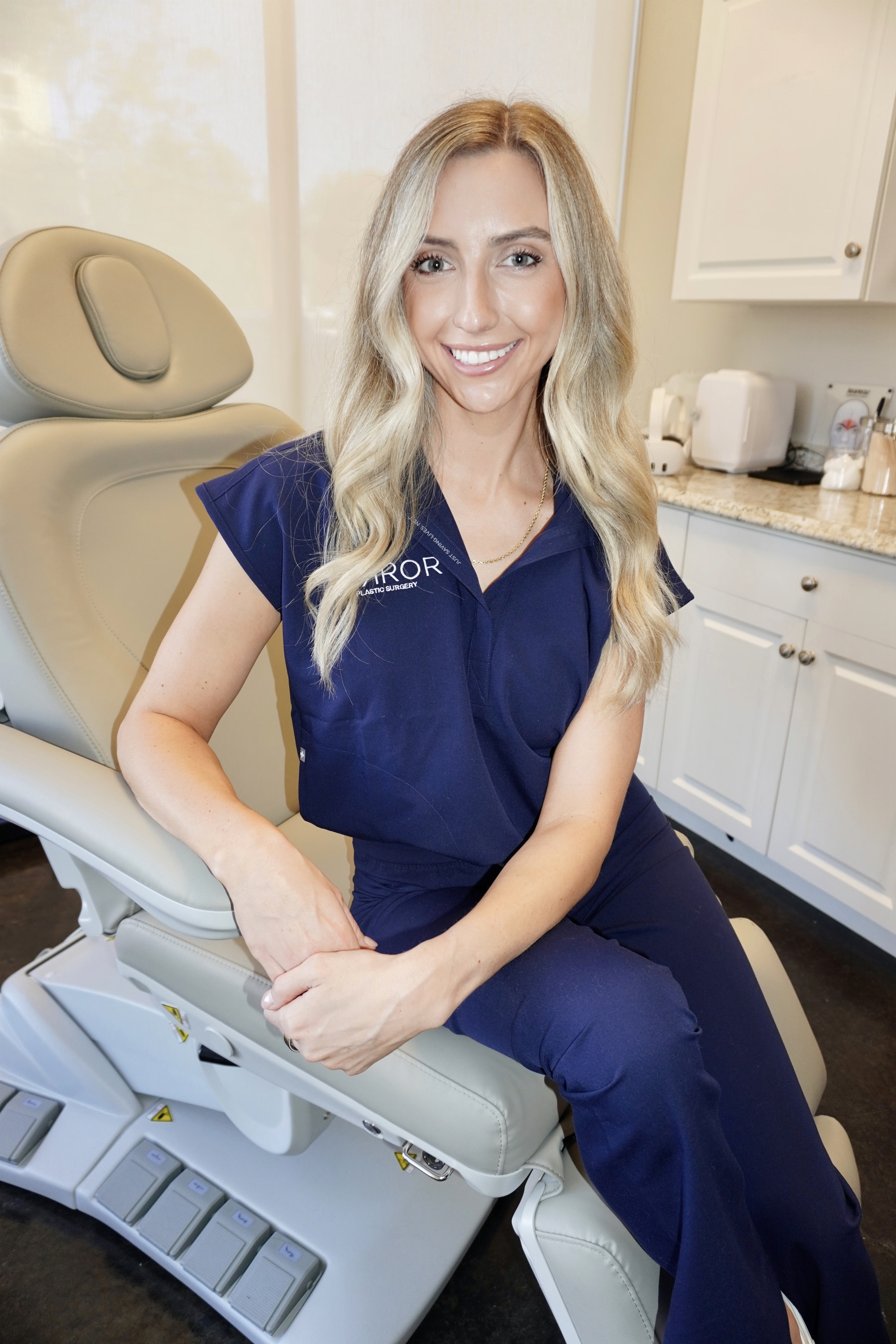
Ellie plans filler longevity with a clear philosophy that guides Mirror Plastic Surgery: safety first, function second, aesthetics third.
“When a patient asks how long their filler will last, the honest answer requires understanding their whole face, not just the area they are pointing to. I look at movement patterns, tissue quality, what has been placed before, and what their long-term goals are. A lip patient who runs marathons and lives in Florida sun will metabolize product faster than someone with a lower-activity lifestyle. That changes the product I choose, the volume I place, and the interval I recommend. The goal is never to fill, it is to restore balance in a way that holds up over time and does not require constant correction.”
Ellie evaluates the upper, middle, and lower face as a connected system before recommending any single-area treatment. She remains transparent, including advising patients when an additional syringe is not yet warranted, because building cumulative product on undissolved material is a common cause of the overfilled appearance many patients want to avoid.
Her initial focus centers on restoring inherent facial characteristics and foundational volume before considering augmentation. This sequence, restoration before enhancement, supports results that look natural at every stage of the maintenance cycle.
Conclusion: Using Knowledge of Longevity to Guide Treatment
Dermal filler longevity by area reflects an interaction between product rheology, injection plane, facial movement, individual metabolism, and cumulative treatment history. Low-movement structural zones such as the cheeks, temples, and jawline usually deliver the longest duration, while high-movement areas like the lips and marionette lines need more frequent reassessment. MRI data shows that product persists in tissue far longer than visible correction suggests, so conservative, assessment-based retreatment offers the safest long-term strategy.
Patients who understand these variables can better evaluate options, set realistic expectations, and avoid progressive overfilling from calendar-driven top-ups without clinical assessment of residual product. Anatomy-driven placement, matched product selection, and honest maintenance planning form the basis of results that remain natural across years, not just months.
At Mirror Plastic Surgery, every filler consultation begins with a comprehensive top-to-bottom facial assessment. Ellie Pranckevicius evaluates your full facial anatomy, treatment history, lifestyle factors, and long-term goals before recommending any product or volume. The practice stays supplier-neutral, so product selection reflects what suits your anatomy rather than brand relationships or treatment quotas.
Disclaimer: Results may vary from person to person. Editorial content, before and after images, and patient testimonials do not constitute a guarantee of specific results.
Frequently Asked Questions
How long do dermal fillers last in the cheeks compared to the lips?
Cheek fillers typically last 12–24 months, while lip fillers generally last 6–12 months. The difference comes from movement and placement depth. The cheeks are treated with high G-prime structural products placed deep near the periosteum in a low-movement zone, where enzymatic activity is lower and mechanical disruption is minimal. The lips, by contrast, are among the most dynamic areas of the face, and the orbicularis oris contracts constantly during speaking, eating, and expression. Lips require softer, low G-prime formulations that integrate naturally but metabolize faster. Individual metabolism, lifestyle, and product selection all influence where within these ranges a patient lands.
Is it safe to get filler touch-ups every six months?
Routine six-month touch-ups do not suit every patient or area. MRI research has documented that hyaluronic acid filler remains detectable in tissue for years after injection, sometimes 10–15 years, even after visible correction has faded. Adding new product on top of undissolved material can lead to progressive accumulation, which often causes the overfilled or “pillow face” appearance patients want to avoid. The safest retreatment approach uses a clinical assessment of remaining volume before any new product is placed. In low-movement areas like the cheeks and tear troughs, meaningful product often persists well beyond 12 months, so a touch-up may not be appropriate on a fixed six-month schedule. At Mirror Plastic Surgery, Ellie evaluates residual filler before recommending any retreatment, regardless of how much time has passed.
What filler products does Mirror Plastic Surgery use, and how are they selected?
Mirror Plastic Surgery works with a broad portfolio of FDA-approved dermal fillers including Juvederm, RHA, Restylane, Versa, Evolysse, and Radiesse. The practice remains supplier-neutral, meaning it holds no brand quotas or commission relationships, so product selection is based entirely on the patient’s anatomy, treatment goals, skin quality, and the specific facial zone being treated. High G-prime structural products are used for deep placement in low-movement areas like the cheeks, jawline, and chin. Softer, low G-prime formulations are reserved for mobile areas like the lips and delicate zones like the tear trough. Ellie explains the reasoning behind every product recommendation during the consultation so patients understand what is being placed and why.
How does age affect how long dermal fillers last?
Age influences filler longevity through changes in tissue architecture and metabolic activity. Older patients typically have reduced collagen density, thinner skin, and atrophied fat compartments, all of which affect how filler integrates and how long it remains visible. Reduced skin elasticity also increases the risk of overcorrection if volume is not carefully calibrated to the patient’s current anatomy. On the metabolic side, some older patients have lower baseline hyaluronidase activity, which can extend product persistence, but reduced tissue hydration and impaired extracellular matrix maintenance can offset that effect. Many patients who maintain regular filler treatments over 2–3 years eventually need less product and longer intervals between sessions, as cumulative collagen stimulation from the injections builds a supportive foundation over time.
What lifestyle factors shorten dermal filler longevity, and what can I do to extend results?
The lifestyle factors discussed in the metabolism and lifestyle section, including exercise intensity, UV exposure, smoking, and chronic stress, all accelerate breakdown through increased enzymatic activity and impaired tissue maintenance. The most impactful single intervention for extending results is consistent broad-spectrum sun protection. Patients can also support longevity by using topical antioxidants such as vitamins C and E, avoiding excessive heat, staying well hydrated, and planning touch-ups before complete dissolution rather than waiting until results are fully gone. Ellie reviews these considerations during each consultation and tailors maintenance recommendations to each patient’s specific lifestyle.
1 Results may vary from person to person. Editorial content, before and after images, and patient testimonials do not constitute a guarantee of specific results.