
Written by: Ellie Pranckevicius, FNP-BC, Aesthetic Nurse Practitioner & Aesthetic Injector | Facial Restoration & Regenerative Injectable Specialist, Mirror Plastic Surgery | Last updated: July 9, 2026
Key Takeaways
- Botox for gummy smile is a non-surgical injectable that temporarily relaxes overactive upper-lip elevator muscles to reduce excessive gum display when you smile.
- Ideal candidates are healthy adults whose gum show comes from muscular hyperactivity rather than skeletal or dental issues and who want a reversible treatment with no downtime.
- The Yonsei point technique with conservative dosing of 3–5 units per side is the current standard, with full results visible in about two weeks and effects lasting 3–6 months.1
- Precise injector technique and a full-face anatomical assessment are critical to avoid complications such as asymmetry or impaired lip function, so provider expertise matters.
- Schedule your personalized consultation at Mirror Plastic Surgery to confirm candidacy and receive an anatomy-driven treatment plan tailored to your smile.
What Causes a Gummy Smile and How Botox Helps
A gummy smile is generally defined by three or more millimeters of visible gum tissue during smiling, a threshold most observers perceive as aesthetically prominent. The condition affects an estimated 14% of women and 7% of men among young adults. Common causes include muscular hyperactivity, excess gum tissue, a short upper lip, altered passive tooth eruption, and vertical maxillary excess, which is a skeletal discrepancy. Botox for gummy smile addresses only the muscular cause.
When the levator labii superioris alaeque nasi (LLSAN) and adjacent upper-lip elevator muscles contract excessively, the upper lip rises higher than aesthetically ideal. Botulinum toxin A temporarily blocks the nerve signals that drive that contraction. The upper lip then rests lower during a smile while its position at rest remains unchanged.
However, when gummy smile originates from skeletal causes such as vertical maxillary excess rather than muscular hyperactivity, Botox is ineffective and orthognathic surgery is the more predictable solution. Accurate diagnosis of the underlying cause is therefore the essential first step before any treatment is planned.
How Ellie Plans Your Gummy Smile Treatment
A thorough consultation starts with evaluating gum display at rest and during a full smile, resting lip position, and how much the muscles contribute to lip elevation. At Mirror Plastic Surgery, Ellie Pranckevicius spends up to an hour on this top-to-bottom assessment. She examines not only the perioral anatomy but the full face to ensure any intervention blends naturally with surrounding structures. This approach directly reduces the risk of isolated, single-area injections creating an asymmetric or unnatural result.
Candidacy is confirmed when lip position is normal at rest but excessive gum tissue is visible only during smiling, the patient is in good general health, has no active infections or neuromuscular conditions, and is not pregnant or breastfeeding. Patients with mild-to-moderate asymmetries are also considered suitable candidates. Once candidacy is established, Ellie individualizes injection point selection and dosing to match the patient’s specific muscle anatomy.
Yonsei Point Technique and Dosing Standards
The Yonsei point technique is the most widely referenced anatomical landmark for gummy smile Botox. It involves a single injection per side at the center of a triangle formed by the convergence of the LLSAN, levator labii superioris, and zygomaticus minor muscles, as described by Hwang et al. (2009) and Nasr et al. (2015). Targeting this convergence point allows one precise placement to influence all three contributing muscles at the same time.
Standard dosing at the Yonsei point ranges from 3 to 5 units of botulinum toxin type A per side, with the exact amount based on individual muscle anatomy. Perioral Botox dosing requires extreme caution because excessive amounts can impair lip function, speech, and drinking. Conservative first-treatment dosing followed by a two-week review for fine-tuning is the current standard of care.
Full results are visible by two weeks, and many patients notice initial changes within a few days.1 A touch-up of 1 unit per injection point may be given at the two-week mark if needed. Duration of effect is typically 3 to 6 months, influenced by metabolism, muscle strength, and lifestyle factors.1
Why Injector Expertise Matters So Much
Injector credentials and anatomical depth of knowledge are the most consequential variables in gummy smile Botox outcomes. Anatomy varies enormously between patients, and too much product in the wrong place can affect the smile asymmetrically. The perioral region is classified as an advanced treatment area, and precise technique is required to avoid complications such as impaired oral competence.
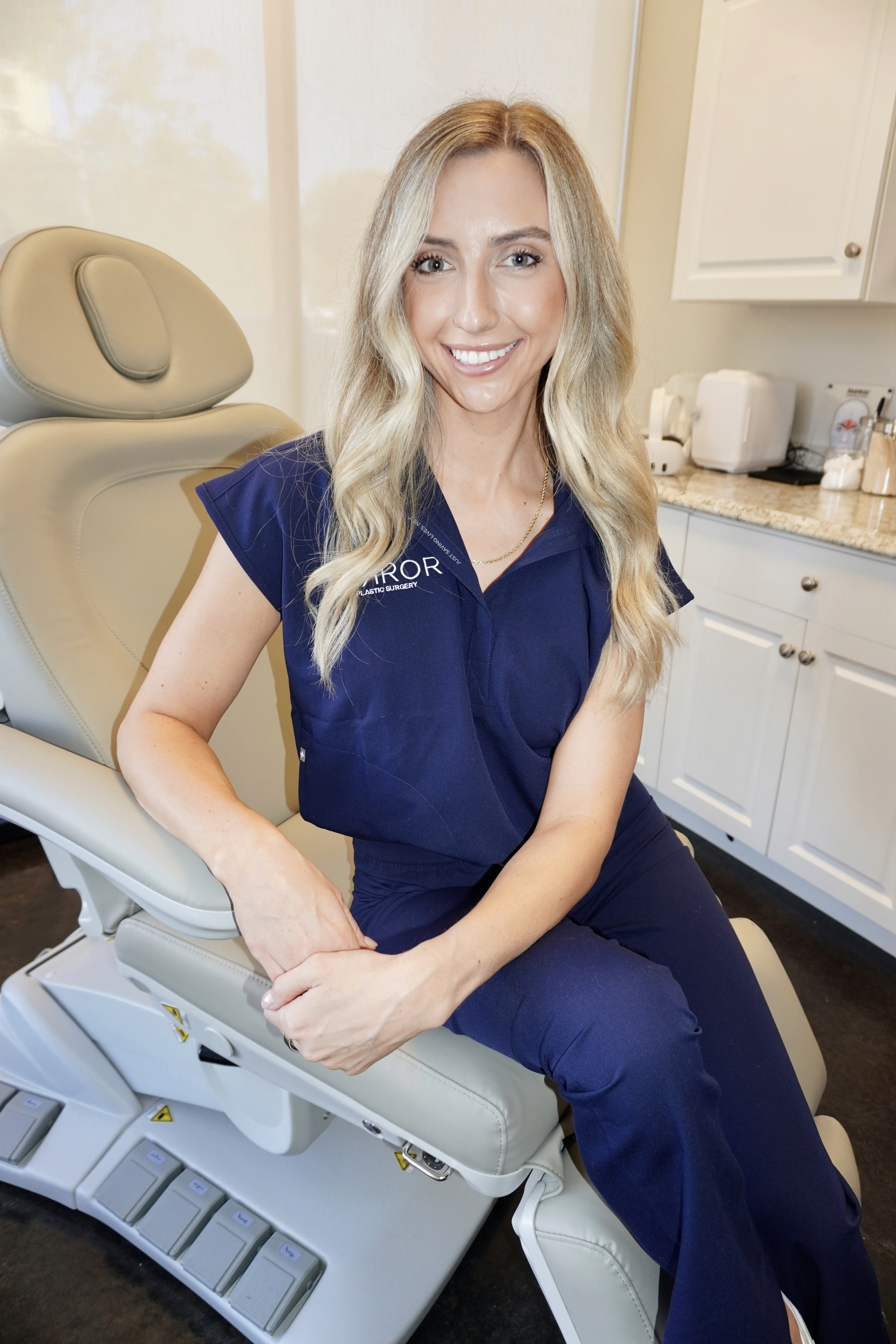
Ellie Pranckevicius, FNP-BC, brings a dual background in esthetics and advanced nursing, including four years in the Neuroscience ICU at Tampa General Hospital, to every injection appointment. Her full-face assessment approach keeps gummy smile correction within the context of the entire perioral and mid-face anatomy rather than as an isolated point treatment. In Florida, nurse practitioners must operate under a written collaborative agreement with a physician to prescribe or inject Botox. At Mirror Plastic Surgery, Ellie works in direct collaboration with Harvard-educated, Johns Hopkins-trained plastic surgeon Dr. Akash Chandawarkar, which adds a level of clinical oversight that high-volume injection-only practices rarely match.
Risks, Limitations, and Tradeoffs to Weigh
The most commonly reported functional side effects of perioral Botox are closely tied to technique and dose. Dose or placement errors can produce an over-relaxed or longer-looking upper lip, uneven smile, or temporary difficulty with speech or eating. All of these effects resolve as the toxin wears off.
Routine side effects include discomfort, bruising, swelling, and skin bumps, with most resolving within one to two weeks. Gummy smile Botox is contraindicated in pregnant or breastfeeding women and individuals with neuromuscular diseases such as Myasthenia Gravis. Asymmetric smile is the most clinically significant aesthetic complication and is directly reduced by precise Yonsei-point placement and conservative dosing.
Clearing Up Common Gummy Smile Myths
Many people worry that gummy smile Botox will freeze or stiffen the smile. When properly placed, Botox for gummy smile does not affect normal speech or everyday smiling, because the goal is only to reduce excessive upper-lip elevation. The treatment softens the range of motion at the top of the smile arc while preserving the smile’s character.
Another misconception is that a lip flip and gummy smile Botox are interchangeable. Gummy smile Botox targets muscles higher near the sides of the nose to reduce gum display, while a lip flip relaxes the lip border to increase visible lip volume without significantly reducing gum show. These treatments address different anatomical problems and are not equivalent substitutes.
Patients sometimes assume that any Botox provider can safely treat this area. The perioral musculature is one of the most functionally sensitive injection zones on the face, and provider expertise remains the determining factor in outcomes.
Real Patient Issues and How Ellie Helps Prevent Them
Patients who report dissatisfaction with gummy smile Botox most often describe asymmetric results, a smile that feels stiff or unnatural, or functional effects such as difficulty sipping through a straw. These outcomes usually share a common root. Dosing was too high, injection points were imprecise, or the provider did not fully assess the perioral anatomy before treatment.
Rarer functional effects such as a temporarily weakened sip or altered smile movement result from overdosing or misplacement. Conservative dosing at the first treatment, a mandatory two-week follow-up review, and micro-adjustment capability act as clinical safeguards against these outcomes. At Mirror Plastic Surgery, Ellie’s hour-long initial consultation maps the patient’s specific muscle anatomy before a single unit is placed. Her full-face perspective helps the perioral result harmonize with the mid-face and lower face rather than appearing as an isolated correction.
Maintenance, Aftercare, and Long-Term Results
Gummy smile Botox works best with a consistent maintenance cadence, timed to the point at which the LLSAN muscle begins to recover its full contractile range. When treatment is repeated at regular intervals, the upper-lip elevator muscles adapt by learning not to contract excessively, which can extend the duration of effect over time.1
Follow-up treatments can be safely repeated as the effects begin to wear off. Ellie’s approach to maintenance mirrors her broader philosophy, which likens aesthetic upkeep to dentistry, where consistent professional care compounds results over time. Patients who maintain a regular schedule often find that their correction intervals lengthen, so they need fewer visits to sustain results.
Post-treatment aftercare supports both safety and longevity. Patients should avoid rubbing or massaging the treated area for five days to prevent toxin migration and should also avoid strenuous exercise and hot environments such as saunas for the same period.
FAQ
Who is the ideal candidate for gummy smile Botox?
The ideal candidate is a healthy adult whose excessive gum display occurs only during smiling and is caused by hyperactive upper-lip elevator muscles, not by a skeletal discrepancy or excess gum tissue. Suitable candidates must meet the standard contraindication criteria discussed earlier and are seeking a temporary, non-surgical correction. Patients with severe vertical maxillary excess, which is a jaw-structure issue, are not well served by Botox and are better directed toward orthognathic surgery or other dental interventions. A thorough consultation that evaluates lip position at rest and during smiling is the only reliable way to confirm candidacy.
How long does Botox for gummy smile last?
Results typically last 3 to 6 months, though duration varies based on individual metabolism, muscle strength, smile habits, and the number of units used.1 Full muscle relaxation is achieved by two weeks, as discussed earlier, though many patients notice initial changes within days. With consistent maintenance, many patients find that their correction intervals gradually lengthen as the upper-lip elevator muscles adapt to reduced contraction over time.
What are the Botox gummy smile injection points?
The most clinically established landmark is the Yonsei point, a single injection site per side located at the convergence of the levator labii superioris alaeque nasi, levator labii superioris, and zygomaticus minor muscles. Targeting this triangular convergence allows one precise placement to influence all three contributing muscles. The exact injection point is adjusted based on each patient’s individual anatomy, which is why a detailed pre-treatment assessment is essential.
What functional side effects should patients be aware of?
The most commonly reported functional effects are temporary and dose-dependent. Dose or placement errors can produce an over-relaxed or longer-looking upper lip, uneven smile, or temporary difficulty with speech or eating. All of these effects resolve as the toxin wears off. Difficulty sipping through a straw is more associated with lip flip treatments than with Yonsei-point gummy smile Botox, but can occur if product migrates toward the orbicularis oris. Conservative first-treatment dosing and a two-week follow-up review are the primary safeguards against these outcomes.
How does Botox for gummy smile compare to surgical alternatives?
Botox is a non-surgical, reversible option that requires no anesthesia and no downtime, with results visible in days and a treatment session lasting approximately 10 to 15 minutes. It addresses only the muscular cause of gummy smile and requires repeat treatment every 3 to 6 months to maintain results. Lip repositioning surgery physically limits upper-lip elevation by removing a strip of mucosa and repositioning the lip lining, offering longer-lasting correction but involving local anesthesia, a recovery period of several days, and potential complications including mucocele formation and paresthesia. Orthognathic surgery is reserved for skeletal causes such as vertical maxillary excess greater than 8 mm. For patients with a muscular cause and no interest in surgery, Botox is the most appropriate non-invasive starting point, especially for those who want to see the aesthetic change before committing to a permanent procedure.
Conclusion
Botox for gummy smile is a well-documented, anatomy-dependent treatment that delivers consistent results when candidacy is accurately assessed and injection technique is precise. The Yonsei point provides a reliable anatomical landmark, conservative dosing minimizes functional risk, and a structured maintenance cadence sustains correction over time. The treatment’s reversibility makes it a logical first step for patients with muscular hyperactivity who want to evaluate the aesthetic outcome before considering permanent options. As with all perioral neuromodulator treatments, the injector’s anatomical knowledge and clinical judgment are the primary determinants of a natural, balanced result.
At Mirror Plastic Surgery in St. Petersburg, Ellie Pranckevicius combines her background in esthetics and advanced nursing with direct collaboration with Dr. Akash Chandawarkar for every gummy smile consultation. The practice’s concierge model, which includes up to an hour per assessment, a focus on safety and function before aesthetics, and no quota-driven upselling, is designed for patients who research thoroughly and expect their provider to do the same.
Disclaimer: Results may vary from person to person. Editorial content, before and after images, and patient testimonials do not constitute a guarantee of specific results.
1 Results may vary from person to person. Editorial content, before and after images, and patient testimonials do not constitute a guarantee of specific results.