Written by: Ellie Pranckevicius, FNP-BC, Aesthetic Nurse Practitioner & Aesthetic Injector | Facial Restoration & Regenerative Injectable Specialist, Mirror Plastic Surgery
Key Takeaways
- Medical spas in Tampa must operate under a licensed physician medical director with documented supervision and verified provider credentials.
- High-volume med spa models prioritize throughput over individualized care, which increases safety risks compared to concierge practices.
- Before any injectable treatment, patients should confirm a Good Faith Exam, emergency reversal agents on site, and legitimate product sourcing.
- Popular 2026 non-surgical options in Tampa include neuromodulators, biostimulatory fillers, radiofrequency microneedling, and non-surgical BBL procedures.
- Scheduling a personalized consultation with Mirror Plastic Surgery provides a comprehensive top-to-bottom assessment and an evidence-based treatment plan tailored to your goals.
How to Find a Reputable Med Spa in Tampa
Florida regulations require that injectables such as botulinum toxin and dermal fillers be administered only by licensed medical professionals, including MDs, DOs, NPs, PAs, or RNs, operating under written physician protocols. Licensure alone does not guarantee safety. Documented training, competency sign-offs, and delegation agreements also matter. Use the following checklist before booking any treatment in the Tampa Bay area.
- Medical director involvement: Florida requires an active Florida-licensed physician medical director with a written agreement for substantive supervision, not a paper-only arrangement.
- License verification: Every provider’s active license must be verifiable through the Florida Department of Health.
- Good Faith Exam protocol: A physician, NP, or PA must conduct a Good Faith Exam before any prescription injectable is administered.
- Emergency reversal agent on site: An adequate supply of hyaluronidase must be maintained on hand at all times, with a documented vascular occlusion response protocol.
- Supplier-neutral product sourcing: All medicines and devices must be purchased from legitimate sources in compliance with applicable regulations.
Book a consultation with Ellie to experience a provider-vetting process that meets every criterion above before a single treatment is recommended.
High-Volume Mills vs. Concierge Medical Spas: Why the Model Matters
Once you confirm a med spa’s credentials and compliance, the next key factor is its business model. This model shapes consultation time, safety culture, and how your long-term plan is built.
High-volume med spa models create a Volume-Safety Inversion in which business metrics override clinical judgment, which leads to rushed consultations and standardized protocols that accumulate meaningful safety risks over time. The table below compares the two models across four clinical dimensions.
Poor med spa selection can result in the need for corrective treatments involving significant costs, extended recovery periods, and psychological effects that reduce professional confidence. Choosing a concierge model from the outset is one of the most effective risk-mitigation strategies available to Tampa-area patients.
5 Questions to Ask Before Booking Any Treatment
- What are your injector’s credentials, and are they verifiable through the Florida Department of Health? Nurse Practitioners hold national board certification and state APRN licensure, which enables injectable and laser procedures under physician protocols. Estheticians and medical assistants are never legally authorized to inject prescription products.
- Who performs the Good Faith Exam, and when does it occur? A physician, NP, or PA must conduct this exam before any delegate injects prescription products such as neurotoxins or fillers.
- What is your emergency protocol for vascular occlusion? Practices maintain a supply of emergency reversal agent on hand at all times with documented emergency protocols.
- Where are your products sourced? All injectables must be purchased from a licensed distributor with appropriate documentation for any off-label use.
- What does long-term maintenance look like for the treatment you are recommending? Radiesse (CaHA) and Sculptra (PLLA) are biostimulatory fillers that require individualized treatment plans with results developing over time.
Non-Surgical Treatments Offered at Reputable Tampa Medical Spas in 2026
RealSelf’s Q1 2026 Trend Report highlights strong growth in energy-based devices, biostimulatory injectables, and regenerative aesthetics, driven by patient preference for treatments that improve skin quality and stimulate biology over time. The table below reflects modalities commonly available at anatomy-focused Tampa practices in 2026.
| Modality | Examples | Primary Indication | Safety-First Rationale |
|---|---|---|---|
| Neuromodulators | Botox, Dysport, Xeomin, Daxxify, Jeuveau | Dynamic wrinkle reduction; masseters, TMJ, trapezius | Results appear within days and last several months, and appropriate dosing protocols can reduce risk of overcorrection.1 |
| Biostimulatory fillers | Radiesse (CaHA), Sculptra (PLLA) | Collagen stimulation; face, neck, décolletage, body contouring | These products cannot be reversed with hyaluronidase, so experienced injectors and explicit irreversibility consent are required.1 |
| Energy-based tightening | Radiofrequency (Morpheus8), HIFU/Ultherapy | Skin laxity; collagen remodeling | The FDA issued a 2025 safety communication on RF microneedling, so the device must be FDA-authorized for the proposed body area and the operator must be trained on that specific device. |
| Resurfacing | Microneedling / SkinPen | Texture, scarring, pore refinement | A 2026 systematic review found RF microneedling generally well tolerated with high satisfaction rates. |
| Non-surgical BBL | Radiesse, AlloClae | Gluteal shape, cellulite, hip dips, symmetry | AlloClae reflects a 2026 shift toward hyper-personalized, regenerative non-surgical treatments that build tissue quality over time. |
| Cellulite treatment | Avéli | Structural cellulite reduction | Performed as an in-office minor procedure under medical director oversight, with a patient-specific candidacy assessment. |
Morpheus8 vs. Ultherapy in Tampa: Comparing Two Popular Tightening Options
Among the energy-based tightening options listed above, Morpheus8 and Ultherapy are the most frequently requested and the most commonly confused. Morpheus8 (radiofrequency microneedling) and Ultherapy (HIFU) both stimulate collagen but differ in mechanism, depth, and downtime.
RF microneedling deposits energy dermally through insulated needles, which makes it safer across Fitzpatrick skin types I–VI than many ablative laser procedures and reduces post-inflammatory hyperpigmentation risk in darker skin tones. HIFU delivers focused ultrasound energy to the SMAS layer, with most side effects limited to temporary redness, mild swelling, and tenderness that resolve within 1–2 weeks; serious complications are associated mainly with incorrect parameters or inadequately trained practitioners.
Morpheus8 typically requires 3–4 sessions with 24–48 hours of downtime per session. A single Ultherapy session targets deeper structural lifting, with results developing over 2–3 months.1 For both modalities, provider experience with your specific Fitzpatrick type is essential.
Mirror Plastic Surgery’s Top-to-Bottom Assessment Framework
Mirror Plastic Surgery structures the initial consultation to connect your emotional goals with precise anatomical planning. The visit can extend up to one hour and starts by identifying the emotional drivers behind your treatment goals before any anatomical evaluation occurs.
This emotional foundation ensures that the clinical assessment focuses on what matters most to you. The provider then applies a structured diagnostic framework, including symptom-based severity scales for conditions such as temporal hollowing, to map findings across the upper, middle, and lower face and body.
This individualized, anatomy-focused consultation requires assessment of facial anatomy, volume distribution, skin quality, asymmetries, vascular landmarks, and Fitzpatrick skin type before any treatment planning begins. Only after this assessment does treatment planning start.
The result is a sequenced, evidence-based plan that restores inherent features first, then considers volume augmentation. This approach helps prevent the overdone or asymmetric outcomes that often follow isolated, single-area injections.
Book a consultation with Ellie to receive a full top-to-bottom assessment tailored to your anatomy and long-term goals.
Non-Surgical BBL in Tampa: Biostimulatory Options with Radiesse and AlloClae
Ellie Pranckevicius uses Radiesse (CaHA) and AlloClae to refine gluteal shape, smooth cellulite, reduce the appearance of stretch marks, and correct asymmetries including hip dips. Hyperdiluted CaHA stimulates neocollagenesis through a controlled inflammatory response that recruits fibroblasts, producing gradual volume from the patient’s own collagen; evidence level II studies show longevity of 30+ months in treated areas, with touch-ups typically needed at 12–18 months.1
Patient-specific dilution ratios, injection planes, and volume ranges are determined during the top-to-bottom assessment rather than pulled from a standardized protocol. AlloClae aligns with the broader 2026 shift toward regenerative, hyper-personalized non-surgical body contouring. Regenerative medicine principles guide the entire approach, with long-term tissue quality prioritized over immediate volumization.
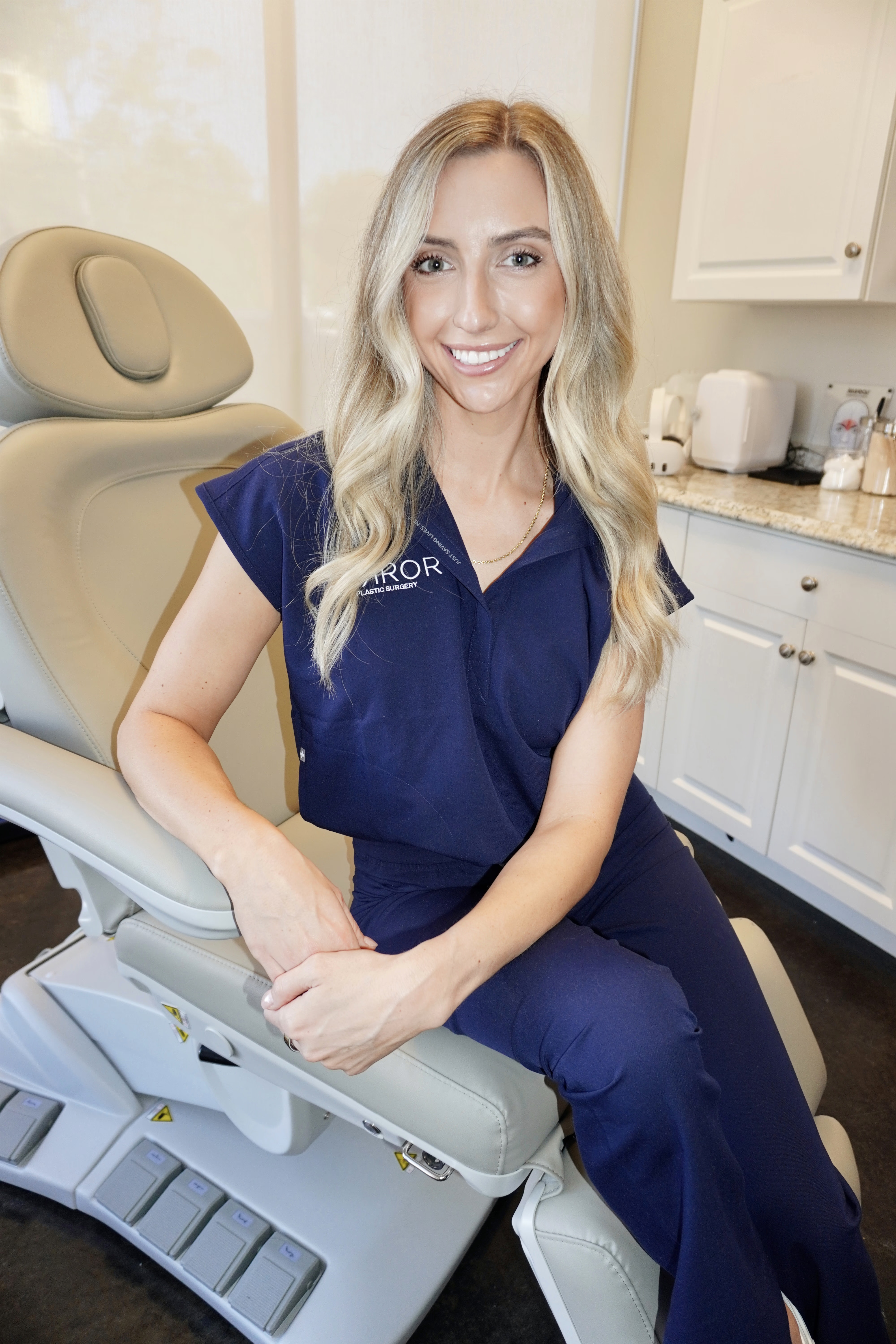
Meet Ellie Pranckevicius, FNP-BC
Ellie Pranckevicius is a board-certified Family Nurse Practitioner and Aesthetic Nurse Practitioner at Mirror Plastic Surgery. She holds a Bachelor’s in Health Science from Boston University, completed a 600-hour aesthetics licensure program, and earned both her BSN and MSN from the University of South Florida.
Before joining Mirror Plastic Surgery, she spent four years in the Neuroscience ICU at Tampa General Hospital, which sharpened her clinical judgment and deep understanding of human physiology. Her career began in 2019 at a high-end medical spa on Newberry Street in Boston, where she advanced from esthetician to medical esthetician.
This trajectory gives her a comprehensive command of both surface skin physiology and subdermal anatomy. Ellie currently welcomes new clients seeking full-face restorative treatments and non-surgical BBL services. Her practice follows the same philosophy as dentistry: professional treatments deliver results, and lasting outcomes depend on patient education and consistent maintenance.
Risks, Misconceptions, and Realistic Expectations
FDA guidance indicates that noninvasive body contouring technologies carry risks and that results may be temporary.1 A 2026 analysis of the FDA MAUDE database identified textural changes as the most frequently reported adverse event associated with RF microneedling devices from 2013 to October 2025.
All FDA-cleared devices carry indication-specific clearances, and off-label use shifts liability to the provider. Non-surgical results also require maintenance. Neuromodulators can last several months, while dermal fillers can last many months to a year or more depending on product and patient factors.1
Realistic expectations, set during a thorough consultation, strongly influence patient satisfaction. A provider who explains likely timelines, maintenance needs, and potential risks helps you make informed decisions and reduces the chance of disappointment.
Frequently Asked Questions
What qualifications should a non-surgical injector have at a Tampa medical spa?
In Florida, injectables must be administered by a licensed MD, DO, NP, PA, or RN operating under written physician protocols. A Nurse Practitioner such as Ellie Pranckevicius holds national board certification (FNP-BC) and a state APRN license, which authorizes injectable procedures under protocols.
Estheticians and medical assistants are never legally permitted to inject prescription products in Florida, regardless of vendor training certificates. Before booking, verify the injector’s license through the Florida Department of Health. You should also confirm that a qualified provider evaluates you clinically before any treatment begins.
How is a non-surgical BBL with Radiesse different from a surgical BBL?
A surgical BBL transfers the patient’s own fat cells to the gluteal region under general anesthesia, which requires significant recovery time. A non-surgical BBL uses biostimulatory fillers, primarily Radiesse (CaHA) and AlloClae, injected in-office without general anesthesia to stimulate the body’s own collagen production, refine shape, smooth cellulite, and correct asymmetries such as hip dips.
Results develop gradually over weeks to months as neocollagenesis progresses, with longevity extending beyond 30 months in clinical studies for CaHA.1 The non-surgical approach does not replace surgical volume for patients seeking dramatic augmentation. It offers a clinically meaningful option for patients who want regenerative enhancement, symmetry correction, or skin quality improvement.
Patient-specific dilution and injection planning remain essential for safe outcomes, so a detailed consultation is non-negotiable.
What is the difference between Morpheus8 and Ultherapy, and which is right for me?
Morpheus8 uses radiofrequency energy delivered through insulated microneedles into the dermis. This approach makes it effective for skin texture, mild-to-moderate laxity, and acne scarring across all Fitzpatrick skin types, with 24–48 hours of downtime per session. A standard series involves 3–4 treatments spaced 4–6 weeks apart.
Ultherapy uses high-intensity focused ultrasound (HIFU) to target the deeper SMAS layer, producing structural lifting effects that develop over 2–3 months after a single session with minimal downtime. The right choice depends on treatment depth goals, skin type, laxity severity, and downtime tolerance, which a full anatomical consultation can clarify.
Neither device is universally superior. Both require an FDA-authorized device and a trained, experienced operator for safe outcomes.
How do I know if a Tampa med spa is operating legally and safely?
Florida requires every med spa to designate a Florida-licensed physician as medical director with documented, substantive supervision, not a paper-only arrangement. Every provider must hold an active Florida license verifiable through the Department of Health, and the practice must maintain written protocols for every treatment.
Safe practices also maintain an adequate supply of hyaluronidase on site for filler emergencies and source products from legitimate distributors. Red flags include high-pressure sales tactics, inability to name the medical director or describe their involvement, no discussion of risks or contraindications, and same-day treatment without a prior clinical assessment.
Requesting to see the medical director’s credentials and the practice’s emergency protocol before booking is a reasonable and appropriate step for any prospective patient.
Conclusion: Choosing a Concierge-Level Tampa Med Spa
The distinction between a high-volume med spa mill and a concierge medical spa is clinical, not cosmetic. Volume-Safety Inversion occurs when business metrics override clinical judgment, and the cumulative safety risks are meaningful.
A reputable Tampa provider invests up to an hour in a structured, anatomy-driven assessment, matches provider credentials precisely to each modality, maintains all required Florida compliance documentation, and plans for long-term harmony rather than isolated quick fixes. In 2026, patient demand has shifted toward regenerative, biostimulatory treatments that deliver cumulative, natural-looking improvement, which rewards providers with deep anatomical knowledge and penalizes those relying on standardized protocols.
Mirror Plastic Surgery’s concierge model, led by Ellie Pranckevicius FNP-BC and overseen by Harvard-educated, Johns Hopkins-trained plastic surgeon Dr. Akash Chandawarkar, reflects this standard of care. Every treatment recommendation is supplier-neutral, evidence-based, and sequenced to support your anatomy and long-term well-being.
Book a consultation with Ellie at Mirror Plastic Surgery, located at 780 4th Ave S, St. Petersburg, FL 33701, or reach the practice by phone or text at 727-361-6515.
Disclaimer: Results may vary from person to person. Editorial content, before and after images, and patient testimonials do not constitute a guarantee of specific results.
1 Results may vary from person to person. Editorial content, before and after images, and patient testimonials do not constitute a guarantee of specific results.