
Written by: Ellie Pranckevicius, FNP-BC, Aesthetic Nurse Practitioner & Aesthetic Injector | Facial Restoration & Regenerative Injectable Specialist, Mirror Plastic Surgery | Last updated: July 5, 2026
Key Takeaways for Tampa Bay Executives
- Non-surgical treatments are rising among executives as video calls increase visibility and demand for subtle, low-downtime results.
- Top selection criteria include extended consultations, strict privacy, and a philosophy that protects natural expression over high-volume turnover.
- Executives should confirm injector credentials, consultation length, full-face assessment, supplier neutrality, and documented safety systems before booking.
- High-volume clinics and national chains often miss on personalization and oversight, while concierge models with surgical backup better support executive needs.
- Schedule your personalized consultation at Mirror Plastic Surgery for a 60-minute, full-face evaluation tailored to your schedule and goals.
Three Non-Negotiables for Executive Med-Spa Care
Time-respect means the practice builds appointments around your calendar, not its own throughput targets. Concierge medicine best practices include 30–60 minute appointments and same-day or next-day access, a standard that high-volume clinics rarely meet. This unhurried approach supports the second requirement, discretion, which includes physical privacy, confidential communication channels, and a patient volume low enough that staff recognize each client individually. Both time-respect and discretion reinforce the third requirement, a natural-results focus, which calls for a provider whose default philosophy is restoration and balance rather than volume maximization. Client preferences in 2026 are shifting toward subtle, restorative treatments that improve skin quality, symmetry, and tone rather than changing facial structure.
Executive Vetting Checklist for Tampa Bay Med Spas
- Verify injector credentials and clinical background. Confirm the injector holds an active advanced practice license (NP, PA, or MD) and has documented experience in a high-acuity clinical setting. ICU, emergency, or surgical backgrounds build rapid assessment skills and precision under pressure.
- Confirm consultation length before booking. A compliant med spa performs a Good Faith Exam (in-person or via telehealth) before initial treatment to assess medical history and potential complications. Any practice that skips this step or limits it to under 15 minutes signals a red flag.
- Ask about the full-face assessment approach. Isolated single-area injections without a whole-face evaluation increase the risk of asymmetry and an overdone appearance. Long-term maintenance planning restores volume where it naturally diminished rather than overfilling surface areas.
- Evaluate the practice’s supplier neutrality. A provider tied to a single brand’s quota may recommend products based on commission rather than your anatomy. Confirm the practice selects products based on individual patient factors.
- Review safety infrastructure. Medical oversight should include a medical director, documented emergency protocols, and ACLS-certified providers who can manage rare complications.
- Test communication responsiveness. Contact the practice before booking. Prompt, direct responses by call, text, or email signal the attentiveness that defines a genuine concierge experience.
Mirror Plastic Surgery’s approach reflects each item on this checklist in daily practice. Schedule your checklist-based evaluation with Ellie to experience a 60-minute assessment built around every point on this list.
How Tampa Bay Med-Spa Options Compare for Executives
The Tampa Bay market offers several practice types, and each serves executives differently across the three core criteria.
Option A — High-Volume General Aesthetic Clinic
Consultation length: typically 15–20 minutes. Injector credentials: variable, sometimes including licensed RNs with limited post-licensure training. Safety philosophy: standardized protocols applied broadly. Why executives choose this option: lower price point and broad appointment availability. Limitation: training requirements for RN injectors vary by state, which creates wide variation in anatomical depth and complication preparedness.
Option B — National Med-Spa Chain
Consultation length: 20–30 minutes. Injector credentials: standardized onboarding, with quality that varies by location. Safety philosophy: corporate protocols with regional oversight. Why executives choose this option: brand recognition and membership pricing. Limitation: single-ownership medical spas held the largest revenue share in 2025 because independent operators deliver more personalized services without corporate sales pressure.
Option C — Boutique Aesthetic Practice (Non-Physician-Led)
Consultation length: 30–45 minutes. Injector credentials: NP or PA with aesthetic-focused training. Safety philosophy: patient-centered with moderate anatomical depth. Why executives choose this option: more personalized than chains, with moderate wait times. Limitation: physician oversight and surgical backup may not be available on-site.
Option D — Concierge Med Spa with Surgical Oversight (Mirror Plastic Surgery)
Consultation length: up to 60 minutes. Injector credentials: FNP-BC with neuroscience ICU background and 600 hours of hands-on esthetics training. Safety philosophy: safety first, function second, aesthetics third, with Harvard and Johns Hopkins trained plastic surgeon oversight available. Why executives choose this option: unhurried full-face assessment, supplier-neutral product selection, and direct access to surgical expertise when needed.
Why Extended Consultations and Advanced Credentials Matter
Patients who understand the biology of their treatment before the first session achieve better outcomes because they complete the full treatment course and follow maintenance protocols.1 Building that understanding requires enough consultation time to explain options and answer questions. Mayo Clinic guidance notes that thorough pre-treatment consultations are essential for patient satisfaction and clear expectations before, during, and after treatment.
Ellie Pranckevicius, FNP-BC, at Mirror Plastic Surgery shows what advanced credentials look like in practice. Her four years in the Neuroscience ICU at Tampa General Hospital built the clinical judgment, anatomical precision, and emergency-response capability that high-acuity clinical backgrounds are specifically noted to provide. Her 600-hour esthetics licensure program and Master’s in Nursing from the University of South Florida add deep knowledge of both surface and subdermal anatomy.
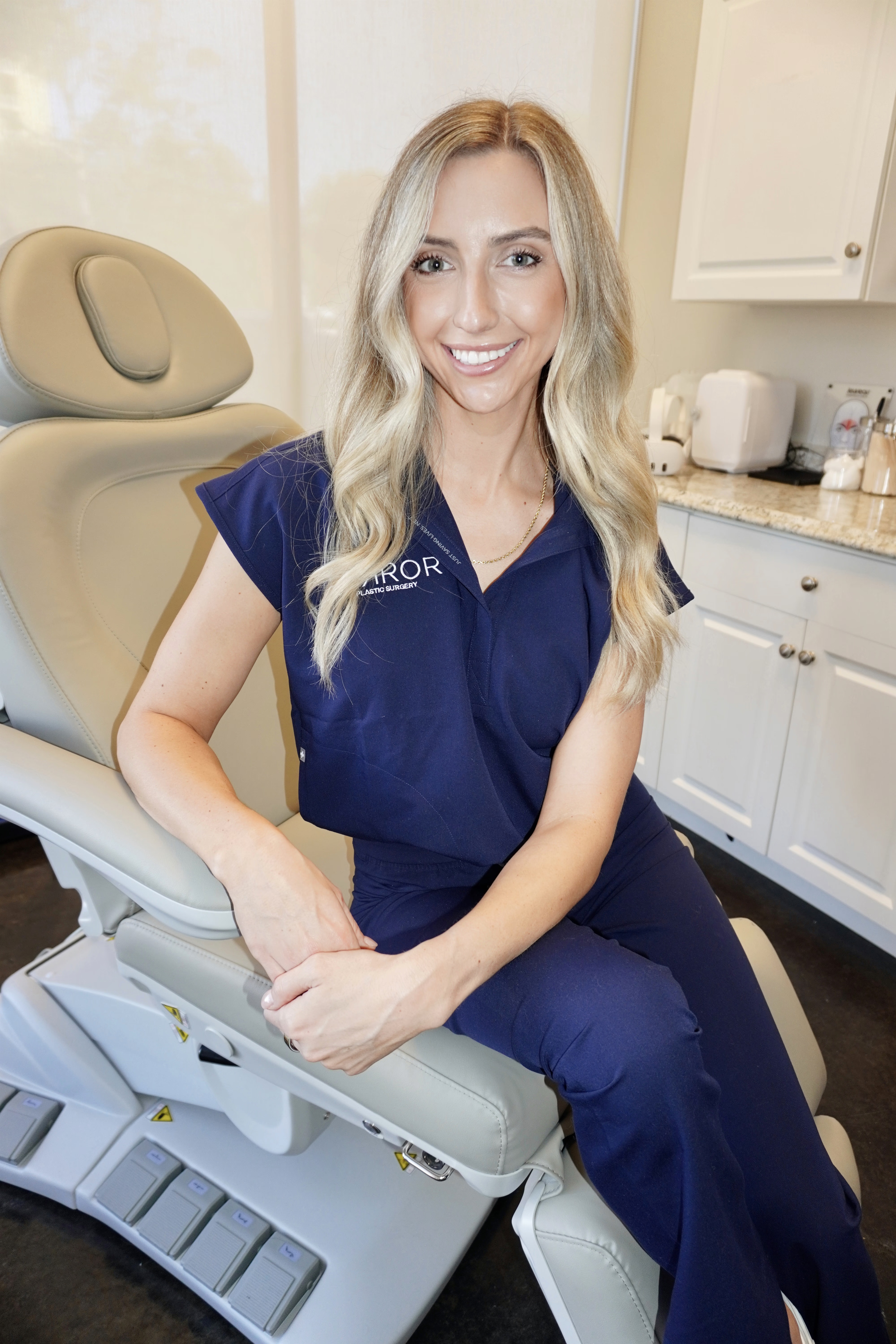
Patients treated by highly skilled master injectors often report higher satisfaction with their results.1 Ellie’s 60-minute assessments follow a structured top-to-bottom diagnostic framework, which addresses the full face before any single area. This approach helps prevent the asymmetry and overdone appearance that executives want to avoid. When non-surgical treatments reach their limit, Dr. Akash Chandawarkar, a Harvard-educated, Johns Hopkins-trained, fellowship-trained plastic surgeon, provides seamless surgical continuity within the same practice.
Experience Ellie’s ICU-informed approach firsthand by booking a full-face assessment with an injector whose clinical background matches the rigor of the treatments she performs.
Planning Natural, Long-Term Results
Conservative treatment that restores volume where it naturally diminished, such as cheeks and temples, while softening lines without freezing expression, defines the standard for long-term maintenance. Long-term maintenance in aesthetic medicine starts with conservative dosing in new patients, which allows gradual assessment of response and lowers the risk of complications like product migration or inflammatory reactions.1
Realistic timelines also matter. Non-surgical results often develop gradually over several months rather than producing immediate facelift-level changes.1 Ellie compares aesthetics to dentistry, where professional treatments create change but lasting outcomes depend on consistent maintenance. This analogy gives executives a practical way to plan treatment around their schedule instead of reacting only when visible decline appears.
Booking at Mirror Plastic Surgery Without Sales Pressure
Mirror Plastic Surgery accepts appointment requests by call, text, or email, and responds promptly in line with its concierge standard. The consultation focuses on education rather than sales. Ellie often advises clients when an expensive service is not yet necessary, which builds trust and removes the upselling dynamic common in high-volume clinics.
A good provider listens to your goals and does not push a laundry list of procedures. Mirror Plastic Surgery follows that principle. The practice is located at 780 4th Ave S, St. Petersburg, FL 33701, and can be reached at 727-361-6515 or hello@mirrorplasticsurgery.com.
Executive Scorecard: How Each Practice Type Performs
| Practice Type | Time-Respect (Consultation Length) | Discretion (Patient Volume Model) | Natural-Results Focus (Assessment Approach) |
|---|---|---|---|
| High-Volume General Clinic (Option A) | 15–20 minutes, high daily throughput | Low, high patient volume, standardized intake | Single-area protocols, limited full-face evaluation |
| National Med-Spa Chain (Option B) | 20–30 minutes, membership-driven volume | Moderate, brand recognition but corporate scale | Standardized menus, corporate sales pressure noted as a differentiator vs. independent operators |
| Boutique Non-Physician Practice (Option C) | 30–45 minutes, personalized but variable | High, smaller patient panels | Patient-centered, surgical backup typically off-site |
| Mirror Plastic Surgery — Concierge Med Spa (Option D) | Up to 60 minutes, meets concierge standard noted above | Very high, intentionally limited daily caseload and direct call or text access | Structured top-to-bottom full-face diagnostic, supplier-neutral, Harvard and Johns Hopkins surgical oversight on-site |
Summary for Executives and Next Step
Tampa Bay executives can use a clear framework when evaluating a concierge med spa. Verify credentials, confirm consultation length, assess the full-face philosophy, and confirm supplier neutrality and safety infrastructure. Across these criteria, Mirror Plastic Surgery’s model, including 60-minute assessments, Ellie Pranckevicius’s neuroscience ICU background, supplier-neutral product selection, and Dr. Akash Chandawarkar’s surgical oversight, addresses gaps that high-volume and chain practices often leave unresolved.
The practice’s safety-first, function-second, aesthetics-third hierarchy keeps every recommendation grounded in your anatomy and long-term well-being rather than a treatment menu or sales quota. Begin your concierge aesthetic journey at Mirror Plastic Surgery with an assessment that respects your time, protects your privacy, and prioritizes results that look like you, only more refreshed.
Disclaimer: Results may vary from person to person. Editorial content, before and after images, and patient testimonials do not constitute a guarantee of specific results.
Frequently Asked Questions
How do I know if a med spa is reputable?
A reputable med spa performs a Good Faith Exam (in-person or via telehealth) before any treatment to assess your medical history and potential complications. This step represents both an ethical standard and, in most states, a legal requirement for prescribing practitioners. Look for injectors with active advanced practice licenses (NP, PA, or MD), documented clinical backgrounds in high-acuity settings, and a practice that maintains emergency protocols and physician oversight.
Supplier neutrality offers another strong signal. A provider who recommends products based on your anatomy rather than brand quotas shows the kind of unbiased judgment that supports safe, natural outcomes. At Mirror Plastic Surgery, every non-surgical treatment begins with Ellie Pranckevicius’s 60-minute top-to-bottom assessment, and Dr. Akash Chandawarkar’s Harvard and Johns Hopkins training adds a surgical oversight layer that most standalone med spas cannot provide.
What should I expect during a consultation at a high-quality med spa?
A high-quality consultation explores your motivations for seeking treatment, reviews your medical history and current medications, and includes a structured physical assessment of the areas of concern. The provider explains recommended treatments, their rationale, expected timeline, realistic limitations, and maintenance requirements. You should also hear about reversibility, follow-up schedules, and what to do if you experience unexpected symptoms after treatment.
You should leave with a written or clearly communicated treatment plan, not just a receipt for services already sold. Ellie’s consultations at Mirror Plastic Surgery follow a structured diagnostic framework that evaluates the full face before addressing any individual area, so recommendations stay grounded in your overall anatomy rather than isolated concerns.
How do busy executives fit med-spa treatments into a demanding schedule?
The most time-efficient strategy is to choose a practice that consolidates assessment and planning into a single extended consultation. This approach avoids the multiple short visits that high-volume clinics often require to assemble a treatment plan. Treatments such as neuromodulators and many dermal fillers involve minimal downtime, so most executives return to professional obligations the same day.
Maintenance intervals, often every three to six months depending on the treatment, can be scheduled in advance and treated like any other recurring professional commitment. Mirror Plastic Surgery’s concierge model supports direct scheduling by call or text, with prompt responses that match the compressed timelines executives manage.
Why does an injector’s clinical background matter for natural-looking results?
Natural-looking results depend on the injector’s ability to visualize needle or cannula placement relative to nearby vessels, fat compartments, and muscle layers in real time. This skill goes beyond theoretical anatomical knowledge. Injectors with high-acuity clinical backgrounds, such as ICU or operating room experience, develop rapid assessment skills, precision under pressure, and emergency-response capability that translate into safer, more accurate injection technique.
This background also shapes conservative treatment planning. An injector who has managed life-threatening events approaches aesthetic procedures with risk-calibrated judgment that guards against overcorrection and complications. Ellie’s ICU background and dual training in critical care and aesthetics, detailed earlier in this article, represent the combination of clinical depth and aesthetic expertise that supports safer, more precise injection technique.
What is the difference between a concierge med spa and a high-volume clinic?
The primary difference lies in patient volume and time per patient. High-volume clinics prioritize throughput, which compresses consultation time, limits the depth of anatomical assessment, and creates environments where upselling becomes structurally incentivized. Concierge med spas intentionally limit daily caseloads to maintain unhurried appointments, direct provider access, and treatment plans built around individual anatomy and long-term goals rather than standardized menus.
The concierge model usually includes more responsive communication, such as direct call, text, or email access to the provider, and a continuity of care that high-volume practices rarely sustain. Mirror Plastic Surgery limits itself to one to two surgical cases per day and structures non-surgical appointments around the same philosophy, so every patient receives the full attention of the clinical team before, during, and after treatment.
1 Results may vary from person to person. Editorial content, before and after images, and patient testimonials do not constitute a guarantee of specific results.