
Written by: Ellie Pranckevicius, FNP-BC, Aesthetic Nurse Practitioner & Aesthetic Injector | Facial Restoration & Regenerative Injectable Specialist, Mirror Plastic Surgery | Last updated: August 8, 2026
Key Takeaways for Choosing Lip Filler
- The best dermal filler for lips comes from matching viscosity, flexibility, and longevity to your movement, volume, and maintenance goals, not from chasing a brand name.
- Restylane Kysse and RHA 3 often deliver the most natural movement in expressive lips, while Juvederm Volbella XC and Versa work well for mature lips with minimal swelling.1
- Provider expertise and a full-face anatomical assessment shape your results more than any single product label.
- HA fillers usually last 6–18 months. First-time results fade faster, and sun exposure or smoking can shorten that window.1
- Schedule a personalized consultation to receive an anatomy-first assessment and supplier-neutral treatment plan tailored to your goals.
Natural-Looking Lip Filler Options at Mirror
Restylane Kysse and RHA 3 consistently lead the conversation on natural lip movement. Both are designed for the constant motion of lip tissue during talking, eating, and smiling.
Restylane Kysse uses XpresHAn Technology to create a crosslinked HA gel with flexibility and support, so lips move naturally instead of looking stiff with expression. It is FDA-approved for lip augmentation and perioral wrinkle correction, and clinical data show 78% patient satisfaction at one year with Restylane Kysse.1 In Galderma’s 2020 phase IV Kissability study, 96% of subjects rated their lips as looking natural after treatment with Restylane Kysse.1
RHA fillers from Teoxane use longer HA chains that stretch and rebound with facial expressions, which helps maintain natural movement in dynamic areas such as the lips. RHA 3 especially suits patients who care most about how their lips look mid-expression during a laugh, conversation, or photograph, rather than only at rest.
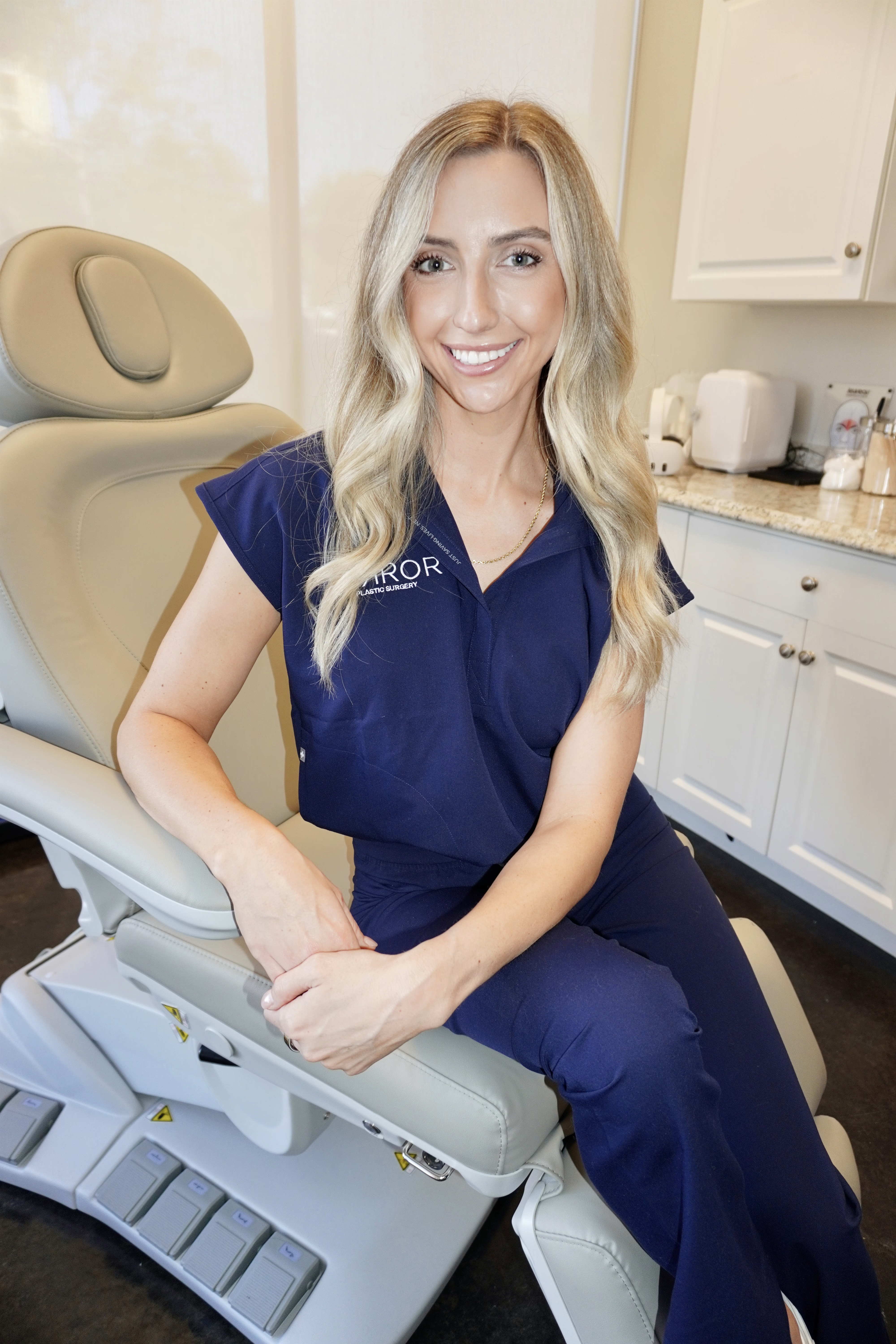
At Mirror Plastic Surgery, Ellie Pranckevicius evaluates lip mobility, tissue thickness, and existing asymmetries before choosing between these flexible fillers. The product follows your anatomy and goals, not the other way around.
Best Lip Filler Choices for Older Lips
Mature lips bring specific anatomical changes such as thinning vermilion, a longer upper lip, vertical perioral lines, and less elastic tissue. Dense fillers in this setting can create a stiff, unnatural look.
Juvederm Volbella XC suits subtle volume enhancement and smoothing vertical perioral lines with minimal initial swelling. This subtle effect works well for mature lips because its low hydrophilicity means less post-treatment puffiness, which helps patients who cannot have obvious downtime.
Versa is another low-viscosity option with a uniform spherical particle structure that integrates smoothly into thinning tissue. For patients with significant perioral lines along with volume loss, a layered approach using Volbella or Versa in the body and a trace of border definition product along the vermilion often creates more balanced results than a single-product treatment.
Proportion often matters more than sheer volume, and small adjustments to balance and shape can create a bigger visual improvement than simply enlarging the lips. Beyond product selection, Ellie’s full-face assessment at Mirror considers how age-related changes in the mid-face, jawline, and perioral region interact. Treating only the lips without that context frequently produces the “overdone” appearance patients want to avoid.
Matching Filler Type to Natural-Looking Results
The most natural-looking result comes from matching a product’s rheological properties to your tissue, not from choosing the most popular brand. For natural movement in mobile lip tissue, low-to-mid G’ gels such as Volbella, Kysse, and RHA Redensity are often preferred because they flow and integrate more smoothly than high-G’ gels like Voluma or Defyne, which resist deformation and can feel stiff.
A 2021 study found that cannula injections had lower odds of vascular occlusion compared with needle injections in filler procedures, and cannula technique also lowers the chance of uneven distribution that creates visible lumps.
Provider skill and anatomical knowledge influence lip filler safety and results more than the specific product brand.
Ellie’s approach at Mirror stays supplier-neutral. She selects from Juvederm, RHA, Versa, and Restylane based on what your anatomy requires, not on quotas or brand affiliations. Her Neuroscience ICU background at Tampa General Hospital trained her to read tissue response and make real-time clinical decisions, which supports precise, anatomy-first injection work.
Realistic Risks and Downsides of Lip Fillers
Lip fillers carry real considerations that every patient should understand before treatment. Over 90% of adverse events from HA fillers are mild and transient, usually limited to injection-site redness, swelling, and bruising. Severe complications from HA fillers remain rare.
Vascular occlusion is the most serious acute risk. Severe pain, blanching, or dusky color change at the injection site require immediate clinical attention. Cannula technique significantly reduces this risk, and every Mirror treatment session keeps hyaluronidase on hand for emergency dissolution.
Repeated overfilling with lip filler can distort normal lip proportions over time, while a measured plan that respects facial anatomy usually gives the most balanced long-term result. Ellie’s philosophy addresses this directly. She prioritizes foundational restoration before volume and tells patients honestly when more filler is not the right next step.
Reversibility offers a meaningful safety net. After hyaluronidase injection, HA lip filler can dissolve quickly. Hypersensitivity reactions to hyaluronidase remain uncommon when it is used to dissolve cosmetic filler.
How Long Lip Filler Results Usually Last
Hyaluronic acid lip fillers typically last 6–18 months as a cosmetic effect, and most patients notice meaningful fade between months 9 and 14.1 The lips metabolize filler faster than static facial areas because of constant mechanical stress from talking, eating, smiling, and pouting, which accelerates hyaluronic acid breakdown compared with areas like the cheeks or jawline.
First-time lip filler usually lasts 6–9 months because the body breaks down new product faster in untreated tissue, while repeat treatments often last 9–12 months due to residual baseline product.1 Lifestyle factors such as sun exposure, smoking, heavy exercise, and dehydration shorten duration, while daily SPF and hydration can modestly extend results.
A mini-boost at the 6-month mark can maintain plumpness and hydration without requiring a full syringe. Ellie builds individualized maintenance schedules at Mirror, with no one-size-fits-all timeline and no pressure to follow a rigid treatment calendar.
How Mirror Avoids Unnatural Lip Filler Results
Unnatural lip results usually come from volume placed without respect for the lip’s existing architecture. Duck lips often result from too much volume in the upper lip compared with the lower, loss of vermilion border definition from superficial or heavy placement, and excessive forward projection from overfilling the lip body.
Ellie’s approach at Mirror starts with a top-to-bottom facial assessment before any product is selected. She evaluates the upper-to-lower lip ratio, Cupid’s bow definition, vermilion border clarity, upper lip length, and how the lips relate to the nose, chin, and mid-face. Lips need balance with the nose, maxilla, and mandible, and profile assessment tools help determine whether additional perioral filler is required for overall harmony.
For first-time patients, experienced injectors often build volume over two sessions spaced 4–6 weeks apart instead of placing all product in one visit. This conservative plan respects the fact that first-time patients may metabolize filler faster and lowers the risk of overcorrection.
Reversibility stays part of every plan at Mirror. Hyaluronidase is available at every appointment, and Ellie documents product name, batch number, and volume injected so that dissolution, if needed, remains straightforward and complete.
Key Questions to Ask Your Lip Filler Injector
Before committing to a lip filler treatment, targeted questions help you identify anatomy-first providers rather than high-volume practices:
- Will you assess my full face, not just my lips, before recommending a product?
- Which specific filler are you recommending, and why does its viscosity suit my lip anatomy?
- What is your protocol if I experience a vascular complication during or after treatment?
- Do you have hyaluronidase on-site at every appointment?
- How do you document the product, volume, and batch number used in my treatment?
- What does a realistic maintenance schedule look like for my goals and metabolism?
- Under what circumstances would you advise me not to add more filler?
Why Mirror’s Assessment-First Approach Matters
The right lip filler choice comes only after a thorough look at your anatomy, movement patterns, age-related changes, and long-term goals. No single brand works best for everyone. Lip augmentation procedures using injectable materials totaled 1,449,565 in 2024, with HA fillers as the predominant type. The wide range of outcomes from that volume reinforces the assessment-first approach Ellie brings to every Mirror consultation.
At Mirror Plastic Surgery in St. Petersburg, Ellie Pranckevicius combines a Neuroscience ICU clinical background, 600 hours of hands-on aesthetics training, and a supplier-neutral philosophy in each lip consultation. Her focus stays on your lips looking balanced, natural, and moving the way lips should move.
Disclaimer: Results may vary from person to person. Editorial content, before and after images, and patient testimonials do not constitute a guarantee of specific results.
Frequently Asked Questions
What is the best lip filler for someone who has never had lip filler before?
For first-time patients, a low-viscosity, flexible hyaluronic acid filler such as Restylane Kysse or Juvederm Volbella XC usually offers a gentle starting point. These products integrate softly with lip tissue, allow natural movement during expressions, and create minimal swelling, which makes it easier to judge the result before adding more volume. Most experienced injectors recommend starting with 0.5 mL to 1 mL and building gradually over two sessions instead of placing maximum volume in a single appointment. Because HA fillers are fully reversible with hyaluronidase, first-time patients can adjust or dissolve results if the outcome does not match their expectations. At Mirror Plastic Surgery, Ellie conducts a full-face assessment before choosing any product so that the starting volume and formulation match your specific anatomy rather than a standard protocol.
Can lip fillers look natural on older lips?
Lip fillers can look natural on older lips when the approach respects age-related anatomical changes that differ from younger tissue. Mature lips often show a longer upper lip, reduced vermilion definition, vertical perioral lines, and thinner, less elastic tissue. Dense, high-viscosity fillers in this setting increase the risk of a stiff, unnatural result. Lower-viscosity options such as Juvederm Volbella XC or Versa tend to suit mature lips because they integrate smoothly without adding excessive projection or rigidity. A skilled injector also evaluates how the lips relate to the mid-face, jawline, and perioral region, since volume loss in surrounding areas often contributes to thin or aged-looking lips. Ellie’s full-face assessment at Mirror is designed to identify these contributing factors before any filler is placed.
How do I know if my lip filler has been overdone or if I need it dissolved?
Signs of overdone lip filler include lips that protrude past the natural facial profile from the side, loss of Cupid’s bow definition, a shelf-like or sausage appearance, visible product migration above the vermilion border, or lips that feel stiff and do not move naturally with expression. If you notice any of these issues, hyaluronidase dissolution offers a safe and well-established option. HA lip filler volume can decrease significantly within the first day after hyaluronidase injection. The lips return to their natural pre-treatment baseline, and new filler can be placed after a waiting period of at least two weeks. At Mirror Plastic Surgery, Ellie is experienced in both corrective dissolution and re-treatment planning and approaches these consultations with the same honesty and anatomical rigor as any new patient assessment.
How often will I need maintenance treatments to keep my lip filler results?
Maintenance frequency depends on the product used, your metabolism, lifestyle factors, and the initial volume placed. Many patients notice fade between months 9 and 14, while first-time patients often see results diminish closer to the 6-to-9-month range because untreated tissue metabolizes new filler faster. A conservative mini-touch-up around the 6-month mark can maintain hydration and shape without requiring a full syringe. High lip movement, sun exposure, smoking, heavy exercise, and dehydration can speed breakdown. The right maintenance plan aligns with your goals, budget, and how your lips respond over time, rather than a rigid schedule. Ellie builds individualized maintenance roadmaps at Mirror and does not pressure patients into treatments that are not yet necessary.
Is Mirror Plastic Surgery the right choice for lip fillers if I have had a bad experience elsewhere?
Mirror Plastic Surgery is structured to address common causes of poor lip filler outcomes such as rushed consultations, limited anatomical assessment, and provider incentives tied to volume instead of results. Ellie spends up to an hour in the initial consultation, performing a top-to-bottom facial assessment that evaluates the lips, perioral region, mid-face, and facial profile. She remains supplier-neutral, so product recommendations are based on your anatomy and goals, not on brand affiliations or quotas. Her Neuroscience ICU background at Tampa General Hospital means she is trained to recognize and manage complications quickly and calmly. If you have experienced asymmetry, unnatural results, or a lack of transparency from a previous provider, a consultation at Mirror is designed to give you the honest, anatomy-first assessment that should have started your treatment journey.
1 Results may vary from person to person. Editorial content, before and after images, and patient testimonials do not constitute a guarantee of specific results.