
Written by: Ellie Pranckevicius, FNP-BC, Aesthetic Nurse Practitioner & Aesthetic Injector | Facial Restoration & Regenerative Injectable Specialist, Mirror Plastic Surgery | Last updated: July 8, 2026
Key Takeaways
- Botox pricing in St. Petersburg reflects injector credentials, product authenticity, and assessment depth more than unit count alone.
- Provider training, dilution practices, and supplier selection directly influence both safety and treatment outcomes.1
- Typical unit ranges vary by area, and forehead, glabella, and crow’s feet are often treated together in one visit.
- Masseter treatments for TMJ use higher volumes and work best with a provider experienced in neuromuscular assessment.
- Schedule your personalized consultation at Mirror Plastic Surgery to receive a transparent, anatomy-based treatment plan.
Why Botox Prices Vary Among St. Petersburg Providers
Botox prices differ across St. Petersburg because each practice makes different choices about training, product quality, and time spent with patients.
Injector credentials and training depth. No federally mandated Botox certification exists in the United States, so legal authority comes from a provider’s state license and scope-of-practice laws. However, true competency in facial anatomy, injection technique, and complication management requires dedicated education beyond basic licensure. Providers who complete advanced anatomical training, supervised live-patient hours, and ongoing medical education usually charge more, and they tend to deliver more predictable outcomes.1
Dilution practices. Botox arrives as a powder and must be mixed with saline before injection. The saline-to-powder ratio directly affects potency per unit. Over-diluted product delivers fewer active molecules per stated unit, so patients may need retreatment sooner without understanding why results faded quickly.1
Consultation length and assessment depth. A rushed five-minute intake cannot match the detail of an hour-long, top-to-bottom assessment. Practices that spend time evaluating muscle strength, facial symmetry, and long-term goals build that clinical work into their pricing.
Supplier selection and product authenticity. The CDC has received more reports of harmful reactions, including difficulty swallowing and breathing, after injections with botulinum toxin products from unlicensed online sources that were not FDA-approved, counterfeit, or unlabeled. Practices that buy only from licensed pharmaceutical distributors pay higher product costs, and that difference appears in their fees.
Red flags to watch for: These warning signs often appear together and usually signal that a clinic prioritizes volume and profit over safety and outcomes.
- Providers who cannot explain their product source or show a labeled vial before injection (suggests questionable sourcing)
- Consultations shorter than 15 minutes with no anatomical assessment (indicates rushed, formulaic treatment)
- Opaque per-unit pricing that changes at checkout (reflects lack of transparency)
- Pressure to purchase bundled units before a clinical evaluation (prioritizes sales over clinical need)
Schedule your transparent consultation to receive an anatomy-based treatment plan with no upselling pressure.
Per-Unit and Per-Area Botox Pricing in St. Petersburg
The table below shows typical unit ranges by treatment area based on current clinical practice. Each person’s anatomy, muscle strength, and goals differ, so actual unit counts and session costs are finalized during a personalized assessment. Specific dollar figures are not listed here, and pricing is shared during consultation.
| Treatment Area | Typical Unit Range | Key Dosing Variable |
|---|---|---|
| Forehead lines | 10–30 units | Muscle depth, forehead size, desired movement |
| Glabellar lines (11s) | 20–25 units | Static vs. dynamic lines, corrugator activity |
| Crow’s feet | 10–30 units total (both sides) | Orbicularis oculi thickness, smile preservation |
| Masseter / TMJ | 40–100 units total (both sides) | Muscle bulk, bite force, functional vs. cosmetic goal |
| Lip lines / lip flip | 4–6 units | Upper lip muscle activity, desired eversion |
| Bunny lines | 8–12 units | Nasalis muscle strength |
| Chin dimpling | 4–8 units | Mentalis activity, skin texture |
| Brow lift | 8 units | Depressor muscle balance, desired arch |
The three most frequently treated areas, forehead, glabella, and crow’s feet, deserve a closer look because they are often combined in one session and make up most first-time Botox treatments.
Units Needed for Forehead, Glabella, and Crow’s Feet
These three zones are the core of many cosmetic Botox plans and often share a single treatment visit.
Forehead. Most patients fall within the 10–30 unit range for forehead lines, and first-time patients usually start at 10–15 units to see how their muscles respond before adjusting dosage. Men often need more units than women for the same area because of larger, stronger facial muscles, so forehead lines may require 20–30 units in men versus 15–20 units in women.
Glabella (11 lines). Glabellar lines typically need 15 to 25 units total, depending on how active the corrugator and procerus muscles are. Deeper static lines that show at rest usually sit at the higher end of that range.
Crow’s feet. Crow’s feet often require 5–15 units per side, or 10–30 units total, with lighter placement to keep your smile natural. The orbicularis oculi muscle is thinner than the frontalis, so precise placement matters more than sheer volume.
A conservative first-time treatment that combines forehead, glabella, and crow’s feet usually totals about 30–50 units. A broader full-face plan that adds more areas can reach 40–80 units total, depending on anatomy and goals.
Typical Botox Dosing and Cost Considerations for TMJ
Masseter Botox for TMJ dysfunction, bruxism, or jaw slimming uses higher unit volumes than standard facial areas, so session cost rises accordingly.
Masseter treatment usually needs 15–30 units per side, or 30–60 units total, with dosing based on muscle bulk and bite force. Full effect can take 2–4 weeks and may gradually slim the jawline over time.1 At the upper clinical range, some providers treat both sides with 40–100 units total when muscle hypertrophy is significant.
TMJ treatment involves functional goals such as pain relief and bite force reduction, so the assessment should cover symptom severity as well as appearance. Providers who skip this functional review and rely on a fixed unit count are not offering individualized care. At Mirror Plastic Surgery, Ellie’s neuroscience ICU background supports a deep understanding of neuromuscular physiology, which helps her evaluate masseter cases in a more holistic way.
Choosing Between Botox, Dysport, and Daxxify
Botox (onabotulinumtoxinA) and Dysport (abobotulinumtoxinA) are both FDA-approved cosmetic botulinum toxin products, yet they differ in onset, spread, unit conversion, and cost structure.
| Characteristic | Botox | Dysport |
|---|---|---|
| FDA approval (cosmetic) | Yes | Yes (glabellar lines, April 2009) |
| Onset | 3–7 days typical | 2–3 days, peak at 10–14 days |
| Diffusion pattern | Precise, localized | Broader spread, suited for large areas like forehead |
| Duration | 3–4 months typical | 3–4 months typical |
| Unit interchangeability | Not interchangeable with Dysport | Not interchangeable, dosing must be adjusted by an experienced injector |
Daxxify (daxibotulinumtoxinA-lanm) is a newer option that is FDA-approved for glabellar lines and designed for longer duration, with a median response of about 6 months in phase-3 trials and some patients seeing results up to 9 months.1 Its tighter diffusion profile suits precise work in delicate areas. Mirror Plastic Surgery uses a supplier-neutral approach and selects the neuromodulator that best fits each patient’s anatomy, treatment area, and goals, rather than favoring a specific brand.
Botox Considerations in Your 40s, 50s, and 60s
Age alone does not rule out neuromodulator treatment. Muscle strength, line depth, skin quality, and goals such as prevention, correction, or maintenance matter more.
Patients in their 40s often show a mix of dynamic lines that respond well to neuromodulators and early static lines that may benefit from pairing Botox with dermal fillers. Muscle activity usually remains strong, so some patients need higher unit counts for full relaxation.
Patients in their 50s and 60s may have deeper static lines, less skin elasticity, and volume changes that neuromodulators alone cannot fully correct. Botox still helps reduce muscle-driven movement and soften expression lines.1 A holistic assessment that considers volume loss, skin laxity, and dynamic muscle activity creates more natural results than treating a single area in isolation.
The idea of being “too late” for Botox matters less than whether treatment fits into a complete facial plan. Ellie’s full-face philosophy keeps neuromodulator dosing aligned with each patient’s current anatomy instead of relying on a formula.
Meet Your Injector: Ellie Pranckevicius
Ellie Pranckevicius, FNP-BC, is Mirror Plastic Surgery’s Aesthetic Nurse Practitioner and focuses on neuromodulators and dermal fillers. Her clinical background is unusually broad for an aesthetic injector.
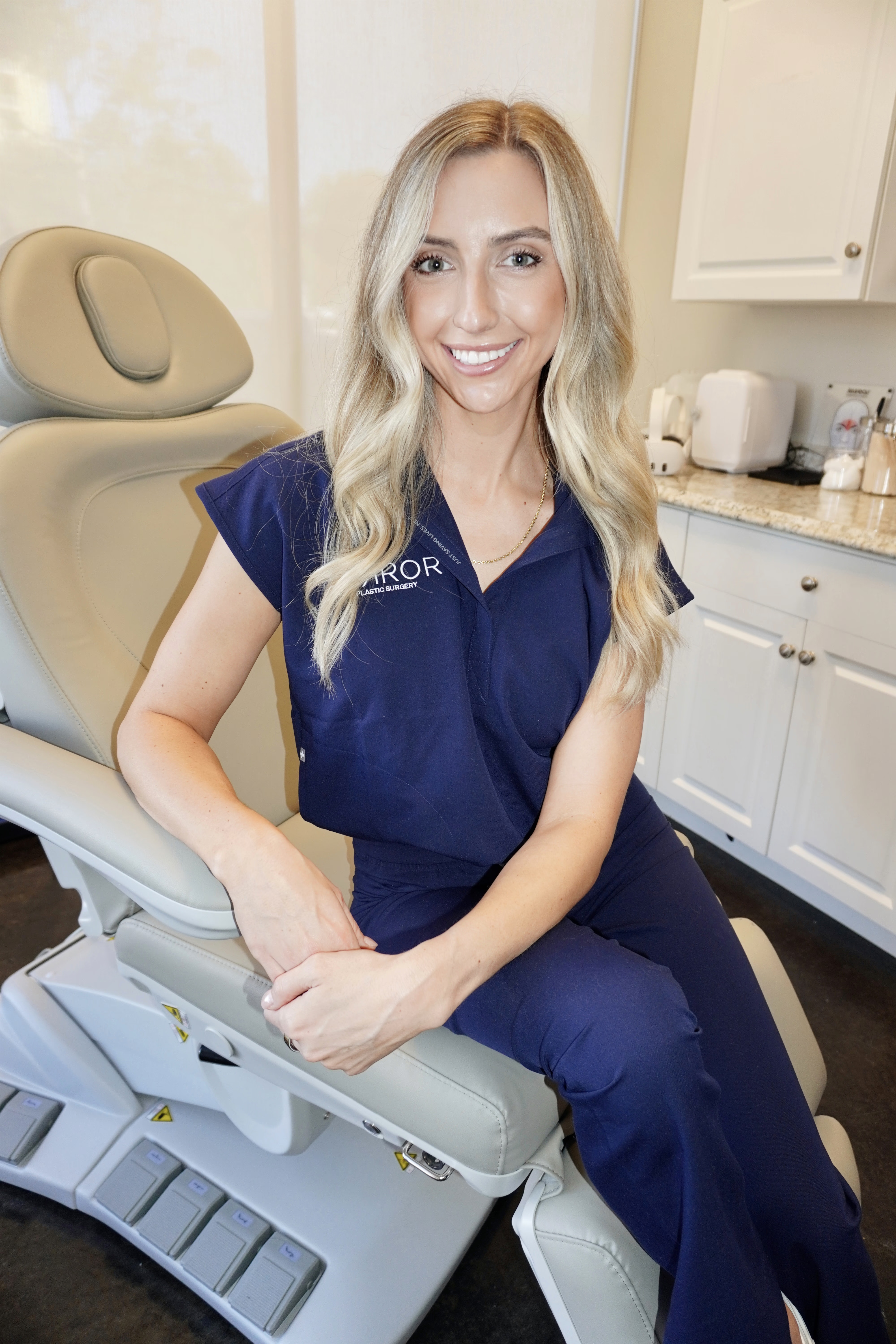
Before joining Mirror Plastic Surgery, Ellie spent four years in the Neuroscience ICU at Tampa General Hospital, caring for critically ill patients and gaining a deep, practical understanding of human physiology and neuromuscular function. That foundation shapes her approach to neuromodulator dosing, especially for complex areas such as the masseter, trapezius, and periorbital region.
Her aesthetic training includes a 600-hour hands-on esthetics licensure program, a Bachelor’s in Health Science from Boston University, and both a Bachelor’s and Master’s in Nursing from the University of South Florida. She began her aesthetic career in 2019 at a high-end medical spa on Newberry Street in Boston, moving from esthetician to medical esthetician and then into advanced nursing practice.
This dual background in esthetics and advanced nursing gives Ellie a layered view of skin physiology, surface anatomy, and subdermal structures that many injectors develop on only one side. Her treatment philosophy centers on full-face harmonization, so she treats the upper, middle, and lower face as a connected system and avoids the asymmetry and overdone look that can follow single-zone injections.
Ellie is currently welcoming new clients who want full-face restorative neuromodulator treatments. Experience a full-hour assessment designed around your anatomy and long-term goals.
How Mirror Plastic Surgery Differs from High-Volume Clinics
The St. Petersburg and Tampa Bay area includes everything from discount, high-volume clinics to boutique concierge practices. These differences affect safety, experience, and results.
| Factor | High-Volume Mill | Mirror Plastic Surgery |
|---|---|---|
| Consultation length | 5–15 minutes typical | Up to one hour, top-to-bottom holistic assessment |
| Product sourcing | May vary, supplier relationships not always disclosed | Supplier-neutral, only FDA-approved products from licensed distributors |
| Dilution risk | Over-diluted product possible at lower price points | Certified product integrity, dosing tied to clinical outcome, not volume quotas |
| Treatment philosophy | Area-by-area, often reactive to patient requests | Full-face harmonization, safety first, function second, aesthetics third |
Red Flags When Choosing a Botox Provider
The CDC advises confirming that your provider holds a valid healthcare license, is trained in administration, and draws product from a labeled vial into the syringe while you watch. Beyond those basics, the patterns below deserve caution.
- Consultations that skip medical history or fail to assess muscle strength and facial anatomy before recommending units
- Pricing that changes between the consultation and the treatment room
- Providers who cannot name the specific FDA-approved product or show the labeled vial
- Clinics offering injections in non-medical settings such as homes, salons, or pop-up events
- In Florida, esthetician licenses alone do not permit Botox administration, so only licensed healthcare professionals such as physicians, nurse practitioners, physician assistants, and dentists within defined scopes may inject
- Pressure to buy large prepaid unit packages before any clinical evaluation
Frequently Asked Questions
How much is 20 units of Botox typically?
Twenty units of Botox usually sit at the lower end of a single-area cosmetic treatment. This amount can cover a conservative forehead treatment in a first-time patient with lighter lines or a partial glabellar treatment. Pricing at Mirror Plastic Surgery is personalized and set during consultation based on your anatomy, muscle activity, and goals, so no fixed per-unit figure appears online. Placement quality, certified product, and proper concentration matter more than the unit count. An under-dosed or over-diluted treatment that needs correction within six weeks does not save money and instead increases total cost.
What is the 4-hour rule after Botox?
The 4-hour rule advises patients to stay upright and avoid lying down, bending forward, or pressing on treated areas for at least four hours after injection. This guideline helps reduce the risk of the neurotoxin moving away from the intended injection site before it binds to target muscle receptors. Standard post-care also usually includes avoiding strenuous exercise, heavy heat exposure such as saunas or hot yoga, and facial massage for 24 hours. Your provider will review personalized aftercare instructions based on the areas treated and the product used.
Will Botox work on a 70-year-old woman?
Botox can still work at 70, although the clinical picture becomes more complex than at younger ages.1 Neuromodulators treat dynamic wrinkles caused by repeated muscle movement. By 70, many lines have become static, meaning they remain visible at rest and are not driven mainly by muscle contraction. Botox softens the dynamic component of those lines but will not erase deep creasing or correct volume loss and skin laxity.1 A thorough assessment is especially important for older patients because the balance between muscle activity, volume deflation, and skin quality determines whether neuromodulators alone or a combined approach will look natural and satisfying. There is no strict upper age cutoff for Botox; the key question is whether it is the right tool for the concern being treated.
Conclusion and Next Steps
Comparing average Botox cost in St. Petersburg, Florida requires more than checking per-unit rates. The factors that decide whether treatment is safe, effective, and worth the investment, such as injector credentials, product integrity, dilution practices, and assessment depth, do not appear on a simple price list. Patients who value an hour-long holistic evaluation over the lowest quote usually see more natural, longer-lasting results with fewer complications and corrections.1
Mirror Plastic Surgery’s concierge model supports that standard with a top-to-bottom anatomical assessment, supplier-neutral product selection, and a full-face treatment philosophy that avoids the asymmetry and overdone look that rushed, isolated injections can create. Ellie Pranckevicius brings a rare blend of neuroscience ICU experience and advanced aesthetic training to every consultation.
Get your personalized neuromodulator assessment at Mirror Plastic Surgery in St. Petersburg, Florida.
Disclaimer: Results may vary from person to person. Editorial content, before and after images, and patient testimonials do not constitute a guarantee of specific results.
1 Results may vary from person to person. Editorial content, before and after images, and patient testimonials do not constitute a guarantee of specific results.