
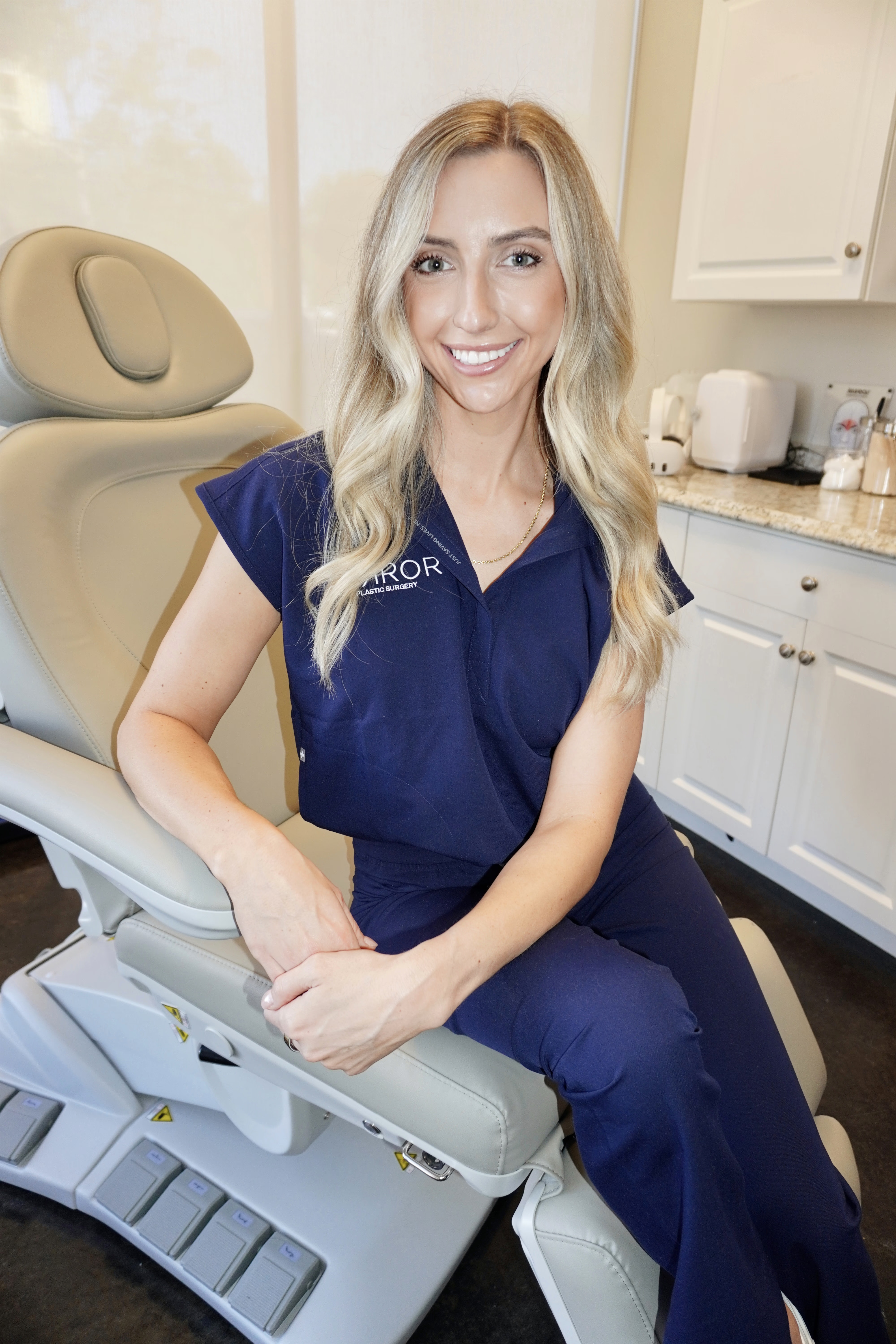
Written by: Ellie Pranckevicius, FNP-BC, Aesthetic Nurse Practitioner & Aesthetic Injector | Facial Restoration & Regenerative Injectable Specialist, Mirror Plastic Surgery | Last updated: July 10, 2026
Key Takeaways
- A thorough pre-treatment consultation is the most effective way to reduce hip dip filler risks through anatomy mapping, medical review, and product selection.
- Most patients experience temporary redness, swelling, bruising, tenderness, and itching that resolve within a few days to two weeks.1
- Serious risks such as infection, asymmetry, product migration, vascular occlusion, and nodule formation are rare but closely linked to provider expertise and technique.1
- Choosing a qualified provider who follows strict safety protocols, uses branded products, and maintains clear emergency procedures helps you avoid red-flag practices.
- Schedule a consultation with Ellie at Mirror Plastic Surgery to receive a personalized hip dip assessment and discuss the safest approach for your anatomy.
The Role of a Thorough Consultation in Risk Reduction
Your consultation establishes the foundation for safe treatment by mapping anatomy, reviewing medical history, and tailoring protocols to your body. During this visit, Ellie evaluates your hip structure, skin quality, and lifestyle to determine whether hip dip filler is appropriate. She also reviews your medications, allergies, and prior procedures to identify any added risks. Together, you discuss product options, expected timelines, and realistic outcomes so you understand each step before treatment begins.
Schedule your pre-treatment consultation to begin your personalized hip dip assessment at Mirror Plastic Surgery in St. Petersburg, FL.
Common Temporary Side Effects After Hip Dip Filler
Most patients experience a predictable set of short-lived reactions after hip dip filler injections. Knowing these in advance helps you recognize normal healing and separate it from warning signs that need medical attention.
- Redness, which appears as mild surface redness at injection sites and typically resolves within a few days.1
- Swelling, which causes pressure and fullness that improves within one to two days and usually subsides within 7 to 14 days.1
- Bruising, which can last about one week and may be reduced by avoiding blood-thinning agents before treatment, when medically appropriate.1
- Tenderness, which feels like mild soreness or pain and is usually manageable with over-the-counter pain relievers approved by your provider.
- Itching, which is typically mild and temporary and fades within a few days.
Serious Risks Including Migration and Vascular Occlusion
Some complications go beyond temporary side effects and require prompt medical evaluation. These serious risks occur infrequently but carry meaningful consequences, and their likelihood is strongly tied to provider skill, product choice, and injection volume.
- Infection, which becomes more likely with larger filler volumes in the gluteal area because of friction, pressure, and slower healing. Symptoms include swelling, redness, warmth, or abscess formation that may require drainage or antibiotics.
- Asymmetry, which may appear after hip dip filler when one side heals differently than the other. Minor asymmetry is often correctable with additional treatment once healing is complete.
- Product migration, which occurs when filler shifts from the injection site due to gravity or normal tissue movement. This movement can create uneven contours or asymmetry and may require dissolution or further treatment to correct.
- Vascular occlusion, which happens when filler enters or compresses a blood vessel in the gluteal region and blocks blood flow. This complication can lead to tissue necrosis and represents a medical emergency that needs immediate intervention. Isolated deaths have been reported in connection with high-volume gluteal filler procedures.
- Nodule formation, which can develop in a small percentage of patients. Biostimulatory fillers such as Sculptra cannot be dissolved like some other fillers, so careful technique and consistent aftercare play a crucial role in prevention.
Because these complications can be serious, understanding them helps you ask better questions and choose a provider who prioritizes safety at every step.
Questions to Ask at Your Consultation
A qualified provider welcomes detailed questions because transparency about technique, products, and emergency planning supports safer treatment. The following checklist highlights topics that matter most for your safety and outcome.
- Provider credentials — Ask about clinical background, licensure, and specific training in body contouring anatomy. Clarify how many hip dip filler procedures the provider has performed and how often.
- Product selection rationale — Ask which biostimulatory filler is recommended for your anatomy and why. Confirm whether this use is FDA-approved or off-label so you understand the regulatory context.
- Reversibility — Confirm that Sculptra, or any other poly-L-lactic acid product, is not reversible like some hyaluronic acid fillers. Discuss how this affects your treatment plan if you dislike the results or experience complications.
- Aftercare protocol — Ask whether you will receive clear written aftercare instructions, including a structured massage plan such as the 5-5-5 rule, to support even collagen stimulation and reduce nodule risk.
- Emergency protocols — Confirm that reversal agents are available on-site when appropriate and ask about the specific steps your provider will take if you show signs of vascular occlusion after leaving the office.
Red Flags When Choosing a Hip Dip Filler Provider
Certain provider behaviors and facility conditions signal that a hip dip filler procedure may not meet basic safety standards. Recognizing these warning signs helps you walk away before treatment begins.
- No medical setting, such as treatment offered in a home, hotel, or salon room instead of a licensed medical facility.
- No informed consent form, including the absence of written disclosure about risks like nodule formation, infection, and irreversibility.
- Pressure tactics or same-day discounts, such as deep discount offers that push you to commit immediately.
- Unbranded or unidentified product, including refusal to name the injectable or use of products falsely marketed as FDA-approved fillers.
- Unrealistic outcome promises, such as claims that hip dips will be completely eliminated or that the procedure carries no risk.
- No anatomical training specific to the gluteal region, even though the area contains large, deep veins that require precise injection depth and detailed anatomical knowledge.
- No medical history review, including proceeding without a health history, medication review, or written aftercare instructions.
Recovery Do’s and Don’ts for Hip Dip Filler
Post-treatment care directly affects both your safety and the quality of your results. The following table outlines key actions to follow and activities to avoid during the early recovery period.
| Do | Don’t |
|---|---|
| Follow the massage protocol discussed during your consultation to support even product distribution and collagen stimulation. | Avoid strenuous exercise and heavy lifting for at least 24 to 48 hours after treatment. |
| Attend all scheduled follow-up appointments so your provider can review progress photos and assess your healing. | Do not apply pressure or sit directly on treated areas during the first 24 hours. |
| Contact your provider immediately if you notice unusual firmness, new lumps, or worsening redness. | Do not take blood-thinning agents such as ibuprofen, aspirin, Vitamin E, or fish oil in the days after treatment without guidance from your provider. |
When to Seek Urgent Care After Hip Dip Filler
Certain symptoms after hip dip filler require immediate contact with your provider or emergency services. Do not wait to see whether these issues improve on their own.
- Increasing or severe pain at or beyond the injection site that worsens instead of improving over time.
- Skin color changes, including blanching, mottling, or darkening of the skin, which may signal vascular occlusion and possible tissue damage.
- Fever or systemic symptoms, which can indicate infection that may need antibiotic treatment.
- Hard lumps or nodules that do not soften with massage within the expected timeframe and may reflect improper product placement.
- Shortness of breath or chest pain, especially after large-volume gluteal procedures, because embolic events can occur when filler enters a blood vessel and travels to vital organs. Call emergency services immediately in this situation.
Current Standards for Safer Hip Dip Filler Treatment
The field of non-surgical hip and gluteal contouring now favors biostimulatory fillers and conservative volume strategies. Products such as Sculptra and Radiesse are often preferred for hip dip correction because they create gradual collagen stimulation over 12 to 24 weeks and a more natural tissue feel. All hip dip filler applications remain off-label, and the FDA advises against using dermal fillers for body contouring procedures such as buttock augmentation or hip dip filling, even when those products hold facial indications.
Modern safety standards emphasize slow, controlled filler placement with constant attention to tissue resistance during injection. Post-treatment monitoring typically includes standardized photography, written aftercare instructions, confirmation of the next visit, and direct provider access for the first 72 hours. Accredited facilities follow strict sterilization procedures and maintain trained staff and emergency medications on-site to reduce infection and vascular risks.
At Mirror Plastic Surgery, Ellie Pranckevicius combines four years of Neuroscience ICU experience at Tampa General Hospital with dual esthetician and advanced nursing training. This background supports the clinical judgment and anatomical precision required for safe hip dip filler treatment. Mirror’s supplier-neutral approach means product selection is based on your anatomy and goals rather than brand quotas. Discuss your biostimulatory options with Ellie to determine which approach fits your individual anatomy.
Frequently Asked Questions
Who is a good candidate for hip dip filler?
Good candidates are generally healthy adults who are not pregnant or breastfeeding and who do not have active infections or autoimmune flares. They also hold realistic expectations about the gradual nature of biostimulatory results. Individuals on anticoagulant therapy, isotretinoin within the past six months, or immunosuppressive medications need a detailed medication review before treatment. Patients with very loose skin in the hip region may benefit more from alternative approaches. A thorough anatomical assessment during your consultation provides a more accurate candidacy decision than any general checklist.
Can hip dip filler be reversed?
Reversibility depends entirely on the product used. Biostimulatory fillers such as Sculptra and Radiesse cannot be enzymatically dissolved and instead are gradually metabolized by the body. This irreversibility makes injector skill, precise placement, and correct dilution essential, because same-day correction is not available if technique errors occur. AlloClae, a regenerative body filler made from human-derived donor fat cells and extracellular matrix proteins, is another option at Mirror Plastic Surgery for hip dip correction with minimal downtime. During your consultation, Ellie reviews the reversibility profile of each product under consideration for your anatomy.
How long do results last and what maintenance is needed?
Result longevity varies by product and by individual healing.1 Sculptra-based hip dip correction usually produces gradual collagen-driven improvements that last more than two years and may extend up to five years with maintenance sessions. Radiesse results often last 12 to 18 months.1 Most biostimulatory protocols require two to four treatment sessions spaced 4 to 6 weeks apart to reach the desired volume and symmetry. Post-treatment massage several times daily during the first days is a required maintenance step for biostimulatory fillers because it strongly influences whether the product spreads evenly or forms nodules.
What makes Ellie Pranckevicius’s approach different?
Ellie holds a Family Nurse Practitioner board certification (FNP-BC), a Master’s in Nursing from the University of South Florida, and 600 hours of hands-on esthetics training. This combination gives her detailed knowledge of both surface skin physiology and deeper subdermal anatomy. Her Neuroscience ICU experience sharpened her ability to recognize early signs of complications and respond quickly in high-stakes situations. At Mirror Plastic Surgery, consultations can last up to an hour and cover your anatomy, medical history, aesthetic goals, and emotional motivations before any recommendation is made. Mirror’s supplier-neutral philosophy means Ellie selects products based on what best matches your tissue characteristics, following a safety-first, function-second, aesthetics-third framework for every treatment plan.
Start your personalized assessment at Mirror Plastic Surgery, located at 780 4th Ave S, St. Petersburg, FL 33701, or reach the team by phone or text at 727-361-6515.
Disclaimer
Disclaimer: Results may vary from person to person. Editorial content, before and after images, and patient testimonials do not constitute a guarantee of specific results. All procedures, including non-surgical injectable treatments, carry inherent risks. The information provided in this article is for educational purposes only and does not constitute medical advice. Consult a qualified medical professional before undergoing any aesthetic treatment.
1 Results may vary from person to person. Editorial content, before and after images, and patient testimonials do not constitute a guarantee of specific results.