
Written by: Dr. Akash Chandawarkar, Board Certified Plastic Surgeon, Mirror Plastic Surgery | Last updated: September 9, 2026
Key Takeaways
- Non-surgical BBL uses much larger filler volumes than hip dip filler, which raises the risk of vascular occlusion, migration, and nodules.
- Biostimulatory fillers such as Sculptra and Radiesse cannot be dissolved with hyaluronidase, so complications are harder to correct.
- No dermal filler is FDA-approved for buttock or hip augmentation; all buttock and hip filler use is off-label.
- Provider expertise and regulatory awareness strongly influence risk, and board-certified plastic surgeons offer the safest approach.
- Schedule a Consultation at Mirror Plastic Surgery to receive a personalized risk assessment from Dr. Akash Chandawarkar.
Methodology: How This Risk Report Was Compiled
This report synthesizes peer-reviewed literature, FDA regulatory communications, and adverse-event database analyses. Primary sources include a 2026 narrative review by Sukmanskaya, Cotofana, and Alfertshofer in the Journal of Cosmetic Dermatology (doi:10.1111/jocd.71104) covering HA and CaHA filler complication rates; a 2026 analysis of the FDA MAUDE database for poly-L-lactic acid (PLLA) adverse events; a 2026 retrospective study of 26 patients receiving gluteal filler; and a 2026 US multicenter retrospective review of 498 subjects treated with PLLA in nonfacial areas. Complication rate data for gluteal filler use remains limited compared with facial filler data, so this report presents the best available evidence with its limitations noted.
Two Procedures, Two Scales: How Volume Defines Risk
Non-surgical BBL and hip dip filler are both non-surgical filler procedures, yet they differ dramatically in scale. Non-surgical BBL typically requires 10–30 or more vials of biostimulatory filler across the entire gluteal region to create volume. Hip dip filler targets a localized lateral trochanteric depression with a much smaller volume. This volume difference drives the distinct risk profiles.
How Volume Changes the Risk Equation
Large-volume injections increase tissue pressure, expand the surface area of vascular exposure, and magnify the impact of any intravascular event. The 2026 Journal of Cosmetic Dermatology review confirms that higher bolus volumes are a recognized risk factor for vascular occlusion. Facial filler safety data does not directly translate to high-volume body contouring because volume, tissue distribution, and contamination exposure all change at larger scales.
Get a Personalized Filler Risk Assessment from Dr. Akash Chandawarkar before moving forward with any body contouring filler procedure.
General Filler Risks: Shared Baseline for Both Procedures
Non-surgical BBL and hip dip filler share a core set of filler-related risks. Common adverse events include bruising, swelling, vascular occlusion, infection, nodules, granulomas, and delayed inflammatory reactions. The most serious complication is vascular occlusion, where filler enters a blood vessel and blocks blood flow, which can cause tissue necrosis.
The 2026 Journal of Cosmetic Dermatology review reports that vascular complications from HA and CaHA fillers occur in under 0.1% of cases overall, with higher risk in anatomically dangerous regions such as the glabella, forehead, and nose, and identifies greater bolus injection volumes as a risk factor. A separate estimate in the same publication broadens the lens to all serious complications, including skin necrosis, and places that rate at 0.27%. The second figure reflects a wider category of severe events than vascular complications alone.
Product-Specific Risk Profiles: Key Differences by Filler Type
Risk profiles vary significantly by product category. The following overview focuses on products most relevant to non-surgical BBL and hip dip filler in the United States.
Biostimulatory Fillers (Sculptra, Radiesse): Non-Reversible Options
Sculptra (poly-L-lactic acid, PLLA) and Radiesse (calcium hydroxylapatite, CaHA) are the primary products used for non-surgical BBL and hip dip filler in the US. Neither product can be dissolved with hyaluronidase, so management of complications relies on medical or surgical treatment. A 2026 MAUDE database analysis found that lumps and nodules were the most common PLLA complication, accounting for 38.7% of reported adverse events, followed by hypersensitivity reactions at 12.2% and infection at 11.3%.
Radiesse shows a similar nodule profile, with granulomas reported in fewer than 1% of treated patients, and CaHA-related granulomas may appear years later, which extends the window for chronic inflammation. Both products require precise deep subcutaneous injection technique to lower complication risk. Modern protocols dilute Sculptra with 8–10 mL of sterile water per vial and allow the vial to stand at least 12 hours before injection to reduce nodule risk.
Illegal Silicone and Permanent Fillers: High-Risk Substances
The FDA’s dermal fillers page states that injectable soft tissue fillers are not approved for body contouring or buttock enhancement and separately warns against injectable silicone marketed for those uses. Injectable silicone can migrate from the injection site and cause chronic pain, infection, tissue death, embolism, stroke, and death. Permanent fillers like PMMA are difficult or impossible to remove if complications occur. These substances present an unacceptable risk for buttock or hip enhancement.
FDA Regulatory Status: What Off-Label Use Means
No dermal filler, including Sculptra and Radiesse, is FDA-approved for buttock augmentation or hip dip correction. All Class III fillers (product code LMH) hold approvals only for facial indications.
Off-label use is legal and common in medical practice, yet patients should understand that the FDA has not formally reviewed safety and effectiveness data for these specific body contouring indications. The FDA-approved physician labeling for Sculptra clearly states that the safety and effectiveness of injecting Sculptra in larger amounts, at different frequencies, or at anatomic sites beyond the intended use have not been evaluated.
Comparative Risk Assessment: Non-Surgical BBL vs. Hip Dip Filler
The evidence supports a clear risk difference between these two procedures. A 2026 retrospective study of 26 patients receiving gluteal filler (mean 220 mL) reported only minor, self-limited adverse events such as localized swelling, ecchymosis, and transient firmness, with no major complications over 6 months, although the small sample and short follow-up limit generalizability. A 2026 US multicenter retrospective review of 498 subjects treated with PLLA in nonfacial areas found treatment-related adverse events in 6.6% of subjects, with injection-site bruising as the most common event at 5.0%; this study was funded by Galderma, the manufacturer of Sculptra, which introduces a potential conflict of interest. Given these short follow-up windows, patients also need to consider what may happen beyond six months.
Long-Term Outcomes: What the Evidence Shows
Long-term data beyond 5–10 years for non-surgical BBL and hip dip filler does not yet exist. The retrospective studies cited above follow patients for only 6 months. Delayed complications, including nodules, granulomas, and delayed inflammatory reactions, can develop weeks to months or even years after injection and often have an immunologic or infectious component.
Granulomas from HA fillers typically appear months to years after injection, and CaHA-related granulomas may present years later, which extends the period of potential chronic inflammation. Because these biostimulatory fillers are not reversible, patients commit to a product that cannot be dissolved if complications arise. The manufacturer of Radiesse notes that safety and effectiveness beyond 3 years in the face and 1 year in the hand have not been established, and no equivalent long-term body data exists for off-label gluteal use. Later sections refer back to this irreversibility when discussing decision-making.
Why Surgeon Expertise Matters: The Mirror Plastic Surgery Standard
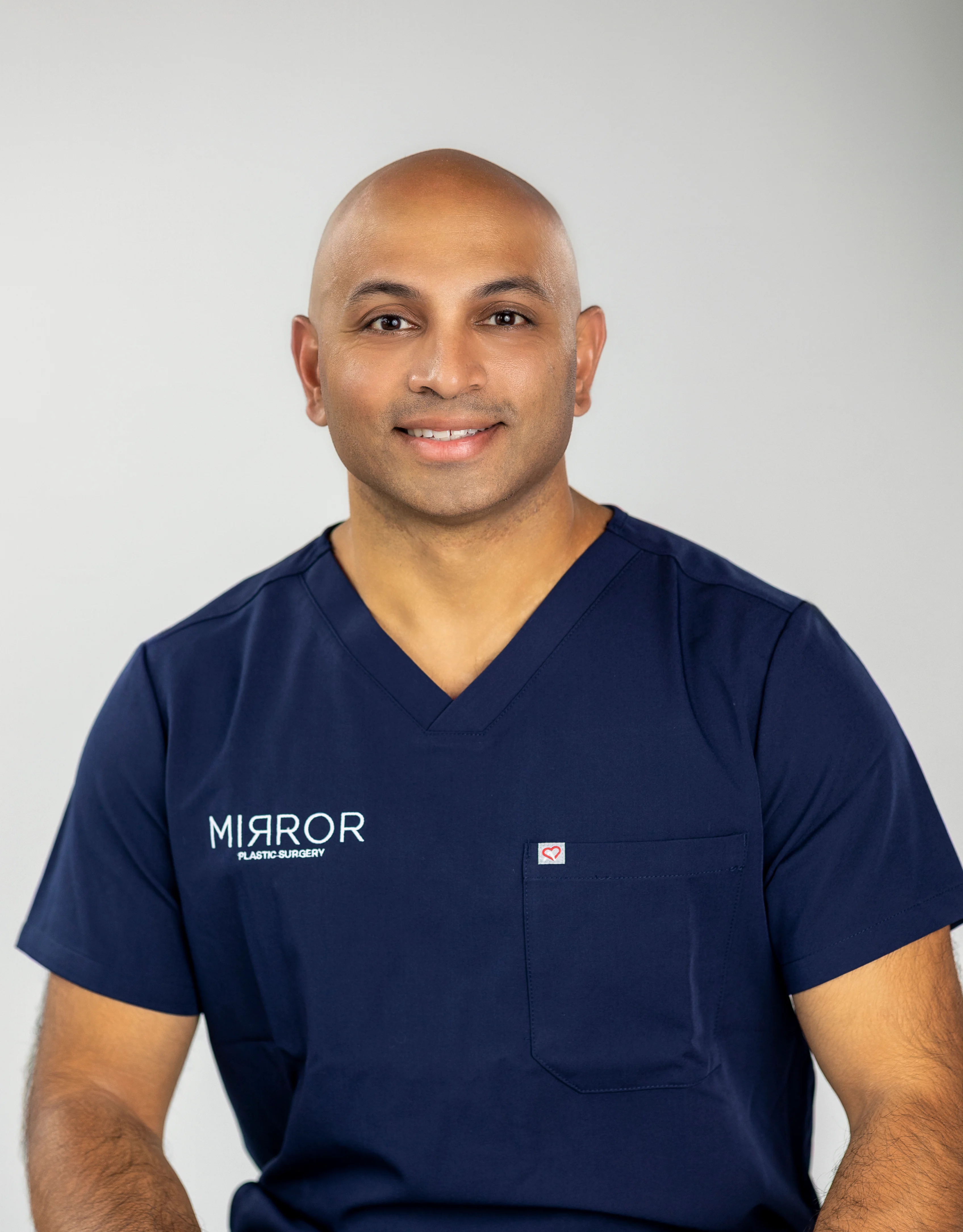
Surgeon training and judgment strongly influence complication risk for both non-surgical BBL and hip dip filler. Dr. Akash Chandawarkar is a Harvard-educated, Johns Hopkins-trained, board-certified plastic surgeon who personally performs all injections at Mirror Plastic Surgery. His fellowship training in aesthetic surgery at the Manhattan Eye Ear & Throat Hospital, combined with advisory roles for Merz Aesthetics (Radiesse) and Tiger Aesthetics (AlloClae), reflects deep, current product expertise.
Consultations at Mirror Plastic Surgery can run up to an hour and follow a philosophy that places safety first, function second, and aesthetics third. Dr. Akash uses Radiesse and AlloClae for body contouring procedures, which are recognized as effective and safe methods for nonsurgical BBL when used appropriately.1 He provides honest, unbiased guidance about whether a procedure suits each patient’s anatomy and goals. Discuss Your Options With Dr. Chandawarkar and review whether non-surgical BBL or hip dip filler aligns with your priorities.
How to Choose: A Practical Decision Framework for Patients
Patients seeking subtle contour correction of a localized hip dip may benefit from small-volume biostimulatory filler in that area. Patients seeking significant buttock volume enhancement should recognize that non-surgical BBL requires much more product, carries a higher risk profile, and may not match the results achievable with surgical options. In both scenarios, patients can prepare for consultation by asking focused, safety-oriented questions.
- Are you a board-certified plastic surgeon?
- What specific filler product will you use, and why?
- What are the specific risks of this product for this anatomical area?
- How do you manage vascular occlusion or other complications if they occur?
- How many similar procedures have you performed?
Bring These Questions to Your Consultation so Dr. Chandawarkar can walk you through personalized risks, benefits, and alternatives.
Frequently Asked Questions
Which Is Safer: Non-Surgical BBL or Hip Dip Filler?
Hip dip filler generally carries a lower risk profile than non-surgical BBL because it uses smaller volumes in a more favorable anatomical location, although direct comparative data remain limited. The lateral trochanteric depression targeted by hip dip filler contains only tiny superficial vessels, while the broader gluteal region treated in non-surgical BBL includes larger vascular structures. Both procedures still carry real risks, and injector expertise remains the most important factor in reducing those risks. A board-certified plastic surgeon with deep anatomical knowledge is the appropriate provider for either procedure.
Can Sculptra or Radiesse Be Dissolved If I Have Complications?
No. Neither Sculptra (poly-L-lactic acid) nor Radiesse (calcium hydroxylapatite) can be dissolved with hyaluronidase, unlike hyaluronic acid fillers. Complications such as nodules or granulomas require management with corticosteroids, other medical treatments, or, in resistant cases, surgical excision. Patients should factor this irreversibility, described earlier, into their decision-making before using these products for body contouring.
Are Buttock and Hip Filler Injections Safe Long-Term?
The current evidence base for long-term safety beyond 5–10 years remains limited. Existing clinical studies follow patients for only about 6 months, and delayed complications such as nodules, granulomas, and delayed inflammatory reactions can appear months to years after injection. Because biostimulatory fillers cannot be reversed, patients commit to a product that cannot be dissolved if later complications occur. Larger prospective studies with long-term follow-up are needed before drawing firm long-term safety conclusions.
What Is the Most Serious Complication I Should Know About?
Vascular occlusion, where filler enters a blood vessel and blocks blood flow, is the most serious complication associated with dermal filler injections. This event can cause tissue necrosis and, in rare cases, more severe systemic outcomes. The risk rises with larger injection volumes, which is why non-surgical BBL carries a higher vascular risk than hip dip filler. Illegal injectable substances such as silicone represent a separate and far more dangerous category, with documented links to embolism, stroke, permanent disfigurement, and death. These substances should never be used.
What Products Does Mirror Plastic Surgery Use for These Procedures?
Dr. Akash Chandawarkar uses Radiesse (calcium hydroxylapatite) and AlloClae for body contouring procedures, which are recognized as effective and safe methods for nonsurgical BBL when used by an experienced surgeon.1 He does not use illegal or unapproved substances, and his advisory relationships with the manufacturers of these products reflect a commitment to evidence-based injectable practice. Every treatment plan is individualized based on anatomy, goals, and an honest assessment of whether a procedure is appropriate for that patient.
Conclusion: Prioritize Safety and Expertise
Non-surgical BBL and hip dip filler both carry meaningful risks, and injection volume drives much of the difference in their risk profiles. Non-surgical BBL’s larger volume requirements increase the likelihood of vascular occlusion, nodules, and migration, while hip dip filler’s smaller volume reduces, but does not remove, those risks. Neither procedure uses FDA-approved products for buttock or hip indications, and patients must weigh the irreversibility discussed earlier when considering biostimulatory fillers. Choosing a board-certified plastic surgeon with deep anatomical expertise and a commitment to honest, evidence-based care remains the most effective way to minimize complications.
Request a Safety-Focused Consultation at Mirror Plastic Surgery to receive a personalized risk assessment from Dr. Akash Chandawarkar, a board-certified plastic surgeon who places your safety first.
Disclaimer: Results may vary from person to person. Editorial content, before and after images, and patient testimonials do not constitute a guarantee of specific results.
1 Results may vary from person to person. Editorial content, before and after images, and patient testimonials do not constitute a guarantee of specific results.