
Written by: Dr. Akash Chandawarkar, Board Certified Plastic Surgeon, Mirror Plastic Surgery
Key Takeaways
- Board certification from the American Board of Plastic Surgery is the only ABMS-recognized credential that guarantees six-plus years of accredited plastic surgery residency training.
- Experience must be area-specific. Ask how many times per month the injector treats your exact target zone because lips, tear troughs, and jawline each require distinct anatomical fluency.
- Every experienced Juvederm specialist must keep hyaluronidase on site at adequate dose and maintain a written vascular occlusion emergency protocol before the first syringe is opened.
- A thorough consultation is a full-face assessment that includes honest discussion of risks, alternatives, and the willingness to refuse treatment when anatomy or safety concerns warrant it.
Start Your Juvederm Consultation With Mirror Plastic Surgery
Why Choosing An Experienced Juvederm Specialist Matters More Than The Product
Juvederm is a family of dermal fillers used for facial rejuvenation, including cheeks, lips, nasolabial folds, chin, jawline, and under-eyes. Outcomes depend far more on the injector’s command of facial and subdermal anatomy than on which syringe is opened. The dominant determinants of harm in non-surgical facial aesthetics are operator training, regulatory environment, and clinic-level protocol. Product brand, patient demographics, and anatomical site alone are less significant. “Experienced” reflects verifiable credentials and protocols, not a marketing adjective. This guide explains how to evaluate an experienced Juvederm specialist across five concrete steps, then covers complication readiness, anatomical danger zones, filler fatigue, dissolution, and aftercare.
Step 1: Verify Board Certification Before You Book
The phrase “board certified” is not a protected term. Any physician with a medical license can describe themselves as board certified as long as they hold certification from some board, even one unrelated to the procedure they are performing. Certification bodies with names like “cosmetic surgery” are not recognized by the American Board of Medical Specialties and do not require a plastic surgery residency.
The American Board of Plastic Surgery (ABPS) is the only plastic surgery certifying board recognized by the American Board of Medical Specialties (ABMS). It requires at least six years of accredited surgical residency training after medical school, including dedicated plastic and reconstructive surgery training. ABPS certification also requires a written qualifying exam and an oral exam in which the surgeon defends a case list from their own recent practice.
To confirm these credentials, verify any provider through three free tools before booking:
- Search the ABMS Certification Matters database at certificationmatters.org. Enter the physician’s name and state to see every ABMS board certification they hold, the certifying board, and whether the certification is current.
- Cross-check the ABPS public lookup tool at abplasticsurgery.org to confirm plastic surgery certification directly.
- Verify state licensure and disciplinary history through the Federation of State Medical Boards’ DocInfo tool at docinfo.org, which aggregates licensing data from all 70 state medical and osteopathic boards.
Step 2: Ask About Injector Volume For Your Specific Treatment Area
Experience is area-specific. An injector who treats lips daily may rarely treat under-eyes, jawline, or nasolabial folds. Ask directly, “How many times per month do you treat my specific target area?” Lips, cheeks, chin, jawline, nasolabial folds, and under-eyes are distinct skill sets that require distinct anatomical fluency.
The infraorbital region (tear trough) carries risks of blindness and infraorbital nerve damage because the infraorbital artery and nerve exit the skull through the infraorbital foramen, located just below the orbital rim on the mid-pupillary line. Tear trough filler must be placed deep on the bone while avoiding the neurovascular bundle. Because of these risks, experience in this area is critical. A high-volume injector who treats 50 lips per month but only 2 tear troughs per month is not equally experienced in both. Ask the question for every area you want treated.
Nurse practitioners and physician assistants are licensed clinicians but not physicians. Patients should verify whoever they will actually see, since many clinics use NP and PA names as the primary clinician with a supervising physician in the background. Confirm that the person holding the syringe is the credentialed provider you researched.
Step 3: Confirm Complication Readiness With Hyaluronidase And Vascular Occlusion Protocols
Vascular occlusion from filler injection is reported at incidences of 0.001–0.05% per millilitre injected, and in the most robust multicentre series at approximately 1 event per 6,410 syringes. Rare events still matter when consequences are severe. Vascular occlusion typically presents during or immediately after injection with sudden, disproportionate pain and localized blanching. This often appears in a reticular “net-like” pattern corresponding to the affected vascular territory. Without reperfusion, it progresses to blistering, eschar formation, and ulceration.
The window for effective intervention with hyaluronidase in skin and soft tissue is measured in hours, whereas in the retinal circulation it is measured in minutes. Every experienced Juvederm specialist must have hyaluronidase on site and a written vascular occlusion emergency protocol before the first syringe is opened.
The CMAC guideline recommends reconstituting hyaluronidase at high concentration, 1500 units in 1 mL of bacteriostatic 0.9% sodium chloride or 1%–2% lidocaine, and infiltrating it along the course of the affected artery as well as across the entire ischemic area. Practitioners who carry only small quantities of hyaluronidase may be inadequately equipped for a true emergency.
Ask these three questions at every consultation:
- “Is hyaluronidase stocked on site right now, and at what dose?”
- “What is your written vascular occlusion emergency protocol?”
- “Who handles the emergency if it happens, and what is your escalation pathway?”
If a provider cannot answer all three clearly, they are not adequately prepared.
Schedule Your Juvederm Safety Consultation With Dr. Akash
Once you have confirmed complication readiness, the next step is to evaluate the consultation experience itself.
Step 4: Evaluate The Consultation Itself And What A Thorough Assessment Looks Like
A thorough consultation is a full-face assessment that includes an honest discussion of risks and alternatives and the willingness to decline treatment when appropriate. The willingness to refuse treatment in high-risk zones such as the glabella, nasal dorsum and tip, and deep periorbital region until supervised practice and a written rescue protocol both exist functions as a safety intervention.
A good injector should clearly explain why they would advise against a particular treatment for your face. If a consultation runs 10 minutes and ends with a product recommendation before your anatomy has been assessed, that signals a problem. Rushed, high-volume “mill” consultations prioritize throughput over safety. The consultation is where you learn whether the injector’s priorities match yours.
Step 5: Verify Credentials And Training Directly
Fellowship training, hospital affiliations, and third-party directory listings are all separately verifiable. For example, membership in the American Society of Plastic Surgeons or The Aesthetic Society requires ABPS certification, so checking for these memberships can help reinforce that a surgeon meets core plastic-surgery standards.
Ask five specific questions before booking:
- Which board certified you, and in what specialty?
- How many years of accredited plastic surgery residency did you complete?
- Do you perform this specific procedure regularly, and can you show ABPS certification directly?
- Where do you operate, and is that facility accredited?
- How do you handle recertification and continuing education?
Reserve Your One-On-One Assessment With Dr. Akash
The Consultation Checklist: Questions To Ask Any Juvederm Injector
Bring this list to any consultation in St. Petersburg or Tampa. Each item is one actionable question.
- Which board certified you, and in what specialty? Verify through ABMS Certification Matters and the ABPS public lookup.
- How many times per month do you treat my specific target area?
- Is hyaluronidase stocked on site right now, and at what dose?
- What is your written vascular occlusion emergency protocol?
- Do you personally perform the treatment, or delegate to a nurse or PA?
- What products do you recommend for my face, and why?
- What would you advise against for my face, and why?
- What does the aftercare and follow-up plan include?
- What is your plan if I have a complication after hours?
- Can you show me your ABPS certification and facility accreditation directly?
Understanding why certain areas are riskier can help you ask more informed questions during your consultation.
The Riskiest Places For Juvederm And Why Anatomy Matters
The glabella is considered the highest-risk facial danger zone for filler because the supratrochlear and supraorbital arteries emerge from the orbit there as terminal branches of the ophthalmic artery, creating a direct vascular pathway to the retinal circulation. Filler injected under pressure into these arteries can travel retrograde into the ophthalmic artery and, when pressure is released, be swept forward into the retinal artery, causing instant and irreversible blindness.
The nasolabial fold is a recognized danger zone because the facial artery runs deep to the muscles in the lower face but becomes more superficial as it ascends the fold toward the nose, where it becomes the angular artery. This anatomy makes mid-dermal injection along the fold high-risk for arterial occlusion and necrosis of the cheek and side of the nose.
The nose is a high-risk filler zone because its vascular network, supplied by the dorsal nasal, lateral nasal, and columellar arteries, forms a tight, superficial web with poor collateral supply. If one vessel is blocked, others cannot easily compensate, which raises the risk of blindness and tip necrosis.
The high-risk facial filler zones, including the glabella, nasal dorsum and tip, forehead, nasolabial fold, and periorbital region, share three anatomical properties. They overlie or contain arterial branches with retrograde access to the ophthalmic artery, they have limited subcutaneous depth, and they are common targets for high-volume bolus or sharp-needle technique by undertrained operators.
An experienced Juvederm specialist should be able to name these danger zones, explain the underlying anatomy, and describe their mitigation strategy, not just show before-and-after photos.
Filler Fatigue And Dissolution: When Juvederm May Not Be Right
Trade reporting through 2024 and 2025 described patients experiencing filler fatigue and either dissolving their filler, delaying appointments, or declining it altogether. American Society of Plastic Surgeons data show HA fillers grew just 1% in 2024 while neuromodulators grew 4%. Reasons include unwanted volume, delayed swelling, feeling overfilled, and a broader preference for subtle enhancement over obvious augmentation.
A 2024 study published in Plastic and Reconstructive Surgery – Global Open used MRI to examine 33 people who had mid-face filler and found filler still visible in all 33 at the end of two years, with complete disappearance in none of them. The common assumption that filler lasts “three to twelve months” does not hold for every product and every area.
Dissolution with hyaluronidase is possible but not risk-free. Hyaluronidase does not distinguish between unwanted filler and the body’s naturally occurring hyaluronic acid, so patients can experience temporary hollowing, flatness, asymmetry, and changes in skin texture or laxity after dissolving. When filler has been repeatedly placed in an area for years it can expand the surrounding tissue, and removing that volume too quickly can leave the face appearing flatter or more aged than expected, a phenomenon sometimes called the “deflated balloon illusion.”
A good injector sometimes advises a patient to wait, to dissolve gradually, or to do nothing at all. That willingness to recommend restraint functions as a credential.
Aftercare: What To Avoid After Juvederm
Swelling and mild bruising typically peak during days 1–3, with cold compresses recommended and pressure on the area avoided.1 During days 4–7, swelling gradually decreases.1 Peak integration and final results occur at weeks 2–4, when the hyaluronic acid has fully integrated into tissue.1
Contact your provider immediately if you experience severe or worsening pain, skin that turns white, gray, or mottled, any change in vision, or dusky or blistering skin in the days after treatment. The FDA instructs providers to stop injecting immediately if a patient shows blanching of the skin, change in vision, signs of a stroke, or unusual pain during or shortly after the procedure, and to tell patients to seek immediate medical attention if those signs appear afterwards.
Choosing An Experienced Juvederm Specialist In St. Petersburg And Tampa
Apply the checklist above to any provider in the St. Petersburg and Tampa Bay area. Then review a worked example.
Dr. Akash Chandawarkar, MD, founder of Mirror Plastic Surgery, is board-certified by the American Board of Plastic Surgery, a Harvard-educated physician, and a Johns Hopkins-trained plastic surgeon. He completed fellowship training in aesthetic surgery at Manhattan Eye, Ear & Throat Hospital (MEETH)/Lenox Hill Hospital, with additional medical innovation training at Stanford University. He personally performs the practice’s injectable and non-surgical treatments, and every neuromodulator and dermal filler is placed by a physician with a surgeon’s command of facial and subdermal anatomy. Mirror Plastic Surgery is a supplier-neutral practice, meaning product recommendations are driven by patient anatomy and goals, not by manufacturer quotas or commissions. Consultations run up to an hour, and the practice limits itself to one to two surgeries per day to support undivided attention before, during, and after every procedure.
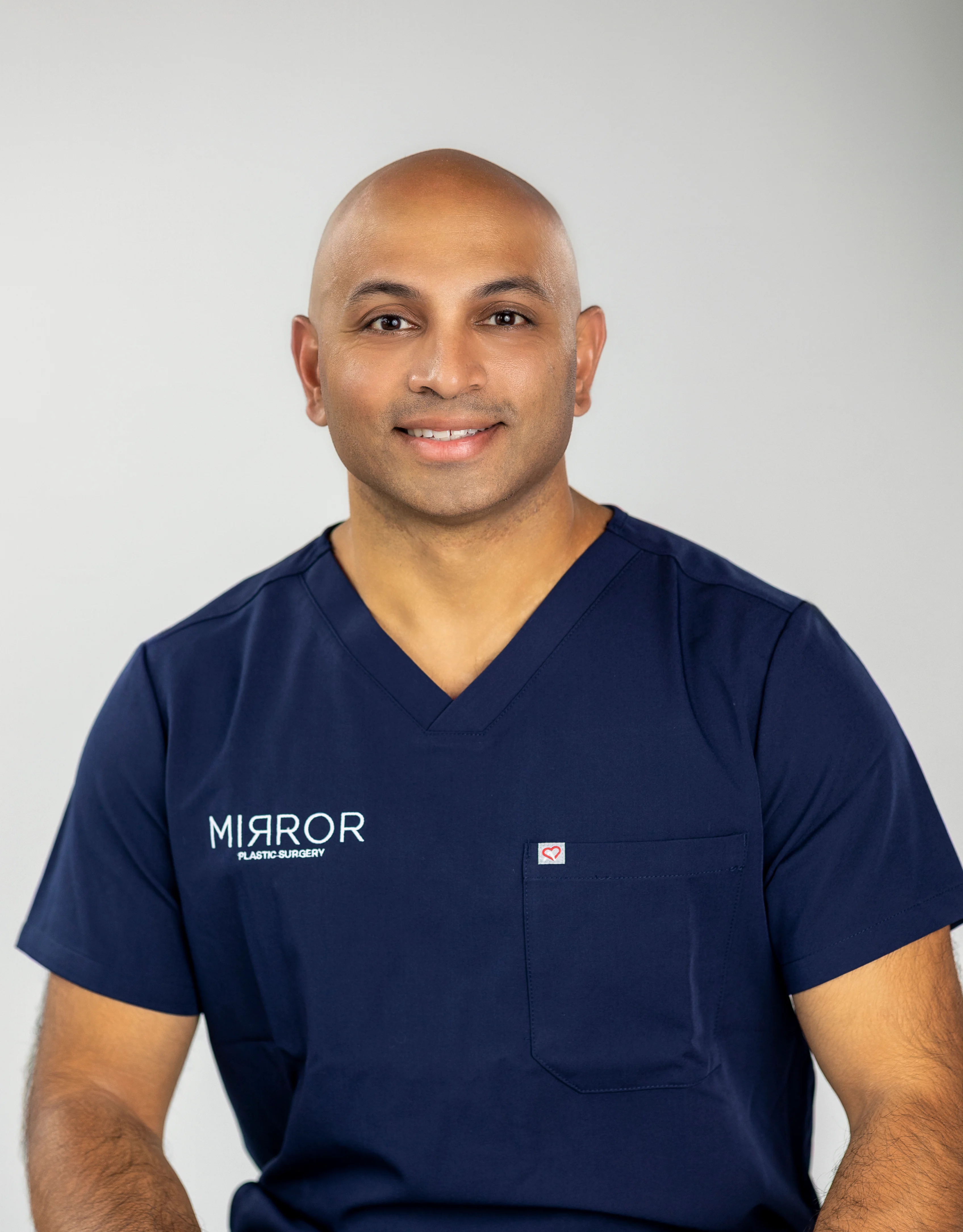
Mirror Plastic Surgery is located at 780 4th Ave S, St. Petersburg, FL 33701, serving patients throughout St. Petersburg and the greater Tampa Bay area. Reach the practice by phone or text at 727-361-6515 or by email at hello@mirrorplasticsurgery.com.
Credential Verification At A Glance
| Verification Type | Source | What It Confirms | Cost |
|---|---|---|---|
| Board Certification | ABMS Certification Matters (certificationmatters.org) and ABPS public lookup (abplasticsurgery.org) | Active ABMS-recognized board certification, certifying specialty, and certification date | Free |
| State Licensure | FSMB DocInfo (docinfo.org) | License status (active, expired, suspended, revoked), issue and expiration dates | Free |
| Disciplinary History | FSMB DocInfo (docinfo.org) and state medical board | Any disciplinary action on file across all 70 state medical and osteopathic boards | Free |
| Facility Accreditation | Accrediting body (AAAHC, JCAHO, or state equivalent) | Facility meets independent safety and quality standards separate from the surgeon’s personal certification | Free |
Pricing Philosophy: Why Cheapest-Per-Syringe Rarely Reflects True Value
The American Society of Plastic Surgeons puts the national average at $715 per syringe for dermal filler, but that figure does not reflect the value of the injector’s expertise, complication readiness, or consultation time. Cost varies by area treated, product selected, and the amount of product genuinely needed for that patient’s anatomy. Per-syringe discounting can lead to over-treatment or under-treatment, and neither outcome serves the patient.
Safe treatment includes medical training, authentic product, sterile supplies, consultation time, follow-up, and emergency readiness, all of which have real costs. Suspiciously cheap filler is a signal worth examining before booking. At Mirror Plastic Surgery, personalized quoting happens after an in-person assessment because the right amount of the right product for your anatomy cannot be determined from a price list.
Key Considerations, Variables, And Decision Points
Outcomes and suitability depend on a range of variables that a thorough consultation should address:
- Facial anatomy and bone structure determine product selection, injection depth, and volume.
- Skin quality and thickness influence technique, since thinner skin in the periorbital region demands different handling than thicker cheek skin.
- Prior filler history matters because residual filler from previous treatments affects placement decisions and total volume.
- Age and tissue laxity affect strategy, since volume alone does not correct sagging and can create a “full but low” appearance.
- Treatment area carries distinct anatomical risk profiles, as detailed in Step 2.
- Product selection shapes results, because higher-G’ gels deliver more structural lift but are less forgiving on superficial placement, while lower-G’ gels are easier to overuse.
- Maintenance expectations should be realistic, with a maintenance plan discussed during the initial consultation.
Safety, Risks, And Common Misunderstandings
Several misconceptions circulate widely among aesthetic consumers in St. Petersburg and Tampa.
All injectors are equivalently trained. Training varies widely. A physician can hold a legitimate medical board certification in an unrelated field such as general surgery, emergency medicine, or family practice and still legally market themselves as a “cosmetic surgeon” performing facelifts or body contouring without ever completing a plastic surgery residency.
“Board certified” always means the same thing. The specialty behind the certification is what actually protects you. Verify the certifying board, not just the phrase.
Filler is risk-free because it is non-surgical. The FDA lists injury to the blood supply from unintended injection into a blood vessel as a dermal filler risk that can result in tissue death, vision abnormalities including blindness, or stroke.
More product always means better results. The two specific injector competencies that function as inflection points for safety are the ability to recognize a vascular event in real time and the willingness to act on suspicion, to stop, flood with hyaluronidase, and escalate, before diagnosis is certain. An injector who prioritizes restraint and anatomical precision over volume is a safer choice than one who defaults to more product.
Practical Guidance And Final Takeaways
- Verify board certification through the American Board of Plastic Surgery and the ABMS Certification Matters database before booking any injector.
- Ask about injector volume for your specific treatment area, since each region of the face represents a distinct skill set.
- Confirm hyaluronidase is on site at adequate dose and that a written vascular occlusion protocol exists, as emphasized in Step 3.
- Request a full-face assessment rather than a quick, single-area injection plan.
- Ask what the injector would advise against for your face, and why, because willingness to say no signals judgment and safety focus.
- Understand that dissolution is possible but not risk-free, and that hyaluronidase does not distinguish between filler and native hyaluronic acid.
- Recognize that the lowest syringe price often omits the value of anatomical expertise, complication readiness, and thoughtful consultation time.
Broader Context For Your Facial Rejuvenation Plan
Injectable planning fits into a broader facial rejuvenation strategy that may include biostimulatory fillers such as Radiesse, which Dr. Akash Chandawarkar advises on as a member of the Merz Aesthetics advisory board, as well as combination approaches with neuromodulators so dynamic and static concerns are addressed together. Long-term maintenance, including how results evolve over months and years, forms part of every Mirror Plastic Surgery consultation. Readers interested in specific product comparisons, under-eye options, or alternatives to Juvederm will find dedicated guides on the Mirror Plastic Surgery website that cover those topics in depth.
Frequently Asked Questions
Is It Better To Get Fillers From A Dermatologist Or A Plastic Surgeon?
A board-certified plastic surgeon and a board-certified dermatologist both complete accredited residency training and hold ABMS-recognized certification, so either can be an excellent injector. The distinction that matters most is anatomical training depth and complication readiness, not the specialty label alone. A plastic surgeon’s training includes extensive surgical anatomy of the face, neck, and subdermal planes, which directly informs injection precision and complication management. Verify the certifying board, ask about injector volume for your specific area, confirm hyaluronidase is on site, and ask about the written vascular occlusion protocol regardless of specialty.
What Is The Riskiest Place For Fillers?
The glabella, nose, forehead, and nasolabial fold are the highest-risk zones because they overlie or contain arterial branches with retrograde access to the ophthalmic artery. The glabella is considered the highest-risk because the supratrochlear and supraorbital arteries emerge from the orbit there as terminal branches of the ophthalmic artery, creating a direct vascular pathway to the retinal circulation. Filler injected under pressure into these vessels can travel retrograde and, when pressure is released, be swept forward into the retinal artery, causing instant and irreversible blindness. The nose carries high risk because its vascular network has poor collateral supply, so if one vessel is blocked, others cannot easily compensate. The nasolabial fold is dangerous because the facial artery becomes more superficial as it ascends toward the nose, increasing the risk of arterial occlusion with mid-dermal injection.
What Is Forbidden After Fillers?
Avoid strenuous exercise, alcohol, and extreme heat, including saunas, hot tubs, and hot yoga, for the first 24 to 48 hours. Avoid placing pressure on treated areas for 2 to 3 days. Avoid blood-thinning medications and supplements unless medically necessary, and discuss any prescribed medications with your provider before stopping them. Wait at least 2 weeks before microneedling, chemical peels, or laser treatments on the treated area. Contact your provider immediately if you experience severe or worsening pain, skin that turns white, gray, or mottled, any change in vision, or dusky or blistering skin in the days following treatment.
What Is The Downside Of Juvederm?
The most common minor adverse events are bruising and swelling, which typically resolve within one to two weeks.1 More significant potential downsides include overfilling, delayed swelling, and the need for dissolution. Results may vary from person to person. Editorial content, before and after images, and patient testimonials do not constitute a guarantee of specific results.
Book Your Personalized Juvederm Consultation Today
1 Results may vary from person to person. Editorial content, before and after images, and patient testimonials do not constitute a guarantee of specific results.