

Written by: Ellie Pranckevicius, FNP-BC, Aesthetic Nurse Practitioner & Aesthetic Injector | Facial Restoration & Regenerative Injectable Specialist, Mirror Plastic Surgery
Key Takeaways for Safer Med-Spa Visits
- Reddit users repeatedly flag ghost medical directors, rushed consultations, and unverified peptide sources as common med-spa safety failures.
- Before booking, verify the medical director’s active license, on-site schedule, and the injector’s state credentials through official board databases.
- Insist on seeing sealed, batch-tested product packaging and a documented aftercare protocol. Refusal on either point is a red flag.
- High-pressure sales tactics or consultations under ten minutes usually indicate volume-driven practices that skip proper medical screening.
- Schedule a no-pressure consultation at Mirror Plastic Surgery to review your labs, health history, and peptide goals with an on-site physician team.
7-Step Medical-Spa Verification Checklist You Can Screenshot
- Confirm the medical director’s name and license number. Look up the name directly through the Federation of State Medical Boards’ DocInfo database or your state medical board. A photocopied certificate does not show current status or disciplinary history. Takeaway: If staff cannot give you a name and license number on request, stop there.
- Ask how often the medical director is physically on site. Expect a specific schedule, not “we have a relationship with Dr. So-and-so.” Vague answers signal a name-only arrangement where the physician never visits. Takeaway: Ask for a day and time, not a vague affiliation.
- Verify the treating provider’s credentials and scope. Ask whether the person performing your treatment is an MD, DO, NP, PA, or RN, and confirm that their license covers the specific procedure. Estheticians cannot legally inject filler or Botox in most U.S. states, though a handful allow limited injections under supervision. Takeaway: “Trained” and “certified” are not the same as state-licensed.
- Evaluate the consultation structure. A legitimate pre-treatment consultation reviews medical history, current medications, and treatment appropriateness. Intake forms limited to two questions signal skipped medical screening. Takeaway: If no one asks about your medications or health history, walk out.
- Watch for high-pressure sales tactics. Statements like “this price is only valid today” or “you need to do this now” are sales tactics, not medical advice. Alex Thiersch, JD, CEO of the American Med Spa Association, states: “If you’re getting rushed, if you feel like you’re being pressured. Those are red flags. It wouldn’t happen in your normal doctor’s office.” Takeaway: Any urgency around an elective medical procedure is a disqualifier.
- Ask about product sourcing and batch testing. For injectables, a reputable provider shows sealed, branded packaging with lot numbers before use. The CDC, collaborating with the FDA, issued 2024 alerts about adverse effects from counterfeit botulinum toxin injections in 9–11 states, while the FDA separately warned 18 websites in 2025 about selling unapproved Botox online. For peptides, ask whether products come from suppliers with documented batch testing. Takeaway: If they will not show you the product, do not accept the injection.
- Confirm an aftercare and emergency protocol exists. Ask for a direct contact number for complications and confirm the practice has written emergency protocols. Med spas that lack a clear emergency aftercare protocol are gambling with patient safety because time-critical issues can lead to permanent damage if not addressed immediately. Takeaway: No aftercare plan means no accountability.
Book an appointment with Ellie to walk through your health history, lab results, and peptide goals in a 30–60 minute concierge consultation, with no sales pressure and no upselling.
How Reddit Complaints Map to Real Med-Spa Risks
The most-upvoted posts in r/MedSpa and r/30PlusSkinCare cluster around a consistent set of complaints. Users describe consultations that lasted under ten minutes, injectors who could not name the product they were using, and medical directors who exist only on a framed certificate. These patterns reflect systemic problems, not rare edge cases.
The medical spa industry is growing quickly, with thousands of medspas operating in the United States. That growth has outpaced regulatory enforcement in many states, which creates the conditions Reddit users describe.
The recurring red-flag phrases from those threads translate directly into the checklist above:
- “The doctor was never there” – ghost medical director
- “They kept pushing more treatments” – volume-driven upselling
- “I don’t know what they injected” – unverified product sourcing
- “The consultation was basically a sales pitch” – no genuine medical assessment
- “I couldn’t reach anyone after my reaction” – no aftercare protocol
Each of those phrases maps to a documented compliance failure. A New York Department of State investigation reported 223 inspections of medical spas and cited 87 businesses for violations including unlawful practice of medicine.
Distant Medical Director Warning
The most frequently cited violation in those enforcement actions, and a top complaint in Reddit threads, involves the ghost medical director. “Ghost MD” or “rent-a-doc” arrangements, where a physician signs a medical director contract for a fee but performs no actual oversight such as chart reviews or protocol sign-off, rank among the top violations in recent state enforcement sweeps. The physician’s name on the wall means nothing if they have never reviewed a chart or visited the facility.
A compliant medical director must sign and annually review clinical protocols, issue standing orders specifying authorized treatments and dose limits, conduct periodic chart reviews, and remain reachable during operating hours. When these documented reviews do not happen over extended periods, state medical boards treat it as evidence that the oversight relationship exists only on paper, which makes it a common trigger for investigations.
In Florida, non-autonomous med-spa NPs require a supervisory protocol with a physician under Fla. Stat. 464.012 and 458.348. The statutes do not require that the physician be a dermatologist, plastic surgeon, or trained in the specific procedures.
Our practice uses direct, on-site physician collaboration so patients receive active, documented clinical oversight instead of a remote signature arrangement.
Med-Spa Upselling Pressure
High-volume practices have financial incentives that conflict directly with patient-centered care. A provider who spends most of the consult pushing additional treatments is flagged as problematic because filler placement is a permanent change that should never be a same-day decision driven by sales pressure.
Our consultations run 30–60 minutes and focus on education, not sales. We often tell clients when a service or product is not necessary for them yet. That approach is the opposite of the upselling model Reddit users warn against.
The practice also limits itself to one to two procedures per day. That structural choice removes the financial pressure that usually drives volume-based upselling.
Verifying Injector Credentials and Daily Volume
The dominant determinants of harm from non-surgical facial injectables are operator training, regulatory environment, and clinic-level protocol rather than product brand, patient demographics, or anatomical site alone. Credential verification therefore becomes the single most powerful safety check a patient can perform.
Studies show 70% of med spa locations lack any affiliation with a physician practice. The injector’s daily patient volume also matters because it reflects the time available for each assessment. An injector seeing 20–30 patients per day cannot conduct the kind of intake that catches contraindications.
Our lead provider holds a Bachelor’s in Health Science from Boston University, completed an aesthetics licensure program, and earned both her Bachelor’s and Master’s in Nursing from the University of South Florida. She spent four years in the Neuroscience ICU at Tampa General Hospital managing complex patients. That experience directly informs her understanding of physiology, metabolic health, and drug interactions.
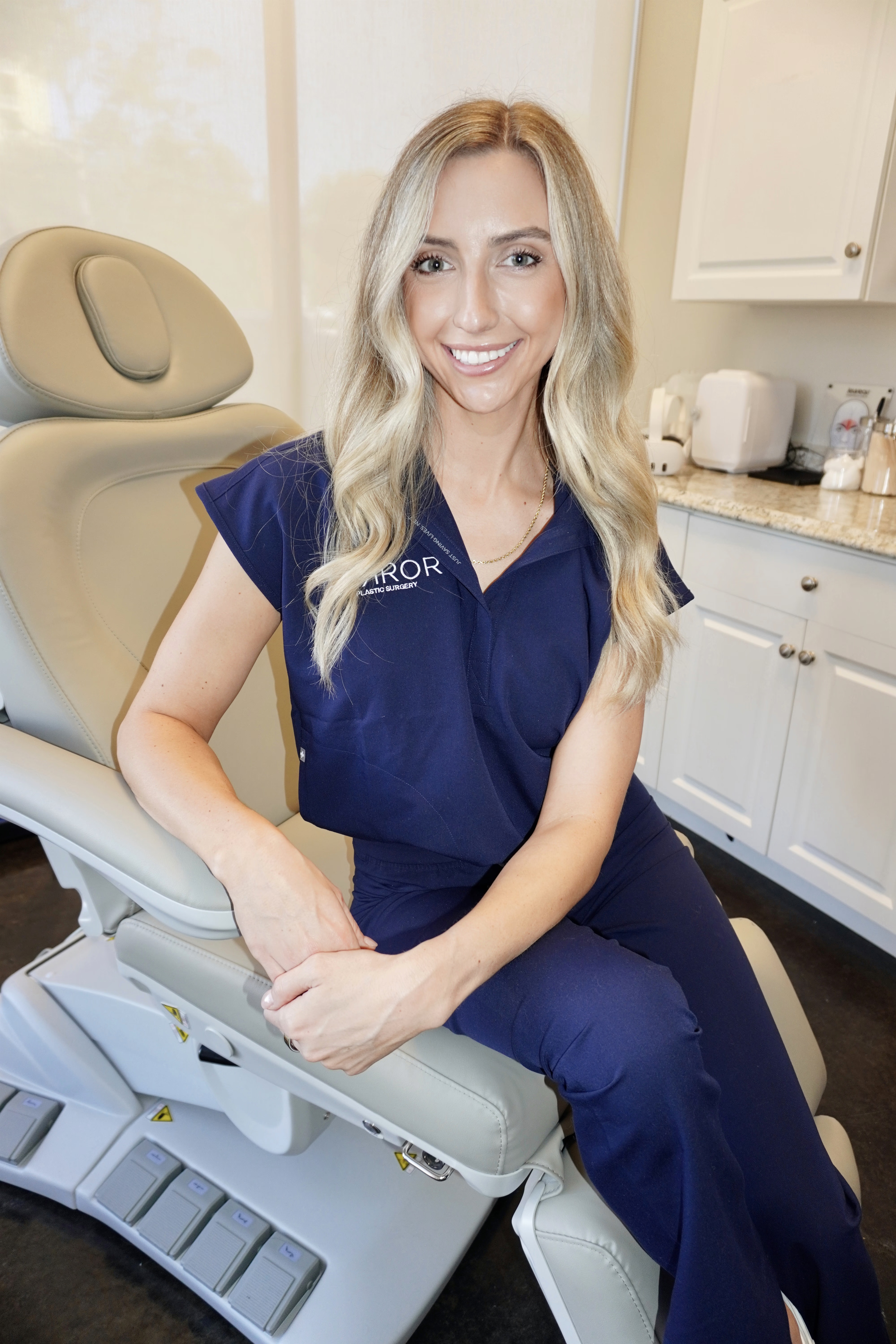
She also began her career at a high-end medical spa in Boston, which gives her a dual perspective on both hospital-level safety and aesthetic outcomes that many injectors do not have.
Sourcing and Quality Red Flags for Peptides
The peptide market presents sourcing risks that do not exist for FDA-approved injectables. Compounded peptides occupy a legal grey area, and grey-market products carry risks of contamination, incorrect dosing, and biological unpredictability. Buying peptides from unverified online retailers means there is no third-party testing for quality, no confirmation of active ingredient content, and no medical professional reviewing your health profile before you begin.
Non-approved peptides such as BPC-157, TB-500, and ipamorelin lack long-term safety data and systematic validation, with significant knowledge gaps remaining around optimal dosing regimens, combination therapy effects, and biomarkers for monitoring efficacy. Those gaps make medical supervision more important, not less.
Our practice sources peptides exclusively from suppliers with documented batch testing, which verifies product quality, purity, and accurate dosage. Every protocol starts with a review of lab panels such as thyroid, liver, kidney, diabetes markers, and hormone panels to confirm the peptide stack matches the individual patient’s health profile.
Book an appointment with our team to have your labs reviewed and receive a custom peptide protocol built around your specific health markers.
Medically Supervised Peptide Therapy: A Reddit-Safe Approach
Peptide therapy at our practice starts with an in-depth consultation that reviews medical history, current medications, and specific health goals. For weight management or inflammatory conditions, lab panels are ordered if not already available.
The results guide a custom peptide stack, with combinations such as the Glow Stack (GHK-Cu, BPC-157, TB-500) for systemic inflammation and collagen support, GLP-3R compounding for weight and metabolic health, NAD for cellular energy, or Selank for anxiety management without the dependency profile of benzodiazepines.
A 2026 systematic review and meta-analysis of 19 randomized controlled trials found that peptides produced statistically significant improvements in skin hydration and wrinkle reduction, with favorable tolerability and no severe adverse events documented across included trials.1 Given the knowledge gaps around peptide dosing and long-term effects mentioned earlier, our protocols begin with careful screening and individualized dosing.
GHK-Cu has demonstrated stimulation of collagen and glycosaminoglycan synthesis, enhanced wound healing, and improved skin elasticity in human and laboratory data1, which makes it one of the more defensible peptides for aesthetic use. GLP-1 receptor agonists have demonstrated clinically meaningful and sustained weight loss plus cardiometabolic benefits in large randomized controlled trials.1
After the initial consultation, our provider gives detailed reconstitution and self-administration instructions, often with video demonstrations. Patients have direct text access for ongoing questions, refill requests, and protocol adjustments.
Telemedicine appointments are available for patients outside the St. Petersburg and Tampa Bay area, with service available across the United States including Hawaii and Alaska.
Frequently Asked Questions
Are peptides approved by the FDA?
Many peptides used in wellness settings are not FDA-regulated. However, they have been studied in clinical trials spanning more than a decade, and some do carry FDA approval for specific indications.
The main risk with peptides comes from obtaining them from unregulated sources with no quality control, no verified dosing, and no medical oversight. At Mirror Plastic Surgery, every peptide protocol starts with a thorough consultation and, when appropriate, lab panels.
Peptides are sourced from suppliers with documented batch testing, and Ellie provides ongoing supervision throughout the treatment period.
What happens if I stop taking peptides?
Stopping peptides causes the benefits to diminish over time, similar to discontinuing any health regimen. If peptides were managing systemic inflammation, that inflammation usually returns to its prior state once treatment stops.
If a growth hormone secretagogue was supporting muscle retention, those effects taper as well. Continued use through a maintenance protocol is generally necessary to sustain the outcomes achieved.
Ellie discusses this directly during the initial consultation so patients understand the long-term commitment before starting, rather than discovering it later.
Will everyone see the same results?
Results from peptide therapy vary significantly from person to person.1 Genetics, baseline lab markers, diet, lifestyle, existing conditions, and the specific protocol all influence outcomes.
What produces rapid improvement in one patient may have a more gradual effect in another.1 Mirror Plastic Surgery does not use one-size-fits-all protocols for this reason.
Every treatment plan is built from individual lab results and health history, and protocols are adjusted over time based on how the patient responds.1
How do I verify state licensing and supervision?
For physician medical directors, use the Federation of State Medical Boards’ DocInfo database or your state’s medical board website to confirm an active, unrestricted license and check for any disciplinary history. In Florida, the Board of Medicine maintains public license lookup records.
For nurse practitioners, verify licensure through the state Board of Nursing. Ask the practice directly for the medical director’s full name, license number, and how often they are physically present.
A compliant practice will answer these questions without hesitation. If staff are evasive or cannot provide a specific name, that behavior matches ghost-director arrangements that state enforcement actions have repeatedly targeted.
Final Summary: Use This Checklist Before Any Treatment
The seven steps above address every major safety failure that Reddit users, regulatory bodies, and clinical experts have identified in the med-spa industry. These include ghost medical directors, unverified injector credentials, high-pressure upselling, inadequate intake screening, unverified product sourcing, and absent aftercare protocols.
Running through this checklist before any consultation takes less than fifteen minutes and removes the practices most likely to cause harm.
For peptide therapy, the stakes are higher than for a standard injectable appointment. The absence of FDA regulation means that sourcing, dosing, and individual health screening depend entirely on the quality of the provider.
A practice that skips lab review, sources from unverified suppliers, or operates without genuine on-site medical oversight cannot deliver safe peptide care, regardless of what their website claims.
Our concierge model addresses each of these gaps directly through in-depth lab analysis, batch-tested sourcing, 30–60 minute consultations, direct ongoing access to our provider, and active physician collaboration on site.
Book an appointment with our team and bring your labs, your questions, and your checklist. The consultation is designed for exactly that conversation.
1 Results may vary from person to person. Editorial content, before and after images, and patient testimonials do not constitute a guarantee of specific results.
Peptide therapy is intended for wellness and optimization purposes and is not prescribed to diagnose, treat, cure, or prevent disease unless specifically stated. Many peptides are not FDA-approved and may be used off-label. Some have limited long-term safety data, with a potential for unknown risks, complications, or desensitization with prolonged use.
