
Written by: Dr. Akash Chandawarkar, Board Certified Plastic Surgeon, Mirror Plastic Surgery | Last updated: September 9, 2026
Key Takeaways
- Hip dip filler recovery depends on product type, injection technique, volume, and your biology. Most swelling and bruising ease within 1–2 weeks.1
- Biostimulatory fillers like Radiesse and Sculptra build collagen gradually over 3–6 months, with results typically reviewed at 3 months.1
- Careful aftercare during the first 48–72 hours, including cold compresses, avoiding pressure, and limiting heat or exercise, supports smoother healing.
- Off-label hip dip filler use is common and legal. Choosing an experienced, board-certified plastic surgeon with deep anatomical knowledge lowers complication risk.
- Schedule your personalized consultation at Mirror Plastic Surgery to review your goals and design a tailored treatment plan with Dr. Akash Chandawarkar.
Hip Dip Filler Recovery Timeline Overview
Most patients notice mild to moderate swelling and tenderness during the first 1–3 days. Swelling usually peaks at 48–72 hours and then eases significantly within 1–2 weeks.1 Bruising is common and typically fades within 7–14 days. For biostimulatory fillers like Radiesse and Sculptra, visible improvement builds gradually over 6–12 weeks as collagen develops, and providers typically assess final results at about 3 months.1
The table below compares how Radiesse and Sculptra recover across each phase, so you can see how swelling, settling, and collagen onset differ between the two.
Days 1–3: Immediate Post-Treatment Recovery
The first few days bring mild to moderate swelling, bruising, tenderness, and possible redness at the injection sites. Hip and buttock filler creates more noticeable swelling than facial filler because deeper placement uses larger volumes, gravity pulls fluid toward the upper thigh, and constant movement from sitting and walking adds friction. Swelling typically peaks within 24–72 hours.1
Common immediate symptoms include:
- Swelling and puffiness at and around the injection sites
- Tenderness or soreness to the touch
- Redness or pinpoint marks at injection points
- Mild bruising that may look darker as swelling subsides
- A feeling of pressure when sitting
During days 1–3, most patients follow these restrictions:
- Avoid strenuous exercise, heat exposure such as saunas or hot tubs, and alcohol for at least 48–72 hours
- Avoid prolonged sitting or direct pressure on the treated area, and use a cushion if you must sit
- Apply a cold compress wrapped in a clean cloth for 10–15 minutes at a time during the first 24 hours to constrict blood vessels and reduce early swelling
- Return to work and light daily activities as tolerated, which many patients can do right away
Week 1: Managing Swelling And Bruising
As you move beyond the first few days, the focus shifts from immediate care to managing the peak of swelling and bruising. Swelling usually peaks at 48–72 hours and then improves over the next 1–2 weeks1. Bruising is common because small blood vessels can leak during injections, and most bruising fades within 7–14 days1.
Light walking is usually fine starting the day after treatment. Weight training that targets the glutes or long sessions on a stationary bike should wait about 3–7 days, then restart slowly with low intensity. Avoid tight clothing or shapewear that compresses the treated area, since pressure can shift filler before it settles. Early asymmetry is common and often improves as swelling evens out. If asymmetry stays obvious after 2 weeks or you feel a hard lump, contact your provider.
Weeks 2–4: Settling, Softening, And Early Collagen
By week two, most visible swelling and bruising have eased. Between weeks 2–4, swelling resolves and your contour becomes clearer1. With biostimulatory fillers, you may notice a temporary return toward your pre-treatment baseline as carrier fluid absorbs. This pattern is normal and does not signal product failure.
Collagen production begins after early swelling settles, and many patients see gradual changes from about 3–6 weeks1. Most people resume normal sitting and regular workouts 1–2 weeks after treatment, while saunas and steam rooms usually stay off-limits until at least the 1–2 week mark.
Months 1–3: Collagen Building And Final Results
Radiesse and Sculptra rely on collagen stimulation, so their most noticeable results appear after the early recovery phase. Radiesse provides an immediate lift from its gel carrier and then stimulates collagen production, with full results developing over 3–6 months1. Sculptra works by prompting your body to create new Type I collagen over 3–6 months, and results can last up to 2 years or longer1.
Patience matters during this stage. Providers usually schedule a formal assessment around 3 months for biostimulatory fillers. Some patients benefit from staged sessions to reach their ideal level of correction.
Hip Dip Filler Aftercare: Do’s And Don’ts
Thoughtful aftercare helps the filler settle smoothly and can shorten your recovery. The first 48 hours play the biggest role in how your results look and feel.
Do
- Apply cold compresses (never directly on bare skin) during the first 24 hours to help limit swelling
- Sleep on your back or side so you avoid direct pressure on the treated area
- Stay hydrated and reduce sodium intake to limit fluid retention
- Attend follow-up visits with your provider as scheduled
- Use acetaminophen (Tylenol) for discomfort instead of NSAIDs, which can increase bruising
- For Sculptra, follow the 5-5-5 massage protocol (5 minutes, 5 times daily, for 5 days) to support even distribution and reduce nodule risk
Don’t
- Engage in vigorous exercise for at least 48–72 hours, and delay intense lower-body workouts for up to a week
- Expose the area to heavy heat such as saunas, hot baths, or sunbathing for at least one week
- Massage the area unless your provider instructs you to, because unsupervised massage can move filler before it stabilizes
- Take blood-thinning medications or supplements such as aspirin, ibuprofen, fish oil, vitamin E, or ginkgo biloba without medical clearance
- Drink alcohol for at least 48 hours after treatment, since it can worsen bruising and swelling
- Avoid tight shapewear or clothing that applies strong pressure to the treated area, because compression can displace filler before it settles
Hip Dip Filler Recovery By Filler Type
Recovery details shift based on the product used. At Mirror Plastic Surgery, Dr. Chandawarkar often recommends biostimulatory fillers, especially Radiesse, because they stimulate your own collagen for gradual, natural-looking, longer-lasting results.
Biostimulatory Fillers (Radiesse And Sculptra)
Radiesse (calcium hydroxylapatite) provides immediate volume and then stimulates collagen and elastin production, with results that can last up to 2 years1. Sculptra (poly-L-lactic acid) triggers new Type I collagen over several months, and results can last 2 years or longer1. The 5-5-5 massage protocol for Sculptra helps distribute the product evenly and lowers the chance of nodules. Because larger volumes are used in the buttocks than in the face, Sculptra swelling in this area tends to be more noticeable and can last 5–10 days. Neither Radiesse nor Sculptra can be dissolved with hyaluronidase, so choosing an injector with strong anatomical expertise is essential.
AlloClae As A Fat-Based Alternative
For patients who want a fat-based option without traditional fat transfer, Mirror Plastic Surgery also offers AlloClae. This FDA-approved injectable fat substitute uses donor cadaveric fat to add volume. AlloClae provides structural fullness rather than collagen stimulation, which can suit patients who lack enough donor fat for liposuction-based transfer or who prefer a non-surgical approach.
Hip Dip Filler Safety And FDA Status
The U.S. FDA classifies dermal fillers as Class III medical devices and has not approved any dermal fillers for cosmetic volume in the hips, thighs, or buttocks. Off-label use remains legal and common in aesthetic medicine, and an estimated 20–60% of all drug and device use in medicine occurs off-label. Ethical off-label use requires clear informed consent, including disclosure of off-label status, discussion of supporting evidence, and a review of specific risks. Mirror Plastic Surgery follows this standard at every consultation.
Hip dip filler is placed in the lateral trochanteric depression, which contains only tiny superficial vessels averaging under 0.9 millimeters in diameter. When an injector stays in the subcutaneous fat plane and uses a blunt cannula, the technique avoids the pulmonary fat embolism risk linked to deep gluteal injections. Possible complications include infection, lumps, asymmetry, vascular occlusion, and product migration. The hip region contains larger vessels than the face, so provider training matters. Dr. Chandawarkar’s background as a board-certified plastic surgeon, with detailed knowledge of subdermal anatomy, sets his approach apart from many high-volume med-spa settings.
Schedule your consultation to have Dr. Chandawarkar assess your anatomy and help you decide whether hip dip filler aligns with your goals.
When To Call Your Doctor: Red Flags After Hip Dip Filler
Most patients recover smoothly, yet you still need to watch for warning signs that require prompt medical attention. Contact your provider right away if you notice any of the following:
- Severe or worsening pain after 48 hours
- Skin that turns pale, white, or bluish-black, which may signal vascular compromise
- Fever, chills, or flu-like symptoms
- Swelling that increases after 72 hours instead of easing
- Widespread redness with a hot, feverish sensation, which can indicate infection
- Firm nodules that continue to grow
- Spreading redness or warmth beyond the injection area after day 3
Hip Dip Filler Vs. Fat Transfer Recovery
Filler recovery usually involves little to no downtime. Most patients return to normal activities right away, and swelling often settles within 1–2 weeks. There are no surgical incisions and no required compression garments.
Fat transfer belongs to a different category. It requires liposuction to harvest donor fat, involves 1–2 weeks of downtime, and includes compression garments plus a longer recovery. The tradeoff is more permanent volume using your own tissue. Fat transfer only works when you have enough donor fat, usually from the abdomen or flanks.
For patients who are not ready for surgery or do not qualify, biostimulatory fillers create a middle path with gradual, natural-looking correction that can last 1–2 years. Filler-based correction needs maintenance every one to two years, while surgical fat transfer generally does not. The right choice depends on your anatomy, goals, and comfort with surgery, which you and your surgeon can clarify during consultation.
Mirror Plastic Surgery also offers AlloClae, an FDA-approved injectable fat substitute made from donor cadaveric fat. ASPS Member Surgeon Johnny Franco, MD, reports that fat-based fillers like AlloClae can lift hip dip areas, which makes them appealing for patients without enough donor fat or those who prefer to avoid surgery.
Frequently Asked Questions About Hip Dip Filler Recovery
How Long Does It Take To Recover From Hip Dip Filler?
Most patients resume normal daily activities right after treatment. Swelling peaks around 48–72 hours and, as noted earlier, usually improves significantly within 1–2 weeks. Bruising often fades within 7–14 days. For biostimulatory fillers such as Radiesse and Sculptra, the collagen-building phase means providers typically assess final results at about 3 months rather than immediately. The procedure involves no surgical incisions, no general anesthesia, and no required downtime.
Are Hip Dip Fillers Worth It?
For the right candidate with mild-to-moderate lateral trochanteric depressions, hip dip fillers can soften the dip and create smoother curves without surgery. Realistic expectations matter. Fillers add volume to a thin area and improve contour, yet they do not match the projection of a surgical Brazilian Butt Lift. Hip dips reflect your underlying skeletal structure, and injectables cannot change bone width. Patients who want dramatic volume or permanent change may be better served by fat transfer or surgery. A detailed consultation helps determine which path fits your anatomy and goals.
How Long Does Hip Dip Filler Last?
Longevity depends on the product. Radiesse often lasts 12–18 months in the hip area, with some reports of results up to 2 years1. Sculptra results can last 2 years or longer as your body maintains its collagen1. Both options usually outlast hyaluronic acid fillers in this region, which tend to last 6–18 months depending on product, volume, and metabolism1. Maintenance sessions keep results steady, and scheduling a touch-up when volume has dropped to about 50% often requires less product and maintains a smoother contour.
What Are The Risks Of Hip Dip Fillers?
Common side effects include temporary swelling, bruising, and tenderness. Rare but serious risks include infection, vascular occlusion, lumps or nodules, asymmetry, and product migration. As mentioned earlier, Radiesse and Sculptra cannot be dissolved with hyaluronidase, so providers manage complications differently than with hyaluronic acid fillers. This reality makes injector expertise crucial. Choosing a board-certified plastic surgeon with deep knowledge of hip and gluteal anatomy reduces risk compared with treatment in settings where injectors may have less training.
Can Fillers Get Rid Of Hip Dips?
Fillers can significantly soften hip dips by adding volume to the lateral trochanteric depression. Complete removal of a deep skeletal dip is often unrealistic because the depression comes from the gap between the iliac crest and greater trochanter, which injectables cannot alter. Staged treatment across multiple sessions usually produces smoother, more natural results than trying to achieve full correction at once. A thorough consultation with a board-certified plastic surgeon helps set clear expectations before you proceed.
Why Do Some Plastic Surgeons Avoid Sculptra For Hip Dips?
Some surgeons favor other products because Sculptra has a gradual results timeline, requires the 5-5-5 massage protocol, and cannot be dissolved if complications arise. When an experienced injector with strong anatomical training performs the procedure, Sculptra can still be a very effective option for hip dip correction. Dr. Chandawarkar serves on the advisory board for Merz Aesthetics (Radiesse) and offers both Sculptra and Radiesse. His recommendations focus on matching the product to each patient’s anatomy, timeline, and goals rather than defaulting to a single filler.
Recovery Is A Partnership
Hip dip filler recovery is usually quick, with minimal downtime and no surgical incisions. Recovery details vary by filler type. Biostimulatory fillers such as Radiesse and Sculptra require patience while collagen builds over weeks and months, and the early period for any product includes swelling and tenderness that typically settle within the first couple of weeks. Careful aftercare and choosing a provider with genuine anatomical expertise are the two factors most within your control. Recovery follows a personalized path, and a one-on-one consultation gives you the clearest picture of what to expect based on your anatomy and the product your surgeon recommends.
Your Next Step: Consult A Board-Certified Plastic Surgeon
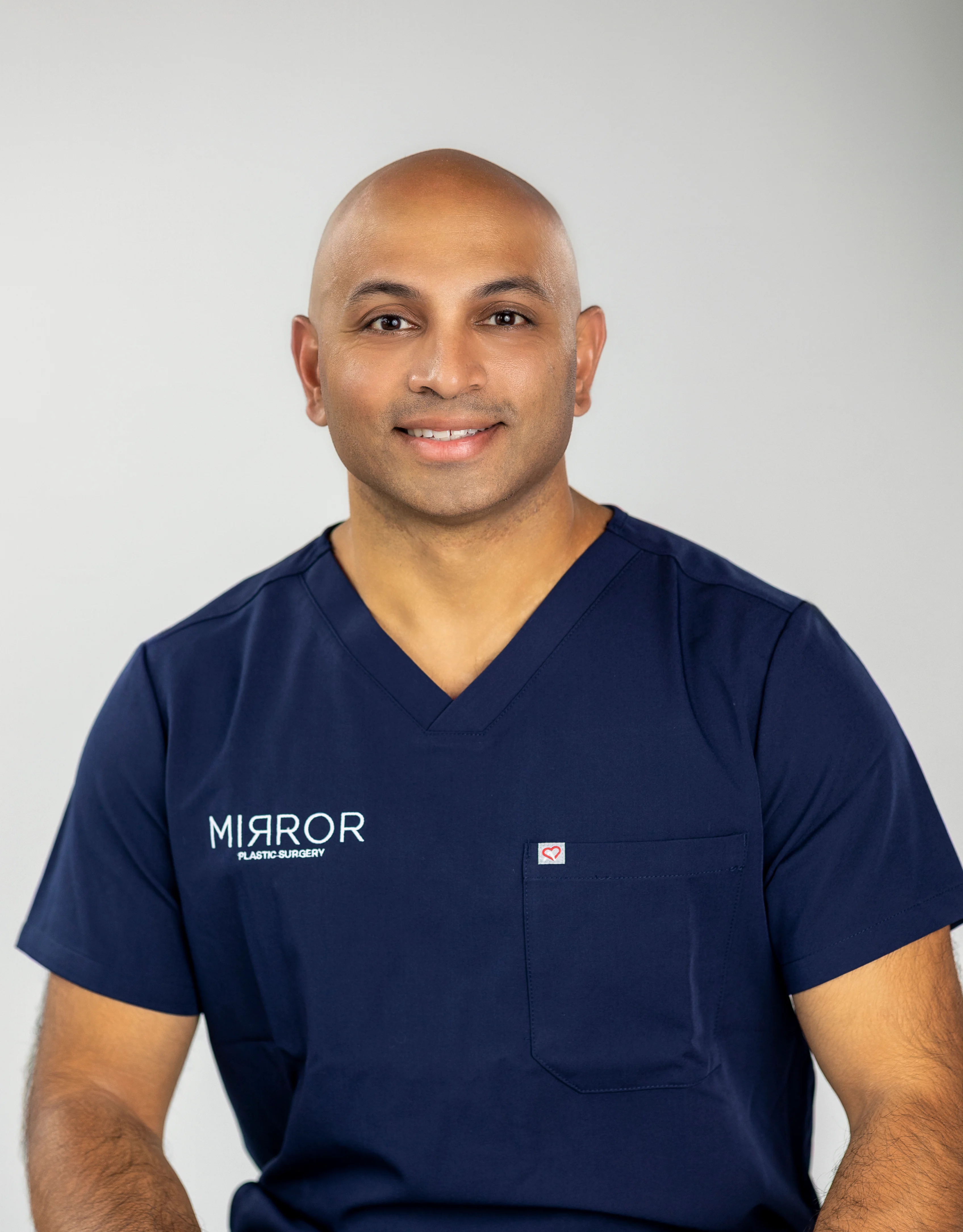
At Mirror Plastic Surgery, Dr. Akash Chandawarkar performs every injection himself rather than delegating to a nurse or med-spa technician. As a Harvard-educated, Johns Hopkins-trained, board-certified plastic surgeon with fellowship training in aesthetic surgery and an advisory role with Merz Aesthetics (Radiesse), he brings surgical-level precision and deep knowledge of hip and gluteal anatomy to each non-surgical body contouring treatment. Mirror’s concierge model allows consultations of up to an hour, giving you time to ask questions and make a confident, informed decision without pressure or upselling.
Book a consultation at Mirror Plastic Surgery to discuss your hip dip filler goals, review your product options, and receive a personalized recovery plan from a board-certified plastic surgeon who prioritizes your safety.
Disclaimer: Results may vary from person to person. Editorial content, before and after images, and patient testimonials do not constitute a guarantee of specific results.
1 Results may vary from person to person. Editorial content, before and after images, and patient testimonials do not constitute a guarantee of specific results.