
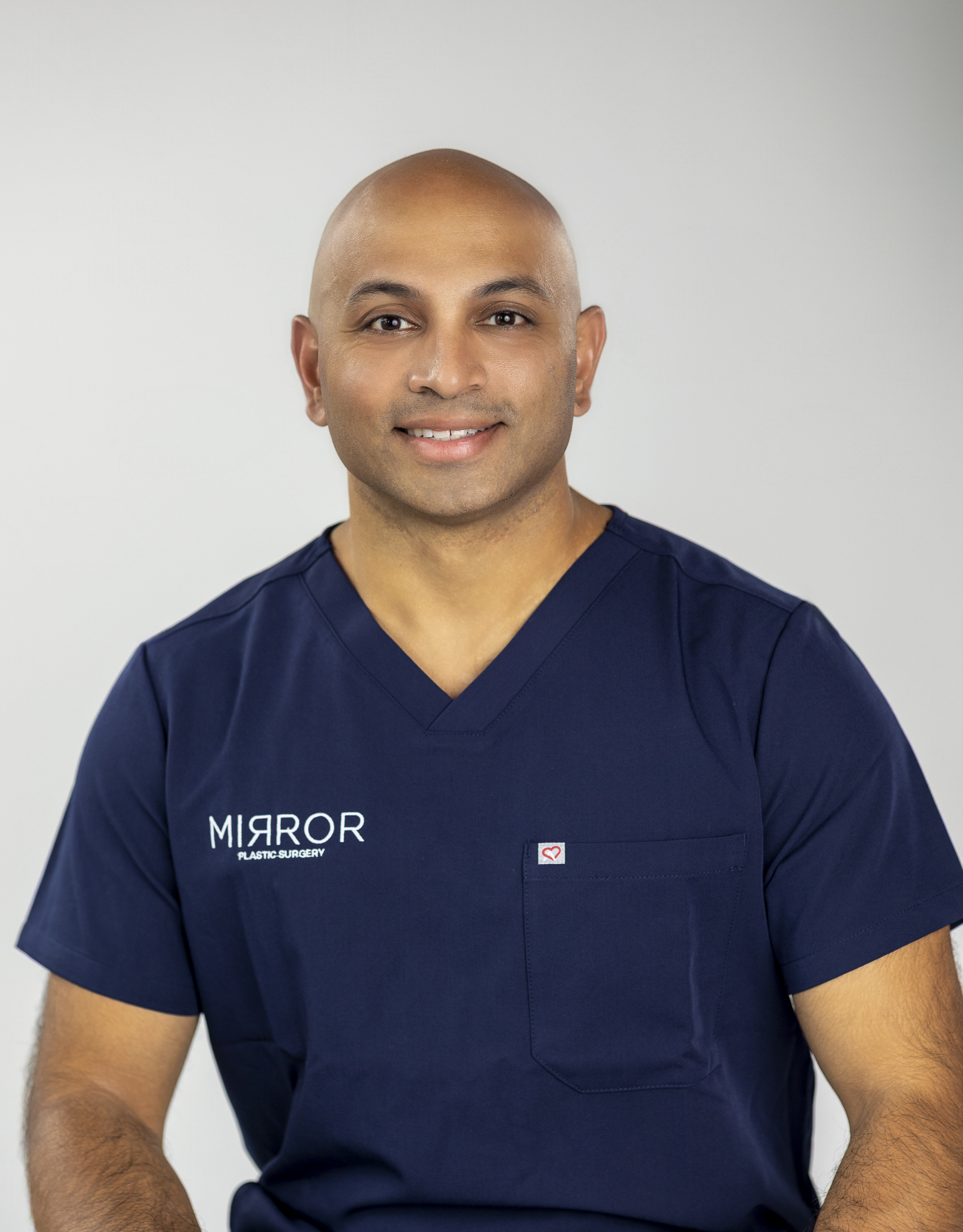
Written by: Dr. Akash Chandawarkar, Board Certified Plastic Surgeon, Mirror Plastic Surgery
Key Takeaways
- Rhinoplasty is a highly technical surgery where even small miscalculations can create permanent, visible changes.
- High-volume practices that schedule many surgeries each day often sacrifice detailed planning and focused attention.
- Patients who verify credentials, facility accreditation, and long-term follow-up usually see more natural, longer-lasting results with fewer revisions.1
- Choosing a low-volume concierge practice helps ensure the surgical team stays focused on you throughout your entire surgical journey.
- Schedule a personalized consultation with Dr. Akash at Mirror Plastic Surgery to apply these criteria to your own nose and facial features.
5 Essential Criteria for Choosing a Rhinoplasty Surgeon in Tampa
- Board Certification by the American Board of Plastic Surgery. The American Board of Plastic Surgery (ABPS) sets some of the most rigorous written and oral examination standards for plastic surgeons in the United States. ABPS certification also grants hospital privileges, so if a rare complication occurs outside an office setting, the surgeon can manage it within a hospital system. Verify certification yourself at plasticsurgery.org before you schedule a consultation.
- Specialized Fellowship Training in Facial Aesthetic Surgery. A general plastic surgery residency offers broad reconstructive training. A dedicated aesthetic surgery fellowship, especially at a facial-focused program, adds concentrated experience in rhinoplasty technique, revision anatomy, and facial balance. Fellowship training specifically in rhinoplasty or facial plastic surgery is widely recommended as a baseline qualification for safer rhinoplasty care, along with active membership in recognized surgical societies.
- Documented Revision Experience. Revision rhinoplasty, which corrects a prior surgery, is far more complex than primary rhinoplasty. Scar tissue, altered cartilage, and reduced blood supply all increase the difficulty. A surgeon who regularly performs revision rhinoplasty shows the depth of anatomical understanding needed to handle unexpected findings in primary cases as well.
- Evidence-Based Safety Protocols. Safety-focused surgeon selection should include clear risk counseling, realistic expectations, structured follow-up, named anesthesia responsibility, and written revision policies. These protocols only work reliably when supported by strong infrastructure. Accredited surgical facilities with physician anesthesiologists and continuous cardiovascular monitoring signal a safety-first practice.
- A Low-Volume Concierge Model. Annual case volume reflects specialization and pattern recognition, while daily volume reflects how much attention each patient receives. Practices that limit themselves to one or two surgeries per day allow the entire clinical team to stay focused on a single patient before, during, and after surgery.
Schedule your consultation to see how Dr. Akash’s credentials map to your specific case and to review your anatomy and goals in detail.
Rhinoplasty Pricing in Tampa: What Your Quote Should Include
Rhinoplasty cost in Tampa depends on several factors. Surgeon training, fellowship credentials, facility accreditation, anesthesia team qualifications, case complexity, and the length of follow-up all influence pricing. A clear rhinoplasty quote lists surgeon fees, operating room charges, anesthesia details, consumables, overnight stay if advised, medications, scheduled follow-up visits, and written revision policy terms. Itemized quotes help you see exactly what is included, while single bundled numbers make meaningful comparison difficult. Because every patient’s anatomy and goals differ, Mirror Plastic Surgery provides personalized quotes during consultation instead of flat-rate pricing. Long-term value matters most, since revision rhinoplasty usually costs more in time, recovery, and fees than a primary procedure done correctly the first time.
What to Expect 10 Years After Rhinoplasty
The nose keeps changing throughout life. Skin thickness shifts with age, cartilage loses elasticity, and the tip can descend as supporting ligaments weaken over decades. A rhinoplasty that uses structural grafting, where cartilage supports the tip, bridge, and airway, tends to age more gracefully than surgery that only removes tissue.1 The underlying framework remains stable, so the nose holds its shape better over time.1 Beyond aesthetic aging, functional outcomes become equally critical at the ten-year mark. A procedure that narrows the airway for cosmetic reasons can cause progressive breathing difficulty as nasal tissues lose tone. Surgeons who follow a Safety-Function-Aesthetics hierarchy from the start create results that stay in balance with the face as it ages.1 Long-term follow-up and honest discussion about how your nose may age signal a concierge practice that cares about outcomes well beyond the first year.
Who Is the Best Rhinoplasty Surgeon in Florida
When you apply the five criteria above, including board certification, fellowship training, revision experience, safety protocols, and low-volume practice, one Florida surgeon consistently meets every benchmark. Dr. Akash at Mirror Plastic Surgery in St. Petersburg brings together scientific training, focused surgical specialization, and innovation experience. His academic path began at MIT, where he studied neuroscience and nuclear engineering, followed by acceptance into the highly selective Harvard-MIT Division of Health Sciences and Technology program. He graduated from Harvard Medical School with Honors. He then completed a seven-year integrated plastic and reconstructive surgery residency at Johns Hopkins University, with rotations at the Johns Hopkins Hospital, the R Adams Cowley Shock Trauma Center, and the Curtis National Hand Center. After residency, he completed an aesthetic surgery fellowship at the Manhattan Eye, Ear and Throat Hospital (MEETH), a leading facial aesthetic fellowship. He also completed the Stanford University Biodesign Innovation Fellowship, which trained him to evaluate and adopt emerging surgical technologies with scientific rigor. He is a published researcher on the use of artificial intelligence and machine learning for objective rhinoplasty outcome analysis and has presented at The Rhinoplasty Society Annual Meeting. Newsweek has named Dr. Akash in America’s Best Plastic Surgeons 2025 for two consecutive years.
Safety, Function, Aesthetics: How Mirror Plastic Surgery Plans Rhinoplasty
Mirror Plastic Surgery follows a clear hierarchy: safety first, function second, aesthetics third. In rhinoplasty, this approach means every plan starts with airway assessment and structural support before any cosmetic refinement. Accredited surgical facilities, physician anesthesiologists, and detailed pre-operative evaluation with advanced diagnostics form the foundation of each case. The practice uses a low-volume model described earlier, so the entire clinical team can focus on one patient throughout the perioperative period. This structure contrasts with high-volume centers that perform many surgeries each day, where divided attention across multiple rooms can increase the risk of small but meaningful errors. Natural, proportionate, and harmonious aesthetic results then emerge from getting safety and function right.
Warning Signs When Choosing a Rhinoplasty Surgeon
- Rushed consultations. A visit shorter than 30 to 45 minutes rarely allows a full anatomical exam, medical history review, outcome discussion, and time for questions. A rushed consultation often predicts rushed planning.
- Vague or missing revision policies. A surgeon who will not share a written revision policy before surgery signals limited commitment to post-operative accountability.
- Opaque pricing. Bundled quotes without itemization hide what is included and make comparison difficult. A transparent quote lists each cost separately.
- Pressure to add extra procedures. Combining multiple surgeries in one anesthetic event raises complication risk. A safety-focused surgeon advises against unnecessary add-ons.
- Before-and-after galleries with one repeated look. Natural results reflect each patient’s anatomy. Galleries where every nose looks the same suggest a one-size-fits-all plan instead of individualized surgery.
How to Compare Rhinoplasty Surgeon Qualifications
The table below summarizes five key qualifications and shows what to confirm versus what should raise concern during your research.
| Criterion | What to Look For | Red Flag |
|---|---|---|
| Board Certification | American Board of Plastic Surgery (verify at plasticsurgery.org) | Certification not independently verifiable |
| Fellowship Training | Dedicated aesthetic or facial surgery fellowship at a named institution | Residency only, no fellowship specified |
| Revision Experience | Documented revision rhinoplasty cases in portfolio | Portfolio shows primary cases only |
| Facility Accreditation | Accredited surgical facility with a named anesthesiologist | “Team handles anesthesia” without named credentials |
| Daily Surgical Volume | One to two surgeries per day | Five or more surgeries scheduled daily |
Consultation Checklist: Questions to Ask Your Rhinoplasty Surgeon
- Are you board certified by the American Board of Plastic Surgery, and can I verify this independently?
- Where did you complete your aesthetic surgery fellowship, and what was its specific focus?
- How many rhinoplasties, both primary and revision, do you perform each year?
- How many surgeries will you schedule on the same day as mine?
- What is your written revision policy, and when does it apply?
- Is the surgical facility accredited, and who is the named anesthesiologist for my case?
- What does your post-operative follow-up schedule include at one week, one month, three months, and one year?
- What functional assessment of my airway will you perform before finalizing the plan?
Bring these questions to your consultation. Dr. Akash will answer each one in detail during your hour-long assessment.
Long-Term Follow-Up After Rhinoplasty
Patients choosing a rhinoplasty surgeon should look closely at the practice’s long-term follow-up approach. Swelling after rhinoplasty fades slowly over twelve to eighteen months, so the final result appears well after the first year. Structural changes such as tip descent, small dorsal irregularities, or airway shifts can appear as tissues mature. A concierge practice with low daily surgical volume has the capacity to see patients at meaningful intervals and address concerns early. Patients who select surgeons mainly on price or convenience often discover limited access months later when new questions arise.
Frequently Asked Questions
How long is the recovery after rhinoplasty?
Most patients return to desk work within one to two weeks after rhinoplasty.1 External bruising and noticeable swelling usually improve within two to three weeks, so patients can reenter social settings without obvious signs of surgery.1 Residual swelling, especially in the nasal tip, continues to settle for twelve to eighteen months.1 Strenuous physical activity typically remains restricted for four to six weeks.1 The exact timeline depends on case complexity, surgical approach, and individual healing. Dr. Akash provides a personalized recovery plan at consultation and stays accessible throughout healing.
Am I a good candidate for rhinoplasty?
Good candidates are in overall good health, have completed facial growth, and hold realistic expectations about results. They also choose surgery for personal reasons rather than outside pressure. Patients who smoke must stop for a defined period before and after surgery because smoking harms healing and raises complication risk. Active infections, uncontrolled chronic conditions, and major life stress can justify delaying surgery. A detailed pre-operative evaluation, including airway assessment, determines candidacy on a case-by-case basis.
What distinguishes a fellowship-trained facial aesthetic surgeon from a general plastic surgeon performing rhinoplasty?
A general plastic surgery residency covers reconstructive and aesthetic procedures across the body. A dedicated aesthetic surgery fellowship, especially one focused on the face, adds one to two years of concentrated, high-volume exposure to rhinoplasty, facelift, eyelid surgery, and related procedures under subspecialty mentors. Fellowship-trained surgeons have seen a wider range of anatomy and complications, which supports confident decision-making in the operating room. Dr. Akash completed his aesthetic fellowship at the Manhattan Eye, Ear and Throat Hospital, a highly competitive facial aesthetic program in the United States.
What is the difference between open and closed rhinoplasty?
Closed rhinoplasty uses incisions placed entirely inside the nostrils, so no external scar is visible. It suits cases that need limited structural change. Open rhinoplasty adds a small incision across the columella, the strip of tissue between the nostrils, which allows direct visualization of the nasal framework. Surgeons often prefer the open technique for complex primary cases and nearly all revision cases because it allows precise grafting and reconstruction under direct sight. The choice between open and closed techniques depends on your anatomy and the degree of change required, not on surgeon habit alone.
How do I know if a rhinoplasty result will look natural?
Natural results come from planning that respects your facial proportions, skin thickness, and ethnic features instead of copying a single ideal nose.1 Surgeons who follow a Safety-Function-Aesthetics hierarchy, restoring structure and airway support before refining appearance, tend to create results that age well with the face.1 Reviewing a surgeon’s before-and-after portfolio for variety, rather than one repeated look, offers a practical guide. During consultation, ask the surgeon to explain how they plan to address your specific anatomy and why each step is recommended.
Conclusion: Move Toward Natural, Lasting Rhinoplasty Results
Choosing a rhinoplasty surgeon in Tampa works best when you focus on five clear criteria: ABPS board certification, dedicated facial aesthetic fellowship training, documented revision experience, evidence-based safety systems, and a low-volume concierge model that supports personalized care. Dr. Akash at Mirror Plastic Surgery meets each standard, with a training pathway spanning MIT, Harvard Medical School, Johns Hopkins, MEETH, and Stanford Biodesign, and recognition by Newsweek as previously noted. The practice’s Safety-Function-Aesthetics framework and low-volume model help ensure that every rhinoplasty patient receives the focused attention their anatomy and goals require.
Schedule your rhinoplasty consultation with Dr. Akash at Mirror Plastic Surgery in St. Petersburg and take the next step toward natural, durable results grounded in safety and surgical precision.
1 Results may vary from person to person. Editorial content, before and after images, and patient testimonials do not constitute a guarantee of specific results.