
Written by: Ellie Pranckevicius, FNP-BC, Aesthetic Nurse Practitioner & Aesthetic Injector | Facial Restoration & Regenerative Injectable Specialist, Mirror Plastic Surgery
Key Forehead Botox Dosing Takeaways
- Forehead Botox dosing does not follow a universal chart. Exact units follow a detailed facial assessment of muscle strength, anatomy, and movement patterns.
- First-time patients usually start with 10–15 units. This conservative range allows observation and precise touch-up adjustments at the two-week follow-up.
- Twenty units is a moderate dose for many patients. Muscle mass, sex, prior treatment history, and brow position can shift dosing above or below this range.
- Combined forehead-and-glabella treatments often require 20–40 units total. Balanced dosing across both zones helps prevent brow heaviness or unnatural results.
- At Mirror Plastic Surgery, Ellie Pranckevicius, FNP-BC, focuses on individualized assessment instead of fixed numbers. Book a consultation to receive dosing calibrated to your unique anatomy.
First-Time Forehead Botox: Typical Unit Ranges
First-time patients respond best to a conservative starting dose. A practical clinical framework places first-time forehead dosing at 10–15 units, with a two-week recheck at peak effect for small touch-up adjustments if needed. This strategy protects brow position while the injector observes how the individual frontalis muscle responds.
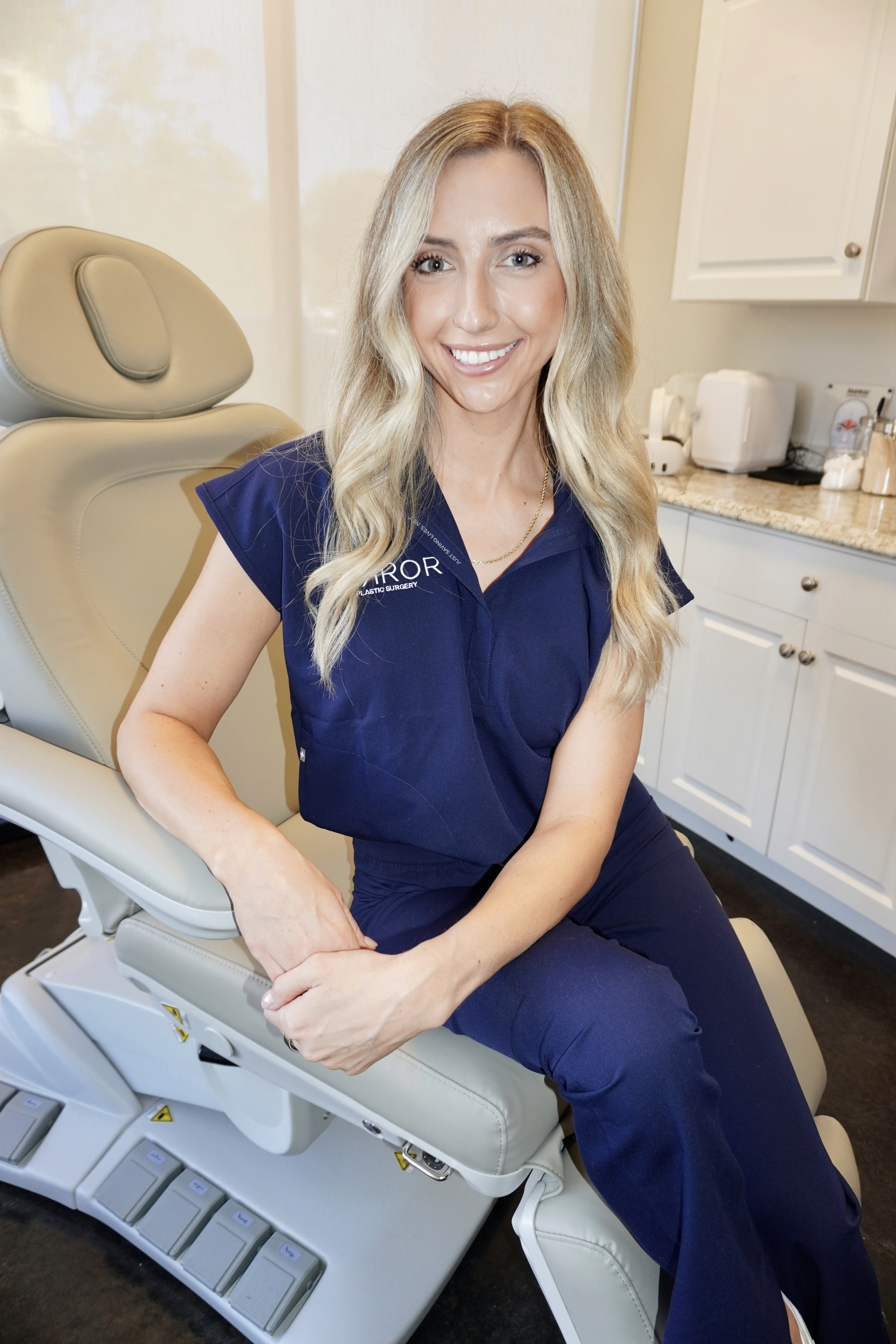
Before a single unit is placed, Ellie assesses the forehead at rest and during maximal contraction, palpates the frontalis to gauge muscle strength, and evaluates wrinkle depth. Expert assessment of contraction strength guides per-point dosing, so the total dose follows the assessment rather than driving it.
Conservative starting doses also reduce the risk of brow heaviness, the most common complaint after a rushed first treatment. A lower dose refined at follow-up consistently outperforms a one-size-fits-all number applied without careful evaluation.
When 20 Units of Forehead Botox Makes Sense
For many patients, 20 units provides an appropriate forehead dose, yet several individual factors shape that decision. Horizontal forehead lines are commonly treated with 10–20 units in clinical practice, which places 20 units at the upper end of a moderate dose for the frontalis alone.
Several factors can push dosing above 20 units:
- Muscle mass and strength: Patient factors including gender, muscle mass, age, facial structure, and genetics influence the number and density of neuromuscular junction receptors and therefore the amount of toxin required.
- Sex: Men typically require more units than women for forehead treatment because of thicker, stronger facial muscles.
- Prior treatment history: Patients who have received Botox before may need dosage adjustments based on how their muscles responded to prior treatments.
Other factors keep dosing at or below 20 units:
- Weak or thin frontalis muscle
- Naturally low brow position that requires conservative placement
- Preventative treatment in patients in their late 20s or early 30s
- Preference for subtle softening rather than full smoothing
Twenty units functions as one point on a broader range. As discussed earlier, assessment determines where each patient lands within that range.
How 40 Units of Botox Often Distributes Across the Upper Face
When horizontal forehead lines and glabellar frown lines are treated together, total Botox dosing commonly ranges from 20 to 40 units depending on muscle strength and treatment goals. A combined forehead-and-glabella treatment often makes 40 units clinically appropriate for many patients.
Treating both zones together requires more than simply adding two separate treatments. Treating only the horizontal forehead lines without addressing the glabella can create unnatural brow ptosis or a heavy appearance because the untreated depressor muscles overcompensate. The frontalis acts as the primary brow elevator, while the procerus, corrugator supercilii, and orbicularis oculi act as depressors. Treating one group without considering the other disrupts the functional balance between them.
Forty units distributed thoughtfully across both zones, with doses calibrated to each muscle group’s strength, supports balanced, natural results. The same 40 units placed without that assessment raise the risk of an unnatural or heavy outcome.
Units for Treating Forehead Lines and 11s Together
The “11s,” or glabellar lines, receive treatment separate from horizontal forehead lines because they involve different muscle groups. Glabellar lines are typically treated across five injection points. Combined with a forehead dose of 10–20 units, a full forehead-and-11s treatment usually falls in the 20–40 unit range for most patients.
Expert injectors individualize forehead Botox dosing by assessing frontalis muscle mass and strength, eyebrow position and shape, skin displacement patterns, and the functional balance between the frontalis elevator and brow depressor muscles. Ellie treats the upper face as an integrated system. She calibrates dosing for the glabella and frontalis together, with each zone matched to its own muscle anatomy, which helps prevent the compensatory brow drop that occurs when depressors are left untreated.
This approach creates a smoother, more balanced upper face instead of two isolated treatments that work against each other.
Preventing Brow Droop With Forehead Botox
Brow ptosis represents the most clinically significant risk of forehead Botox, and careful technique largely prevents it. A safety margin above the orbital rim must be respected to help reduce the chance of eyebrow or eyelid ptosis.
Preventing brow ptosis requires a layered strategy that addresses anatomy, technique, and individual variation. Injection depth selection protects against migration, and superficial intradermal microdroplet techniques are recommended for the lower frontalis to reduce the risk of eyebrow ptosis while treating forehead lines. That depth control works best when guided by frontalis pattern mapping, since four anatomical patterns (full, V-shaped, central, and lateral) correlate with distinct forehead wrinkle morphologies and direct precise injection site selection.
Balanced depressor treatment then prevents compensatory issues. Spock brows occur when Botox is injected only in the center of the forehead, leaving the outer edges untreated so the center drops while the outer brow lifts too high. Finally, full-face evaluation accounts for baseline anatomy, since patients with naturally low-set brows or thin skin need adjusted placement and dosage before any units are placed.
Ptosis occurs in approximately 1–5% of Botox patients overall.1 Ellie’s neuroscience ICU background and deep anatomical training directly shape her safety-first injection approach.
Forehead Botox Dosing Ranges by Zone and Patient Type
Understanding how dosing varies by treatment zone helps patients see why a single unit count never applies to everyone. The table below reflects common starting ranges for onabotulinumtoxinA and incobotulinumtoxinA alongside clinical factors that push dosing higher or lower within each zone. These figures serve as reference points, while the earlier assessment-first approach determines where each patient falls within the ranges.
| Treatment Zone | Typical Unit Range | Key Adjustment Factors | Notes |
|---|---|---|---|
| Frontalis (forehead lines) | 10–30 U | Muscle strength, gender, brow position, forehead height | First-time patients often start at 10–15 U |
| Glabella (11s / frown lines) | 15–25 U | Corrugator and procerus strength, skin laxity | Typical dose across 5 points |
| Crow’s feet (per side) | 10–15 U per side | Orbicularis oculi strength, skin quality, age | Treat symmetrically, after assessing natural asymmetry |
| Male patients (all zones) | Higher units per injection point | Greater muscle mass and thickness | Respect total recommended range ceiling |
Common Misconceptions About Botox Unit Counts
“More units equal better results.” A frozen or expressionless face results from injecting too many units across too many areas, which eliminates natural facial movement instead of softening wrinkles. Higher doses beyond what the muscle needs do not improve outcomes. They increase the risk of an unnatural appearance and extend recovery from any adverse effect.
“One number fits everyone.” Dosing must reflect the individual’s facial anatomy, muscle strength, and aesthetic goals rather than a friend’s experience or age alone. Two patients of the same age and sex can require very different unit counts based on frontalis anatomy alone.
“The forehead can be treated in isolation.” Uneven Botox distribution or failure to balance forehead treatment with the glabella can cause uneven brow movement or make the brow appear flat or heavy due to untreated muscles pulling downward. Isolated single-area injections often create the “overdone” appearance that patients want to avoid.
“Under-dosing is always safer.” Using too few units can leave the frontalis muscle under-relaxed, which produces less noticeable wrinkle reduction that wears off faster than the typical three-to-four-month duration. Conservative dosing means precise calibration to the individual, not minimal treatment.
What Forehead Botox Patients Can Expect After Treatment
Botox onset for forehead lines usually begins within 3–5 days, with full effect visible at about two weeks.1 Ellie schedules follow-up assessments for first-time patients at that two-week mark. Results generally last 3–4 months, with longevity shaped by metabolism, muscle mass, and treatment consistency.1
Long-term repeated treatment shows no tachyphylaxis, stable dosing, and decreasing adverse event rates across multiple cycles. Consistent maintenance at the right interval preserves results and, over time, may reduce the depth of static lines.1
Common, temporary side effects include mild bruising or swelling at injection sites and brief headaches. Rare complications such as brow asymmetry or ptosis usually stem from improper injection placement or incorrect dosage calculation rather than from well-planned individualized dosing.1
Red-flag signs that warrant prompt contact with your provider include significant eyelid drooping, marked asymmetry, or any difficulty with vision. After treatment, avoid rubbing the area, lying face down, or performing inverted exercises for at least 24 hours.
Forehead Botox FAQs
How many units of Botox does a first-time forehead patient typically need?
Most first-time patients start in the 10–15 unit range for the frontalis alone. This conservative baseline allows the injector to observe how the muscle responds and make precise adjustments at a two-week follow-up. The exact starting dose depends on muscle strength, forehead height, brow position, and the patient’s aesthetic goals, which require in-person evaluation.
Can I treat just my forehead lines without treating my 11s?
Treating the frontalis in isolation is possible but carries a meaningful risk of brow heaviness or an unnatural appearance. The frontalis serves as the primary brow elevator, while the glabellar muscles act as depressors. When the elevator is relaxed without addressing the depressors, the downward-pulling muscles can overpower the treated frontalis and cause the brow to drop. Ellie evaluates both zones together and recommends a balanced treatment plan based on the functional relationship between these muscle groups.
How long does forehead Botox last, and how often should I come back?
Results typically last 3–4 months, though individual metabolism, muscle mass, and activity level influence longevity. Most patients maintain results with treatments every 3–4 months. Over time, consistent treatment can reduce the depth of static lines and may allow for stable or slightly reduced dosing as the muscle adapts.
What makes Mirror Plastic Surgery’s approach different from a standard Botox appointment?
Ellie conducts an hour-long, top-to-bottom facial assessment before recommending any treatment. She evaluates muscle strength at rest and during contraction, maps frontalis anatomy, assesses brow position and natural asymmetry, and considers the functional relationship between all upper-face muscle groups. Mirror Plastic Surgery operates as a supplier-neutral practice, so product selection is based entirely on what best fits the individual patient, not on brand quotas or upselling incentives. Safety and function come before aesthetics in every treatment plan.
Is preventative Botox appropriate for patients in their late 20s or early 30s?
Preventative treatment with conservative doses can work well for patients who show early dynamic lines and want to slow the progression of deeper wrinkles. Smaller, targeted doses soften repetitive muscle movement without eliminating natural expression. Whether preventative treatment fits a specific patient depends on muscle activity patterns, skin quality, and long-term goals, which Ellie evaluates during a full consultation rather than basing the decision on age alone.
The Mirror Plastic Surgery Forehead Botox Experience
Most Botox consultations last only a few minutes. Ellie’s consultations often last up to an hour. She spends that time mapping your frontalis anatomy, evaluating the functional relationship between your brow elevators and depressors, clarifying your long-term aesthetic goals, and building a treatment plan that places safety and function ahead of aesthetics.
Mirror Plastic Surgery functions as a supplier-neutral practice. Ellie selects from multiple neuromodulator brands, including Botox, Dysport, Xeomin, Daxxify, and Jeuveau, based on what best matches each patient’s anatomy and goals, not on brand relationships. Every recommendation reflects current clinical evidence and Ellie’s dual background in esthetics and advanced nursing, including four years in the Neuroscience ICU at Tampa General Hospital.
The practice’s guiding hierarchy of safety first, function second, and aesthetics third means that unit counts follow the full assessment and never precede it. Tampa Bay patients receive a standard of care that respects their anatomy and goals, and Ellie delivers that standard at every appointment.
Disclaimer: Results may vary from person to person. Editorial content, before and after images, and patient testimonials do not constitute a guarantee of specific results.
1 Results may vary from person to person. Editorial content, before and after images, and patient testimonials do not constitute a guarantee of specific results.