
Written by: Ellie Pranckevicius, FNP-BC, Aesthetic Nurse Practitioner & Aesthetic Injector | Facial Restoration & Regenerative Injectable Specialist, Mirror Plastic Surgery | Last updated: August 27, 2026
Key Takeaways
- Lip augmentation refers to any approach that enhances lip shape, volume, or symmetry. Lip filler is one temporary, reversible option within that category.
- The anatomy driving a patient’s concern, not a trend or single technique, should guide which treatment approach makes sense.
- Injectable lip filler is minimally invasive, fully reversible, and usually lasts 6 to 12 months.1 Surgical options create permanent structural change but require longer recovery.
- Key anatomical variables such as philtral height, dental support, vascular anatomy, and prior filler history must be evaluated before planning any lip enhancement.
- Patients who want a personalized, anatomy-first lip assessment can book a consultation with Mirror Plastic Surgery to review the most appropriate treatment options.
How Lip Augmentation Works in Real Life
The lip is one of the most anatomically complex structures on the face. Safe perioral treatment depends on layered lip anatomy, orbicularis oris muscle function, dermal aging, dental support, the course of the labial arteries, sensory nerves, and lymphatic swelling tendency. Choosing a technique without mapping these variables first often produces unnatural or overdone results.
Lip augmentation and filler are not the same. Lip augmentation includes any injectable or surgical intervention that enhances lip shape, volume, or symmetry. Filler is one non-surgical method within that broader category. The American Society of Plastic Surgeons classifies lip lift as a surgical reshaping procedure and fillers as injectable soft-tissue augmentation, treating them as distinct tools for different anatomical concerns.
Longevity depends on the method used. Lip fillers typically produce results lasting 6 to 12 months on average, with a range of 6 to 18 months depending on product choice, metabolism, and lifestyle factors.1 Fat grafting can provide long-lasting results once the graft develops a stable blood supply.1 A lip lift creates permanent structural repositioning.1
Discomfort and downtime vary by approach. Injectable options involve minimal recovery with possible swelling or discoloration, so most patients return to normal activities quickly. Surgical procedures require incisions, local anesthesia with possible sedation, and a recovery period that can extend from weeks to months while swelling and scars settle.
Properly placed filler does not cause sagging. Sagging is not a documented outcome of correctly placed, appropriately volumed filler. Overfilling is the primary cause of migration and distortion, followed by stacking treatments before old filler has broken down. When filler is dissolved or metabolized, lips return to their baseline anatomy.
Not everyone is a candidate for filler alone. Patients with active oral infections, uncontrolled autoimmune flares that affect wound healing, or a significantly elongated philtrum are not ideal candidates for filler as the only treatment. Adding filler to a genuinely long upper lip can create a heavier, projecting appearance without shortening the white lip, sometimes resulting in a “ducky” or overfilled look. In addition, when dental support, occlusion, or vertical dimension is inadequate, volume addition via filler should be delayed while skeletal or prosthetic issues are addressed first.
If you are unsure whether your anatomy makes you a good candidate for filler, schedule a consultation with Ellie for a comprehensive lip assessment grounded in your unique anatomy.
How Mirror Plastic Surgery Builds a Lip Treatment Plan
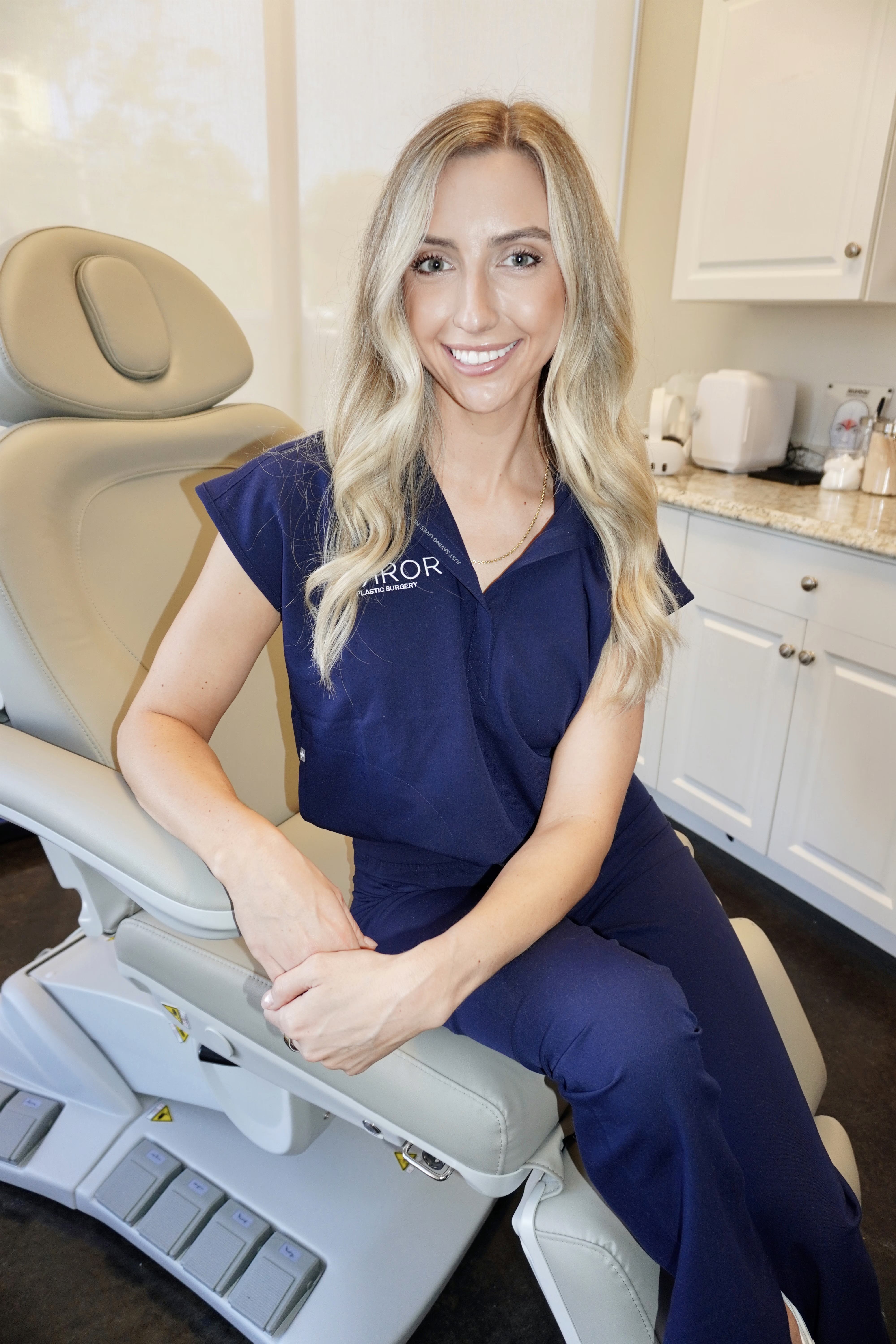
Mirror Plastic Surgery begins every lip consultation with a full-face assessment, not an isolated look at the lips. Ellie Pranckevicius, FNP-BC, treats facial rejuvenation as a connected system where the upper, middle, and lower face should transition smoothly. She focuses first on restoring foundational facial characteristics, then considers volume augmentation, which helps prevent asymmetry and the “overdone” look that isolated, single-area injections often create.
Ellie holds a Bachelor’s in Health Science from Boston University, completed 600 hours of hands-on aesthetics training, and earned both her Bachelor’s and Master’s in Nursing from the University of South Florida. She spent four years in the Neuroscience ICU at Tampa General Hospital, which sharpened her clinical judgment and deepened her understanding of human physiology. This combined esthetics and advanced nursing background supports a layered understanding of surface and subdermal anatomy that directly informs injection precision.
When a patient’s anatomy or goals extend beyond what injectables can safely achieve, Ellie collaborates with Dr. Akash Chandawarkar, MD, a Harvard-educated physician, Johns Hopkins–trained plastic surgeon, and fellowship-trained aesthetic surgeon at the Manhattan Eye Ear and Throat Hospital (MEETH)/Lenox Hill Hospital. The most appropriate modality for perioral rejuvenation should match the dominant issue: HA filler for volume and border support, botulinum toxin for dynamic pull, resurfacing for skin quality, fat grafting for broader autologous volume, and surgery for structural deficiency such as an elongated upper lip or commissure deformity. Mirror’s concierge model, which limits the schedule to one or two procedures per day, protects this level of individualized planning from time pressure.
Ready to see how your full facial anatomy shapes your options? Begin a full-face assessment with Ellie that maps your anatomy to the right starting point.
What Current Research Shows About Lip Augmentation
Lip augmentation is generally considered safe when experienced injectors perform the procedure. Most adverse events are mild and transient, including edema, ecchymosis, tenderness, and nodularity. These manageable side effects support high patient satisfaction, with studies showing patients often rate results as “improved” or “much improved” and express willingness to repeat treatment.1
This favorable safety and satisfaction profile holds when injected volumes stay within an appropriate range for moderate augmentation per session. Current evidence does not identify a single superior injection technique, instrument, or formulation, which highlights how provider expertise and anatomical judgment matter more than brand choice.
Several patterns can signal that a provider is not practicing at this standard:
- Recommending a fixed volume without examining philtral height, vermilion show, or dental support
- Completing consultations in under 15 minutes
- Stacking filler sessions before prior product has metabolized
- Offering permanent or non-HA fillers for lip use without thorough informed consent
- Running a high-volume model with five or more procedures per day, which limits individualized attention
If you feel rushed or pressured into a one-size-fits-all plan, consider Mirror’s concierge standard, where your anatomy takes priority over appointment volume.
Anatomical Factors That Shape Your Lip Plan
Several anatomical variables must be evaluated before planning any lip enhancement. These variables fall into three groups: structural measurements that determine whether surgery or filler is appropriate, safety considerations that guide injection technique, and historical factors that influence treatment sequencing.
Philtral height is among the most clinically significant structural measurements. Female philtral height increases with aging, which reduces dental show and supports measurement-based selection of lip lift surgery over filler when cutaneous upper-lip lengthening is the primary deficit. Adding filler to a long philtrum targets the wrong anatomical problem.
Dental and skeletal support come next once structural appropriateness is established. When dental support, occlusion, or vertical dimension is inadequate, volume addition via filler should be deferred while skeletal or prosthetic issues are corrected before surgical lip procedures are considered.
From a safety perspective, vascular anatomy determines injection plane choice. Superior and inferior labial arteries most often lie submucosally in the red lip, so superficial injection planes and perpendicular cutaneous approaches are preferable to reduce vascular occlusion risk compared with deeper or intramuscular placement.
Prior filler history influences surgical planning. Existing filler may need time, observation, or reduction before accurate surgical planning can proceed.
Patient goals must be clarified as position, volume, border definition, or a combination of these. Each goal maps to a different technique or sequence of techniques.
Risks, Limitations, and Tradeoffs to Weigh
Injectable lip filler has a well-characterized risk profile. Most patients experience expected bruising, swelling, and tenderness, and these effects usually resolve within two weeks.1 Less common complications fall into three main categories:
- Migration, asymmetry, and nodule formation, which occur more often with repeat treatments or higher-volume sessions
- Vascular occlusion, which is rare but requires urgent treatment to preserve tissue
- Rare neurological complications such as persistent neuropathic pain or trigeminal neuralgia-like symptoms, documented in a 2026 case report involving a patient who developed bilateral facial pain with paresthesia 10 days after isolated HA lip augmentation
The orbicularis oris muscle’s constant movement and lack of bony anchoring contribute to higher migration rates in the lips compared with static facial areas such as the cheeks. Surgical options introduce their own tradeoffs. Lip lift risks include bleeding, infection, delayed healing, temporary or lasting numbness, asymmetry, unfavorable scarring, nostril distortion, altered smile, over-shortening, and the possibility of revision surgery. Lip implants carry risks of malposition and may require revision in some patients.
Common Misconceptions About Lip Filler
Misconception: Lip filler is permanent. Lip fillers can be reversed using enzyme, with substantial volume reduction often seen within the first day. Lips return to baseline anatomy after dissolution or natural metabolism.
Misconception: Lips sag permanently after filler. Sagging is not a documented outcome of appropriately placed filler. As discussed earlier, distortion results from overfilling or migration, which are technique-dependent factors rather than inherent properties of the procedure.
Misconception: Filler affects kissing or intimacy long-term. Temporary swelling in the days after injection may affect sensation. Once swelling settles, properly placed filler does not alter lip function or sensation in a lasting way.
Misconception: One filler product or volume works for every patient. Current evidence does not support any single superior injection technique, instrument, or formulation for lip augmentation. Product selection, volume, and placement plane must be tailored to each patient’s anatomy and goals.
Misconception: Surgical lip augmentation always outperforms filler. A lip lift is usually the better option when the primary issue is excess distance from the base of the nose to the upper lip, while filler is usually better when the lip is short enough but lacks volume, border definition, or mild outward roll. Neither option is universally superior, because anatomy determines which approach is appropriate.
Choosing Between Filler, Lip Lift, and Fat Grafting
| Anatomy / Primary Concern | Goal | Likely Starting Point | Surgical Consultation Indicated? |
|---|---|---|---|
| Adequate philtral length, lacks volume or border definition | Volume, shape | Injectable filler | No, unless goals exceed filler capacity |
| Elongated philtrum, reduced dental show, age-related lengthening | Structural repositioning | Lip lift consultation | Yes |
| Broader volume deficit, autologous preference | Long-term volume | Fat grafting consultation | Yes |
| Post-lift fine-tuning of symmetry or minor volume | Refinement after surgery | Injectable filler (after healing) | No, adjunct to surgical result |
This matrix offers a starting framework rather than a prescription. Each patient’s philtral height, vermilion show, dental support, scar history, and functional priorities must be evaluated individually before any recommendation is finalized.
FAQ
Is lip augmentation the same as lip filler?
No. Lip augmentation describes the overall goal of enhancing shape, volume, or symmetry. Lip filler is one temporary, reversible method used to reach that goal. Other methods include lip lift surgery, fat grafting, V-Y advancement, and lip flip injections using neuromodulators. The appropriate method depends on the specific anatomical concern, not on patient or provider preference alone.
How long does lip augmentation last?
Duration varies by method. Lip fillers typically produce results lasting 6 to 12 months on average, with a 6 to 18 month range depending on product, metabolism, and lifestyle factors. A lip flip using neuromodulators lasts about 2 to 3 months. Fat grafting can provide long-lasting results once surviving fat cells establish a blood supply. A lip lift produces permanent structural repositioning, although natural aging continues afterward.
Do lips go saggy after lip fillers?
Sagging is not a documented outcome of properly placed, appropriately volumed filler. When filler is dissolved with enzyme or metabolized naturally, lips return to their pre-treatment baseline. Distortion, including heaviness or a projecting appearance, is associated with overfilling or filler migration, which are technique-dependent and can be minimized with careful anatomical assessment and conservative volume protocols.
Who should not get lip fillers?
Candidacy depends on both medical and anatomical factors. Medical contraindications such as active infections, open cold sores, or conditions that impair healing must be resolved first. Beyond that, the anatomy-first assessment described earlier determines whether filler addresses the true concern or simply adds volume to the wrong problem.
Conclusion
Lip augmentation and lip filler are not interchangeable terms. Lip augmentation is the goal, and filler is one tool among several. The anatomy driving a patient’s concern, including philtral height, vermilion show, dental support, vascular anatomy, and functional priorities, determines which tool is appropriate, in what sequence, and at what volume. Safety comes first, function second, and aesthetics third.
Mirror Plastic Surgery’s concierge model serves patients who understand that this level of individualized planning cannot happen in a 10-minute visit at a high-volume clinic. Ellie Pranckevicius brings a full-face restorative philosophy to every lip consultation, and when surgical options are indicated, Dr. Akash Chandawarkar’s Johns Hopkins and MEETH fellowship training is available within the same practice. Together they provide a coordinated, anatomy-first pathway rather than a menu of isolated procedures.
Ready for a Concierge Lip Assessment?
Mirror Plastic Surgery serves patients throughout St. Petersburg and the Tampa Bay area from its location at 780 4th Ave S, St. Petersburg, FL 33701. Consultations are available by appointment. Reach the practice by phone or text at 727-361-6515 or by email at hello@mirrorplasticsurgery.com.
Book a consultation with Ellie to receive a top-to-bottom assessment that maps your unique lip anatomy and goals to the most appropriate, safety-first starting point.
Disclaimer: Results may vary from person to person. Editorial content, before and after images, and patient testimonials do not constitute a guarantee of specific results.
1 Results may vary from person to person. Editorial content, before and after images, and patient testimonials do not constitute a guarantee of specific results.