
Written by: Dr. Akash Chandawarkar, Board Certified Plastic Surgeon, Mirror Plastic Surgery | Last updated: July 13, 2026
Key Takeaways
- A mini tummy tuck treats only skin and fat below the navel. A full tummy tuck restores the entire abdominal wall from ribcage to pubic bone with comprehensive muscle repair.
- Candidacy depends on the exact location of skin laxity and the extent of diastasis recti. Choosing the wrong procedure creates an unbalanced result rather than a milder version of the right one.
- Patients with upper abdominal looseness, stretch marks above the navel, or significant muscle separation across the full abdomen are not candidates for a mini tummy tuck.
- Recovery is generally faster after a mini tummy tuck.1 Both procedures still require careful pre-operative assessment and close adherence to post-operative guidelines for healthy healing.
- Schedule your personalized anatomical evaluation at Mirror Plastic Surgery to determine whether a mini or full tummy tuck best matches your specific needs.
Key Anatomical Differences at a Glance
The following table summarizes the core anatomical distinctions between mini and full tummy tuck procedures and shows how each approach treats different regions and structural issues.
| Feature | Mini Tummy Tuck | Full Tummy Tuck |
|---|---|---|
| Area Treated | Infra-umbilical region only (below navel) | Entire abdominal wall, upper and lower regions |
| Muscle Repair Scope | Limited lower rectus plication only, does not correct upper diastasis | Complete repair of muscle separation across upper and lower abdomen |
| Scar Length | 4–8 inches along the bikini line, no periumbilical incision | Hip-to-hip incision plus a periumbilical incision for navel repositioning |
| Functional Outcome | Suitable only when skin tone and muscle tone above the navel remain good | Comprehensive abdominal wall restoration with dramatic flattening and tightening1 |
Choosing Between a Mini and Full Tummy Tuck
Candidacy is primarily determined by the location of skin laxity and the presence of diastasis recti. Start with a simple standing mirror test. Lift the lower abdominal skin and watch what happens to the upper abdomen.
If the upper abdomen stays relatively smooth, a mini tummy tuck may be enough. If the upper abdomen also looks loose, crepey, or pools when you bend forward, a full tummy tuck is usually indicated.
Diastasis recti can be preliminarily assessed at home by lying flat, performing a small crunch, and checking for a ridge or bulge along the midline. This self-test offers a helpful starting point, but it does not replace a clinical exam. A surgeon must measure how wide the separation is and how far it extends up and down the abdomen.
Understanding the full scope of muscle separation matters because unrepaired upper abdominal muscles leave the core structurally compromised. This weakness contributes to chronic lower back strain and a persistent forward bulge that no amount of lower-only skin excision will resolve.
Schedule your comprehensive anatomical assessment with Dr. Akash to receive a top-to-bottom evaluation, not a rushed estimate.
When a Mini Tummy Tuck Is Not Enough
A mini tummy tuck cannot correct upper abdominal looseness, significant muscle separation throughout the abdomen, major skin excess after losing 50 or more pounds, stretch marks above the belly button, or a protruding or poorly positioned belly button.
Performing a mini tummy tuck on a patient who truly needs a full procedure creates a new problem. The lower abdomen becomes tighter while the upper abdomen remains lax, and the untreated tissue can bunch or pooch downward toward the repair site. Patients with visible bulging above the belly button or significant muscle separation usually require a full tummy tuck for adequate support and contour.
The following patient profiles are not candidates for a mini tummy tuck:
- Patients who have undergone multiple pregnancies or bariatric surgery with massive weight loss
- Patients with stretch marks extending above the navel
- Patients with significant diastasis recti extending into the upper abdomen
- Patients who plan future pregnancies, because pregnancy reverses tightening and muscle repair
- Patients with unstable weight, because major fluctuations after surgery reintroduce laxity
Recovery Differences Between Mini and Full Tummy Tuck
Recovery after a mini tummy tuck is usually faster than after a full tummy tuck because the surgery involves less tissue dissection and a smaller treatment area. The table below summarizes evidence-based recovery ranges for each procedure and shows how the extent of tissue dissection affects return-to-activity timelines.
| Recovery Milestone | Mini Tummy Tuck | Full Tummy Tuck |
|---|---|---|
| Return to desk work | 1–2 weeks | 2–3 weeks |
| Light exercise clearance | 3–4 weeks | 4–6 weeks |
| Full exercise clearance | 4–6 weeks | 6–8 weeks |
| Compression garment use | 2–4 weeks | 4–6 weeks |
| Final results and scar maturation | 3–6 months | 6–12 months |
Both procedures may require a compression garment to support healing and reduce swelling. Some full tummy tuck patients may also need drains, depending on the surgical plan.
Diastasis Recti Repair: Mini vs Full Tummy Tuck
A mini tummy tuck can improve mild lower abdominal muscle separation located below the belly button through lower rectus diastasis repair and fascial plication. It generally does not correct major upper abdominal muscle separation.
A full tummy tuck repairs abdominal muscle separation completely across the upper and lower abdomen, which is especially important for post-pregnancy patients. Complete muscle wall restoration reduces chronic lower back strain, improves core stability, and eliminates the forward bulge that persists when only the skin layer is addressed.1
This approach reflects Mirror Plastic Surgery’s philosophy of safety first, function second, and aesthetics third. Muscle integrity sits at the center of abdominal wall planning.
Decision Flowchart: Skin and Muscle Location Questions
Use the following self-assessment sequence to clarify your anatomy before you meet with a surgeon in person.
- Where is the loose skin? If laxity is confined strictly below the navel with a smooth upper abdomen, a mini may be relevant. If laxity extends above the navel, a full procedure is usually required.
- Are there stretch marks above the navel? Stretch marks that extend higher on the abdomen typically indicate a need for a full tummy tuck.
- Is there a midline ridge during a crunch? A visible ridge or bulge along the midline suggests diastasis recti that requires clinical evaluation.
- How many pregnancies or how much weight loss? Multiple pregnancies or bariatric surgery with massive weight loss typically point toward a full tummy tuck.
- Are future pregnancies planned? Surgery should be deferred until pregnancies are complete because pregnancy can reverse tightening and muscle repair.
Every pathway in this sequence ends at the same recommendation: an in-person evaluation with a board-certified surgeon. Self-assessment highlights patterns, but only a surgeon can confirm tissue quality, the extent of muscle separation, and the precise procedure required.
Schedule your hour-long evaluation with Dr. Akash, named to Newsweek’s America’s Best Plastic Surgeons list two years in a row including 2025, for a structured consultation at Mirror Plastic Surgery in St. Petersburg, FL.
Safety Standards and Facility Requirements
Abdominoplasty, whether mini or full, is a surgical procedure performed under general anesthesia and carries inherent risks. Complication rates for tummy tuck procedures stay low in healthy patients treated by experienced board-certified plastic surgeons. The facility and team surrounding the surgeon play a major role in that safety profile.
Mirror Plastic Surgery operates within accredited surgical facilities and employs board-certified physician anesthesiologists, not nurse anesthetists, for every procedure. Dr. Akash, a Johns Hopkins-trained plastic surgeon with an aesthetic surgery fellowship from the Manhattan Eye, Ear and Throat Hospital (MEETH), holds board certification from the American Board of Plastic Surgery and maintains hospital privileges for the rare event of a complication that requires escalated care.
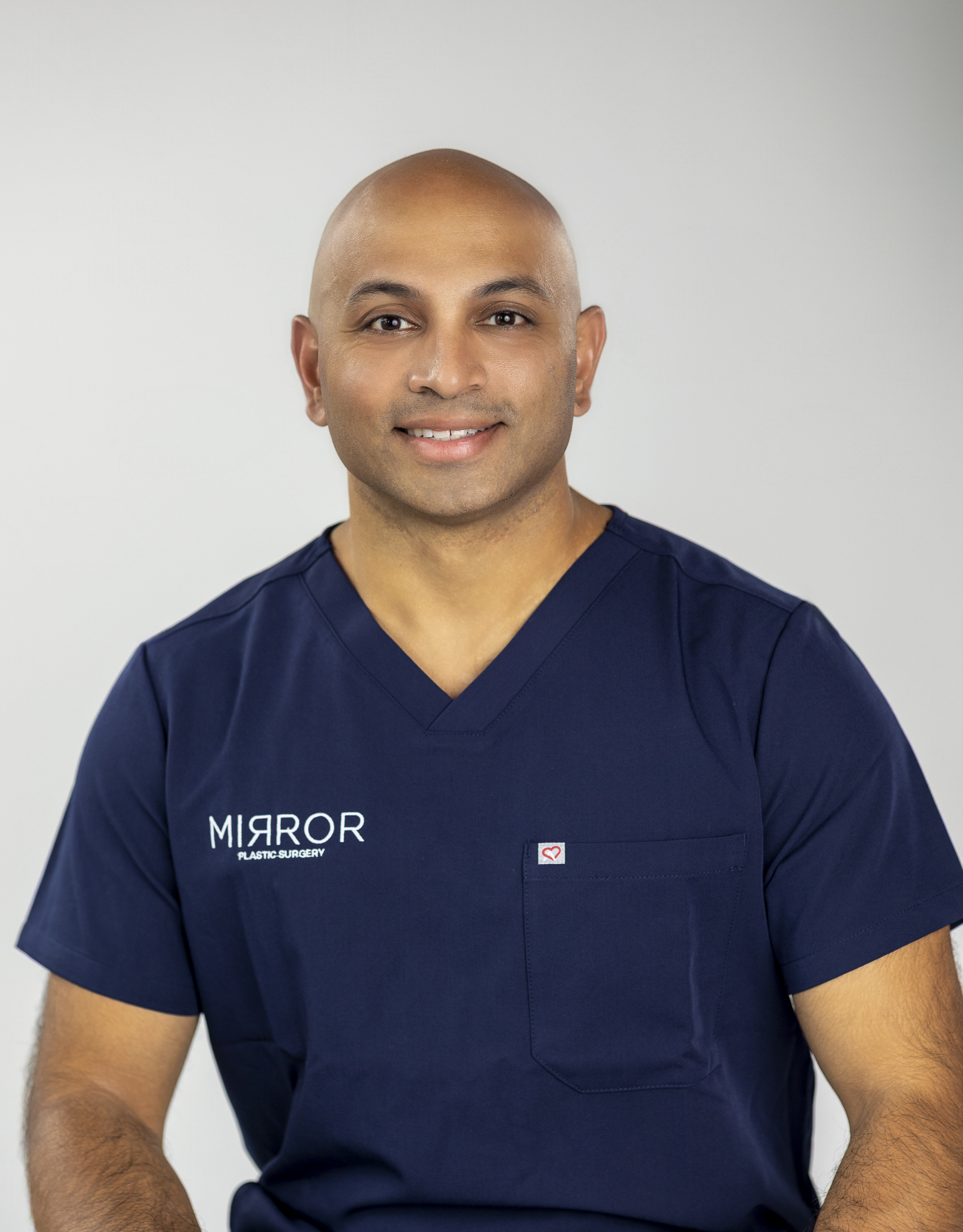
The practice performs one to two surgeries per day. This deliberate limit keeps the full clinical team’s attention on a single patient through every phase of care. This focused approach also shapes the pre-operative assessment, which includes advanced in-office diagnostic tools such as ultrasound for precise tissue evaluation and a tailored surgical plan.
Risk factors such as smoking and uncontrolled diabetes, which are associated with poorer wound healing and higher complication risk in abdominoplasty patients, are identified and addressed during this comprehensive pre-operative evaluation.
Frequently Asked Questions
Can a mini tummy tuck be converted to a full tummy tuck later if results are insufficient?
Revision surgery is possible but significantly more complex than performing the correct procedure initially. Scar tissue from the first operation alters tissue planes, increases dissection difficulty, and can affect blood supply to the skin flap. The most reliable path to a durable outcome is a thorough pre-operative anatomical assessment that identifies the correct procedure before any incision is made. Patients who feel uncertain about their anatomy benefit most from a comprehensive evaluation rather than a staged approach.
Will a tummy tuck address the loose skin left after C-section delivery?
Prior C-section scars do not disqualify patients from abdominoplasty. In many cases the existing scar can be incorporated into the low bikini-line incision used for either a mini or full tummy tuck, effectively removing it.
C-section scar position and the quality of surrounding tissue still influence surgical planning. Patients with a C-section shelf, or overhang of skin above the scar, often have lower abdominal laxity that may or may not extend above the navel. This pattern makes a thorough anatomical assessment essential before selecting a procedure type.
How long do tummy tuck results last?
Results from both mini and full tummy tuck procedures can last many years when patients maintain stable weight, consistent exercise, and healthy nutrition.1 The muscle repair component of a full tummy tuck is particularly durable because sutures placed along the fascial layer create a structural correction rather than a surface-only change.1
Future pregnancy or significant weight fluctuation can re-stretch both the skin and the repaired muscle wall, which partially reverses surgical improvements. Patients are advised to complete all planned pregnancies and reach a stable weight before undergoing either procedure.
Is the navel repositioned in both procedures?
Navel repositioning is a defining anatomical difference between the two procedures. In a mini tummy tuck, the belly button remains in its original position because the upper abdominal skin is not lifted or re-draped.
In a full tummy tuck, the entire abdominal skin flap is advanced downward. This movement would distort the navel’s position without a separate periumbilical incision to reattach it at the correct anatomical location. The appearance and position of the navel after a full tummy tuck is a meaningful aesthetic consideration that is addressed during surgical planning.
What is the difference between a tummy tuck and liposuction for post-pregnancy changes?
Liposuction removes localized fat deposits but does not address skin laxity or muscle separation. Post-pregnancy patients commonly present with all three issues, including excess fat, loose skin, and diastasis recti, in varying combinations.
Liposuction alone on a patient with skin laxity can worsen the appearance of loose skin by removing the volume that was providing some surface tension. A tummy tuck, whether mini or full depending on anatomy, addresses the structural causes of abdominal contour changes rather than fat volume alone. The appropriate combination of procedures is determined by a complete anatomical assessment.
Next Steps for Your Tummy Tuck Decision
The decision between a mini and full tummy tuck cannot be made accurately from photographs, online quizzes, or brief consultations. It requires a direct assessment of skin laxity location, muscle separation extent, tissue quality, and individual anatomy. That level of evaluation takes time and expertise to perform correctly.
At Mirror Plastic Surgery in St. Petersburg, FL, every consultation with Dr. Akash is structured as an hour-long anatomical evaluation. Dr. Akash, a Harvard Medical School graduate, Johns Hopkins-trained plastic surgeon, and MEETH aesthetic surgery fellow, will provide a clear, evidence-based recommendation grounded in your specific anatomy and goals, not a sales-driven upsell.
Get the anatomical clarity you need by consulting with Dr. Akash at Mirror Plastic Surgery so you can make a confident, informed decision.
1 Results may vary from person to person. Editorial content, before and after images, and patient testimonials do not constitute a guarantee of specific results.