
Written by: Ellie Pranckevicius, FNP-BC, Aesthetic Nurse Practitioner & Aesthetic Injector | Facial Restoration & Regenerative Injectable Specialist, Mirror Plastic Surgery | Last updated: July 26, 2026
Key Takeaways
- A lip filler touch up is a maintenance or corrective visit that restores volume, refines symmetry, or extends results when 75–80% of the initial effect remains, typically every 6–12 months.1
- Early signs that a touch-up may be needed include noticeable volume loss, fading border definition, returning asymmetry, reduced hydration, resurfacing fine lines, and measurable changes confirmed by photo comparison.
- Swelling peaks within 24–48 hours and settles substantially within 3–7 days, so final results and any fine-tuning are best assessed after two weeks to avoid overcorrection.1
- Touch-up sessions usually require less product than initial treatments, which often means lower cost, shorter recovery, and more consistent outcomes when scheduled before complete dissolution.1
- Patients in the Tampa Bay area seeking a safety-first, anatomy-driven approach to lip filler maintenance can schedule a consultation with Ellie Pranckevicius, FNP-BC, at Mirror Plastic Surgery for a personalized treatment plan.
How Often to Schedule a Lip Filler Touch Up
Lips metabolize dermal filler faster than almost any other facial area.1 Constant mechanical stress from speaking, eating, smiling, and sipping breaks down the product more quickly than in static areas like the cheeks or jawline, placing the typical maintenance window at 6 to 12 months for most patients.
Ellie’s clinical guidance aligns with the “75% rule,” which means scheduling a touch-up when roughly 75–80% of the initial effect remains rather than waiting for complete dissolution. Working with a residual foundation typically requires less product and produces a more consistent outcome. It also avoids the jarring contrast of sudden volume loss.
Some patients prefer a softer maintenance cycle and extend to longer intervals before a fuller refill. Ellie evaluates each person’s anatomy and lifestyle individually before recommending a schedule.
Clear Signs You Are Ready for a Lip Filler Touch Up
This checklist highlights the most reliable indicators that a reassessment is warranted. Review recent photos taken in natural light and compare them with your two-week post-treatment baseline before deciding.
- Noticeable volume loss. Lips appear thinner or flatter than your settled post-treatment result, particularly in the body of the lip.
- Fading border definition. A less distinct cupid’s bow or blurred vermilion border signals that filler support is diminishing.
- Return of asymmetry. Uneven breakdown driven by sleep position, chewing patterns, or facial muscle movement can produce visible asymmetry within 6–9 months.
- Reduced hydration and glow. A tired or dull lip appearance with diminished surface luminosity can precede significant volume loss and often appears early.
- Fine lines resurfacing. Reappearance of perioral fine lines or creases where makeup begins settling into previously smooth areas indicates diminishing filler support.
- Photo comparison confirms change. Side-by-side comparison of current and post-treatment images reveals measurable differences in projection, shape, or contour that match what you notice in daily life.
Lumps, firmness, or persistent asymmetry that was not present after the prior treatment are not routine touch-up indicators. These changes require a clinical reassessment before any additional product is placed.
Two-Week Lip Filler Touch Up Review at Mirror
Swelling after lip filler typically peaks within 24–48 hours and settles substantially within 3–7 days, with final results best assessed after 2 weeks. Evaluating or adding product before swelling fully resolves increases the risk of overcorrection and an inaccurate read of the underlying anatomy.
Ellie conducts a structured two-week review for patients who received their initial treatment at Mirror Plastic Surgery. During this appointment, she assesses how the filler has integrated, confirms symmetry, and determines whether any fine-tuning is clinically indicated.
A gradual filler protocol uses this two-week evaluation to decide if additional product is needed for refinement. This staged approach, rather than placing maximum volume in one visit, reflects Mirror’s philosophy of measured, anatomy-driven enhancement.
Lip Filler Touch Up Cost Expectations in Tampa Bay
Touch-up sessions typically require less product than an initial treatment because residual filler remains in the tissue. Because touch-ups often use smaller volumes, they are frequently more affordable than a full first-time session.
The national average cost of a full lip filler session in the U.S. is approximately $959 as of 2026, with per-syringe pricing for experienced injectors typically ranging from $450–$800 in many markets.
Mirror Plastic Surgery does not publish fixed pricing because every patient receives a personalized quote during consultation based on their anatomy, the product selected, and the volume clinically indicated. Ellie operates without sales quotas or supplier commissions, so her recommendation reflects what your lips actually need, not an upsell target.
How Ellie Addresses Lip Symmetry at Touch Up Visits
Asymmetry that develops months after a successful treatment is not necessarily a sign of poor technique. The habits mentioned earlier, such as sleep position, chewing patterns, and muscle movement, affect each side of the face differently. Because the superior and inferior labial arteries vary considerably in depth and path between individuals, filler metabolism is not always symmetrical.
Ellie’s response to symmetry concerns begins with her top-to-bottom facial assessment. This is the same structured diagnostic process used at the initial consultation. She evaluates the full perioral region in the context of the mid-face and lower face before placing any corrective product.
This approach prevents the common error of chasing lip asymmetry in isolation while missing a contributing structural imbalance elsewhere. Her goal is always restoration of balance without overcorrection, consistent with Mirror’s commitment to natural, harmonious results.
Habits That Help Lip Filler Results Last Longer
Several lifestyle factors directly accelerate filler breakdown. High-intensity exercise performed five or more days per week increases circulation and speeds up dermal filler breakdown, while UV radiation accelerates filler degradation in skin tissue and smoking reduces circulation and breaks down collagen faster, shortening lip filler duration. Frequent heat exposure such as saunas or hot yoga similarly shortens filler longevity.
Ellie’s approach extends beyond the injection itself. She educates patients on post-treatment care, including avoiding blood thinners, alcohol, salty foods, exercise, and heat in the first 48 hours. She also discusses how broader skincare and lifestyle habits affect long-term outcomes.
Her holistic, full-face philosophy treats support of the perioral area with appropriate skincare and sun protection as part of the treatment plan, not an afterthought.
Maintenance vs. Correction: Lip Filler Decision Guide
| Scenario | Recommended Approach |
|---|---|
| Results at ~75–80% of original effect; symmetry intact; no structural concerns | Early maintenance touch-up, typically 0.5 mL or less required, straightforward session with existing filler foundation |
| Results fully dissolved; significant volume loss; asymmetry present | Full corrective re-treatment, clinical volume determined by assessment per session, top-to-bottom assessment required before product placement |
| Lumps, firmness, migration, or asymmetry not explained by dissolution | Clinical reassessment before any addition, possible hyaluronidase dissolution first, Ellie evaluates whether correction or dissolution is the appropriate next step |
| Two-week post-initial-treatment review; minor unevenness noted | Fine-tuning with 0.5 mL if clinically indicated, no product added if swelling is still resolving |
Red-Flag Lip Filler Complications Requiring Immediate Care
Ellie’s four years in the Neuroscience ICU at Tampa General Hospital trained her to recognize and respond to acute physiological changes rapidly. That clinical skill set directly informs her approach to filler safety. The following signs require immediate contact with your injector or emergency care, not a scheduled follow-up.
- Skin blanching or dusky blue-purple discoloration in or around the lips, which may indicate vascular occlusion. Prompt administration of the reversal agent is critical following signs of occlusion.
- Disproportionate or worsening pain beyond normal post-procedural tenderness, particularly electric, stabbing, or burning sensations. Persistent neuropathic-type pain after lip filler warrants prompt reassessment to exclude vascular, infectious, or nerve-related complications.
- Capillary refill time exceeding 3 seconds in the treated area, which is a clinical sign of compromised circulation.
- Cool temperature in the lip or surrounding tissue, distinct from the normal warm, pinkish-red swelling expected after injection.
- Nodules or lumps persisting beyond two weeks, particularly if painful, visibly irregular, or associated with color change. Delayed-onset nodules can appear weeks or months after lip filler due to inflammatory reactions possibly triggered by illness, stress, or repeat injections.
- Signs of infection including increasing redness, warmth, swelling, or discharge beyond the expected 48-hour post-treatment window.
Mirror Plastic Surgery maintains reversal agent on-site and Ellie is trained in its emergency application. Only licensed practitioners with immediate reversal access should be performing lip filler injections.
Frequently Asked Questions
Am I a good candidate for a lip filler touch up if I have had filler elsewhere before?
Prior filler experience at another practice does not automatically qualify or disqualify you for a touch-up at Mirror Plastic Surgery. Ellie conducts a full top-to-bottom assessment at your first consultation, which includes evaluating any existing product in the lips and surrounding areas.
If cumulative volume is a concern, she may recommend dissolving existing filler before adding more. She treats this as a normal clinical step, not a complication. Candidacy is determined by your current anatomy, the integrity of prior work, and your long-term aesthetic goals.
How long is recovery after a lip filler touch up?
Recovery generally follows the typical filler timeline discussed earlier, with swelling peaking in the first 48 hours and resolving within about a week.1 Because touch-up sessions typically use less product than an initial treatment, many patients find recovery even milder.
Ellie advises avoiding intense exercise, alcohol, salty foods, and heat exposure for the first 48 hours to support healing and comfort.
Can I make my lip filler last longer between touch-ups?
You can extend results within reasonable limits. Consistent daily SPF application, moderate exercise habits, avoiding smoking, and limiting sauna or hot yoga sessions all reduce the rate of filler breakdown.
Scheduling your touch-up before the product fully dissolves, rather than waiting until results are gone, also means each session usually requires less product and maintains a more consistent look over time. Ellie discusses personalized longevity strategies as part of every treatment plan, drawing on her background in both esthetics and advanced nursing to address skin health holistically.
What is the difference between a touch-up and a full correction?
A touch-up is a maintenance session performed while meaningful filler volume remains, typically when results are at roughly 75–80% of their original effect. It requires less product, is more straightforward, and maintains continuity of your existing result.
A full correction is needed when filler has largely or completely dissolved, when significant asymmetry has developed, or when prior work needs to be dissolved and rebuilt. Ellie determines which approach is appropriate during your consultation, based on a clinical assessment rather than a predetermined protocol.
Is it safe to get a lip filler touch up if I have a history of cold sores?
A history of oral herpes simplex does not automatically prevent you from receiving lip filler, but it does require proactive management. Ellie screens for this during your medical history review and, when appropriate, coordinates antiviral prophylaxis before treatment to reduce the risk of a cold sore outbreak triggered by the injection.
Active cold sores or any active infection near the mouth are contraindications that require postponing the appointment until the area has fully healed. Full disclosure of your medical history during consultation is essential for safe treatment planning.
Choosing Mirror Plastic Surgery for Lip Filler Maintenance
A lip filler touch up is not a one-size-fits-all procedure with a fixed schedule. Timing, volume, and technique are determined by individual anatomy, metabolism, lifestyle, and the integrity of prior work. These variables call for a thorough clinical assessment, not a quick refill appointment.
At Mirror Plastic Surgery, Ellie Pranckevicius, FNP-BC, brings her dual background in esthetics and advanced nursing, combined with four years of critical care experience, to every touch-up consultation. Her safety-first, full-face approach keeps each session focused on your long-term well-being rather than a short-term volume target.
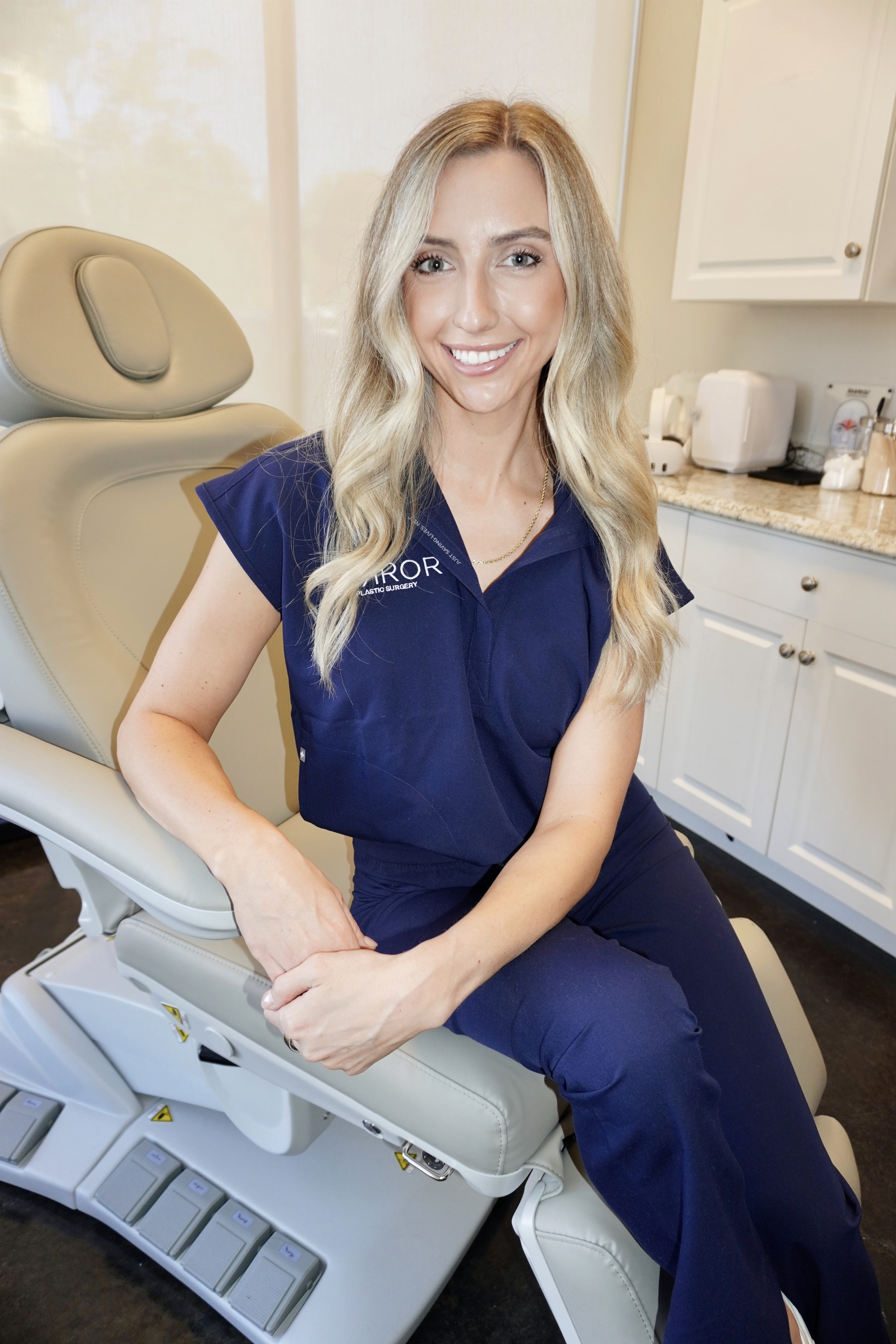
If you are a Tampa Bay patient ready for an honest, anatomy-driven conversation about your lip filler maintenance, Mirror Plastic Surgery offers a concierge alternative to rushed, high-volume clinics.
Disclaimer: Results may vary from person to person. Editorial content, before and after images, and patient testimonials do not constitute a guarantee of specific results.
1 Results may vary from person to person. Editorial content, before and after images, and patient testimonials do not constitute a guarantee of specific results.