
Written by: Ellie Pranckevicius, FNP-BC, Aesthetic Nurse Practitioner & Aesthetic Injector | Facial Restoration & Regenerative Injectable Specialist, Mirror Plastic Surgery | Last updated: August 17, 2026
Key Takeaways
- GHK-Cu and the Glow Stack act directly on hair follicles, influencing growth phase length, inflammation, and blood supply to support regrowth.
- Most supervised protocols show less shedding by weeks 6–8, early density and texture gains by month 3, and peak measurable density by month 6.1
- Evidence for GHK-Cu is promising but limited by small studies and a lack of large randomized trials, so medical supervision is strongly recommended.
- Unregulated online peptide products often have purity, sterility, and dosing problems that can reduce results and increase risk.
- Mirror Plastic Surgery offers lab-guided peptide plans with batch-tested sourcing and 24/7 concierge support; schedule your consultation to explore personalized GHK-Cu or Glow Stack options.
Ellie Pranckevicius, FNP-BC: Your Peptide Hair Therapy Clinician
Ellie Pranckevicius is a board-certified Family Nurse Practitioner and the lead clinician for peptide therapies at Mirror Plastic Surgery. She earned her Bachelor’s in Health Science from Boston University on the premedical track, completed a rigorous aesthetics licensure program, and obtained both her Bachelor’s and Master’s in Nursing from the University of South Florida. She then spent four years in the Neuroscience ICU at Tampa General Hospital, managing highly complex patients, which gave her deep experience with metabolic health, systemic inflammation, and recovery. That critical-care background, combined with her early work in high-end medical aesthetics, allows her to design peptide protocols that are both evidence-based and cosmetically focused.
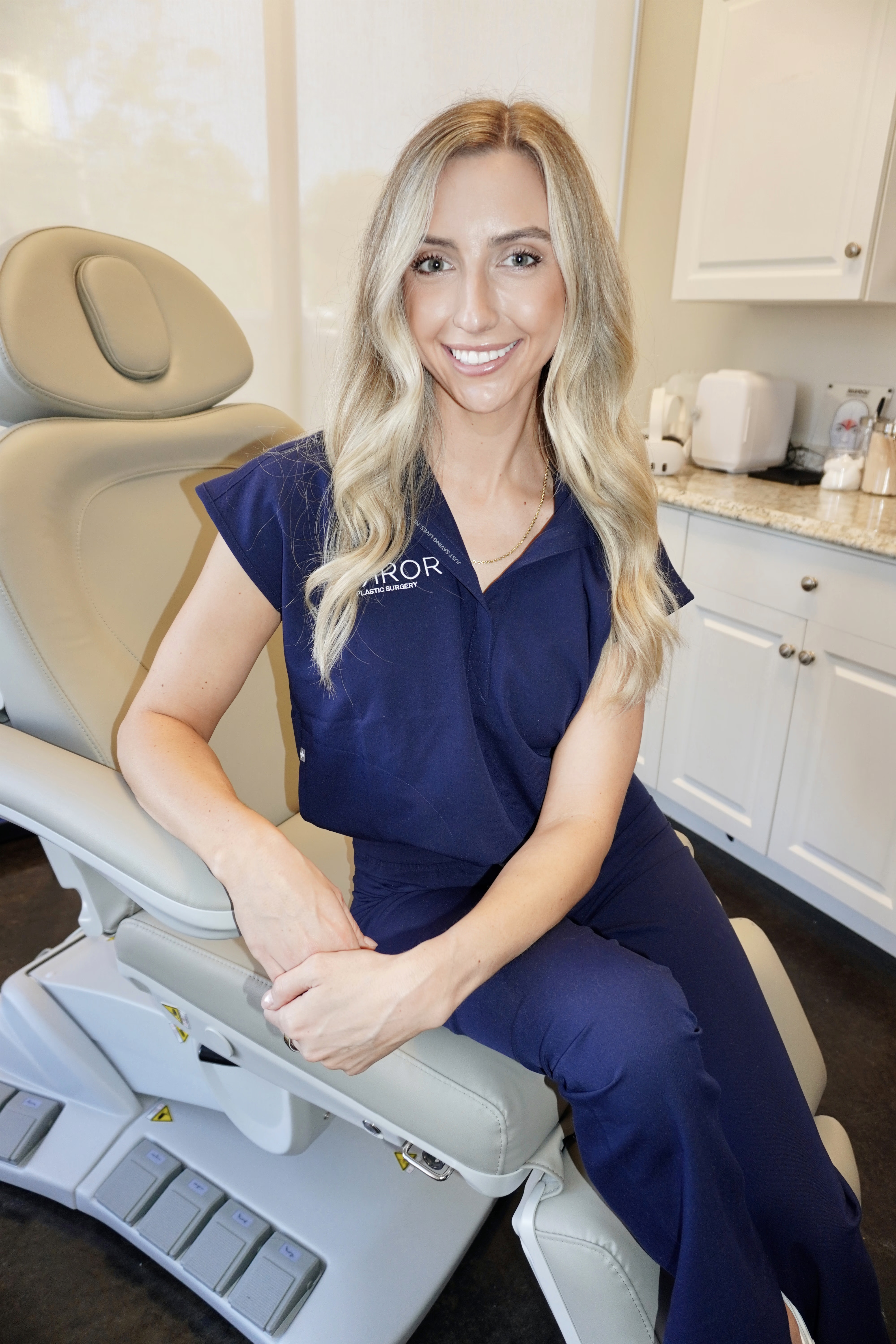
Book an appointment with Ellie for a personalized GHK-Cu or Glow Stack evaluation grounded in lab data and clinical oversight.
How GHK-Cu and the Glow Stack Support Hair Growth
GHK-Cu is a naturally occurring human tripeptide, glycyl-L-histidyl-L-lysine, that binds copper and declines with age. Serum GHK-Cu levels fall from about 200 ng/mL in the 20s to roughly 80 ng/mL by the 60s, which tracks with slower follicle cycling and gradual thinning. Its actions on follicle biology involve several coordinated pathways.
GHK-Cu activates Wnt/β-catenin signaling and increases β-catenin in dermal papilla cell nuclei, which counters DHT-induced DKK1 secretion and helps move follicles from resting (telogen) into growth (anagen). It also suppresses TGF-β1 secretion from dermal fibroblasts, which helps prevent early exit from the growth phase, and upregulates VEGF to support new blood vessel formation around follicles. A 2026 zebrafish inflammation study found that GHK-Cu lowered pro-inflammatory cytokines TNF-α, IL-1β, and IL-6 while increasing anti-inflammatory IL-10, which supports its role in calming scalp inflammation that speeds follicle miniaturization.
While GHK-Cu alone offers these follicle and anti-inflammatory benefits, pairing it with complementary peptides can strengthen the overall regenerative environment. Mirror Plastic Surgery’s Glow Stack combines GHK-Cu with BPC-157 (Body Protective Compound 157) and TB-500 (Thymosin Beta-4). GHK-Cu focuses on follicle cycling and local scalp inflammation. BPC-157 extends anti-inflammatory and tissue-repair effects throughout the body. TB-500 adds support for soft tissue inflammation and wound healing. Together, they create a three-pathway approach that supports the scalp more comprehensively than any single peptide.
One key limitation remains. No peptide blocks the DHT pathway as strongly as finasteride. GHK-Cu can reduce androgen receptor sensitivity and provide some local 5-alpha reductase inhibition, but patients with high DHT-driven loss usually need combination therapy with finasteride or minoxidil for stronger results. Delivery route also shapes outcomes. Topical formulations have the most human safety data, while injectable protocols require pharmaceutical-grade sourcing and direct medical supervision.
What Current Research Shows About GHK-Cu Timelines
The clinical research base for GHK-Cu in hair restoration spans about three decades and shows meaningful, though methodologically limited, results.
| Time Point | Expected Change | Supporting Evidence | Supervision Note |
|---|---|---|---|
| Weeks 6–8 | Reduced daily shedding | Clinical studies report shedding reduction within 6–8 weeks1 | Baseline lab panel recommended before initiation |
| Month 3 | Early density and texture gains | Clinical reports indicate that early density and texture gains can occur around this time point1 | Protocol adherence review, adjust dosing if needed |
| Month 6 | Peak measurable density improvement | Research indicates that peak measurable density improvement often occurs by month 61 | Trichoscopic reassessment, maintenance protocol decision |
| Months 9–12 | Fuller cosmetic coverage | Fuller cosmetic benefits typically observed by 9–12 months of consistent use1 | Ongoing concierge support, lab re-evaluation as indicated |
These timeline expectations come from the available clinical research base, which remains promising but incomplete. Some clinical research has explored GHK-Cu serum for patients with androgenetic alopecia, and comparative approaches have examined adding copper peptides to other hair loss treatments.
Several caveats shape how this evidence should guide care. No randomized controlled trial has directly compared pure GHK-Cu against minoxidil for hair loss. Human studies often involve small groups, and some receive industry funding. Data beyond 12 months is not yet available. These gaps do not negate the findings, but they do support the use of individualized, supervised protocols instead of unsupervised self-experimentation.
How Mirror Uses Peptides in Real-World Hair Protocols
Peptide therapy fits best at specific decision points in a hair restoration plan. Adults who have plateaued on minoxidil after 6–12 months form a core candidate group, because GHK-Cu’s Wnt/β-catenin and angiogenic effects add to minoxidil’s vasodilation rather than repeating it. Post-surgical patients recovering from hair transplantation or scalp procedures may also benefit from the Glow Stack. In these cases, BPC-157 and TB-500 support healing and inflammation control while GHK-Cu helps maintain follicle cycling.
Formulation quality is a major hidden variable in real-world outcomes, and GHK-Cu is especially sensitive. It degrades at pH above 7, in the presence of high-concentration vitamin C, and with poor storage. The optimal pH range for copper tripeptide stability is generally 4 to 6.5, which many retail products do not maintain. These chemistry constraints mean that even high-grade GHK-Cu can become ineffective if formulated or stored incorrectly. Mirror Plastic Surgery responds to this by sourcing peptides only from providers with rigorous batch testing and certificates of analysis, which protects purity, concentration, and stability that online products often fail to provide. Ellie then supplies clear reconstitution and administration instructions, often with video support, and stays available by text for ongoing questions and protocol adjustments.
Risks, Limits, and the Regulatory Landscape
Regulatory context shapes safe peptide use. None of the peptides discussed here, including GHK-Cu, BPC-157, or TB-500, have FDA approval for hair loss or scalp-health indications. Injectable formulations require a valid prescription and must come from a 503A-licensed compounding pharmacy with a certificate of analysis showing more than 95% purity by HPLC.
The risks of unregulated online sourcing are specific and well documented.
- Analyses of commercially available research-grade peptides have found wide variation in purity, so patients may receive ineffective or contaminated products.
- Injectable research peptides carry sterility and dosing risks from self-injection, and the FDA has issued warning letters about unapproved peptide products.
- BPC-157 has no published Phase III human clinical trials for any indication and has drawn specific FDA regulatory attention.
- People with Wilson’s disease should avoid copper peptides because of copper metabolism issues.
- Outcome variability is real. Genetics, DHT burden, lifestyle, adherence, and formulation quality all influence results, and visible improvements from topical hair peptides usually involve density and thickness gains rather than regrowth of follicles that are already permanently destroyed.
Mirror Plastic Surgery’s model addresses these risks through in-depth lab screening before treatment, batch-tested pharmaceutical-grade sourcing, and Ellie’s 24/7 concierge availability. This structure contrasts sharply with unmonitored online purchases.
Book an appointment with Ellie to review your lab results, DHT status, and candidacy for a supervised GHK-Cu or Glow Stack protocol.
Why Peptide Hair Therapy Matters Beyond the Scalp
Peptide hair therapy connects directly to broader systemic health. GHK-Cu’s effects on inflammation, oxidative stress, and gene expression place it within the larger field of longevity-focused medicine. The same mitochondrial and anti-inflammatory pathways that support follicle cycling also influence cellular energy, skin collagen integrity, and metabolic resilience. For patients with chronic low-grade inflammation, the Glow Stack’s systemic anti-inflammatory actions may provide benefits that extend beyond hair. Mirror Plastic Surgery integrates peptide therapy with surgical and non-surgical aesthetics to reflect this whole-body view, so hair restoration plans are built within each patient’s overall health picture.
Frequently Asked Questions
Do peptides actually regrow hair on the crown?
GHK-Cu and combination peptide protocols can improve hair density and shaft thickness in areas of active thinning, including the crown, but they cannot rebuild follicles that are already permanently lost from advanced androgenetic alopecia.1 Peptides work by reactivating miniaturized follicles and improving the scalp environment, so they perform best when follicles are thinned but still alive. Results still vary based on the degree of follicle loss, DHT burden, and whether a DHT-blocking agent is used at the same time. A trichoscopic assessment and lab panel before treatment help set realistic expectations for each person.
How long until I see results?
Most patients notice reduced shedding first, followed by gradual improvements in hair texture and density over the next several months.1 The timeline detailed in the research section above applies here, although individual responses differ based on formulation quality, adherence, and the pattern of hair loss. These expectations assume pharmaceutical-grade peptides, correct concentration, appropriate formulation pH, and consistent use. Patients who self-source peptides online often see uneven results because purity and stability problems are hard to detect without third-party testing.
Can I combine peptides with minoxidil or finasteride?
Combination therapy often makes the most sense for androgenetic alopecia. GHK-Cu, minoxidil, and finasteride act through distinct mechanisms, including follicle cycling and angiogenesis, vasodilation, and DHT suppression, so their effects add rather than overlap. Clinical data supports this approach. Adding copper peptides to finasteride produced a 41% hair density improvement at 6 months compared with 28% for finasteride alone in one comparative study.1 During consultation, Ellie reviews each patient’s current regimen and designs a peptide plan that complements existing treatments, with lab monitoring to maintain safety across the combined protocol.
What happens if I stop treatment?
Peptide-related hair gains require maintenance. GHK-Cu does not permanently change follicle genetics or remove the underlying DHT-driven miniaturization process in androgenetic alopecia. When treatment stops, follicle-supportive signaling, including Wnt/β-catenin activity, VEGF production, and inflammation control, gradually fades. The original thinning process then resumes at a rate that varies by person and by how well the root cause is managed. Most patients who reach meaningful density gains move to a maintenance protocol instead of stopping outright, and Ellie structures this as part of the ongoing concierge relationship.
Are results the same for everyone?
Results differ widely between patients. Factors that shape outcomes include androgen sensitivity and scalp DHT levels, the degree of existing follicle miniaturization, genetics, diet, lifestyle, adherence, and the quality and concentration of the peptide formulation. Women with female pattern hair loss and men with high DHT burden often respond differently, and two products with similar labels from different suppliers can perform very differently if purity, pH, or copper coordination stability vary. This variability explains why Mirror Plastic Surgery uses comprehensive intake, lab panels, batch-tested sourcing, and individualized protocol design instead of one-size-fits-all plans.
Medical Disclaimer: The information in this article is for educational purposes only and does not constitute medical advice, diagnosis, or treatment. Individual results vary and are not guaranteed. GHK-Cu, BPC-157, TB-500, and related peptides are not FDA-approved for the treatment of hair loss or any scalp condition. Injectable peptide formulations require a valid prescription and must be obtained from a licensed compounding pharmacy. Consult a qualified healthcare provider before beginning any peptide therapy. Patients with Wilson’s disease or copper metabolism disorders should not use copper peptides. Mirror Plastic Surgery’s peptide protocols are available to patients following a comprehensive clinical evaluation, including review of medical history and, where indicated, laboratory testing.
1 Results may vary from person to person. Editorial content, before and after images, and patient testimonials do not constitute a guarantee of specific results.
Peptide therapy is intended for wellness and optimization purposes and is not prescribed to diagnose, treat, cure, or prevent disease unless specifically stated. Many peptides are not FDA-approved and may be used off-label. Some have limited long-term safety data, with a potential for unknown risks, complications, or desensitization with prolonged use.