
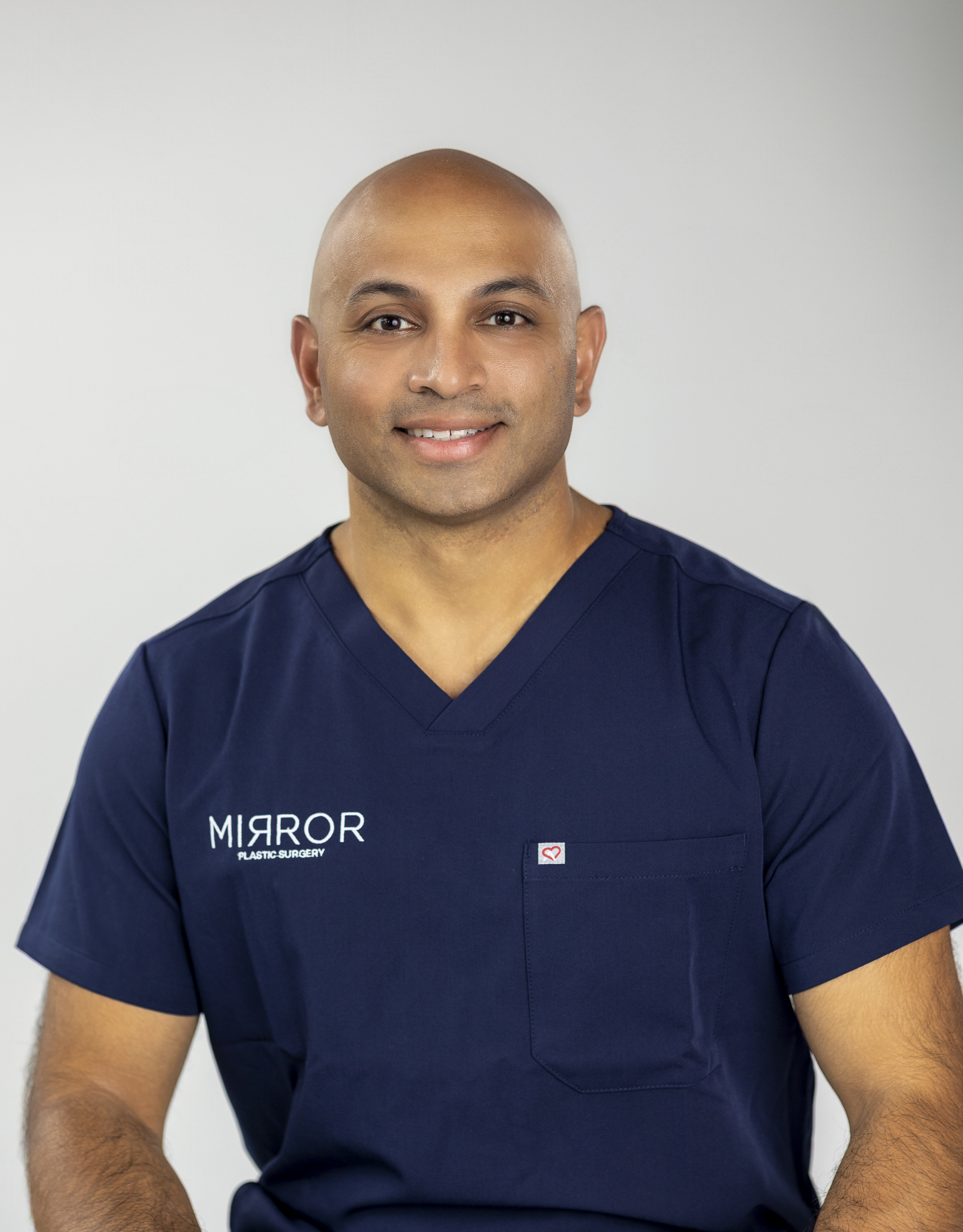
Written by: Dr. Akash Chandawarkar, Board Certified Plastic Surgeon, Mirror Plastic Surgery | Last updated: July 14, 2026
Key Takeaways for Post-Weight-Loss Arm Lift Surgery
-
Brachioplasty after major weight loss is technically demanding and requires a surgeon who meets four non-negotiable criteria: ABPS board certification, high-volume post-weight-loss experience, refined scar technique, and an accredited facility with a board-certified anesthesiologist.
-
ABPS certification is the only ABMS-recognized credential for plastic surgery. Patients should verify it at certificationmatters.org and confirm hospital privileges before booking.
-
Post-weight-loss patients face higher complication rates (20–40%), so surgeons must limit daily volume, assess nutritional status, and plan staged procedures to protect outcomes.
-
Strong scar results depend on aligning incisions with Main Folding Lines and using layered deep-tension closure. Ask about the surgeon’s personal revision rate for scar concerns.
-
At Mirror Plastic Surgery, Dr. Akash’s concierge model and elite training deliver focused care for post-weight-loss patients. Schedule your personalized evaluation to experience this approach firsthand.
Four Non-Negotiable Criteria for Your Brachioplasty Surgeon
The best brachioplasty surgeon after major weight loss meets four non-negotiable criteria. First, they hold board certification from the American Board of Plastic Surgery (ABPS), the only ABMS-recognized plastic surgery board in the United States. Second, they can show documented high-volume experience specifically with post-weight-loss arm contouring. Third, they use refined scar placement along anatomical tension lines with layered closure technique. Fourth, they operate in an accredited surgical facility staffed by a board-certified anesthesiologist.
Board Certification You Should Confirm
The American Board of Plastic Surgery is the only ABMS-recognized board certifying physicians in plastic surgery in the United States. Achieving ABPS certification requires graduation from an accredited medical school, completion of a minimum six-year surgical training program covering reconstruction, microsurgery, craniofacial, hand, and aesthetic surgery, and passing both comprehensive written and oral examinations. The oral examination requires submission of a year-long operative case log evaluated by examiners. Surgeons must then maintain certification through ongoing continuing medical education and self-assessment.
Training pathway also shapes a surgeon’s skill set. An integrated six-year plastic surgery residency at a major academic medical center, particularly one with high-volume trauma, oncologic reconstruction, and microsurgery exposure, builds different capabilities than a shorter independent-track residency.
An additional aesthetic surgery fellowship, such as those offered at institutions like the Manhattan Eye, Ear and Throat Hospital (MEETH), adds focused, high-volume exposure to body contouring techniques that residency alone does not replicate.
Research shows that procedures performed by ABPS-certified surgeons result in better patient outcomes, including lower rates of complications and mortality.1 Patients can verify any surgeon’s ABPS status at certificationmatters.org or abplasticsurgery.org.
Practical takeaway: Confirm ABPS certification before any consultation. Ask about residency program, fellowship training, and whether the surgeon has hospital privileges, which provide a safety backstop if a rare complication requires inpatient care.
Post-Weight-Loss Experience That Truly Counts
Patients undergoing brachioplasty after significant weight loss or bariatric surgery demonstrate a consistently higher risk of complications compared to those with mild skin laxity alone, with overall complication rates across studies ranging from 20–40%, most classified as minor. This elevated baseline reflects the unique tissue characteristics of post-bariatric skin. These include poor elasticity, nutritional deficiencies that affect wound healing, and greater skin redundancy that requires longer incisions and higher-tension closures.
A surgeon who performs five to ten surgeries per day across multiple procedure types cannot dedicate the preoperative assessment time, intraoperative focus, or postoperative follow-up that post-weight-loss brachioplasty demands. A concierge-model practice that limits itself to one to two surgeries per day keeps the entire surgical team’s attention on a single patient before, during, and after the procedure. A 2026 multicenter retrospective study of 1,182 massive-weight-loss patients undergoing 2,665 body-contouring procedures found that complication rates rose sharply from 5.1% for two combined procedures to 20.2% when three procedures were combined1, which underscores that patient selection and surgical discipline, not speed, define outcomes.
Practical takeaway: Ask how many brachioplasties the surgeon performs annually, what percentage involve post-bariatric or post-massive-weight-loss patients, and how many total surgeries are scheduled on the day of your procedure.
Scar Placement and Technique for Better Long-Term Results
Scar outcome is the most visible long-term marker of brachioplasty quality. Brachioplasty incisions typically extend from the elbow to the armpit and are positioned along the inner or posterior aspect of the arm to minimize scar visibility. Placement alone, however, does not suffice without proper orientation relative to skin tension lines.
A 2025 peer-reviewed analysis of striae distensae directions from 213 photographs established that Main Folding Lines (MFL) on the arms run obliquely from the anterior axilla toward the inner elbow. Incisions placed parallel to these lines heal with minimal visible scarring because wound tension is reduced and collagen fibers align parallel to natural skin folds. The same research concludes that MFL, not the traditionally cited Langer’s lines, should guide elective incisions in body-contouring procedures to prevent hypertrophic or widened scars.
Modern layered closure techniques distribute tension internally via deep sutures rather than on the surface skin, significantly reducing scar widening risk.1 Widened or prominent scars can still occur in brachioplasty patients, and scar appearance continues to evolve over time.
Practical takeaway: Ask your surgeon to describe their incision orientation philosophy, whether they use layered deep-tension closure, and what their personal revision rate is for scar-related concerns.
Facility Accreditation and Anesthesia Safety
A 2023–2024 national analysis of 246,119 liposuction cases performed exclusively in accredited ambulatory surgery facilities reported low overall complication rates.1 When brachioplasty is combined with liposuction, the combined-procedure complication rate can rise because of longer operative time, greater anesthesia exposure, more extensive tissue disruption, and increased blood loss. These factors make accreditation and anesthesiologist involvement even more consequential.
Practical takeaway: Confirm the facility’s accreditation body and ask whether a board-certified physician anesthesiologist, not a CRNA alone, will be present for the entire procedure.
Concierge Volume vs. High-Volume Mill Practices
Practice volume philosophy directly affects patient safety and outcome quality. High-volume practices that schedule five to ten surgeries per day distribute surgical team attention, limit preoperative assessment depth, and compress postoperative follow-up. This pattern often produces rushed consultations that fail to address a patient’s specific anatomy, nutritional status, or weight-stability timeline, all of which are critical for post-weight-loss brachioplasty.
Mirror Plastic Surgery limits its schedule to one to two surgeries per day. This model ensures that Dr. Akash and his team maintain complete focus on each patient before, during, and after surgery. Consultations run up to an hour and cover anatomy, realistic outcomes, staged procedure planning, and nutritional optimization. This mirrors the preoperative framework that Johns Hopkins researchers identify as essential for safe body contouring after massive weight loss, including BMI assessment, smoking cessation, nutritional status, and psychosocial evaluation.
Practical takeaway: Ask how many surgeries are scheduled on your procedure day and how long your preoperative consultation will last. These answers reveal the practice’s true priorities.
Schedule your one-hour anatomy-first evaluation designed specifically for post-weight-loss patients.
How Dr. Akash’s Credentials Support Post-Weight-Loss Brachioplasty
Dr. Akash’s training represents one of the most comprehensive credential stacks in American plastic surgery, combining elite academic medicine, high-volume reconstructive residency, dedicated aesthetic fellowship, and medical innovation training. The table below maps each credential to its direct relevance for post-weight-loss arm contouring, so you can see how this pathway addresses the unique challenges these patients face.
|
Credential |
Institution |
Training Path |
Relevance to Brachioplasty |
|---|---|---|---|
|
M.D., Honors |
Harvard Medical School / Harvard-MIT HST |
Physician-scientist integrated program combining rigorous research with clinical medicine |
Evidence-based surgical decision-making and anatomical depth |
|
Plastic & Reconstructive Surgery Residency (7 years, integrated) |
Johns Hopkins University / University of Maryland |
Rotations at Johns Hopkins Hospital, R Adams Cowley Shock Trauma Center, and Curtis National Hand Center |
High-complexity tissue management, wound healing, and reconstructive technique directly applicable to post-weight-loss body contouring |
|
Aesthetic Surgery Fellowship |
Manhattan Eye, Ear and Throat Hospital (MEETH) / Lenox Hill Hospital |
Competitive post-residency fellowship in facial rejuvenation, breast surgery, and body contouring |
Advanced scar technique, body contouring refinement, and aesthetic judgment |
|
Biodesign Innovation Fellowship |
Stanford University |
Physician-innovator program identifying unmet clinical needs and developing technological solutions |
Adoption of emerging minimally invasive and ultrasound-assisted techniques |
|
Board Certification |
American Board of Plastic Surgery (ABPS) |
Written and oral examinations; ongoing Maintenance of Certification |
Verified safety standards, hospital privileges, and accountability |
|
State Licensure |
Florida, New York, Pennsylvania |
Active multi-state licensure |
Regulatory compliance and professional standing |
|
Newsweek America’s Best Plastic Surgeons |
Newsweek |
Named to the list |
Independent national peer recognition of surgical outcomes and patient satisfaction |
Tampa Bay Patients: What to Expect at Mirror Plastic Surgery
Mirror Plastic Surgery is located in St. Petersburg, Florida, and serves the greater Tampa Bay area. The practice operates on a concierge medicine model that directly addresses the most common pain points post-weight-loss patients report, including rushed evaluations, generic treatment plans, and results that look operated rather than natural.
Every new patient receives an up-to-one-hour consultation with Dr. Akash that includes a top-to-bottom anatomical assessment, photographic documentation, and an evidence-based discussion of staged versus combined procedures. The practice’s guiding principle, safety first, function second, aesthetics third, means that brachioplasty planning begins with tissue quality, nutritional status, and weight stability before any incision design is discussed.
Practical takeaway: Patients traveling to the Tampa Bay area for brachioplasty should factor in the practice’s concierge model, which provides the preoperative depth and postoperative follow-up that high-volume practices cannot match.
Smart Questions to Ask During Your Consultation
The following questions align directly with the four non-negotiable criteria and reveal whether a surgeon meets the standard for post-weight-loss brachioplasty:
-
Are you board certified by the American Board of Plastic Surgery, and do you hold active hospital privileges?
-
How many brachioplasties do you perform annually, and what percentage involve post-bariatric or post-massive-weight-loss patients?
-
How many surgeries are scheduled on the day of my procedure?
-
Can you describe your incision orientation philosophy and how you determine scar placement relative to skin tension lines?
-
Do you use layered deep-tension closure, and what is your personal revision rate for scar-related concerns?
-
Is your surgical facility accredited by AAAASF, AAAHC, or the Joint Commission?
-
Will a board-certified physician anesthesiologist be present for the entire procedure?
-
How do you assess nutritional status and weight stability before scheduling surgery?
-
What is your protocol for DVT prophylaxis and hypothermia prevention?
Recovery Timeline and Realistic Expectations
Brachioplasty recovery follows a predictable trajectory, though post-weight-loss patients should anticipate a modestly longer healing curve because of tissue quality and the extent of skin removal required.
Most brachioplasty patients return to desk work within one to two weeks, resume light exercise by four to six weeks, and see final scar maturation at 12–18 months.1 Swelling peaks between days three and seven, with the majority of visible swelling resolving within two to four weeks and residual subtle swelling persisting for three to six months.1
Temporary numbness, tingling, or altered sensation is common early post-operatively, but sensation typically returns over six to twelve months as nerve fibers regenerate.1 Brief electric shock or zapping sensations along the incision between weeks four and twelve are a normal sign of nerve regeneration.1
Brachioplasty is among the more demanding body-contouring recoveries. Recovery from brachioplasty combined with other procedures such as abdominoplasty involves greater fatigue, additional activity restrictions, and a need for more support at home during the first two to three weeks. Patients who have lost 100 or more pounds often require longer incisions and more tissue removal, which can extend the recovery window.
Practical takeaway: Plan for a minimum of two weeks before returning to sedentary work, six weeks before resuming upper-body activity, and 12–18 months before evaluating final scar appearance. Do not schedule brachioplasty until weight has been stable for at least three to six months.
Red Flags When Choosing a Brachioplasty Surgeon
The following warning signs indicate a surgeon or practice that does not meet the standard for post-weight-loss brachioplasty:
-
No verifiable ABPS board certification or inability to confirm certification at certificationmatters.org
-
No hospital privileges, which means complications cannot be managed in an inpatient setting if needed
-
Consultations lasting 15 minutes or less with no anatomical assessment or nutritional discussion
-
Five or more surgeries scheduled on the same day as your procedure
-
Surgical facility with no stated accreditation body
-
Anesthesia provided by a CRNA without physician anesthesiologist oversight
-
No discussion of weight stability, BMI, or nutritional status before scheduling
-
Pressure to combine multiple procedures without staged planning or complication-rate discussion
-
Inability to provide personal complication or revision rate data
How to Think About Brachioplasty Cost
Brachioplasty cost varies based on surgeon credentials, facility accreditation, anesthesia type, geographic market, and the complexity of the individual case. Each patient at Mirror Plastic Surgery receives a personalized quote during consultation based on their specific anatomy, goals, and surgical plan, since no two cases are identical.
The relevant cost framework for post-weight-loss patients is not the lowest price point but the total cost of a complication. Revision surgery after brachioplasty is required in approximately 3–25% of cases1, and wound breakdown requiring management occurs in some post-weight-loss patients. Choosing a lower-cost, lower-credential surgeon in a non-accredited facility increases the probability of outcomes that require additional procedures, extended recovery, and greater total expenditure. The value of ABPS certification, accredited facilities, and a concierge-volume practice appears in reduced complication probability and the quality of the result at 18 months, not the initial invoice.
What Is a Good Age for Brachioplasty?
There is no single ideal age for brachioplasty. The relevant criteria are physiological, not chronological. Most plastic surgeons recommend waiting 12 to 18 months after bariatric surgery and require patients to demonstrate stable weight within 5 kg of target for at least three to six months before body contouring surgery. Operating before weight stabilization risks residual laxity, wound tension complications, and the need for revision.
Younger patients with good skin elasticity may achieve better scar outcomes1, but Lemperle’s 2025 research specifically notes that young women and adolescents are at higher risk of hypertrophic scarring when incisions are not aligned with Main Folding Lines, which makes technique selection more consequential, not less, in younger patients. Older patients with comorbidities require additional preoperative medical optimization. The right age for brachioplasty is when weight is stable, nutritional deficiencies are corrected, medical conditions are optimized, and the patient has realistic expectations about scar maturation timelines.
Alternatives and Adjuncts to Brachioplasty
Non-surgical alternatives to brachioplasty address mild skin laxity but have defined limitations for post-weight-loss patients with significant redundant skin. In December 2023, Sofwave Medical received FDA clearance for its SUPERB synchronous ultrasound parallel beam technology to improve the appearance of skin laxity on the upper arms as a non-surgical alternative. Radiofrequency, ultrasound, and laser-based skin-tightening devices can improve mild laxity and skin texture in patients who are not surgical candidates or who prefer to avoid surgery.
For patients who have lost 50 or more pounds, however, the volume of redundant skin typically exceeds what any energy-based device can address. Non-surgical options do not remove excess skin, cannot reposition tissue, and do not produce the functional improvement, including reduced skin-on-skin friction, improved arm mobility, and elimination of intertrigo, that surgical brachioplasty achieves. They are appropriate as adjuncts or for patients with contraindications to surgery, not as primary alternatives for post-massive-weight-loss arm contouring.
Determine your optimal treatment approach in a consultation that evaluates whether brachioplasty, a non-surgical alternative, or a staged combination is right for your anatomy and goals.
Conclusion: Applying the Four Criteria to Your Choice
Selecting the best brachioplasty surgeon after major weight loss requires applying four non-negotiable criteria. You need verified ABPS board certification, documented high-volume experience with post-weight-loss arm contouring, refined scar placement along anatomical tension lines with layered closure, and an accredited surgical facility staffed by a board-certified anesthesiologist. Marketing claims, price, and geographic convenience remain secondary to these four factors.
Dr. Akash at Mirror Plastic Surgery in St. Petersburg, Florida, meets each criterion through his Harvard-MIT, Johns Hopkins, MEETH, and Stanford training, ABPS board certification, active hospital privileges, and a concierge practice model limited to one to two surgeries per day. He brings an anatomy-first, evidence-based philosophy to every brachioplasty consultation.
To schedule a personalized, one-hour consultation at Mirror Plastic Surgery, text or call the St. Petersburg office at 727-361-6515, or submit a request online. Start your evaluation with a surgeon whose credentials, volume philosophy, and safety standards are built for post-weight-loss patients.
Frequently Asked Questions
How long should I wait after bariatric surgery before getting brachioplasty?
The waiting period and weight stability requirements discussed earlier apply universally. Surgery should not be scheduled until weight has been stable for the recommended duration. Operating before weight stabilization increases wound tension, raises complication risk, and may produce residual laxity that requires revision.
Before surgery, your surgeon should also order lab work to identify and correct nutritional deficiencies common after bariatric procedures, including protein, iron, vitamin B12, and zinc, all of which are essential for wound healing. At Mirror Plastic Surgery, Dr. Akash conducts a comprehensive preoperative assessment that includes nutritional status, BMI evaluation, and medical optimization before any surgical date is confirmed.
Is brachioplasty one of the hardest plastic surgery procedures to recover from?
Brachioplasty is among the more demanding body-contouring recoveries, particularly for post-massive-weight-loss patients. The arms are in near-constant use, which means activity restrictions are more disruptive to daily life than restrictions following procedures on the trunk.
The recovery milestones outlined earlier apply to most patients, though post-massive-weight-loss cases may experience a modestly extended timeline. Temporary numbness and tingling along the inner arm affect the majority of patients and typically resolve within six to twelve months. Post-weight-loss patients often experience greater tissue tension, a higher likelihood of drain use, and a modestly elevated rate of minor wound complications such as wound separation near the axilla.
These factors make surgeon experience, meticulous technique, and close postoperative follow-up especially important. Mirror Plastic Surgery’s concierge model, which limits the practice to one to two surgeries per day, ensures that postoperative monitoring receives the same focused attention as the procedure itself.
What is the difference between a board-certified plastic surgeon and other cosmetic surgeons?
The American Board of Plastic Surgery is the only plastic surgery board recognized by the American Board of Medical Specialties in the United States.
Achieving ABPS certification requires a minimum of six years of post-medical school surgical training specifically covering plastic and reconstructive surgery, followed by comprehensive written and oral examinations including submission of a year-long operative case log. Surgeons certified by other boards, including those marketed as “board-certified cosmetic surgeons,” may have completed as little as one year of additional training after a non-surgical residency and are not ABMS-recognized.
This distinction matters for brachioplasty after major weight loss because the procedure involves complex tissue management, nerve anatomy, wound healing challenges, and potential complications that require the depth of training ABPS certification demands. Patients can verify any surgeon’s ABPS status at certificationmatters.org before scheduling a consultation.
Can brachioplasty be combined with other body-contouring procedures?
Combining brachioplasty with other body-contouring procedures is possible but requires careful patient selection and surgical discipline. A 2026 multicenter study of over 1,100 massive-weight-loss patients found that combining two procedures is safe when strict criteria are met, including BMI at or below 30, stable weight for at least six months, corrected nutritional deficiencies, and ASA I-II classification.
However, complication rates rose sharply when three or four procedures were combined in a single stage, primarily because of wound dehiscence and increased operative time. At Mirror Plastic Surgery, Dr. Akash follows a staged approach when combining procedures, limiting operative time and prioritizing patient safety over convenience.
The practice’s philosophy of safety first, function second, and aesthetics third means that combination planning is driven by evidence and individual anatomy, not by the desire to complete everything in a single session.
What should I expect from brachioplasty scarring long-term?
Brachioplasty scars are permanent, but their final appearance depends heavily on incision placement, closure technique, and individual healing biology. Scars typically progress from red or pink and firm in the first months to flatter and faded over 12 to 18 months. Widened or prominent scars can occur in some patients, with risk elevated by high wound tension, poor skin quality, smoking, early excessive arm movement, and genetic healing tendencies.
The layered closure approach described earlier, which places tension on deep sutures rather than surface skin, is one of several factors that determine long-term scar appearance. Risk is also elevated by high wound tension, poor skin quality, smoking, and inadequate scar care. Research published in 2025 identifies Main Folding Lines on the upper arm as the optimal guide for incision orientation, with oblique placement parallel to these lines producing the least visible scarring.
At Mirror Plastic Surgery, Dr. Akash applies an anatomy-first approach to incision design and uses layered closure as standard technique. Postoperative scar management, including silicone sheeting, sun protection for at least 12 months, and gentle massage, is discussed at every follow-up appointment.
1 Results may vary from person to person. Editorial content, before and after images, and patient testimonials do not constitute a guarantee of specific results.