
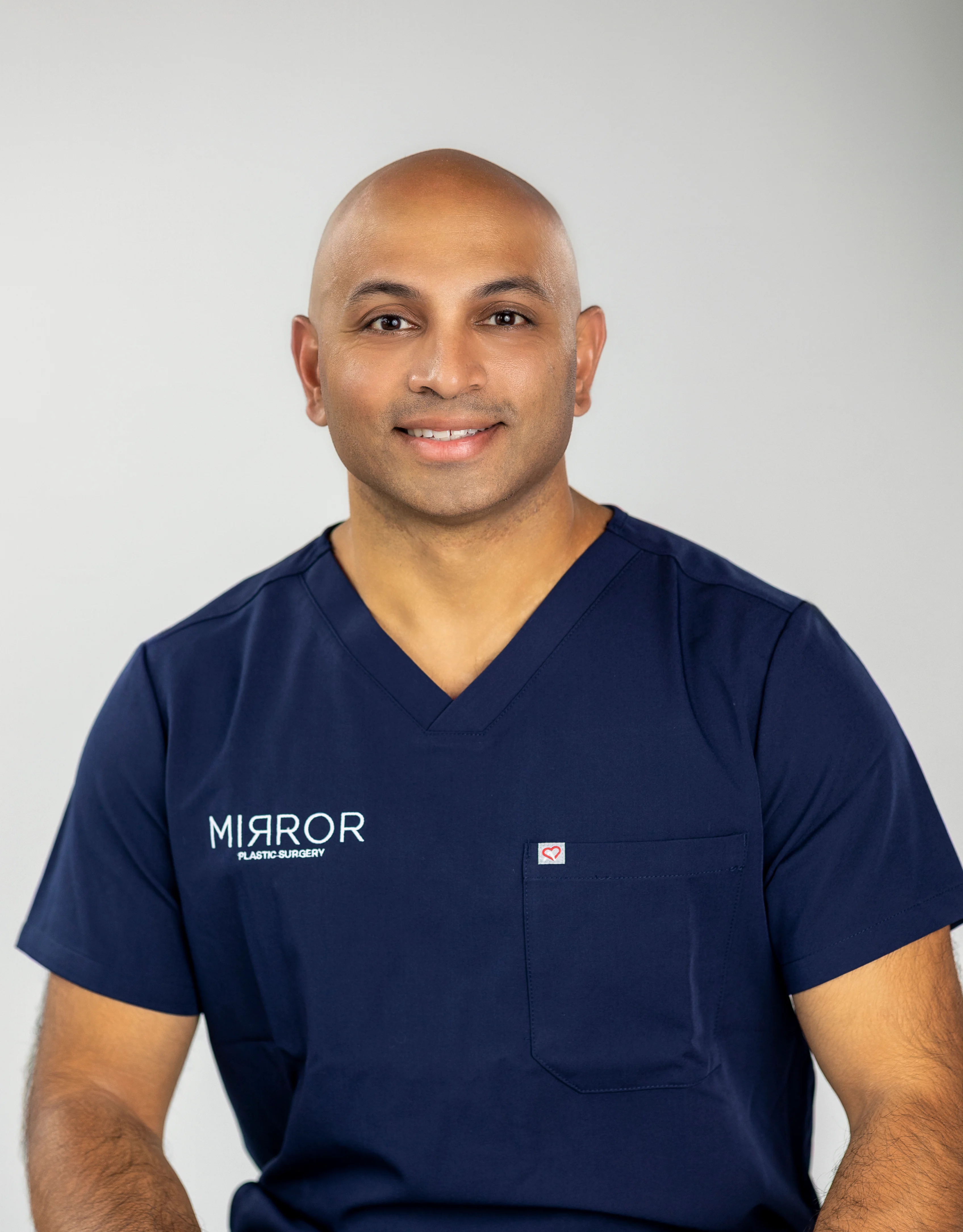
Written by: Dr. Akash Chandawarkar, Board Certified Plastic Surgeon, Mirror Plastic Surgery | Last updated: September 9, 2026
Key Takeaways
- Natural facial volume restoration depends primarily on the injector’s anatomical knowledge, technical precision, and aesthetic judgment rather than the filler product itself.
- Board-certified plastic surgeons bring three-dimensional spatial reasoning and surgical training that significantly reduces complication risks compared to non-surgeon injectors.1
- Overfilled or unnatural results usually stem from poor anatomical assessment and one-size-fits-all approaches rather than the filler material.
- Choosing a provider who can both prevent and immediately manage complications is essential for safe, natural outcomes.1
Now, explore how each of these factors works in real treatment settings, starting with why facial volume loss occurs.
Step 1: Understand Why Facial Volume Loss Happens
Facial aging involves more than skin losing elasticity. The face undergoes structural change across bone, ligament, fat, and skin at the same time. Fat compartments descend, ligaments weaken, and bone resorbs along the orbital rim, maxilla, and mandible. The deep medial cheek fat compartment often deflates first, pulling the midface downward and creating the nasolabial fold. The sub-orbicularis oculi fat then descends and contributes to the tear trough.
Common areas of volume loss include the cheeks, temples, nasolabial folds, and marionette lines. A 2026 review in the Journal of Cosmetic Dermatology emphasizes that using only volumetric logic to treat structural problems with HA fillers may increase fullness without restoring youthful facial geometry. This is why treating the face as a whole, rather than isolated features, forms the foundation of natural results. An experienced plastic surgeon understands this structural complexity before opening the first syringe.
Step 2: Evaluate the Injector’s Anatomical Knowledge
Safe and precise filler placement requires a three-dimensional appreciation of depth and neighboring structures, recognition of anatomical variation across patients, and dynamic assessment of how facial structures change with movement, age, and expression. Static textbook diagrams are insufficient. In older patients, vessels may lie closer to the surface, so surface landmarks alone do not provide enough guidance for safe injection.
Riskiest Areas for Fillers The glabella and nasal region carry the highest risk. The dorsal nasal artery anastomoses with the angular artery and can provide a direct pathway for filler emboli into the retinal circulation, risking blindness. The temple region contains the superficial temporal artery and vein with deep connections to the middle meningeal system, where vascular compromise can lead to blindness or extensive skin necrosis. A 2021 multicenter study in JAMA Dermatology found vascular occlusion rates of approximately 1 in 6,410 syringes for needles versus 1 in 40,882 for cannulas. This shows that instrument choice and injection technique materially affect complication rates.
Dr. Akash Chandawarkar’s surgical training at Johns Hopkins and fellowship at the Manhattan Eye Ear & Throat Hospital give him a detailed command of subdermal anatomy, including the precise layering of vessels, nerves, and fat compartments. The most useful mental model for safe filler placement is a map of depth rather than a map of named arteries, because the vessels that matter are stratified layer by layer. A surgeon’s training builds exactly this kind of three-dimensional spatial reasoning.
Schedule a Consultation With Ellie at Mirror Plastic Surgery to review your anatomy and goals with a board-certified plastic surgeon.
Step 3: Assess Aesthetic Judgment
Technical safety creates the baseline for treatment, but aesthetic judgment shapes the final result. Aesthetic judgment means the ability to assess facial proportions, balance, and harmony across the entire face.
Why Some Patients Look Older After Fillers Overfilled syndrome, facial heaviness, and unnatural broadening often result from inappropriate indication, excessive medial filling, poor sequencing, and insufficient analysis of the ligament-fat compartment support system. These problems arise from technique and planning rather than the filler material itself. An injector who follows a one-size-fits-all template and fills wherever volume appears missing can distort facial proportions. The face may then read as older or heavier instead of refreshed.
The clinical question should shift from “Where is volume missing?” to “Which anatomical support relationship has failed?” This reframing requires holistic, anatomy-guided aesthetic judgment that develops through years of surgical training and patient care. Dr. Akash’s approach centers on restoring inherent facial characteristics first. He considers volume augmentation only after foundational support is addressed, which helps patients look like themselves again.
Step 4: Verify Safety Protocols and Complication Management
Dermal fillers rank among the most commonly performed aesthetic procedures in the United States, with over 4.3 million treatments recorded annually by the American Society of Plastic Surgeons. Serious complications remain rare, yet they are real. Minor injection-site adverse events occur in roughly 10–35% of hyaluronic acid filler treatments, while clinically meaningful nodules, biofilm, and persistent inflammatory reactions occur in about 0.5–5% of treatments depending on product, plane, and operator.
Operator training, regulatory environment, and clinic-level protocol are the dominant determinants of harm in non-surgical facial aesthetics. Lower complication rates cluster in regulated, clinician-led settings that have written and rehearsed complication protocols, in-date hyaluronidase, and defined escalation pathways.
Physicians can diagnose a vascular event as it is happening and respond immediately with hyaluronidase. This capability sets them apart from many non-physician injectors. At Mirror Plastic Surgery, Dr. Akash’s philosophy of safety first, function second, and aesthetics third keeps patient well-being ahead of volume or revenue targets.
Step 5: Ask the Right Questions During Your Consultation
Direct questions during a consultation reveal a provider’s depth of knowledge and commitment to safety more clearly than marketing or social media. During any filler consultation, ask:
- “What is your specific experience with facial fillers for volume restoration?”
- “How do you assess my facial anatomy before injecting?”
- “What is your approach to achieving natural-looking results?”
- “How do you handle complications like vascular occlusion?”
- “Can I see before-and-after photos of patients with similar facial structure and concerns?”
A provider who cannot answer these questions with specificity and confidence, or who rushes through a consultation without a thorough top-to-bottom facial assessment, will not be a strong choice for natural facial volume restoration. Consultations at Mirror Plastic Surgery routinely extend to an hour. This gives Dr. Akash time to assess facial anatomy, aging patterns, and long-term goals before recommending any treatment.
Step 6: Critically Evaluate Before-and-After Photos
Before-and-after portfolios help you understand a provider’s style when you evaluate them critically. To assess a portfolio, look for three things: consistency of natural results across a diverse range of patients, evidence of facial balance and harmony rather than dramatic volume changes, and results that preserve each patient’s individual features instead of imposing a signature look.
Be cautious of portfolios that show heavily filtered images, a narrow range of patient types, or results where every patient appears to have received the same treatment regardless of anatomy. A 2026 international consensus paper in the Journal of Cosmetic Dermatology defines natural filler outcomes across four dimensions: visual observation, palpation, patient satisfaction, and dynamic facial expression. This standard goes well beyond how a result photographs in a static image. A surgeon’s portfolio should reflect all four dimensions.
Discuss Your Goals With Ellie to review Dr. Akash’s approach and explore what natural results could look like for your features.
Key Considerations for Choosing Your Provider
The outcome of a dermal filler treatment depends on four interacting variables: provider experience, product selection, injection technique, and patient anatomy. Of these, provider experience governs all the others. For example, an experienced plastic surgeon selects the appropriate product for the anatomical plane, adapts technique to individual vascular risk, and makes real-time aesthetic judgments that no protocol or product can replace.
When comparing providers, prioritize board certification in plastic surgery or dermatology, demonstrated experience with facial volume restoration, the ability to manage complications on-site, and a consultation style that emphasizes education and honest assessment over upselling. An international survey estimated that practitioners require approximately 3.85 years and nearly 800 filler injections to reach an advanced competency level. Keep this benchmark in mind when you evaluate experience claims.
Safety, Risks, and Common Misunderstandings
Several persistent myths about dermal fillers cause patients to underestimate the importance of provider selection.
Myth: Fillers Are Completely Risk-Free. A 2026 systematic review in Aesthetic Plastic Surgery identifies the most severe permanent complications as blindness, stroke, chronic granulomatous inflammation, and irreversible tissue necrosis. Anatomic injection site and incorrect technique, rather than injected volume alone, drive most irreversible injuries.
Myth: More Filler Produces Better Results. Facial overfilled syndrome manifests as distorted facial proportions such as “chipmunk” cheeks, “pillow” faces, and “sunset” eyes. These changes reflect excessive filler use without individualized anatomical planning.
Myth: All Injectors Are Equally Skilled. The largest published case series of catastrophic filler events are dominated by practitioners whose training consisted of short, didactic-heavy courses with limited live supervised practice. Longer and more structured training correlates with lower rates of significant adverse events and faster recognition of vascular events.
Ready to see how a surgeon’s expertise can shape your outcome? Book Your Appointment With Ellie at Mirror Plastic Surgery to discuss your goals with Dr. Akash Chandawarkar.
Practical Guidance and Takeaways
The following principles summarize a practical framework for choosing a provider and achieving natural facial volume restoration:
- Experience includes anatomical knowledge, technical skill, and aesthetic judgment, not just years in practice or number of syringes used.
- Natural results come from a holistic, conservative approach that treats the face as a structural system rather than isolated features.
- Safety matters most. Choose a provider who can prevent complications through anatomical precision and manage them immediately if they occur.
- Ask specific, direct questions during your consultation and pay attention to the clarity and detail of the answers.
- Evaluate before-and-after photos for evidence of individual facial harmony instead of a uniform aesthetic template.
- Prioritize a provider who will tell you when a treatment does not suit you. That level of honesty signals genuine expertise.
Frequently Asked Questions
How Long Do Dermal Fillers Last?
Duration varies by product type, the anatomical area treated, and individual metabolism. Hyaluronic acid fillers typically last 6 to 18 months.1 Softer formulations used in dynamic areas like the lips metabolize more quickly than denser products placed in structural zones like the cheeks or chin. Biostimulatory fillers like Radiesse work by stimulating collagen production, with results that can last 18 months or longer.1 An experienced injector selects the appropriate product for each area and explains realistic longevity during the consultation.
Are Dermal Fillers Safe?
Dermal fillers are safe when a qualified, experienced provider performs treatment in a properly equipped clinical setting. Risks range from common minor events, such as bruising in approximately 20–30% of treatments, to rare but serious complications including vascular occlusion. The critical safety factors are the provider’s anatomical knowledge, injection technique, and the clinic’s readiness to manage complications immediately. Every filler appointment at Mirror Plastic Surgery includes access to emergency protocols and reversal agents on-site.
Will I Look Overfilled?
A provider who prioritizes natural results, uses conservative volumes, and approaches the face holistically can avoid an overfilled look.1 Overfilled outcomes usually result from inappropriate product selection, excessive medial filling, poor sequencing, or failure to analyze the face’s structural support system before injecting. A board-certified plastic surgeon with a philosophy centered on restoring your inherent features, rather than imposing a standardized aesthetic, will aim for results that look like a refreshed version of you.1 Dr. Akash’s initial focus stays on revitalizing what is already there before considering additional volume.
How Do I Choose Between a Plastic Surgeon and a Med Spa?
Training depth, anatomical expertise, and complication management create the main differences. A board-certified plastic surgeon completes medical school, residency, and often fellowship training in surgical anatomy, including the precise layering of vessels, nerves, and fat compartments that determine safe filler placement. Physicians can diagnose and treat vascular events immediately, which is a key advantage over many non-physician injectors. Med spas vary widely in injector qualifications, and most U.S. states do not restrict filler injection to physicians. When the stakes include your face and your safety, credentials and complication-management capability matter more than convenience or price.
The Value of Experience
This focus on training, anatomy, and safety highlights the core issue: the value of experience. The product represents only half of the equation. A plastic surgeon’s experience, including command of facial anatomy, aesthetic judgment, and the ability to prevent and manage complications, plays the central role in whether dermal filler results look naturally refreshed or artificially done. Choosing a provider means choosing the entire system of knowledge, training, and clinical readiness that surrounds the syringe.
At Mirror Plastic Surgery in St. Petersburg, Florida, Dr. Akash Chandawarkar brings Harvard medical education, Johns Hopkins surgical training, and fellowship-level aesthetic expertise to every injectable treatment. His concierge approach, with up to an hour per consultation and a philosophy of safety first, suits patients who want more than a high-volume, one-size-fits-all experience.
Your face benefits from a surgeon’s expertise. Schedule Your Consultation With Ellie at Mirror Plastic Surgery today to explore options for natural facial volume restoration.
Disclaimer: Results may vary from person to person. Editorial content, before and after images, and patient testimonials do not constitute a guarantee of specific results.
1 Results may vary from person to person. Editorial content, before and after images, and patient testimonials do not constitute a guarantee of specific results.