
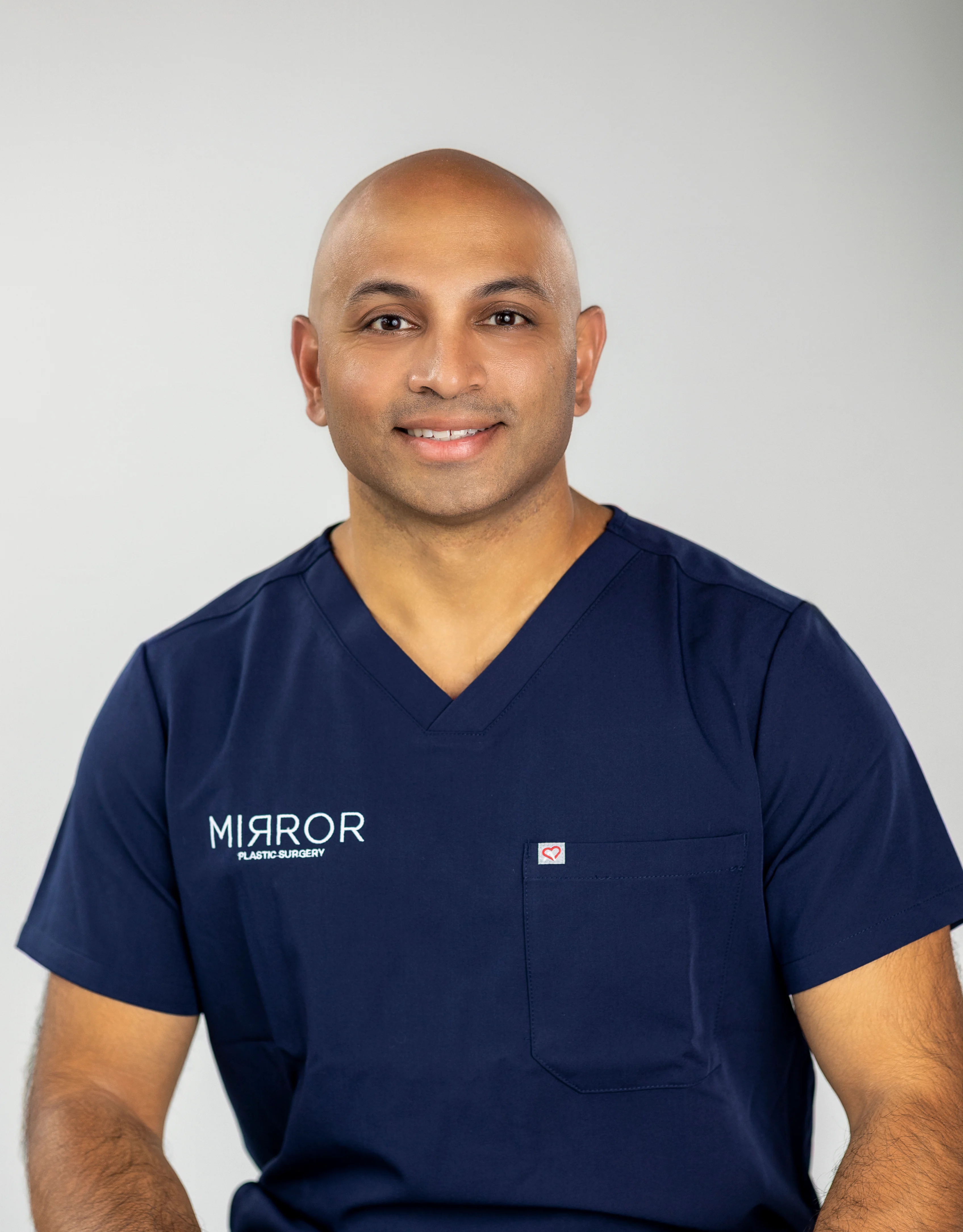
Written by: Dr. Akash Chandawarkar, Board Certified Plastic Surgeon, Mirror Plastic Surgery | Last updated: September 9, 2026
Key Takeaways
- AlloClae offers immediate structural volume with minimal downtime, which suits patients without enough donor fat or those wanting subtle-to-moderate enhancement.1
- Surgical BBL remains the gold standard for dramatic, large-volume results and requires general anesthesia, recovery time, and adequate donor fat.1
- Sculptra works gradually through collagen stimulation without immediate volume and usually requires multiple sessions over several months for subtle contour changes.1
- AlloClae shows higher retention than traditional fat grafting, which can reduce repeat procedures and influence long-term cost.1
AlloClae vs. Surgical BBL: The Core Trade-Off
Invasiveness and the Challenge for Lean Patients
Surgical BBL requires liposuction to harvest fat, so patients must have enough donor fat available. Many lean, athletic women and patients who lost significant weight on GLP-1 medications like semaglutide or tirzepatide do not meet this requirement. AlloClae eliminates the harvesting step entirely, which makes it a realistic option for many of these patients. Hip dips relate mainly to skeletal structure and soft tissue attachment, so restoring volume addresses them more effectively than weight loss.
Downtime and Recovery
Surgical BBL involves general anesthesia, two to four weeks of restricted sitting, compression garments, and significant time off work. AlloClae is an in-office procedure under local anesthesia. Most patients return to normal activities within 24 to 48 hours, which benefits people who cannot take extended time away from work or family.1
Volume and Results Ceiling
Surgical BBL remains the standard for dramatic, large-volume enhancement. AlloClae focuses on subtle-to-moderate enhancement and contour refinement. Most patients tolerate approximately 100–200cc per session comfortably under local anesthesia. As board-certified plastic surgeons at Chicago Breast and Body note, patients who want BBL-level results from a non-surgical treatment need a different conversation. That honesty builds trust and forms the foundation of a reliable recommendation.
Retention and Efficiency
Traditional fat grafting often loses 40–60% of the transferred fat. Early AlloClae experience suggests approximately 80% or higher retention, with some surgeons reporting up to 90% survival at one year compared to 40–50% for traditional fat grafting.1 This efficiency means approximately 75–100cc of AlloClae may achieve results similar to roughly 250cc of liposuctioned fat, although individual outcomes vary.
Cost Structure
Surgical BBL is usually quoted as a bundled fee that includes operating room time, anesthesia, and surgeon fees. AlloClae pricing is based on the volume placed. For low-volume contouring of about 25–75cc, AlloClae can be more cost-effective than surgery and avoids extra costs for compression garments, post-operative massage, and recovery medications. However, once enhancement needs exceed about 100cc per side, surgical BBL by a board-certified plastic surgeon in an accredited facility becomes the more economical option. The higher retention rate mentioned earlier can also reduce the need for repeat AlloClae sessions, which influences long-term cost.
Every patient at Mirror Plastic Surgery receives a personalized quote during consultation, because volume, anatomy, and goals vary too much for flat pricing.
AlloClae vs. Sculptra: Two Very Different Non-Surgical Options
AlloClae and Sculptra are both injectable and non-surgical, yet they work in very different ways. Treating them as interchangeable often leads to disappointment or overpromising.
Mechanism of Action
Sculptra is a biostimulator. It does not provide volume itself and instead stimulates your body to build collagen over two to three months. AlloClae provides immediate structural volume and acts as a scaffold for tissue integration. As Dr. Arthur Desrosiers III of Marquis Plastic Surgery explains, biostimulators like Sculptra “do not work as volumizers for high-volume augmentation” because they are collagen stimulators rather than structural fillers.
Results Timeline and Volume Ceiling
Sculptra usually requires two to three sessions over about six months and works best for subtle contouring. AlloClae delivers immediate volume that continues to improve over three to six months and can create more noticeable enhancement per session.1 For patients who want meaningful gluteal volume or hip dip correction, AlloClae’s structural strength provides lifting of the hip dip areas in a way biostimulators alone cannot match.
Longevity Comparison
Sculptra results often last two or more years as collagen builds gradually. AlloClae results can last 18 months to three years or longer, and many patients view the improvement as effectively permanent once the scaffold integrates with living tissue.1 Long-term data is still emerging, and factors such as weight stability, metabolism, and lifestyle strongly influence longevity.
Cost Per Treatment Course
Sculptra often appears less expensive per session, yet a full treatment course can require many vials across several visits. A complete Sculptra BBL series can reach $7,200–$15,000 for moderate enhancement, which matches or exceeds AlloClae’s typical range for similar goals. Total cost for either option depends heavily on your anatomy and desired outcome, so a consultation is essential before committing.
Safety and Risk: What Current Evidence Shows
Regulatory Status
AlloClae is classified as a Human Cell, Tissue, and Cellular and Tissue-Based Product (HCT/P) under Section 361 of the Public Health Service Act and 21 CFR Part 1271. It must meet strict donor screening, communicable disease testing, and current good tissue practice standards. It has not gone through the same premarket clinical review that new drugs or medical devices require. Calling AlloClae “FDA-approved” is inaccurate, because it is FDA-regulated under the HCT/P framework.
The AlloClae product insert confirms that donor eligibility follows FDA requirements, including testing for HIV-1, HIV-2, Hepatitis B, Hepatitis C, Syphilis, and HIV-1/HCV/HBV NAT by an FDA-registered, CLIA-certified laboratory. The product is terminally sterilized using gamma radiation. While these federal standards apply nationwide, state-level licensing can also affect availability. For example, state regulators in New York halted AlloClae distribution, alleging distribution without required state approvals. This dispute involved state licensing rather than a nationwide safety recall, and Tiger Aesthetics paused distribution during litigation.
Known Risks and Complications
The manufacturer’s product insert lists the following potential complications:
- Cystic formations
- Nodule formation
- Pain at the procedure site
- Infection
- Hematoma
- Anaphylaxis or allergic responses
- Immune responses
- Skin discoloration
Documented cases of fat necrosis and oil cysts have been reported, especially in breast applications where injected fat fails to vascularize and dies. These cases highlight a key point. AlloClae is not reversible with an enzyme the way some other fillers are. Unwanted nodules may require aspiration or surgical removal. Conservative treatment planning and experienced technique play a central role in reducing these risks.
The Evidence Gap
Current science still has unanswered questions. As Dr. Lara Devgan, board-certified plastic surgeon, writes, “Patients deserve evidence. The most responsible path forward is rigorous science, transparent reporting, long-term follow-up, and a willingness to allow evidence, rather than excitement, to determine the future role of any new technology.” No published long-term human studies yet describe AlloClae outcomes at three, five, or ten years. The manufacturer reports more than 2,000 treated patients, yet independent registry data is not available. This uncertainty makes provider experience and conservative planning especially important.
Why Provider Expertise Is the Differentiator
Board-certified plastic surgeons bring detailed anatomical knowledge, sound clinical judgment, and complication-management skills to AlloClae treatments. Some surgeons, such as Dr. Sarah Mess at the Plastic Surgery Center of Columbia, use real-time ultrasound guidance for precise, image-confirmed placement of AlloClae, which reflects a surgical level of precision. Other practices may use ultrasound selectively or rely on different techniques. Dr. Akash’s advisory board role with Tiger Aesthetics keeps him current on emerging safety data and best practices.
Making the Right Choice: A Practical Decision Framework
A structured framework can help you narrow your options before you meet with a surgeon, although it never replaces a personalized consultation.
AlloClae may be appropriate if you:
- Want subtle-to-moderate enhancement without surgery or general anesthesia
- Lack sufficient donor fat for a surgical BBL, including after GLP-1–related weight loss
- Prefer immediate volume with minimal downtime
- Are targeting specific issues such as hip dips, asymmetry, or post-liposuction contour irregularities
- Accept that multiple sessions may be needed for best results
Surgical BBL may be appropriate if you:
- Desire dramatic, large-volume enhancement
- Have enough donor fat for harvesting
- Are comfortable with surgery, anesthesia, and two to four weeks of downtime
- Prefer a single procedure with potentially long-lasting results
Sculptra may be appropriate if you:
- Prefer a gradual, collagen-stimulating approach with no immediate volume
- Want very subtle contour improvement over time
- Can commit to two to three sessions over about six months
Some patients benefit from combination strategies. AlloClae can be used alone or combined with autologous fat transfer to enhance shape, symmetry, and durability. This approach can suit patients who want scaffold support along with their own fat. During your consultation, Dr. Akash will design a treatment plan that reflects your anatomy and goals.
Book a consultation with Dr. Akash to determine which approach or combination fits you best.
Frequently Asked Questions
How Long Does AlloClae Last Compared to Surgical BBL and Sculptra?
AlloClae results usually develop over three to six months as the scaffold integrates with your own tissue. Many patients see their final result around six months, with volume remaining stable for 18 months to three years or longer depending on individual factors. Some patients describe the improvement as effectively permanent once integration completes, although data beyond three years is still emerging. Weight stability plays the largest role, because significant weight loss can reduce volume and weight gain can enlarge it.
Surgical BBL results can last many years, yet traditional fat grafting often loses 40–60% of the transferred fat, so final results may look less dramatic than immediately after surgery. Some patients need staged procedures to reach their goals.
Sculptra results typically last two or more years as collagen builds slowly. Because Sculptra stimulates collagen rather than providing structural volume, results appear gradually and do not create the immediate contour change that AlloClae or surgical BBL provide.
Metabolism, weight stability, smoking status, overall health, and the specific treatment area influence longevity for all three options.
Is AlloClae Safe?
AlloClae is regulated by the FDA as an HCT/P under 21 CFR Part 1271. It must meet strict donor screening, communicable disease testing, and current good tissue practice standards. Donors are tested for HIV-1, HIV-2, Hepatitis B, Hepatitis C, Syphilis, and HIV-1/HCV/HBV NAT by an FDA-registered, CLIA-certified laboratory, and the product is terminally sterilized using gamma radiation.
AlloClae has not undergone the same premarket clinical review as a new drug or device, and long-term human outcome data is still developing. Known risks include bruising, swelling, nodule formation, infection, and, in some reported breast cases, fat necrosis. As noted earlier, AlloClae is not reversible with an enzyme, so unwanted outcomes may require aspiration or surgical removal.
Choosing an experienced, board-certified plastic surgeon reduces risk. Provider expertise in anatomy, candidate selection, injection technique, and complication management serves as the primary safety factor.
Is AlloClae Worth the Cost Compared to a Surgical BBL?
The value depends on your goals and anatomy. For subtle-to-moderate enhancement, especially for patients addressing hip dips, asymmetry, or volume loss without enough donor fat for surgery, AlloClae can deliver meaningful results with minimal downtime and no operating room costs. Its higher retention rate mentioned earlier means less product may be needed to reach your goal, which affects long-term cost.
For dramatic, large-volume enhancement, surgical BBL usually delivers more volume per dollar and remains the standard. Patients who need several AlloClae sessions to approach BBL-level results may ultimately spend more than they would with surgery.
A consultation clarifies which option offers the best value for your anatomy and goals. Mirror Plastic Surgery provides personalized quotes during consultation, because pricing depends on each patient’s needs.
Does AlloClae Look Natural?
AlloClae can look very natural when an experienced provider performs the treatment.1 It integrates with your own tissue over three to six months, creating soft, natural-feeling volume rather than a firm or artificial look. Because it comes from human adipose tissue and preserves the extracellular matrix, it behaves similarly to your own fat once integrated.
Conservative volume planning and precise placement matter most. Overcorrection or poor technique can cause irregularities or asymmetry, which is why your provider’s training and experience are so important.
Can AlloClae Be Combined with Other Treatments?
AlloClae can be combined with surgical fat transfer for patients who want both scaffold support and the volume of their own fat. It can also pair with skin-tightening treatments such as radiofrequency or ultrasound for more comprehensive contouring. Some patients follow a staged plan, starting with AlloClae and later adding autologous fat grafting once the scaffold integrates.
During your consultation, Dr. Akash will design a personalized plan based on your anatomy, goals, and timeline. Combination approaches are recommended when they clearly support your needs rather than as routine add-ons.
Conclusion: Choosing Buttock Enhancement with Confidence
AlloClae, surgical BBL, and Sculptra each fill a specific role in buttock enhancement, with different trade-offs in invasiveness, downtime, timeline, longevity, cost, and risk. The best option depends on your anatomy, goals, and comfort with surgery.
Your choice of provider influences safety and satisfaction more than any single product. Dr. Akash Chandawarkar’s board certification, surgical training, advisory board role, and commitment to transparent, evidence-based care make Mirror Plastic Surgery a trusted destination for AlloClae buttock enhancement in the St. Petersburg and Tampa Bay area.
Your next step is a clear, honest conversation about your goals. Book a consultation with Dr. Akash today and explore which approach fits you best.
Disclaimer: Results may vary from person to person. Editorial content, before and after images, and patient testimonials do not constitute a guarantee of specific results.
1 Results may vary from person to person. Editorial content, before and after images, and patient testimonials do not constitute a guarantee of specific results.