
Written by: Ellie Pranckevicius, FNP-BC, Aesthetic Nurse Practitioner & Aesthetic Injector | Facial Restoration & Regenerative Injectable Specialist, Mirror Plastic Surgery | Last updated: August 15, 2026
Key Takeaways
- Hair growth peptides like GHK-Cu act through specific pathways such as Wnt/beta-catenin activation and VEGF upregulation. Current evidence supports modest, adjunctive benefits for early thinning, not dramatic regrowth.1
- Clinical data supports consistent use over three to twelve months for visible improvements in hair thickness or reduced shedding. Results often fade when treatment stops.1
- Peptides work best as a complementary option alongside proven treatments like minoxidil or finasteride, not as standalone replacements for FDA-approved hair-loss medications.
- Quality sourcing, appropriate delivery methods, and medical supervision strongly influence whether peptide protocols produce measurable results or create safety risks.
- Adults with early-to-moderate hair thinning can explore supervised peptide therapy through a consultation at Mirror Plastic Surgery for personalized, batch-tested protocols.
How Well Hair Growth Peptides Actually Work
Hair growth peptides work modestly, selectively, and only with consistent use. A 2026 evidence review concludes that topical copper peptides have biologic plausibility and some human data, but the compound is best viewed as an adjunct rather than a standalone hair-loss treatment. The same review notes that minoxidil and finasteride still hold the strongest evidence for androgenetic alopecia.
Peptides still exert real biological effects. GHK-Cu operates through multiple follicle-relevant mechanisms, including Wnt/beta-catenin activation, VEGF upregulation, TGF-beta1 suppression, and androgen receptor downregulation. These mechanisms differ from those of minoxidil or finasteride. That distinction supports ongoing research into combination protocols, even though standalone peptide trial data remain limited.
Peptides vs Minoxidil for Hair Loss
To understand where peptides fit in the treatment landscape, the table below compares four approaches across regulatory status, mechanism, evidence quality, and safety profile. This context highlights why medically supervised protocols differ from over-the-counter or self-sourced options.
A randomized, double-blind trial (NCT07536100) comparing a peptide factor hair serum to topical minoxidil for androgenetic alopecia began recruiting in May 2026 with an estimated enrollment of 80 participants and a primary completion date of November 2026; no results have been posted. That trial will expand a currently thin head-to-head evidence base.
Hair Growth Peptides Before and After: Realistic Timeline
Consistent daily use for three to four months is required before potential results in hair thickness or reduced shedding may appear1, according to dermatologist guidance. These timelines apply to thinning hair, not to areas of complete follicle loss.
Peptides show limited effectiveness in areas of advanced hair loss with significant follicle loss, where hair transplantation may be more appropriate1. Peptide therapy is more effective at strengthening and thickening existing miniaturized hairs than at resurrecting completely dormant follicles; if a follicle has been inactive for years and has fibrosed over, the window for recovery narrows substantially1.
Copper Peptides Hair Growth Evidence
GHK-Cu is an endogenous tripeptide. Endogenous GHK-Cu concentrations decline from approximately 200 ng/mL in the 20s to 80 ng/mL by the 60s, correlating with slower follicle cycling and thinner hair. This decline supports the mechanistic case for supplementation.
Wnt/beta-catenin signaling: GHK-Cu activates Wnt/beta-catenin signaling in dermal papilla cells, which upregulates stem cell activity in the hair follicle bulge region and shifts follicles from telogen into anagen. This counters DHT-induced secretion of DKK1 that otherwise suppresses Wnt signaling in dermal papilla cells.
Androgen receptor modulation: Research suggests GHK-Cu may reduce androgen receptor sensitivity in follicle cells, thereby decreasing follicle sensitivity to DHT without directly blocking DHT production.
VEGF and angiogenesis: In vitro research has demonstrated that GHK-Cu can promote proliferation of dermal papilla cells along with VEGF upregulation and TGF-β2 downregulation.
Against this mechanistic backdrop, the clinical evidence ceiling remains low. As noted in the comparison above, the clinical evidence ceiling for GHK-Cu remains limited: no controlled human trials have tested it against placebo for hair loss. Existing evidence comes from in-vitro dermal papilla studies and animal wound-healing models. Marketing claims that exceed this evidence base deserve skepticism.
Injectable vs Topical Peptides for Hair
Delivery route shapes both the risk profile and the regulatory category of a peptide product.
Topical GHK-Cu is regulated as a cosmetic ingredient. Clinically supervised topical use of pharmaceutical-grade GHK-Cu formulations represents the safest approach for hair restoration compared to unregulated or DIY preparations. Penetration limits still apply. GHK-Cu has a molecular weight of approximately 402 daltons, which sits near the upper limit for passive skin penetration. Real-world topical absorption is therefore much lower than with mesotherapy or microneedling delivery.
Injectable peptides carry a very different risk profile. Injectable research peptides such as TB-500, BPC-157, CJC-1295, and ipamorelin carry higher uncertainty for hair restoration use, with poor controlled human safety data, inconsistent gray-market quality, added self-injection sterility and dosing risks, and classification as “for research use only”. The May 14, 2026 FDA 503A bulk-substances update added GHK-Cu except for injectable routes back to Category 1 under evaluation after a nominator clarified intent to retain a non-injectable nomination. This update reflects ongoing regulatory scrutiny of injectable routes.
Medical supervision is the minimum standard for safe injectable protocols.
Real User Results Compared to Marketing Claims
Forum discussions on Reddit’s r/Peptides and r/tressless show a consistent pattern. Users report modest improvements in shedding reduction and texture within three to four months, but rarely the dramatic density transformations shown in product marketing imagery. Common complaints include purchasing peptides from unverified suppliers, receiving products with no certificate of analysis, and experiencing no response. These issues likely occur because research peptides are not FDA-regulated for quality, so purity, concentration, sterility, and identity are self-reported by suppliers.
Clinics and brands claiming peptides can replace finasteride or minoxidil, or promising stem-cell activation and full follicle regeneration, are making claims that most current peptide marketing lacks sufficient evidence to support. Real-world user experience matches the clinical literature. Patients see incremental improvement in existing hair, not full restoration of lost follicles.1
Bioactive peptides for hair regeneration face topical application limits due to poor skin delivery from their relatively large molecular weight and hydrophilic nature, often requiring frequent dosing to maintain biological activity in conventional lotions, sprays, or gels. Products that ignore this delivery challenge are unlikely to achieve the results their marketing implies.
Quality and Sourcing Risks
The unregulated online peptide market creates risks that extend beyond efficacy. Products labeled “research use only” or “not for human use” place the burden of safety assessment on the buyer when used for self-administered hair restoration protocols. Contamination risks are significant with GHK-Cu sourced from unregulated suppliers and reconstituted without sterile technique, representing a primary practical safety concern for injectable or compounded formulations.
Injectable peptides should include third-party HPLC analysis confirming purity above 98% and a certificate of analysis from an accredited laboratory. The contamination risks mentioned earlier are compounded by the fact that most online retailers do not provide this documentation.
Mirror Plastic Surgery sources peptides exclusively from reputable providers with rigorous batch testing, which supports product quality, purity, and accurate dosage. This approach offers a structural safety advantage over self-sourcing.
When Supervised Peptide Therapy Makes Sense
Supervised peptide therapy for hair thinning suits adults aged 35–55 with early-to-moderate androgenetic alopecia or diffuse thinning who have not achieved adequate results with standard interventions, or who want an evidence-informed adjunct alongside proven treatments. Peptide use is best positioned as scalp support, regenerative adjunct therapy, or transplant optimization rather than as a replacement for proven hair-loss medications.
At Mirror Plastic Surgery, Ellie Pranckevicius, FNP-BC, leads peptide protocols for hair. She is a board-certified Family Nurse Practitioner. Her four years in the Neuroscience ICU at Tampa General Hospital built a strong foundation in critical-care physiology and systemic signaling. She then completed esthetician training at a high-end Boston medical spa, which deepened her understanding of aesthetic goals and realistic outcomes. Graduate nursing education at the University of South Florida integrated these skills into advanced clinical practice. This background allows Ellie to approach peptide therapy with a clear view of both follicle biology and patient expectations.
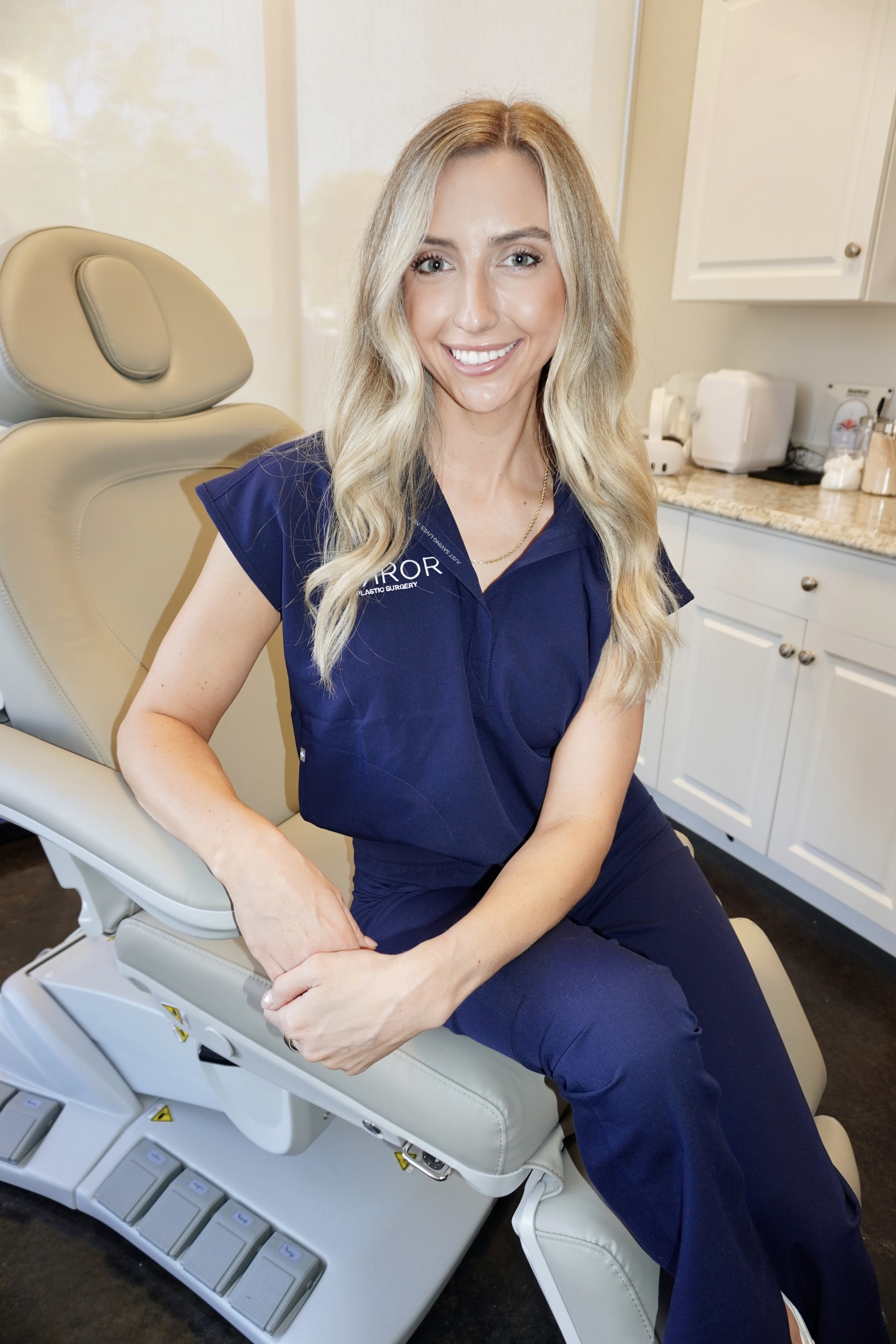
Her process starts with an in-depth review of medical history and, when indicated, lab panels that may include thyroid, hormone, and inflammatory markers. She then designs a protocol only after this review. Patients receive direct 24/7 access to Ellie via text for ongoing support, dosing questions, and protocol adjustments.
Mirror Plastic Surgery’s Glow Stack, which combines GHK-Cu, BPC-157, and TB-500, targets systemic inflammation, collagen and elastin production, and hair, skin, and nail health as a coordinated protocol rather than a single-ingredient approach. Protocols are individualized based on consultation findings and lab results, not applied as a one-size-fits-all template.
Frequently Asked Questions
Are hair growth peptides FDA-approved?
No hair growth peptide, including GHK-Cu, BPC-157, or TB-500, is FDA-approved as a drug for hair loss. Topical GHK-Cu is regulated as a cosmetic ingredient, which means it faces lower regulatory scrutiny than a pharmaceutical. Injectable peptides occupy a more complex regulatory position. BPC-157 received an FDA Category 2 designation in 2023, which prevents commercial compounding. TB-500 carries an FDA “Substance with Safety Concerns” classification for compounding. Minoxidil and finasteride remain the only FDA-approved pharmacological options for androgenetic alopecia. The main risk with peptides comes from obtaining them from unregulated sources without quality verification or medical oversight. Mirror Plastic Surgery sources from providers with documented batch testing and offers full medical supervision before, during, and after any protocol.
What happens if I stop taking hair growth peptides?
Stopping a peptide protocol gradually removes the follicle-environment benefits it created. Growth continues only while the protocol continues. Stopping treatment usually returns the follicle environment to its pre-treatment state over several months. This pattern mirrors most hair-loss interventions. Minoxidil produces a similar rebound effect when discontinued. Reduced-frequency maintenance protocols can sustain results after an initial treatment cycle, and Ellie structures Mirror Plastic Surgery’s protocols with this transition in mind.
Will peptides work the same way for everyone?
No. Results from peptide therapy vary significantly from person to person based on genetics, degree and duration of hair loss, scalp inflammation levels, hormonal status, diet, and lifestyle. As explained in the timeline section, peptides work on miniaturized hairs that are still cycling, not on follicles that have been dormant for years. This biological limitation, not product quality or dosing alone, explains why results differ so widely between patients. Mirror Plastic Surgery addresses this variability through in-depth consultations and lab reviews before starting any protocol.
Can I use peptides alongside minoxidil or finasteride?
Combination approaches attract growing clinical interest. A 2025 JAAD International paper reported improved hair regrowth after monthly sessions combining minoxidil, dutasteride, and copper peptides, although the study did not isolate copper peptides as the sole cause of improvement. GHK-Cu operates through mechanisms such as Wnt/beta-catenin activation, VEGF upregulation, and androgen receptor downregulation, which differ biologically from both minoxidil and 5-alpha reductase inhibitors. This difference makes combination use mechanistically reasonable. Decisions about combining treatments and selecting doses require review of your full health profile. Ellie evaluates each patient’s existing regimen during the consultation before recommending any protocol.
Is it safe to buy peptides online and self-administer for hair growth?
Self-administering injectable peptides purchased from unregulated online sources carries meaningful risks. These risks include lack of third-party quality verification, unknown purity and concentration, no sterility assurance, and no medical screening for contraindications such as Wilson’s disease, pre-existing malignancies, or drug interactions. Topical products carry lower risk but still vary widely in formulation quality. Two products listing the same peptide can produce different outcomes based on vehicle ingredients and delivery strategy. Mirror Plastic Surgery’s model, which includes batch-tested sourcing, pre-protocol lab panels, and 24/7 practitioner access, addresses each of these risks in a structured way.
Summary and Next Steps
Hair growth peptides, particularly GHK-Cu, act through biologically plausible mechanisms that differ from approved hair-loss drugs. Current evidence supports modest, adjunctive benefits for early-to-moderate thinning with consistent use over several months, not dramatic regrowth in areas of complete follicle loss or replacement of minoxidil or finasteride. Sourcing quality, delivery formulation, and medical supervision largely determine whether a peptide protocol produces meaningful results. Adults interested in peptide therapy can reduce risk and improve outcomes by working with a clinic like Mirror Plastic Surgery that provides batch-tested products, lab-informed protocols, and ongoing clinical support.
1 Results may vary from person to person. Editorial content, before and after images, and patient testimonials do not constitute a guarantee of specific results.
Peptide therapy is intended for wellness and optimization purposes and is not prescribed to diagnose, treat, cure, or prevent disease unless specifically stated. Many peptides are not FDA-approved and may be used off-label. Some have limited long-term safety data, with a potential for unknown risks, complications, or desensitization with prolonged use.