
Written by: Ellie Pranckevicius, FNP-BC, Aesthetic Nurse Practitioner & Aesthetic Injector | Facial Restoration & Regenerative Injectable Specialist, Mirror Plastic Surgery | Last updated: July 22, 2026
Key Takeaways for HA Fillers at Mirror Plastic Surgery
- Dermal fillers are injectable gels that restore facial volume, soften folds, and refine contours when placed by an experienced provider with strong anatomical training.
- More than 90% of adverse events are mild and short-lived, and hyaluronic acid fillers are fully reversible with hyaluronidase, which offers a major safety advantage.1
- Results usually last 6 to 24 months depending on product, treatment area, and metabolism, with realistic expectations set after a detailed facial assessment.1
- Provider selection matters most; deep anatomical knowledge, supplier neutrality, and full-face planning support natural, balanced results.
- Schedule your personalized consultation at Mirror Plastic Surgery for an anatomy-first assessment tailored to your goals and long-term well-being.
How Hyaluronic Acid Fillers Work in Your Skin
Hyaluronic acid is a glycosaminoglycan that binds water molecules, which supports skin hydration and structural resilience. In its native form it degrades quickly in the body. Chemical cross-linking with agents such as BDDE (1,4-butanediol diglycidyl ether) stabilizes the gel and extends its duration in tissue. The degree of cross-linking shapes a filler’s firmness, flexibility, and longevity, often described together as rheology.
Several FDA-cleared HA filler families are available in the United States, each with distinct technologies and use cases:
- Juvéderm (Allergan Aesthetics), which includes Hylacross and Vycross technology variants for lips, folds, and volumization
- Restylane (Galderma), which includes NASHA and XpresHAn/OBT technology variants for contouring, lips, and tear troughs
- RHA Collection (Crown Laboratories), which features minimal chemical modification designed to mimic natural skin HA and resist dynamic facial movement
- Versa (Revanesse), which uses smooth-particle HA for facial folds and lip augmentation
Longevity data from 2026 research clarifies realistic expectations. Lips and nasolabial folds tend to have shorter duration due to constant movement, while cheeks and jawline often last longer, generally ranging from 6–18 months overall.1 A 2026 prospective cohort study of a low-modification (MoD 2%) HA filler demonstrated substantial retention at 6 months with near-complete resorption by 24 months and no residual palpable nodules1. These findings align with the finite, predictable degradation profile of modern low-cross-linker formulations.
Reversibility with hyaluronidase remains the defining safety feature of the entire HA filler category. All hyaluronic acid dermal fillers, including Juvéderm and Restylane families, are reversible with hyaluronidase enzyme, which provides a meaningful safety advantage that biostimulatory fillers do not share.
How Ellie Plans Your Filler Treatment
Understanding these product differences and safety features provides essential context for the planning process itself. Individualized planning at Mirror Plastic Surgery begins with a comprehensive structural facial assessment rather than a symptom-by-symptom approach. A thorough facial analysis for HA filler planning should include overall appearance, ethnicity, asymmetry, key facial arteries to avoid, skeletal and volumetric changes, and how treatment will affect facial volume and contour.
Clinically, this means evaluating the three facial thirds in proportion, identifying which support structures have lost volume, and assessing tissue quality. Superficial fat loss typically begins around age 40 and presents as a slight depression at the lid-cheek junction or loss of normal malar projection, while deep fat loss is more predictable and age-dependent after 40, often with bone resorption causing nasolabial fold deepening and inferior shift of superficial fat. Dynamic assessment techniques such as the pinch test help distinguish superficial from deep fat loss. That distinction directly guides the injection plane and product choice.
At Mirror Plastic Surgery, Ellie Pranckevicius often spends up to an hour on a top-to-bottom assessment before recommending any treatment. Her dual background in esthetics and advanced nursing, combined with four years of critical care experience at Tampa General Hospital, supports a detailed understanding of surface and subdermal anatomy. She focuses first on restoring inherent facial characteristics, then considers volume augmentation, which helps maintain a seamless transition across the upper, middle, and lower facial regions.
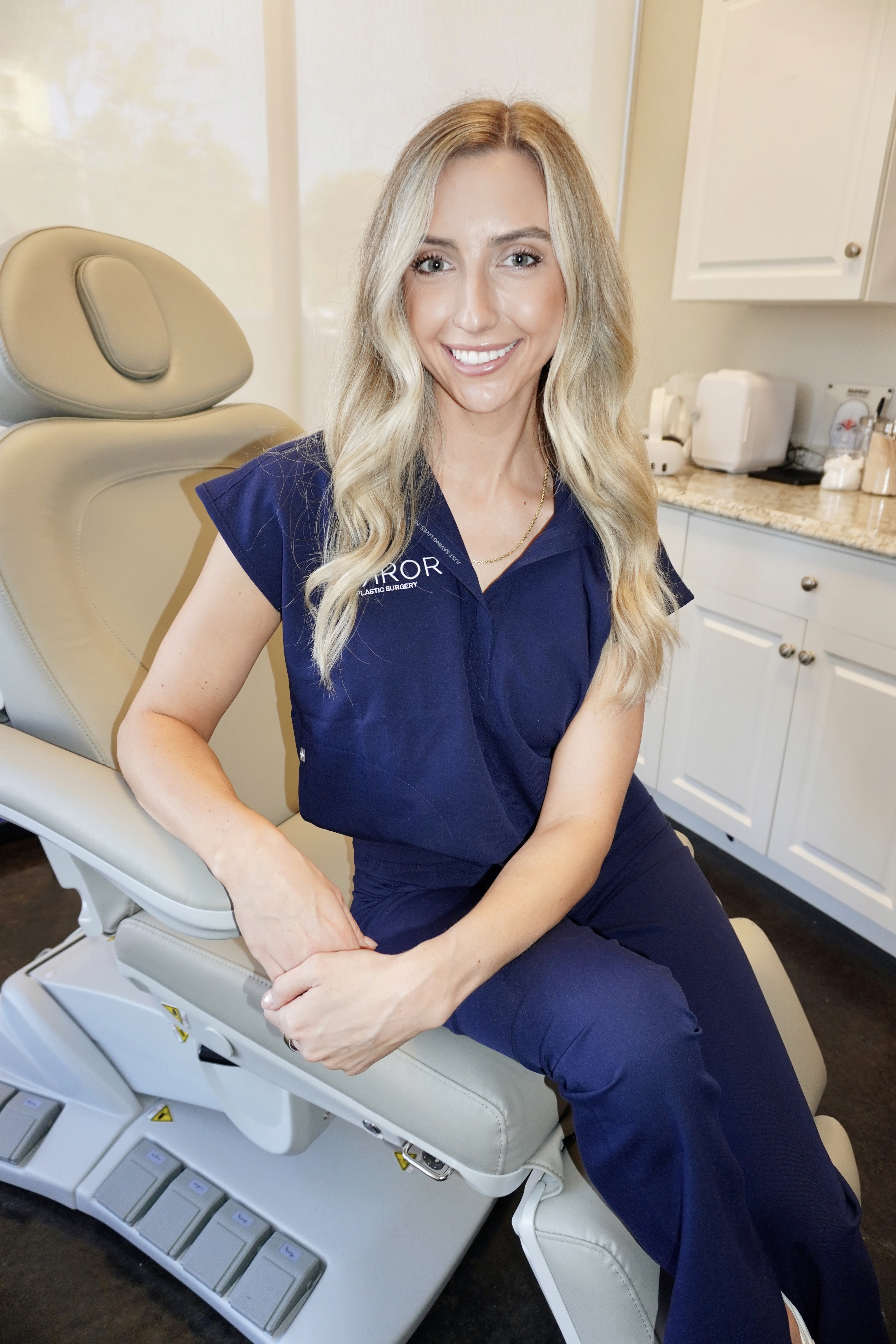
Book a consultation with Ellie to receive a personalized, anatomy-first assessment at Mirror Plastic Surgery in St. Petersburg.
2026 Filler Trends and Emerging Technologies
The 2026 landscape shows a clear shift toward lower chemical modification, improved tissue integration, and full-face harmonization instead of isolated area treatment. Patients increasingly seek subtle, global refinement rather than single-spot correction.
On the formulation side, low-MoD HA fillers are hypothesized to reduce long-term foreign-body responses and granuloma risk by lowering cumulative exposure to chemically modified HA and residual cross-linker while still providing meaningful aesthetic duration. A novel click-chemistry crosslinked filler (HLR-2), which achieved minimal chemical modification without BDDE, demonstrated high responder rates at 6 months with no serious adverse events over the study period.
Self-crosslinking HA (SC-HA) represents the next frontier in filler science. Early-stage research published in MDPI Polymers (2024) demonstrates viable gel formation and biocompatibility, and at least one SC-HA filler (Belotero Volume (+) Lidocaine) had received FDA approval as of mid-2026.
Clinically, the trend toward full-face harmonization reflects growing recognition that isolated injections in a single area can create imbalance. Providers trained in top-to-bottom assessment are better positioned to deliver results that look natural across all facial regions at the same time.
What to Look for Before You Get Filler
Choosing the right provider is the single most consequential decision in the HA filler process. The following factors work together to support safe, natural outcomes.
First, anatomical expertise forms the baseline requirement. The injector must understand facial fat compartments, vascular anatomy, and tissue planes, not just injection technique. This anatomical foundation then supports evidence-based product selection, because clinically relevant differences among HA fillers lie in crosslinking technology, firmness, cohesivity, and flexibility. Matching product rheology to the specific anatomical zone and goal requires that level of detail.
Supplier neutrality also matters. Even a knowledgeable provider cannot make ideal product matches when limited to a single brand portfolio. Long-term maintenance planning deserves attention as well, since follow-up surveys show that many patients feel more likely to seek additional treatments after HA filler treatment. Filler usually becomes a maintenance relationship rather than a one-time event.
Thorough contraindication screening completes the safety picture. Absolute contraindications include active infection or inflammation, pregnancy or breastfeeding, and relevant histories of hypersensitivity. Certain active autoimmune diseases are typically listed as relative contraindications, and significant immunosuppression requires individualized assessment.
Mirror Plastic Surgery operates as a supplier-neutral practice. Ellie selects from Juvéderm, RHA, Versa, Restylane, and other options based solely on what best serves each patient’s anatomy and goals, not on quotas or brand agreements.
Risks, Side Effects, and Safety Tradeoffs
Clear understanding of the risk profile supports informed consent and realistic comfort with treatment. The evidence is reassuring for most patients, with important caveats for high-risk anatomical zones.
Common side effects are usually mild and transient:
- Injection-site redness, swelling, and bruising, which account for more than 90% of all reported adverse events
- Malar edema in tear trough cases due to lymphatic compression
Less common but clinically significant risks include:
- Delayed-onset nodules, often linked to delayed inflammation or bacterial biofilms
- Ischemic complications including skin necrosis, which remain rare
- Vision loss and cerebrovascular events, which are exceedingly rare but documented, with highest-risk injection sites including the glabella, nasal region, nasolabial fold, and forehead
The FDA has issued warnings regarding vascular occlusion risks, particularly in high-risk anatomical zones. Providers must keep hyaluronidase on-site and stay trained in vascular occlusion recognition and emergency reversal protocols. This requirement represents a standard of care, not an optional precaution.
Clearing Up Common Filler Myths
Several persistent misconceptions circulate in patient forums and social media, and current clinical evidence directly contradicts them.
- “HA filler stays in your face forever.” This claim is false. High-frequency ultrasound in a 2026 study demonstrated complete absence of sonographically detectable residual product at 24 months1 for a low-MoD HA filler, which matches the finite degradation profile of all HA gels.
- “Dissolving filler is unpredictable and uneven.” Hyaluronidase degrades HA enzymatically and systematically. When a trained provider administers it, reversal is reliable and complete.
- “HA fillers always look overdone.” Overfilled results reflect planning and technique errors, not an inherent property of the material. A 2026 study found that patient satisfaction often outlasts objective filler volume in select facial regions, which shows that well-placed, conservative treatment can provide durable perceived improvement even as volume gradually diminishes.
- “All HA fillers are the same.” Clinically relevant differences lie in crosslinking technology, firmness, cohesivity, and flexibility, and product selection matched to anatomy often separates natural outcomes from problematic ones.
Comparing HA Fillers to Biostimulatory Injectables
HA fillers are not the only injectable option for facial rejuvenation. Biostimulatory agents such as Radiesse (calcium hydroxylapatite) and Sculptra (poly-L-lactic acid) work by stimulating the body’s own collagen production rather than providing immediate volumization. Collagen-stimulating fillers such as Sculptra can last up to two years by prompting the body’s own collagen production, but they are not reversible with hyaluronidase.
The choice between HA and biostimulatory options depends on the clinical scenario:
- Pure structural volume loss with good skin quality, where HA fillers are typically the primary indication
- Mixed volume loss with skin laxity or poor tissue quality, where biostimulation or tissue-quality improvement may be prioritized before or alongside HA fillers
- No structural loss present, where biostimulation, polynucleotides, or energy-based treatments may be more appropriate than fillers
For body contouring procedures such as the non-surgical BBL, biostimulatory fillers, not HA fillers, represent the evidence-supported and safe standard of care for the gluteal region. Ellie’s non-surgical BBL approach at Mirror Plastic Surgery uses biostimulatory agents to achieve refined shape, symmetry, and volume in that context.
Book a consultation with Ellie to determine which injectable approach, HA filler, biostimulatory, or a combination, fits your specific anatomy and goals.
Frequently Asked Questions
Are hyaluronic acid fillers good?
For the right candidate with realistic expectations, HA fillers rank among the most well-studied and versatile tools in aesthetic medicine. They are biocompatible, reversible, and supported by decades of clinical data. Their suitability depends on the specific concern, the patient’s anatomy and tissue quality, and the injector’s expertise. A thorough assessment offers the only reliable way to decide whether HA fillers are appropriate for a given individual.
What are the cons of hyaluronic acid fillers?
The main limitations include temporary duration, which requires maintenance treatments, and a small but real risk of vascular complications in high-risk anatomical zones. Suboptimal results can occur when product selection or injection technique does not match the patient’s anatomy. Mild side effects such as bruising and swelling are common and short-lived, while delayed-onset nodules remain infrequent. Serious complications are rare but highlight the need for a provider with deep anatomical knowledge and emergency reversal protocols in place.
Does hyaluronic acid filler stay in your face forever?
HA fillers do not stay in the face forever. The body degrades them enzymatically over time. Duration varies by product and treatment area, typically 6 to 18 months for most facial indications, with some highly cross-linked volumizing products lasting up to 24 months. Ultrasound imaging in a 2026 clinical study confirmed complete absence of detectable residual product at 24 months for a low-modification HA filler. Hyaluronidase can also dissolve HA filler intentionally at any point, which provides a reliable reversal option that biostimulatory fillers do not offer.
How long do hyaluronic acid fillers last?
Duration depends on the specific product, treatment area, and individual metabolism. As noted earlier, the 6–18 month range reflects differences in facial movement, with high-motion zones such as lips degrading product faster than structural areas such as the midface and jawline. Highly cross-linked volumizing formulations such as Juvéderm Voluma XC can last 18–24 months in the midface. Patient satisfaction often persists beyond measurable volume retention, particularly in the malar and perioral regions, so the perceived benefit of a well-placed treatment can outlast the objective volume data.
How do I choose the right provider for hyaluronic acid fillers?
The most important factors are anatomical expertise, supplier neutrality, and a commitment to individualized assessment. A qualified provider evaluates the full face, not just the area of chief complaint, and selects products based on the patient’s specific tissue quality, fat compartment distribution, skeletal support, and prior treatment history. Red flags include rushed consultations, single-brand portfolios, and a focus on volume over harmony. A provider who sometimes advises against a treatment demonstrates the kind of clinical judgment that supports long-term trust and natural outcomes.
Why Patients Choose Mirror Plastic Surgery for Fillers
Dermal fillers function as safe, reversible, and effective tools for facial volume restoration and harmonization when planned with anatomical precision. The 2026 evidence base confirms a well-characterized safety profile, predictable degradation timelines, and meaningful patient satisfaction that often persists beyond measurable volume retention. Emerging low-MoD and click-chemistry formulations continue to advance biocompatibility, while the clinical standard keeps shifting toward full-face assessment over isolated area treatment.
The outcomes patients fear, such as overdone results, uneven dissolution, and permanent changes, do not reflect inherent properties of fillers. These problems usually arise from mismatched planning, limited anatomical knowledge, or high-volume practice environments that prioritize speed over individualized care.
At Mirror Plastic Surgery in St. Petersburg, Ellie Pranckevicius brings esthetician training, advanced nursing expertise, and critical care clinical judgment to every filler consultation. Her anatomy-first, full-face approach, supported by the surgical oversight of Harvard-educated, Johns Hopkins-trained plastic surgeon Dr. Akash Chandawarkar, keeps every treatment plan grounded in safety, function, and long-term outcomes.
Book a consultation with Ellie at Mirror Plastic Surgery and receive a comprehensive, top-to-bottom assessment tailored to your anatomy, your goals, and your long-term well-being.
Disclaimer: Results may vary from person to person. Editorial content, before and after images, and patient testimonials do not constitute a guarantee of specific results.
1 Results may vary from person to person. Editorial content, before and after images, and patient testimonials do not constitute a guarantee of specific results.