Written by: Dr. Akash Chandawarkar, Board Certified Plastic Surgeon, Mirror Plastic Surgery
Key Takeaways
- Natural hair transplant results depend on hairline design, precise graft angulation, and full surgeon involvement at every stage.1
- Study before-and-after portfolios for irregular hairlines, single-hair grafts in the front row, and consistent outcomes in patients who resemble you.1
- Confirm in writing that the surgeon personally performs extraction, recipient-site creation, and hairline design; delegation patterns vary widely across clinics.
- Choose a surgeon who gives an honest candidacy assessment, plans conservatively for future hair loss, and protects long-term donor supply.
- Schedule Your Facial-Anatomy Evaluation With Mirror Plastic Surgery to receive a personalized plan for undetectable, age-appropriate results.1
Step 1: Learn Why Natural Results Leave No Margin For Error
Transplanted hair is permanent, and donor supply is finite.1 A poorly designed hairline rarely disappears without additional surgery, and repair and revision procedures climbed to 6.9% of all hair transplants performed in 2024, up from 5.4% in 2021, a 28% relative increase in three years.
Natural results require a surgeon who understands facial anatomy and proportions, because graft counts alone cannot predict how a hairline will age.1 For most adult men, the mid-frontal point of the hairline sits approximately 7 to 9 cm above the glabella. Placing it lower often creates an artificial, unsustainable appearance as hair loss progresses. The hairline is a facial feature that frames every interaction, and it deserves the same anatomical precision as any other facial procedure.
Step 2: Inspect The Portfolio Like A Surgeon Would
The most reliable way to judge natural results is the before-and-after gallery. Use this checklist with every portfolio you review:
- Hairline Shape: A natural hairline shows a soft, irregular front edge with small breaks, age-appropriate height, and blended temple corners. Avoid straight walls or perfectly geometric lines.
- Front-Row Grafts: The transition zone should use single-hair follicular units only. Multi-hair grafts in the first row create a pluggy or corn-row look.
- Graft Angulation: Frontal hairline grafts should sit at 15 to 20 degrees from the scalp surface, almost parallel to the skin, to mimic the natural forward-pointing angle.
- Density Gradient: Density should build gradually from the hairline through the mid-scalp. Abrupt shifts from sparse to dense often look artificial.
- Donor Area: Examine the back and sides for over-harvesting, which appears as patchy thinning or a moth-eaten texture.
- Consistency: Look for results across many patients with hair color, texture, and loss patterns similar to your own, not a single standout case.
Ask for outcome photos taken at the same angle and lighting across many patients. A 5-degree deviation in graft exit angle is associated with roughly 75% lower odds of a fully natural rating in blinded evaluations.
Technology, including robotic FUE, can move grafts efficiently. Naturalness still comes from hairline design and the surgeon’s judgment.
Have Your Portfolio Questions Answered By Dr. Akash and review examples that match your hair type and goals.1
Step 3: Ask The Three-Stage Accountability Question
Many patients worry about who actually performs each part of the procedure. A hair transplant has three distinct surgical stages: extraction, recipient-site creation, and graft placement. At every Tampa consultation, ask clearly: “Who personally performs each of these three stages, and what percentage of the procedure will you, the surgeon, perform yourself?”
According to ABHRS and ISHRS standards, extraction incisions, recipient-site creation, and hairline design are non-delegable acts that must be performed by the licensed physician of record. Technicians or assistants should not perform these steps. Recipient-site creation most directly affects naturalness, because graft angulation, direction, and density distribution depend on the surgeon’s hand.
Repair specialist data shows that more than 95% of hair transplant clinics worldwide, including those in the United States, have non-physicians performing extractions. That pattern makes the accountability question essential.
Follow up with these questions at each visit:
- How many hair restoration cases do you perform per month?
- Can I speak with patients whose hairlines resemble my goals?
- What is your plan if the result needs revision?
- Are your technicians in-house staff or per-diem contractors?
Evasive or vague answers to these questions signal a poor fit.
Step 4: Compare FUE And FUT For Natural Results In Tampa
Both FUE and FUT can produce natural results when the surgeon designs a thoughtful hairline and controls graft angle and density.1 The harvesting method matters less than the surgeon’s aesthetic judgment and planning.
FUE removes individual follicular units with a small circular punch, leaving dot-shaped scars scattered across the donor zone. FUE now accounts for approximately 85.4% of all male hair transplant procedures globally. FUT removes a strip of scalp and leaves a single linear scar. With trichophytic closure, hair can grow directly through the FUT donor scar, which can make it less visible. FUT may also preserve donor supply in some cases by allowing more precise graft dissection under magnification.
The right approach depends on loss pattern, donor density, hair texture, and long-term goals. For patients with Afro-textured hair, FUE is strongly preferred over FUT because it significantly reduces keloid risk in the donor area and requires specialized punch selection calibrated to the follicle’s subsurface curl pattern. Some Tampa practices offer both robotic and manual FUE, yet the surgeon’s skill remains the deciding factor.
Step 5: Screen For Honest Candidacy Assessment
Poor candidates for hair transplantation include patients with diffuse unpatterned thinning, active scalp disease, uncontrolled medical conditions, unrealistic expectations, or rapidly progressing loss without stabilization. Operating on a man in his early twenties with active androgenetic alopecia often creates predictable long-term failure. The transplanted hair stays while surrounding native hair keeps receding, leaving a stranded frontal island with expanding baldness behind it.
Younger patients with early loss may benefit from waiting or from medical therapy such as finasteride or minoxidil first. An honest surgeon will tell a patient no when surgery would harm the long-term result, and that refusal signals integrity because it protects the patient instead of the clinic’s schedule. Look for board-certified surgeons who personally perform or directly supervise the procedure, who assess your loss pattern and donor area thoroughly, and who recommend a conservative approach when appropriate.
Step 6: Plan For Your Hairline Ten Years From Now
Transplanted follicles are harvested from the DHT-resistant safe zone and retain their genetic resistance to balding after relocation, a principle called donor dominance.1 At ten years, the transplanted hair usually still grows.1 The native hair around it continues to change.
Without planning for future loss, the result can become an island of density in a receding landscape. That outcome reflects decisions made at the first surgery, not graft failure.
A hairline placed very low in a 25-year-old may look natural at the time yet appear out of place at 40 when surrounding hair has receded. Patients who choose a surgeon focused on facial proportions and conservative, age-appropriate hairline design tend to age better with their result. Long-term donor management, such as limiting a first procedure to around one-third of existing donor density, preserves options for future sessions.
Step 7: Decode Cost And Graft-Count Quotes In Tampa
Every patient at Mirror Plastic Surgery receives a personalized quote during consultation. Graft count, technique, surgeon involvement, and the number of sessions required all vary by individual. Cost usually reflects the size of the balding area, donor density, and how involved the physician is at each stage.
Budget clinics often cut costs by using technicians instead of surgeons for extraction or by running high-volume assembly lines. Both shortcuts increase the risk of unnatural hairline placement, patchy density, and visible scarring. Correcting a botched transplant often costs more than having the original procedure at a trusted clinic.
A responsible quote follows an in-person evaluation. Any clinic that quotes a large graft number before examining your scalp is selling a marketing figure instead of a clinical plan.
How To Choose A Tampa Hair Transplant Surgeon For Natural Results
Verify three elements before you book. First, inspect the portfolio for irregular hairlines and single-hair grafts in the frontal row. Second, confirm in writing who personally performs extraction, recipient-site creation, and hairline design. Third, verify board certification and facial-anatomy training. These steps separate a concierge, anatomy-first practice from a high-volume mill.
Practice Models To Compare Before You Book
To make those differences concrete, compare the practice models you see in Tampa on credentials, techniques, and how clearly they document surgeon involvement.
| Practice Model | Board Certification | Technique Offered | Surgeon Involvement Confirmed In Writing |
|---|---|---|---|
| Dr. Akash, Mirror Plastic Surgery, St. Petersburg, FL | American Board of Plastic Surgery; fellowship-trained in aesthetic surgery at MEETH/Lenox Hill Hospital | FUE and FUT, with manual and technology-assisted options discussed at consultation | Yes, surgeon documents which stages he performs and his role throughout the case |
| High-Volume Or Technician-Led Clinic | Varies; any licensed physician in the United States can legally perform hair transplant surgery without specialized training | Varies; often marketed by device name rather than surgeon skill | Often unclear; patients should request written confirmation of surgeon participation at each stage and compare it with the 95% delegation figure noted earlier |
Common Misunderstandings That Lead To Bad Decisions
Several widespread misconceptions push Tampa patients toward poor outcomes:
- “FUE Is Always More Natural Than FUT.” Naturalness depends on hairline design, graft angle, and density distribution. A poorly designed FUE hairline looks just as artificial as a poorly designed FUT hairline.
- “More Grafts Always Mean A Better Result.” The donor area is a finite, lifelong budget. Overharvesting in the first procedure permanently reduces what remains for future sessions.
- “A Lower Hairline Always Looks Younger.” In the modern FUE era, poor hairline design, especially hairlines that are too low or too straight, has become a leading cause of unnatural results. A low hairline that suits a 25-year-old face can look out of place at 45.
- “The Device Or Robot Determines Quality.” The organized disorder of a natural hairline must be designed by the surgeon. No robotic system replaces artistic judgment and facial-anatomy training.
Your Tampa Consultation Checklist
Bring this checklist to every Tampa hair transplant consultation:
- Ask who personally performs extraction, recipient-site creation, and graft placement.
- Request before-and-after photos of patients with similar hair texture, color, and loss pattern to your own, at 12 months or later.
- Confirm board certification and verify facial-anatomy or aesthetic surgery training.
- Ask how the surgeon plans for future hair loss and donor preservation across your lifetime.
- Ask what happens if a revision is needed, and get the answer in writing.
Bring This Checklist To Your Consultation At Mirror Plastic Surgery. Each visit can run up to an hour and includes a top-to-bottom assessment of your anatomy, loss pattern, and long-term goals.
Why Mirror Plastic Surgery Focuses On Natural Results In Tampa Bay
Dr. Akash is a Harvard Medical School graduate, Johns Hopkins-trained plastic surgeon, and fellowship-trained aesthetic surgeon at the Manhattan Eye, Ear and Throat Hospital (MEETH)/Lenox Hill Hospital. He is board certified by the American Board of Plastic Surgery and has been recognized in America’s Best Plastic Surgeons 2025 by Newsweek for two consecutive years. His background in facial surgery, including facelifts, rhinoplasty, blepharoplasty, and brow lifts, means he treats the hairline as a facial feature that must harmonize with the entire face.
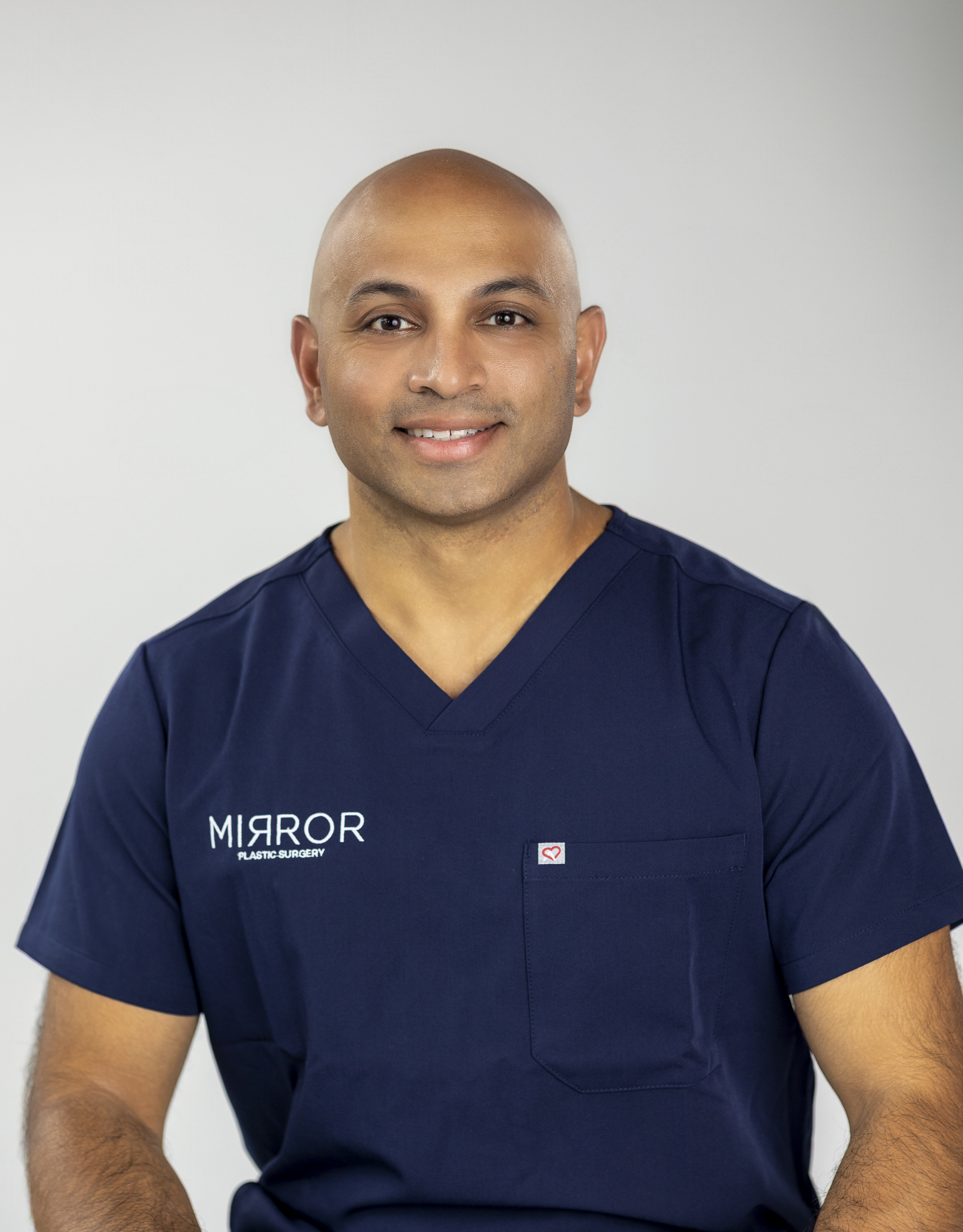
Mirror Plastic Surgery operates on a philosophy of safety first, function second, aesthetics third. The practice limits itself to one to two surgeries per day, in contrast to high-volume clinics that may perform many more, so the surgeon can focus fully on each patient before, during, and after the procedure. Consultations are in-depth and include a comprehensive anatomical assessment, which supports honest candidacy evaluation, conservative hairline planning, and thoughtful donor management.
Mirror Plastic Surgery is located in St. Petersburg and serves the entire Tampa Bay area. To schedule your consultation, call or text 727-361-6515, visit the practice at 780 4th Ave S, St. Petersburg, FL 33701, or book online.
Start With An Honest Candidacy Assessment
Frequently Asked Questions
How Much Does A Hair Transplant Cost In Tampa?
Hair transplant cost depends on graft count, technique, the degree of surgeon involvement at each stage, and the number of sessions required. Graft count itself reflects the size of the balding area, donor density, and target coverage. Every patient at Mirror Plastic Surgery receives a personalized quote following an in-person evaluation, and any quote issued before a scalp examination functions as marketing rather than medical planning.
How Many Grafts Do I Need?
Graft count is determined by your Norwood stage, the size of the treatment area, your donor density, and your target density. Early recession usually requires fewer grafts than moderate frontal thinning or crown loss, and advanced loss may need a staged approach across more than one session. A responsible surgeon also reserves donor supply for future hair loss instead of harvesting the maximum possible in a single procedure.
Is A Hair Transplant Permanent?1
Transplanted follicles are harvested from the DHT-resistant donor zone and retain that resistance after relocation, so the transplanted hair itself is typically permanent.1 Native, non-transplanted hair continues to thin over time. Without ongoing medical management such as finasteride, minoxidil, or both, the area surrounding the transplanted zone can recede, creating contrast between the dense transplanted area and thinner adjacent scalp. Long-term planning and honest candidacy assessment at the outset give the best chance of a result that still looks natural at ten years.
Conclusion: Natural Results Start With One Core Question
All seven steps above point to a single decision: does your surgeon treat your hairline as a facial feature or as a graft count? When you answer that question clearly, the right choice of clinic, technique, and timing usually follows.
Mirror Plastic Surgery
780 4th Ave S, St. Petersburg, FL 33701
Phone / Text: 727-361-6515
Email: hello@mirrorplasticsurgery.com
Schedule Your Tampa Bay Hair Transplant Consultation
1 Results may vary from person to person. Editorial content, before and after images, and patient testimonials do not constitute a guarantee of specific results.