Written by: Dr. Akash Chandawarkar, Board Certified Plastic Surgeon, Mirror Plastic Surgery
Key Takeaways for Tampa VIP Plastic Surgery Patients
- Concierge plastic surgery in Tampa requires a surgeon who limits daily case volume, spends an hour in consultation, and personally oversees every phase of care, standards rarely met by practices dominating local search results.
- Miami-based practices that appear in Tampa searches introduce logistical risks including long travel distances and limited surgeon access if complications arise after surgery.
- Integrated post-operative support managed directly by the surgical practice outperforms outsourced nursing services by keeping communication seamless between recovery nurses and the operating surgeon.
- Dr. Akash’s elite training at Harvard-MIT, Johns Hopkins, MEETH, and Stanford, combined with recognition on Newsweek’s America’s Best Plastic Surgeons list, establishes a verifiable standard of care for Tampa patients.
- Patients seeking VIP concierge plastic surgery care in Tampa can schedule a consultation with Dr. Akash at Mirror Plastic Surgery to experience integrated, safety-first care.
Why Tampa-Based Surgical Care Matters When Miami Practices Dominate Search
Miami practices frequently appear at the top of Florida plastic surgery searches because of their marketing scale, not because they serve Tampa Bay patients better. Travel to Miami for surgery introduces logistical complexity, including long post-operative driving distances, unfamiliar recovery environments, and limited access to the operating surgeon if a complication arises after discharge.
Tampa Bay patients benefit from a surgeon who holds hospital privileges locally. Hospital privileges require formal credentialing review of training history, licensure, and professional standing, and they provide a practical safety net. If a rare complication occurs, the surgeon can intervene at a credentialed facility rather than directing a patient to an unfamiliar emergency room hours away. For high-net-worth professionals managing demanding schedules, proximity and continuity of care function as safety variables, not conveniences.
Schedule your consultation with Dr. Akash to see how an integrated Tampa-based concierge model addresses your anatomy, goals, and recovery logistics.
Tampa Recovery Logistics: Integrated Post-Operative Support vs Outsourced Nursing
Proximity to your surgeon matters most when complications arise. Post-operative recovery is where the gap between true concierge care and high-volume practices becomes most visible. The first 24 to 72 hours after cosmetic surgery carry the highest risk of nausea, bleeding, clots, and complications, so clinical judgment during that window directly affects outcomes.1
Third-party concierge nursing services, common in Phoenix and Scottsdale and increasingly marketed to Tampa patients, provide skilled RN care but operate independently of the surgical practice. Continuity with the same nurse, direct access between visits, and structured coordination with the operating surgeon distinguish high-quality post-operative support from rotating-staff recovery houses. When the recovery nurse and the surgeon do not work in an integrated system, communication gaps can delay recognition of early warning signs.
Post-operative complications can occur in surgical patients, and many are detectable early with proper monitoring. At Mirror Plastic Surgery, post-operative follow-up is managed directly by Dr. Akash’s team, not outsourced to a separate agency, so any clinical change is communicated to the surgeon who performed the procedure.
Tampa’s subtropical climate adds a specific recovery variable. Heat and humidity accelerate swelling and increase infection risk at incision sites during the summer months. Patients recovering from body contouring, breast surgery, or facial procedures in July and August require compression garment guidance and wound monitoring calibrated to these conditions, not generic protocols designed for cooler, drier climates.
5 Questions to Ask Any Tampa Concierge Plastic Surgery Practice
Direct questions reveal whether a practice operates as a true concierge model or simply uses the term as a marketing label. Use these five questions to compare options across Tampa Bay.
- How many surgeries does the surgeon perform each day? High-volume practices often perform five to ten surgeries daily. A genuine concierge model limits cases to one or two per day, so the entire team can focus on each patient before, during, and after the procedure.
- Is the surgeon board-certified by the American Board of Plastic Surgery (ABPS)? The ABPS is the sole board recognized by the American Board of Medical Specialties for the specialty of plastic surgery, and boards with similar-sounding names do not carry equivalent verified training standards.
- Where did the surgeon complete residency and fellowship training? ABPS certification requires at least five years of surgical training, including a minimum of two years devoted exclusively to plastic surgery. Fellowship training in aesthetic surgery at a competitive program adds a further layer of specialization beyond residency minimums.
- Who manages post-operative recovery, and how is communication handled between the recovery team and the surgeon? Outsourced nursing services and recovery houses with rotating staff introduce coordination gaps. Ask whether the surgeon’s office is directly reachable after hours and whether recovery protocols are procedure-specific.
- Does the practice use ultrasound guidance for applicable procedures? Florida passed HB 1471 in 2023 requiring ultrasound guidance during gluteal fat grafting procedures. This law establishes a baseline safety standard for one high-risk procedure. Practices that exceed this minimum, using advanced diagnostic imaging across their full procedure menu rather than only where required, demonstrate a safety culture that goes beyond regulatory compliance.
Inside Dr. Akash’s Training, Innovation Work, and Newsweek Recognition
Dr. Akash’s credentials reflect a training pathway that remains uncommon even among board-certified plastic surgeons. His undergraduate work at MIT in neuroscience and nuclear engineering preceded acceptance into the highly selective Harvard-MIT Division of Health Sciences and Technology, a joint program that integrates rigorous scientific research with clinical medicine. He graduated from Harvard Medical School with Honors.
His surgical training included a seven-year integrated plastic and reconstructive surgery residency at Johns Hopkins University. That program involved complex cancer and trauma reconstruction at the Johns Hopkins Hospital, advanced trauma care at the R Adams Cowley Shock Trauma Center, and microsurgical training at the Curtis National Hand Center. After residency, Dr. Akash completed an aesthetic surgery fellowship at the Manhattan Eye, Ear and Throat Hospital (MEETH), one of the most competitive aesthetic fellowship programs in the United States. He also completed the Stanford University Biodesign Innovation Fellowship, which trained him to identify unmet clinical needs and develop technological solutions.
Dr. Akash has been named to Newsweek’s America’s Best Plastic Surgeons list for two consecutive years, including 2025. He serves on the Next Generation Editorial Board of the Aesthetic Surgery Journal, has testified before the FDA on breast implant safety, and serves on advisory boards for companies developing technologies including Motiva, Tiger Aesthetics, Cypris Medical, and Merz Aesthetics.
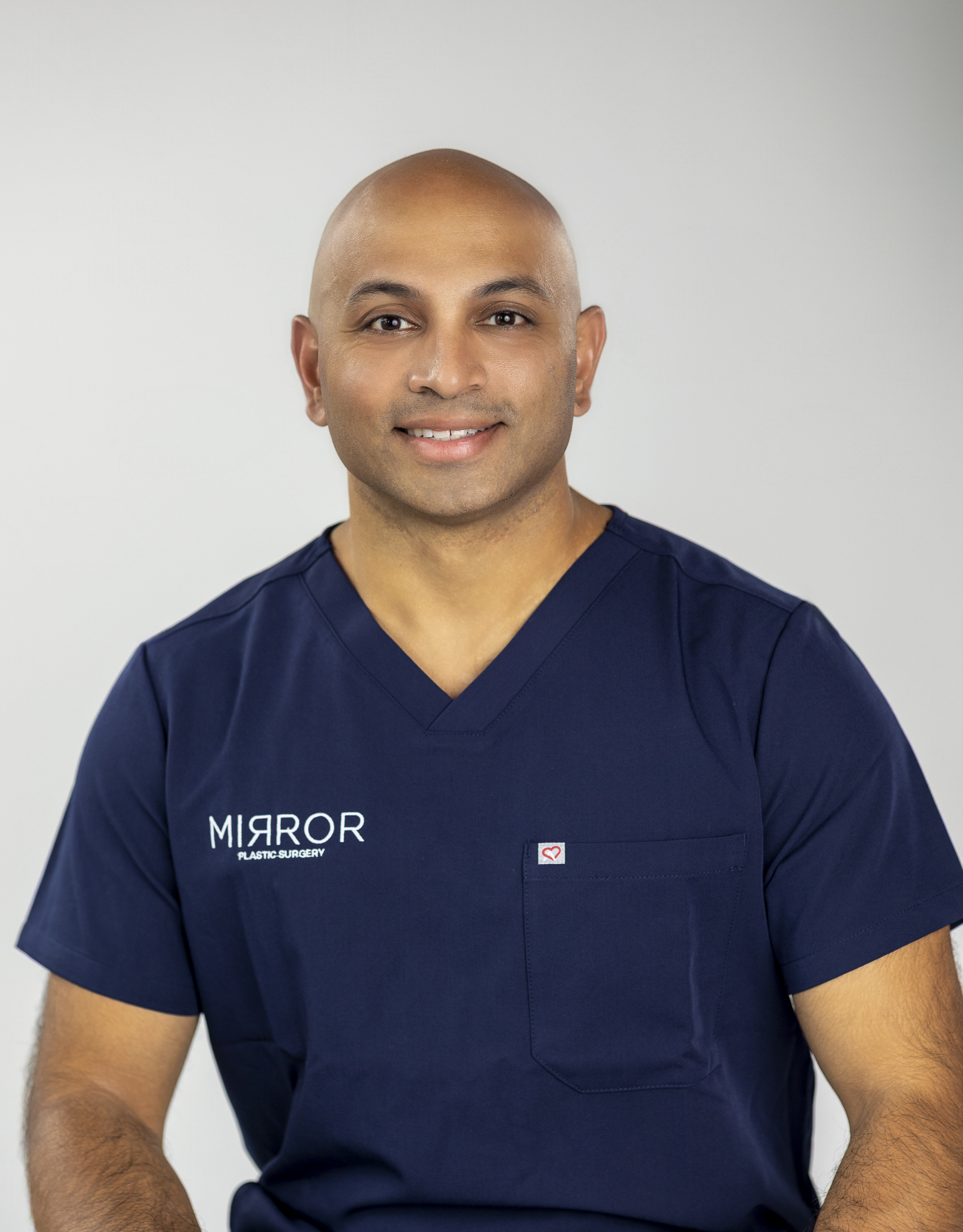
Request a consultation with Dr. Akash to experience how this training background shapes surgical planning and outcomes.
The Safety-Function-Aesthetics Framework Behind Mirror Plastic Surgery
Mirror Plastic Surgery operates on an explicit three-tier hierarchy: safety first, function second, aesthetics third. This sequence functions as a clinical decision-making structure that shapes every consultation, procedure plan, and recovery protocol.
Safety includes rigorous pre-operative evaluations, accredited surgical facilities, board-certified physician anesthesiologists, and in-office ultrasound for precise pre-operative assessment. It also includes advising against combining too many procedures at once, because evidence shows that stacking procedures can sharply increase complication rates. ABPS board certification provides hospital access if a rare complication requires escalation beyond the outpatient setting.
Function recognizes that a functional body often appears more attractive. Tummy tucks at Mirror Plastic Surgery restore the entire abdominal musculature from chest to pubic area, not just the lower abdomen, because partial repairs produce inferior long-term results. Breast procedures address animation deformities and implant positioning to restore natural movement. Rhinoplasty improves airflow alongside cosmetic appearance.
Aesthetics follow from the restoration of underlying structures. Natural, athletic, and timeless results emerge when anatomy is respected rather than overridden. This framework directly addresses the fear of “overdone” results that sophisticated patients consistently cite as a primary concern.
What VIP Concierge Plastic Surgery Looks Like in Tampa
The concierge medicine model maintains a smaller patient roster, allowing physicians to spend more time during each patient interaction and to provide a comprehensive treatment plan. At Mirror Plastic Surgery, this translates to consultations of up to one hour, a top-to-bottom anatomical assessment, and a treatment plan built around the patient’s unique anatomy and long-term goals rather than a standardized menu.
The primary operational effects of smaller patient panels include longer appointments, pre-visit planning, more accessible communication, proactive care coordination, and continual follow-up. Mirror Plastic Surgery limits surgical volume to one to two procedures per day, compared to five to ten at many high-volume practices, so the surgeon’s full attention and the team’s full resources remain allocated to each patient across every phase of care.
The practice is supplier-neutral, so product and technique recommendations are driven by evidence and patient anatomy, not vendor quotas or upselling incentives. This transparency functions as a structural feature of the concierge model, not an optional add-on.
Day-3 Recovery Challenges in Tampa’s Heat and Humidity
Day three after surgery often feels like the most uncomfortable point in recovery across many plastic surgery procedures. Surgical anesthesia has fully cleared, initial pain management is transitioning, and inflammatory swelling typically peaks. In Tampa’s climate, where summer temperatures regularly exceed 90°F with high humidity, these physiological challenges are compounded by environmental factors.
Heat increases vasodilation, which can intensify swelling and place additional stress on incision sites. Humidity affects compression garment performance and increases the risk of skin maceration under dressings. Patients recovering from body contouring procedures, mommy makeovers, or breast surgeries during Tampa’s summer months require monitoring protocols that address these conditions explicitly.
Many patients use concierge post-op nursing for the first three to seven days after surgery, with the most intensive support concentrated in this critical early window. When recovery oversight is integrated with the surgical practice rather than outsourced, the surgeon’s specific post-operative orders, including climate-adjusted wound care and compression guidance, are followed consistently rather than interpreted by a third party unfamiliar with the case.
How to Judge Surgical Volume and Post-Operative Protocols in Tampa
Surgical volume offers a measurable proxy for the attention each patient receives. A study published in Annals of Surgery found that the first operation of the day may be associated with higher rates of composite adverse events compared to subsequent cases. The authors suggested that surgeon preparation and team calibration within a given day affect outcomes. The study also found lower adjusted relative risks for major complications, reoperation, and extended ICU stays when surgeons had already accumulated operative time before a given procedure.
Separately, a JAMA Surgery study found that anesthesiologists directing multiple overlapping surgeries had higher complication rates compared to those directing fewer overlapping surgeries. High-volume practices that run multiple simultaneous operating rooms introduce this overlap risk structurally.
When evaluating any Tampa practice, ask for the surgeon’s average daily case count, whether the same anesthesiologist remains present throughout each procedure, and what the post-operative follow-up schedule looks like for the first 72 hours. Practices that cannot answer these questions specifically are unlikely to meet the standards of a true concierge model.
Conclusion: Using Clear Standards to Choose a Tampa Concierge Practice
VIP concierge plastic surgery care in Tampa is defined by measurable standards such as one to two surgeries per day, ABPS board certification, elite residency and fellowship training, integrated post-operative support, and a safety-function-aesthetics hierarchy applied consistently across every case. These qualities function as verifiable criteria that any practice claiming the concierge designation should be able to document.
Mirror Plastic Surgery meets each of these criteria under the direction of Dr. Akash, whose credentials, detailed earlier, establish a standard of care that high-net-worth Tampa Bay professionals can evaluate objectively. The practice’s volume limit, supplier-neutral philosophy, and direct post-operative oversight operate as structural commitments, not marketing language.
Receive a thorough, evidence-based consultation with Dr. Akash at Mirror Plastic Surgery’s St. Petersburg location and experience genuine concierge plastic surgery care in Tampa.
Frequently Asked Questions
What distinguishes a true concierge plastic surgery practice from a high-volume clinic in Tampa?
A true concierge plastic surgery practice limits daily surgical volume to one or two procedures per day so the surgeon and the entire clinical team can dedicate full attention to each patient before, during, and after surgery. High-volume clinics performing five to ten surgeries daily cannot provide the same level of pre-operative planning, intraoperative focus, or post-operative follow-up. Additional distinguishing features include hour-long consultations, procedure-specific recovery protocols managed directly by the surgical practice rather than outsourced to third-party nursing agencies, ABPS board certification, and a documented safety-first philosophy. At Mirror Plastic Surgery, these features define how the practice operates, not optional upgrades.
Why does Dr. Akash’s training matter for patient safety and outcomes?
Dr. Akash’s training pathway ranks among the most rigorous available in plastic surgery. His medical degree from Harvard Medical School through the Harvard-MIT Health Sciences and Technology program trained him as a physician-scientist. His seven-year integrated plastic and reconstructive surgery residency at Johns Hopkins included complex cancer reconstruction, trauma reconstruction, and microsurgical training. His aesthetic surgery fellowship at MEETH provided advanced specialization in facial rejuvenation, breast surgery, and body contouring. His Stanford Biodesign Innovation Fellowship adds a dimension of technological judgment that informs his evaluation of new techniques and devices. This combination means that his clinical decisions rest on deep anatomical knowledge, evidence-based research, and direct experience with complex reconstructive cases, which reduces risk and improves outcomes for elective aesthetic patients.1
What should Tampa patients know about post-operative recovery after plastic surgery?
The first 24 to 72 hours after surgery represent the highest-risk window for complications including bleeding, hematoma, infection, and blood clots. Patients benefit most from clinical monitoring during this period by someone who has direct communication with the operating surgeon and follows procedure-specific protocols rather than generic post-operative instructions. Tampa’s subtropical climate introduces additional recovery variables, because heat and humidity can intensify swelling, affect compression garment performance, and increase incision site risk during summer months. Mirror Plastic Surgery manages post-operative follow-up directly, ensuring that any clinical change is communicated to Dr. Akash’s team rather than filtered through a third-party service. Patients also receive counseling on realistic recovery timelines, activity restrictions, and climate-specific wound care as part of the practice’s comprehensive concierge approach.
How does Mirror Plastic Surgery’s safety-function-aesthetics hierarchy affect surgical planning?
The hierarchy means that every procedure recommendation begins with a safety assessment. The team evaluates candidacy, the appropriateness of combining procedures, facility accreditation, and the involvement of board-certified physician anesthesiologists. Function comes next, focusing on whether the procedure restores or improves anatomical integrity, such as abdominal muscle repair in a tummy tuck or airflow improvement in rhinoplasty. Aesthetics are addressed last as the natural outcome of restoring underlying structures correctly. In practice, this approach means Dr. Akash may recommend a different combination of procedures than a patient initially requests if the original plan introduces unnecessary risk or would produce a functionally suboptimal result. This honest, anatomy-driven strategy responds directly to the “overdone” results and revision surgeries that often follow from practices that prioritize aesthetic volume over structural integrity.
Is Mirror Plastic Surgery the right choice for combined procedures such as a mommy makeover?
Mirror Plastic Surgery performs combined procedures including mommy makeovers, which typically involve breast and abdominal or body procedures together, but the planning process remains more rigorous than at many high-volume practices. Dr. Akash evaluates each patient’s anatomy, health status, and goals to determine which combination of procedures can be performed safely in a single operative session. Evidence shows that combining too many procedures simultaneously can sharply increase complication rates, so the practice advises against stacking procedures beyond what the patient’s physiology can safely support.1
1 Results may vary from person to person. Editorial content, before and after images, and patient testimonials do not constitute a guarantee of specific results.