

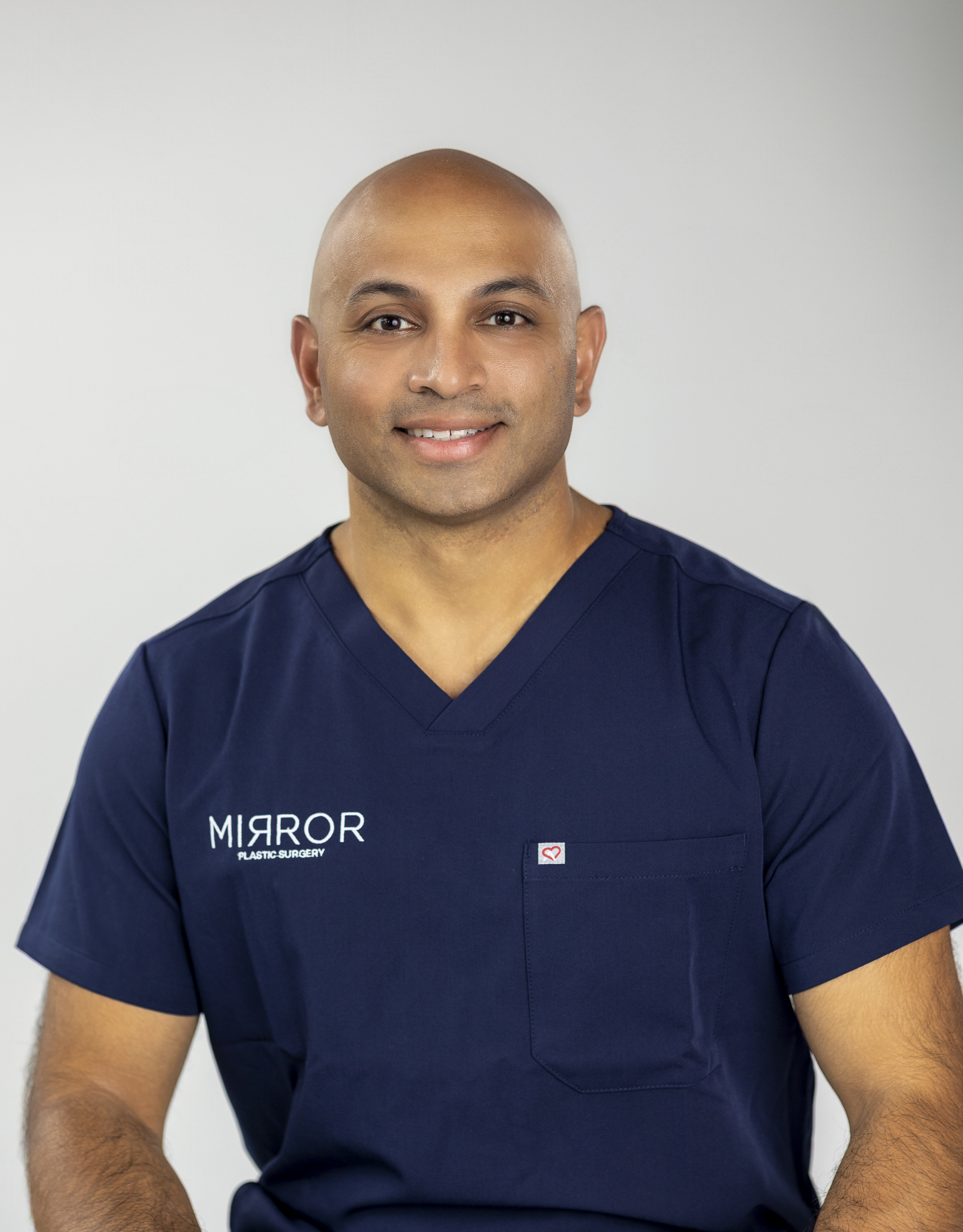
Written by: Dr. Akash Chandawarkar, Board Certified Plastic Surgeon, Mirror Plastic Surgery
Key Takeaways
- Blepharoplasty outcomes in Tampa depend on technique, anatomy, surgeon training, and recovery habits, with a six-stage timeline shaped by local heat, humidity, and UV exposure.
- Upper and lower eyelid procedures create a refreshed, not transformed, appearance.1 Realistic expectations and conservative tissue handling help avoid dissatisfaction or revision.
- Age alone does not disqualify patients in their seventies. Candidacy depends on overall health, eye surface condition, and lower-lid support structures.
- Functional benefits such as expanded upper visual field, reduced brow strain, and headache relief often accompany cosmetic improvement when overhanging skin blocks vision.1
- Choosing a fellowship-trained oculoplastic or facial aesthetic surgeon and using anatomy-first planning significantly lowers revision risk. Schedule your personalized assessment at Mirror Plastic Surgery to discuss your specific goals.
Six-Stage Recovery Timeline After Blepharoplasty
Tampa’s subtropical climate, with sustained heat, high humidity, and intense UV exposure, affects swelling and incision healing. The table below outlines each recovery stage, key milestones, and local considerations.
| Stage | Timeframe | Primary Milestones | Tampa-Specific Considerations |
|---|---|---|---|
| 1 — Acute | Days 1–3 | Peak swelling and bruising, cold compresses, strict head elevation | Avoid outdoor heat, and rest in air conditioning to reduce inflammation |
| 2 — Early Healing | Days 4–7 | Suture removal if non-absorbable, bruising begins to yellow, light indoor activity | Humidity can soften wound edges, so keep incisions dry and avoid sweating |
| 3 — Functional Recovery | Weeks 2–3 | Most bruising resolved, return to desk work and driving, reading and screen use tolerated | Wear polarized sunglasses outdoors, since UV exposure can darken incision lines |
| 4 — Social Presentability | Weeks 3–6 | Residual swelling becomes subtle in social and professional settings, light exercise allowed | Schedule outdoor exercise for early morning or evening to avoid peak heat and sun |
| 5 — Scar Maturation | Months 2–3 | Incision lines fade from pink toward skin tone, full makeup use typically cleared | Apply SPF 50+ daily, because Florida sun can darken scars without protection |
| 6 — Final Result | Months 4–6 | Swelling fully resolved, final contour and eyelid position visible, long-term outcome established | Schedule yearly skin-cancer screening due to cumulative Tampa UV exposure |
Realistic Outcomes for Eyelid Surgery in Tampa
Understanding the recovery timeline sets expectations for healing, and the next step is knowing what that healing works toward. Upper blepharoplasty removes excess skin and, when needed, a conservative strip of orbicularis muscle and herniated orbital fat, which produces a cleaner upper eyelid platform, reduced hooding, and a more open, rested look.1 Lower blepharoplasty treats under-eye bags, hollowing, and skin laxity through fat repositioning or removal, sometimes combined with skin excision, to smooth the lid-cheek junction.1
The lower eyelid has less structural redundancy than the upper lid, so lower-lid procedures involve a longer swelling timeline and a narrower margin for error. This structural difference explains why conservative planning matters so much. Patients should expect a refreshed, not dramatically altered, appearance, because the goal is anatomical restoration rather than transformation.1
Regret Rates and Avoidance Strategies
Dissatisfaction after blepharoplasty most often comes from four sources: unrealistic expectations, asymmetry, over-resection of tissue that causes lagophthalmos (incomplete eyelid closure), and under-resection that leaves residual hooding. Preventing these problems requires attention to both technical details and patient education. On the technical side, surgeons rely on thorough preoperative photography, standardized functional assessment, and conservative tissue removal guided by anatomical landmarks instead of arbitrary amounts.
On the educational side, patients who receive clear explanations of what surgery can and cannot correct, including the persistence of fine surface wrinkles and ongoing aging of nearby facial tissue, report higher satisfaction because their expectations match achievable results. Both the technical and educational pieces depend on surgeon expertise, so selecting a surgeon with dedicated fellowship training in oculoplastic or aesthetic facial surgery, rather than a generalist who performs occasional eyelid cases, remains the most consistent predictor of avoiding revision surgery.
Is 70 Too Old for Eyelid Surgery?
Age alone is not a contraindication for blepharoplasty. Candidacy for patients in their seventies and beyond depends on systemic health, ocular surface health, dry-eye severity, and the strength of the lower eyelid support structures, including the canthal tendons and tarsal plate. Older patients often have more significant dermatochalasis, or excess upper eyelid skin, so they frequently gain substantial benefit from functional upper blepharoplasty.
Key preoperative evaluations include a complete ophthalmologic exam, Schirmer’s tear test for dry-eye baseline, and assessment of eyelid laxity. When these measures fall within acceptable ranges and systemic conditions are well-controlled, outcomes in older adults match the safety and satisfaction seen in younger patients.1 The risk profile shifts slightly with age, since healing slows and anesthesia planning requires closer coordination, yet surgeons can manage these factors within a safety-first framework.
Why Some Patients Appear Older After Blepharoplasty
Age itself does not disqualify patients, but poor planning can make patients of any age look older after surgery. Post-surgical aging appearance usually reflects anatomical changes that surgery did not address or accidentally worsened. The orbital septum, a fibrous membrane that separates the eyelid from orbital fat, weakens with age and allows fat to push forward.
Aggressive fat removal without repositioning can hollow the under-eye area and create a skeletonized look that reads as older. The levator aponeurosis, the tendon that lifts the upper eyelid, can stretch or detach with age, and if surgeons do not repair it during blepharoplasty, residual drooping persists and the eyelid still appears heavy. Midface descent, or the downward shift of cheek fat pads, can also create a step-off between the lower eyelid and cheek that eyelid-only surgery cannot fix. Modern anatomical approaches address these structures together instead of treating eyelid skin in isolation.
Functional Vision Benefits Beyond Aesthetics
A 2011 report by the American Academy of Ophthalmology (Cahill et al.) outlines functional indications for upper eyelid ptosis and blepharoplasty surgery, with thresholds for meaningful improvement based on visual field and margin reflex distance measurements. Documented functional benefits include measurable expansion of the superior visual field, reduced brow strain from constant frontalis muscle overuse, and relief of headaches linked to chronic brow elevation.1
The American Society of Plastic Surgeons evidence-based guideline on eyelid surgery for upper visual field improvement (Kim et al., 2022) provides society-backed criteria for safe patient selection and planning for blepharoplasty and ptosis repair. When overhanging skin blocks the upper visual field, upper blepharoplasty can restore peripheral vision that affects driving safety, reading comfort, and work performance, so the benefits extend well beyond cosmetic change.1
Current Best-Practice Standards in Aesthetic Eyelid Surgery
Modern eyelid surgery favors tissue preservation and anatomical repositioning instead of maximal removal. Fat transposition, which moves prolapsed orbital fat to fill the tear-trough depression, has replaced simple fat excision as the standard approach for many lower blepharoplasty candidates. For upper lids, surgeons focus on precise skin measurement with the eye open and closed, careful preservation of orbicularis muscle, and concurrent ptosis repair when they identify levator aponeurosis disinsertion.
Objective functional assessment, including superior visual field testing and margin reflex distance measurement, now forms a routine part of preoperative planning. It no longer serves as an optional extra. The idea that more aggressive removal produces better results conflicts with the pattern seen in revision cases, which mostly involve over-resection rather than under-resection.
Surgeon Selection Framework
Objective criteria for evaluating a blepharoplasty surgeon in Tampa include board certification by the American Board of Plastic Surgery or the American Board of Ophthalmology, the fellowship training mentioned earlier as the key revision-avoidance factor, a case-volume philosophy that favors focused attention over throughput, active hospital privileges that provide a safety net for rare complications, and a clear protocol for managing issues such as lagophthalmos, ectropion, and dry-eye flares.
Dr. Akash at Mirror Plastic Surgery meets each of these benchmarks. His medical training began at MIT in neuroscience and nuclear engineering, followed by a Harvard Medical School degree through the Harvard-MIT Health Sciences and Technology program. He completed a seven-year integrated plastic and reconstructive surgery residency at Johns Hopkins University, then a dedicated aesthetic surgery fellowship at the Manhattan Eye, Ear and Throat Hospital, where he received advanced training in blepharoplasty, ptosis repair, and periorbital rejuvenation from leading specialists. His credentials include the Newsweek recognition noted earlier, along with board certification and fellowship training that distinguish him from generalist practitioners. Mirror Plastic Surgery performs one to two surgeries per day, which allows the full team to focus on each patient before, during, and after surgery, in contrast to high-volume practices that perform many more procedures daily.
Frequently Asked Questions
Who is a good candidate for eyelid surgery?
Good candidates are adults in stable health who have excess upper eyelid skin that causes visual obstruction or cosmetic concern, lower eyelid fat prolapse that creates under-eye bags, or both. Dry-eye disease, uncontrolled thyroid conditions, and significant lower eyelid laxity require evaluation and sometimes treatment before surgery. As discussed in the age-candidacy section, a thorough preoperative assessment that includes ophthalmologic evaluation determines candidacy more accurately than any age cutoff.
How should I prepare for blepharoplasty?
Preparation includes stopping blood-thinning medications and supplements, such as aspirin, ibuprofen, fish oil, and vitamin E, for a period your surgeon specifies. Surgeons strongly recommend quitting smoking at least four weeks before surgery, because nicotine impairs healing and raises infection risk. Baseline photographs and, for functional cases, visual field testing are completed before surgery. You should also arrange for a responsible adult to drive you and assist for the first 48 hours, since vision may be temporarily blurred and depth perception affected.
How long does blepharoplasty last?
Upper blepharoplasty results usually last many years, and most patients do not need repeat surgery for ten to fifteen years, if at all.1 Lower blepharoplasty longevity depends on technique, and fat repositioning often produces more durable results than simple excision because it treats the structural cause of hollowing instead of removing volume that might later be missed.1 Ongoing facial aging, sun exposure, and skin-quality changes affect nearby tissue over time, so consistent sun protection and skin care help extend the visible benefit of surgery.
What are the risks of revision blepharoplasty?
Revision eyelid surgery is more demanding than primary surgery because scar tissue alters normal planes and reduces the margin for further excision. Common reasons for revision include over-resection of skin that causes lagophthalmos, persistent ptosis from unaddressed levator aponeurosis disinsertion, and lower eyelid ectropion from excessive skin removal or canthal laxity. Choosing a surgeon with fellowship-level training and a conservative, anatomy-first approach lowers the chance of needing revision.
How do I evaluate whether a plastic surgeon in Tampa is qualified for eyelid surgery?
Verify board certification through the American Board of Plastic Surgery or the American Board of Ophthalmology. Confirm that the surgeon completed a dedicated fellowship in aesthetic facial or oculoplastic surgery beyond residency, since residency alone offers limited exposure to complex eyelid cases. Ask about hospital privileges, which show that an independent body has reviewed their qualifications, and request details about their complication-management protocol. Review before-and-after photographs of eyelid cases specifically, not only general facial surgery portfolios, and consider whether the surgeon’s daily case volume allows enough time for detailed assessment and close follow-up.
Conclusion: Turning Consultation Into Confident Outcomes
Blepharoplasty outcomes in Tampa depend on anatomy-based technique selection, clear expectations, climate-aware recovery planning, and a surgeon whose training focuses on periorbital anatomy. Functional vision improvement, long-lasting aesthetic results, and low revision rates are realistic when surgeons plan conservatively and operate with a safety-first mindset.1 Age does not block candidacy when surgeons assess risk objectively. The difference between a satisfying outcome and a revision case usually traces back to the consultation, including how thoroughly anatomy is evaluated, how honestly expectations are discussed, and how carefully the plan is tailored.
1 Results may vary from person to person. Editorial content, before and after images, and patient testimonials do not constitute a guarantee of specific results.
