
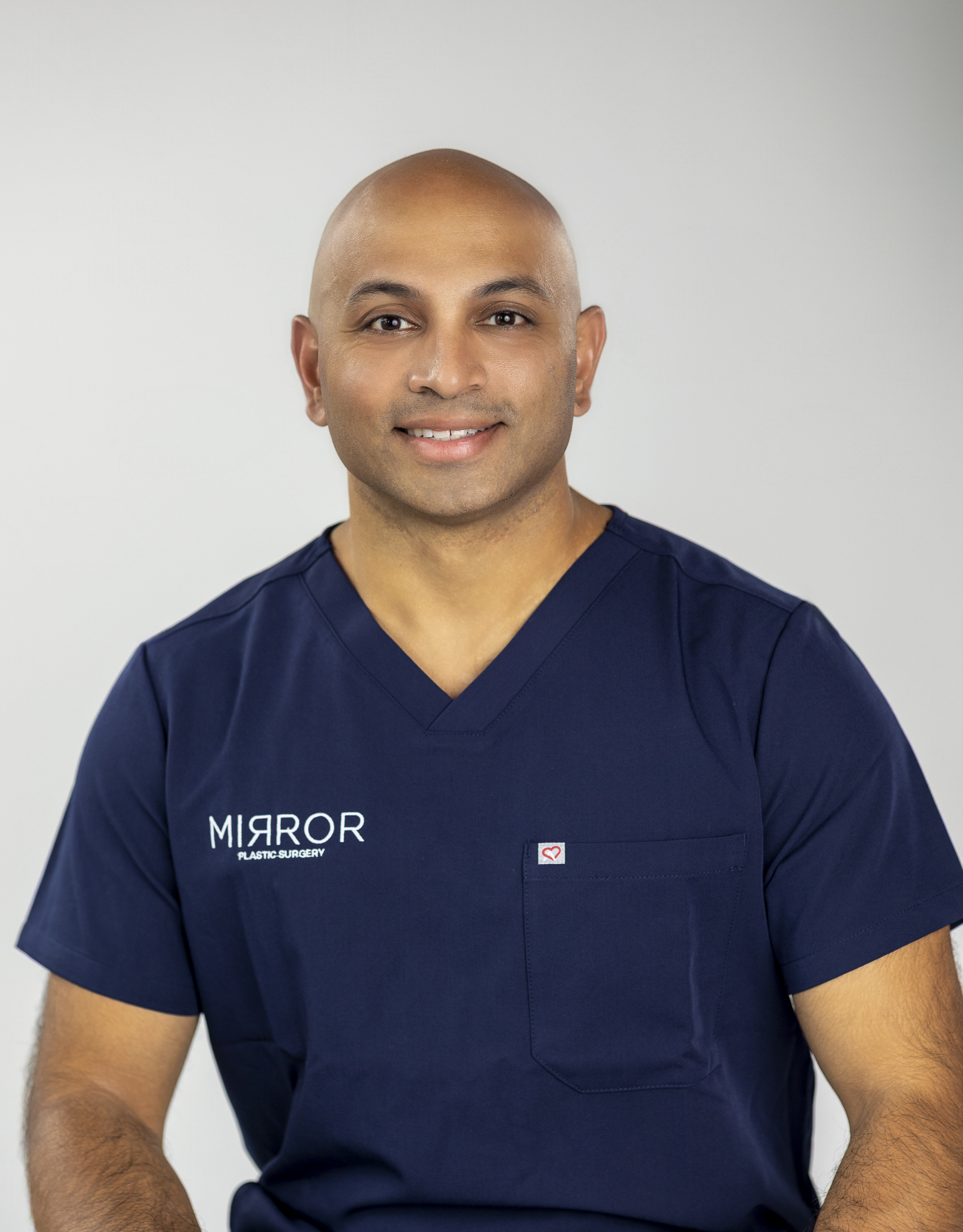
Written by: Dr. Akash Chandawarkar, Board Certified Plastic Surgeon, Mirror Plastic Surgery | Last updated: July 3, 2026
Key Takeaways for Hip Dip Safety and Results
- Autologous fat grafting performed by an ABPS-certified surgeon in an accredited Florida facility is the safest surgical option for hip dip correction and removes implant-related risks.
- Fat survival stabilizes by the six-month mark, which serves as the clinical benchmark for judging final volume and planning any touch-up procedures.1
- Surgeon credentials, facility accreditation, and limited surgical volume are critical safety factors that directly affect outcomes and day-of-surgery attention.
- Non-surgical options such as AlloClae fillers and targeted resistance training suit patients with mild depressions or limited donor fat who prefer to avoid surgery.
- Schedule your personalized consultation at Mirror Plastic Surgery to identify the safest and most effective hip dip correction plan for your anatomy.
Safest Procedure for Correcting Hip Dips in Florida
Autologous fat grafting is the primary surgical choice for hip dip correction among board-certified plastic surgeons. The surgeon harvests fat with liposuction from donor areas such as the abdomen or flanks, processes it, and injects it into the trochanteric depression to restore lateral hip curvature. Because the transferred material is the patient’s own tissue, the risk of foreign-body reaction drops to essentially zero.
Fat survival rates after grafting depend on technique, patient metabolism, and post-operative compression protocols. The clinical standard is to evaluate final volume retention at the six-month mark, after early resorption has stabilized.1 Surgeons usually overfill slightly during transfer to offset the expected resorption that occurs in the first several weeks.
Surgeon volume and focus function as measurable safety variables. At Mirror Plastic Surgery, Dr. Akash maintains a limited surgical schedule so the full clinical team can concentrate on each patient before, during, and after the procedure. This approach differs from high-volume practices that divide staff attention across many cases in a single day. Dr. Akash’s training spans the Harvard-MIT Division of Health Sciences and Technology, a seven-year integrated plastic and reconstructive surgery residency at Johns Hopkins University, an aesthetic surgery fellowship at the Manhattan Eye, Ear and Throat Hospital (MEETH), and a biodesign innovation fellowship at Stanford University. He is board certified by the American Board of Plastic Surgery and has been named to Newsweek’s America’s Best Plastic Surgeons list for two consecutive years, including 2025.
Schedule a personalized anatomical assessment with Dr. Akash to determine whether autologous fat grafting aligns with your goals.
Risk Profile of Hip Dip Surgery in Florida
All surgical procedures carry inherent risk, and hip dip correction is no exception. The key comparison involves the risk profile of autologous fat grafting versus implant-based hip augmentation and whether the facility and surgeon meet Florida’s regulatory standards.
| Factor | Autologous Fat Grafting | Hip Implants | Clinical Note |
|---|---|---|---|
| Foreign-body reaction risk | None (own tissue) | Present (silicone implant) | Implants carry capsular contracture and seroma risk not applicable to fat grafting |
| Infection pathway | Donor site + recipient site | Implant pocket | Implant pocket infections may require implant removal, while fat-graft infections are typically managed with antibiotics |
| Revision likelihood | Volume touch-up if resorption exceeds expectation | Implant exchange or removal | Implant revisions are more surgically complex than fat-graft touch-ups |
| Florida facility requirement | Accredited office-surgery facility required for procedures exceeding local anesthesia thresholds | Accredited facility required | Both procedures must comply with Florida Administrative Code Chapter 64B8-9 when performed in an office setting |
Florida Regulatory Checklist for Office-Based Hip Surgery
Start with facility credentials and confirm that the surgical center holds current accreditation from AAAHC, AAAASF, or The Joint Commission, as required under Florida Administrative Code 64B8-9.009. Next, verify that the operating surgeon holds an active Florida medical license through the Florida Health Care Provider Lookup. Anesthesia safety requires a board-certified physician anesthesiologist or CRNA who practices within Florida scope-of-practice rules. The facility should also maintain documented emergency transfer protocols to a licensed hospital for situations that need higher-level care. Finally, confirm that the surgeon holds ABPS board certification, which requires hospital-privilege maintenance and provides a crucial safety backstop if complications occur.
Mirror Plastic Surgery operates within an accredited surgical facility and employs board-certified physician anesthesiologists. Dr. Akash’s ABPS certification includes active hospital privileges, which adds a safety tier that many non-certified practices cannot offer.
Non-Surgical and Hybrid Alternatives to Hip Dip Surgery
Non-surgical options for hip dip correction include injectable fillers and biostimulatory agents. These treatments add volume to the trochanteric depression without incisions or general anesthesia. Most injectable fillers are not FDA-indicated for large-volume body contouring, results usually last 12 to 18 months depending on the product, and patients need repeat sessions to maintain the effect.1
AlloClae, an adipose-derived filler available at Mirror Plastic Surgery as an in-office minor procedure, offers a middle-ground option. It provides structural volume and supports fat integration without the full surgical recovery associated with traditional fat grafting. Dr. Akash evaluates each patient’s anatomy and volume deficit to decide whether an in-office AlloClae treatment, a surgical fat-grafting session, or a staged combination approach fits best.
Resistance training that targets the gluteus medius can improve the visual appearance of hip dips in patients with mild depressions and adequate soft tissue coverage. This strategy carries no surgical risk but delivers limited correction for patients with significant bony or soft-tissue deficits.
Longevity of Hip Dip Fat Grafting Results
Results from autologous fat grafting become long-term once the surviving fat cells establish a blood supply, which occurs within the first several weeks after surgery.1 The fat that survives this early phase behaves like native adipose tissue and responds to weight changes in the same way as surrounding fat. Patients who keep a stable body weight after surgery preserve their results most reliably.1
The six-month post-operative assessment mentioned earlier serves as the standard clinical benchmark for evaluating final volume retention.1 At that visit, the surgeon and patient can decide whether a touch-up session is appropriate to address asymmetry or additional resorption.
Implant-based hip augmentation does not involve resorption, but implants have a finite lifespan and may require exchange over a decade or more because of capsular contracture, implant migration, or changes in patient preference.
Common Reasons Patients Do Not Qualify for Hip Dip Surgery
The following clinical criteria function as standard contraindications that surgeons review during pre-operative assessment.
- Insufficient donor fat: Autologous fat grafting requires adequate harvestable fat volume. Patients with very low body fat may not have enough donor tissue for meaningful correction.
- Active infection or skin compromise: Any active infection at the donor or recipient site is an absolute contraindication until fully resolved.
- Uncontrolled systemic disease: Unmanaged diabetes, coagulopathies, or cardiovascular conditions raise anesthetic and surgical risk to unacceptable levels.
- Active smoking: Nicotine impairs microvascular circulation and significantly reduces fat-graft survival rates. Most surgeons require cessation for at least four to six weeks before surgery.
- Unrealistic expectations: Patients who expect complete elimination of the trochanteric depression instead of meaningful contour improvement need expectation recalibration before surgery.
- Recent significant weight fluctuation: Patients who recently lost or gained substantial weight are usually advised to reach a stable weight first to support graft survival and symmetry.
- Pregnancy or breastfeeding: Elective body contouring is contraindicated during pregnancy and throughout the breastfeeding period.
- Certain medications: Blood thinners, immunosuppressants, and some herbal supplements often require a supervised washout period before surgery.
Key Questions to Ask Your Hip Dip Surgeon
- Are you certified by the American Board of Plastic Surgery, and do you hold active hospital privileges?
- Is this procedure performed in a state-accredited facility with a board-certified physician anesthesiologist?
- How many hip dip correction procedures have you performed, and can you show anatomically comparable before-and-after results?
- How many surgeries do you perform per day, and who manages my care if you are operating on another patient?
- What is your revision policy if fat resorption exceeds the expected range at six months?
- Have you been independently recognized for clinical excellence, such as through Newsweek’s America’s Best Plastic Surgeons ranking?
Dr. Akash’s Newsweek recognition reflects independent peer validation of clinical outcomes. His limited surgical schedule, described earlier, ensures that each patient receives focused attention from the Mirror Plastic Surgery team throughout the surgical day.
Choosing a Safe Hip Dip Correction Pathway
The safest surgical pathway for hip dip correction in Florida combines autologous fat grafting, an ABPS-certified surgeon, and a state-accredited facility. Careful review of surgeon credentials, daily surgical volume, facility accreditation status, and realistic outcome expectations forms the foundation of an informed decision. Non-surgical alternatives suit patients who need mild correction or lack sufficient donor fat, and a detailed anatomical consultation provides the right starting point for any plan.
Frequently Asked Questions
Difference Between a Hip Dip Procedure and a BBL
A hip dip refers to the inward curvature along the lateral hip between the iliac crest and the greater trochanter of the femur, which represents a normal anatomical feature shaped by bone structure and soft-tissue distribution. A Brazilian Butt Lift (BBL) is a surgical procedure that transfers fat to the buttocks to increase projection and improve overall gluteal shape. A BBL can sometimes improve hip dip appearance by adding volume to the upper outer buttock, but it does not directly target the trochanteric depression. Hip dip correction via fat grafting focuses specifically on depositing volume into the lateral hip depression. Some patients benefit from a combined approach, which Dr. Akash evaluates individually during consultation.
How Mirror Plastic Surgery’s Hip Dip Approach Differs
Mirror Plastic Surgery maintains a limited surgical schedule that prioritizes safety and attention. This structure allows Dr. Akash and the full clinical team to focus on each patient’s pre-operative preparation, intraoperative execution, and post-operative monitoring without the divided attention common in high-volume practices. Every patient receives an up-to-one-hour initial consultation in which Dr. Akash performs a detailed anatomical assessment, reviews goals and expectations, and explains the evidence supporting the recommended plan. This concierge-style model functions as a structural safety feature rather than a marketing slogan.
Effect of Weight Changes on Hip Dip Fat Grafting Results
Fat cells transferred during autologous fat grafting behave like native adipose tissue once they establish a blood supply. Weight gain after surgery causes the grafted fat cells to enlarge proportionally, which can increase hip volume beyond the original correction.1 Weight loss reduces grafted volume and can soften the result.1 Patients who maintain a stable body weight after surgery preserve their outcomes most consistently. Dr. Akash reviews individualized weight-stability recommendations during consultation so patients can plan recovery and long-term maintenance.
Anesthesia Type and Recovery After Hip Dip Surgery
Surgical hip dip correction with fat grafting is typically performed under general anesthesia or deep sedation administered by a board-certified physician anesthesiologist. Recovery includes wearing compression garments over both donor and recipient sites for several weeks to limit swelling, support fat integration, and reduce bruising. Most patients return to sedentary work within one to two weeks, while strenuous activity usually remains restricted for four to six weeks. Patients minimize pressure on the lateral hips during early healing to protect the grafted fat while it develops a blood supply. Final results are assessed at the six-month visit, and individual timelines vary based on transfer volume, donor-site extent, and overall health.1
Non-Surgical Hip Dip Options at Mirror Plastic Surgery
Mirror Plastic Surgery offers AlloClae, an adipose-derived filler administered as an in-office minor procedure, as a non-surgical option for patients with mild to moderate hip dip depressions or those who are not surgical candidates. AlloClae provides structural volume and fat integration that differs from traditional hyaluronic acid fillers, which are not indicated for large-volume body contouring. Dr. Akash evaluates each patient’s anatomy, volume deficit, and goals to determine whether AlloClae, surgical fat grafting, or a staged combination approach is most appropriate. Patients who want to understand which option fits their anatomy can schedule a consultation for a tailored recommendation.
1 Results may vary from person to person. Editorial content, before and after images, and patient testimonials do not constitute a guarantee of specific results.