
Written by: Dr. Akash Chandawarkar, Board Certified Plastic Surgeon, Mirror Plastic Surgery
Key Takeaways for Tampa Rhinoplasty Patients
- ABPS or ABFPRS board certification, verified through ABMS-recognized channels, is the most reliable signal of training and exam standards.
- Documented rhinoplasty case volume and transparent personal revision rates, typically 5–15%, show real-world outcomes that generic board lists cannot.1
- Active hospital privileges and an accredited surgical facility act as independent safety checkpoints if complications occur.
- Florida-specific license verification via mqa.doh.state.fl.us plus national checks at certificationmatters.org and DocInfo.org gives Tampa-area patients a complete credential picture.
- The final verification step, an in-person consultation, lets you confirm credentials directly, review the surgeon’s portfolio, and assess communication style and facility standards.
Board Certifications That Count for Rhinoplasty
The American Board of Plastic Surgery (ABPS) is the only American Board of Medical Specialties (ABMS) recognized board certifying physicians specifically in plastic surgery. Its scope includes reconstructive and aesthetic procedures, including rhinoplasty. ABPS certification requires an accredited plastic surgery residency plus written and oral exams that include submission of a 9-month operative case log.
The ABFPRS requires an accredited residency in otolaryngology/head-and-neck surgery or plastic surgery, prior certification by the American Board of Otolaryngology or American Board of Plastic Surgery (or Canadian equivalent), documentation of at least 100 facial plastic surgery cases per year for two years, and passage of written and oral examinations. Both ABPS and ABFPRS provide legitimate pathways for rhinoplasty.
The verification steps for board certification follow a simple sequence. First, confirm ABPS certification at certificationmatters.org or abplasticsurgery.org, or confirm ABFPRS certification directly through the ABFPRS board registry. Then verify that the certifying board is an ABMS member board, because non-ABMS boards do not meet the same credentialing rigor and represent a major red flag.
Red flag: A surgeon who claims board certification by a non-ABMS board, deflects the question, or cannot confirm their certifying body warrants immediate scrutiny.
Takeaway: ABMS recognition provides the clearest external confirmation that a surgeon’s training and examination standards have been independently verified.
Book a consultation with Dr. Akash, ABPS board-certified and named to Newsweek’s America’s Best Plastic Surgeons list two years in a row, to discuss your rhinoplasty goals with a surgeon whose credentials are fully verifiable.
ENT vs. Plastic Surgeon: Training Backgrounds for Rhinoplasty
Facial plastic surgeons complete a five-year otolaryngology residency followed by a one-to-two-year fellowship in facial plastic and reconstructive surgery, while plastic surgeons complete a six-plus-year residency covering the full body, including face, breast, and body contouring. Neither pathway is automatically superior for rhinoplasty.
ENT training offers particular value in revision rhinoplasty because prior surgery often leaves scar tissue, missing cartilage, weakened support, and altered anatomy that require both cosmetic correction and functional reconstruction. Plastic surgeons contribute broad aesthetic principles from full-body training to facial work, which makes both ENT and plastic surgery backgrounds suitable for purely cosmetic rhinoplasty cases.
The decisive factors, regardless of specialty, include three elements.
- Completion of a dedicated rhinoplasty or facial plastic surgery fellowship
- The proportion of the surgeon’s current practice devoted to rhinoplasty
- Routine evaluation of nasal airway function, including septum, turbinates, and nasal valves, alongside cosmetic goals
Red flag: Rhinoplasty performed without full consideration of internal nasal structures can cause postoperative nasal obstruction, collapse, or weakened structural support. Any surgeon who does not discuss functional airway assessment during the consultation raises concern.
Takeaway: Fellowship training and documented rhinoplasty volume matter more than the base residency specialty when you select a rhinoplasty surgeon. Once you confirm specialty credentials, the next critical verification step is hospital privileges, which serve as an independent safety checkpoint beyond basic board certification.
How to Verify Hospital Privileges in Tampa
Hospital privileges show that a credentialing committee at an accredited hospital has reviewed the surgeon’s training, competency, and outcomes and approved them to operate there. Even when procedures occur in office suites, hospital privileges remain a meaningful external quality indicator.
If complications occur during rhinoplasty in a private clinic, a surgeon with active hospital privileges can directly admit the patient and continue managing their care. A surgeon without privileges cannot provide that same continuity.
Tampa-area patients can verify hospital privileges and facility accreditation with a short sequence of checks.
- Search the surgeon’s name on the Florida Health MQA license lookup portal to review real-time license status and any public disciplinary actions.
- Contact the credentialing office of a named Tampa-area hospital and ask whether the surgeon holds active rhinoplasty privileges.
- Confirm that the surgical facility carries accreditation from AAAASF, AAAHC, or that it is a licensed ambulatory surgical center.
- Use DocInfo.org, operated by the Federation of State Medical Boards, to check license status and public board actions across all 50 states.
Red flag: A surgeon who lacks hospital privileges and cannot provide a clear explanation, or who operates in an unaccredited facility with no emergency protocols or hospital affiliation, presents an unacceptable safety risk.
Takeaway: Active hospital privileges and an accredited surgical facility function as safety checkpoints that no credential list or marketing badge can replace.
Questions to Ask About Rhinoplasty Revision Rates
Peer-reviewed data show that revision surgery is required in 5% to 15% of primary rhinoplasty cases, with a widely cited figure of 9% to 10% across large surgical series. Some patients still report dissatisfaction even when the surgeon considers the anatomical correction successful.
A large claims-based study of 175,842 septorhinoplasty patients in JAMA Facial Plastic Surgery reported a primary revision rate of 3.1% and an 11% revision rate for secondary septorhinoplasty. These figures highlight why revision experience is a distinct and critical credential.
Patients can use targeted, evidence-based questions to clarify a surgeon’s experience.
- How many primary rhinoplasties do you perform annually, and how many revision rhinoplasties?
- What is your personal revision rate, and how do you track it?
- Can you show before-and-after photographs of patients with nasal anatomy similar to mine?
- If a revision were needed, would you perform it, and what would that process involve?
- Do you have documented outcomes data from your own case series?
Red flag: A surgeon who claims a 0% revision rate is either not performing enough surgery or is not tracking outcomes honestly. Any zero-revision claim should remove that surgeon from consideration.
Takeaway: A surgeon who discusses revision rates openly and cites their own case volume shows outcome accountability that high-volume mills often avoid.
Consultation Red Flags to Watch For
The consultation functions as a live credential check. Patients can spot warning signs across credential, facility, and communication categories.
Credential red flags:
- Inability to confirm ABPS or ABFPRS certification or deflecting the question
- Claims of certification by a non-ABMS board
- Unclear or missing information about residency or fellowship training locations
- Lack of hospital privileges without a clear explanation
Facility red flags:
- Surgery performed in an unaccredited facility
- The surgeon administering their own anesthesia, which prevents safe, continuous monitoring
- No clear emergency protocols or disclosed hospital affiliation
Communication red flags:
- Pressure to commit to surgery quickly
- Vague or dismissive answers about risks, complications, or revision scenarios
- Refusal or inability to provide a portfolio of before-and-after photos from their own patients
- Rushed consultation that ignores nasal anatomy or functional airway assessment
Takeaway: A surgeon who cannot answer credential, facility, and outcome questions directly during the consultation is unlikely to provide the transparency needed for safe decision-making.
Book a consultation with Dr. Akash and experience a structured, hour-long evaluation that addresses anatomy, function, and aesthetic goals, with every credential question answered clearly.
Tampa-Specific Tools for Credential Verification
Florida patients can use several authoritative tools that many national guides overlook. Florida physicians can be verified directly through the Florida Health MQA license lookup portal, which provides real-time license status and any public disciplinary actions.
A complete Tampa-focused verification sequence includes several steps.
- Florida Board of Medicine license lookup: Visit mqa.doh.state.fl.us and search the surgeon’s full name to confirm active licensure, license type, and any disciplinary history in Florida.
- ABMS Certification Matters: Confirm specialty certification at certificationmatters.org, which covers more than 997,000 physicians across 24 member boards.
- DocInfo.org national check: Run a DocInfo.org search to aggregate license status and public board actions from all 50 states, including any out-of-state disciplinary history.
- Hospital privilege confirmation: Contact the credentialing office of a named Tampa-area hospital to confirm active rhinoplasty privileges.
- The Rhinoplasty Society membership: Verify membership at The Rhinoplasty Society, whose criteria include demonstrated rhinoplasty expertise and peer recognition.
- Facility accreditation: Confirm that the surgical facility is accredited by AAAASF, AAAHC, or licensed as an ambulatory surgical center.
Takeaway: Florida-specific license lookup, combined with national ABMS verification and direct hospital privilege confirmation, creates a verification standard that marketing claims cannot match.
Reader Checklist: Tampa Rhinoplasty Surgeon Verification
Use this checklist before committing to any rhinoplasty surgeon in the Tampa area.
- Confirmed ABPS or ABFPRS certification via certificationmatters.org
- Verified active Florida medical license at mqa.doh.state.fl.us with no disciplinary actions
- Completed national license and disciplinary check at DocInfo.org
- Confirmed active hospital rhinoplasty privileges directly with a Tampa-area hospital credentialing office
- Verified surgical facility accreditation (AAAASF, AAAHC, or licensed ASC)
- Confirmed fellowship training in rhinoplasty or facial plastic surgery beyond residency
- Requested annual rhinoplasty case volume and personal revision rate
- Reviewed before-and-after photos of the surgeon’s own rhinoplasty patients
- Confirmed that a board-certified physician anesthesiologist, not the surgeon, administers anesthesia
- Checked The Rhinoplasty Society for membership status
- Received direct, unhurried answers to all credential and outcome questions during consultation
Conclusion: The Four Credential Pillars
Rhinoplasty credential verification reduces to four non-negotiable pillars.
- ABMS-recognized board certification
- Documented rhinoplasty case volume with transparent revision data
- Active hospital privileges
- An accredited surgical facility
Each pillar addresses a distinct failure mode: fraudulent credentials, low-volume inexperience, unmanaged complications, and unsafe operating environments that generic board-cert lists often miss.
Dr. Akash at Mirror Plastic Surgery satisfies every item on the checklist above. His training includes the Harvard-MIT Health Sciences and Technology program, a seven-year integrated plastic and reconstructive surgery residency at Johns Hopkins University, and an aesthetic surgery fellowship at the Manhattan Eye, Ear and Throat Hospital (MEETH), one of the most competitive facial surgery training programs in the United States.
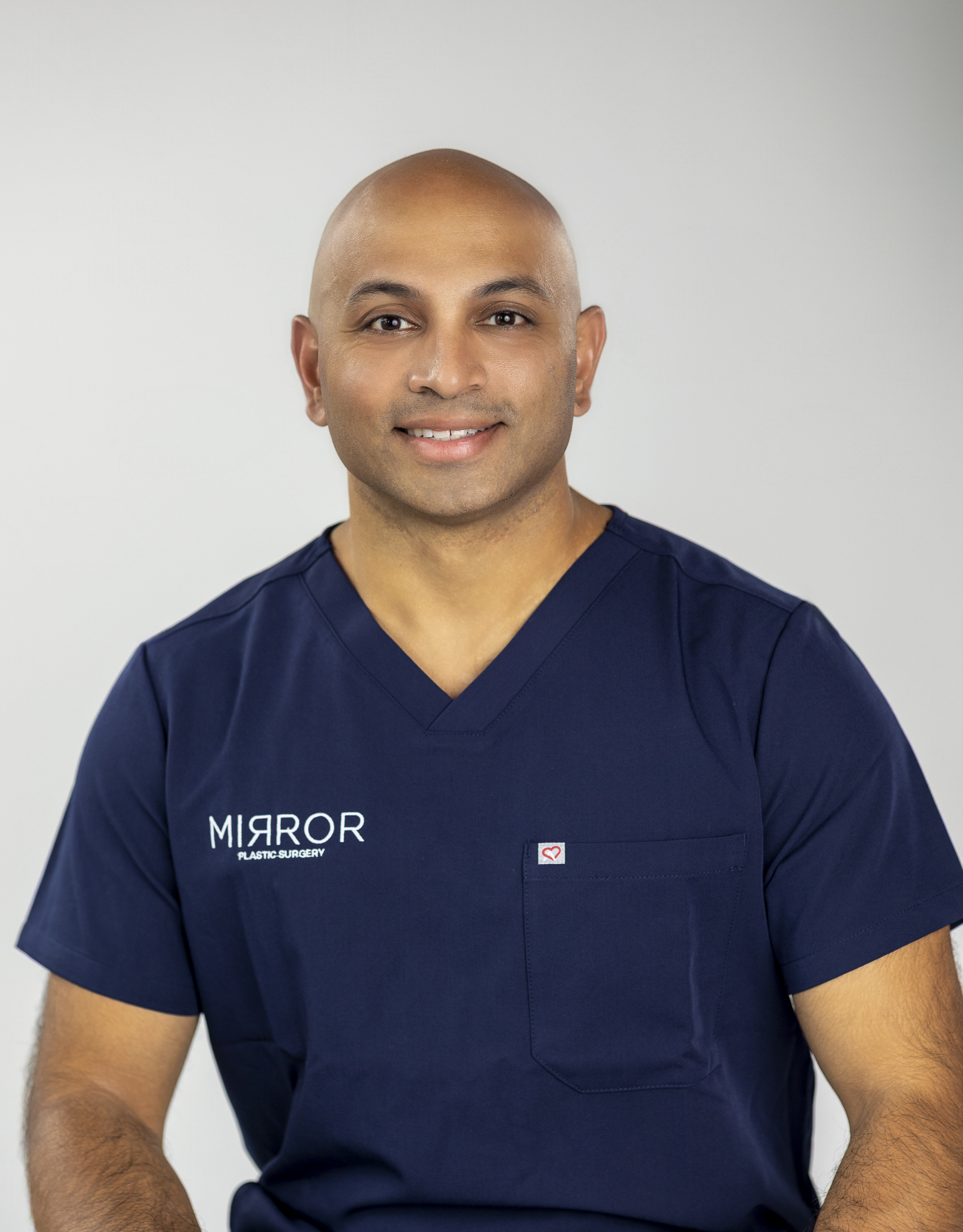
He holds ABPS board certification, maintains active hospital privileges, and operates only in accredited surgical facilities with board-certified physician anesthesiologists. Mirror Plastic Surgery performs one to two surgeries per day, a deliberate limit that preserves undivided clinical focus on each patient. Dr. Akash has been named to Newsweek’s America’s Best Plastic Surgeons list two years in a row, and his rhinoplasty research has been presented at The Rhinoplasty Society Annual Meeting.
Book a consultation with Dr. Akash to complete your verification in person and receive a thorough, anatomy-first rhinoplasty evaluation at Mirror Plastic Surgery in St. Petersburg, Florida.
Frequently Asked Questions
What is the difference between ABPS and ABFPRS certification for rhinoplasty?
The American Board of Plastic Surgery (ABPS) is the only ABMS-recognized board certifying physicians in plastic surgery across the full body, including rhinoplasty. It requires completion of an accredited plastic surgery residency pathway followed by written and oral examinations that include submission of a 9-month operative case log. The ABFPRS requires completion of an accredited residency in otolaryngology/head-and-neck surgery or plastic surgery, prior certification by the American Board of Otolaryngology or American Board of Plastic Surgery (or Canadian equivalent), documentation of at least 100 facial plastic surgery cases per year for two years, and passage of written and oral examinations. Both boards provide legitimate credentialing paths for rhinoplasty. The key point is that both require ABMS recognition or equivalent rigor, so any surgeon claiming certification outside this framework has not met the same standard of independent verification.
How do I verify a rhinoplasty surgeon’s credentials in Florida?
Florida patients should complete four separate checks. First, search the surgeon’s name on the Florida Health MQA license lookup portal at mqa.doh.state.fl.us to confirm active licensure and review any public disciplinary actions. Second, verify board certification at certificationmatters.org, the ABMS tool covering more than 997,000 physicians. Third, run a national license and disciplinary history check at DocInfo.org, operated by the Federation of State Medical Boards, which aggregates records from all 50 states. Fourth, contact the credentialing office of a named Tampa-area hospital to confirm whether the surgeon holds active rhinoplasty privileges. No single database contains all four elements, so all four checks together create a complete picture.
What revision rate should I expect for rhinoplasty, and how do I ask about it?
As discussed in the revision rates section above, peer-reviewed data consistently place primary rhinoplasty revision rates between 5% and 15%, with the JAMA study finding even lower rates, around 3.1%, in large claims-based analyses. Any surgeon who claims a 0% revision rate is not tracking outcomes honestly or is not performing enough volume to generate meaningful data. Patients should ask directly how many rhinoplasties the surgeon performs annually, what their personal revision rate is, and how they document and track outcomes. A surgeon who answers with specific numbers and supporting case documentation shows the outcome accountability that separates high-quality practices from high-volume mills.
Why do hospital privileges matter if my rhinoplasty is performed in a private surgical suite?
Hospital privileges matter because they represent an independent credentialing review that goes beyond basic licensure. A hospital’s credentialing committee evaluates a surgeon’s training, competence, and safety record before granting permission to operate, through a process separate from state medical board licensure. If a complication occurs during or after rhinoplasty in a private clinic, a surgeon with active hospital privileges can directly admit the patient and continue managing their care. A surgeon without privileges cannot, which creates a gap in continuity of care during a critical window after a complication. At Mirror Plastic Surgery, Dr. Akash holds active hospital privileges, so patients have a direct path to hospital-level care if a rare complication requires it.
What makes Mirror Plastic Surgery different from other rhinoplasty practices in Tampa?
Mirror Plastic Surgery follows a safety-first, function-second, aesthetics-third philosophy that sets it apart from many high-volume practices. Dr. Akash limits the schedule to one to two surgeries per day, while some practices perform five to ten, so each patient receives focused attention before, during, and after surgery. Each consultation lasts about one hour and includes a detailed anatomical assessment that covers cosmetic goals and functional airway considerations.
Dr. Akash’s training includes a Harvard-MIT HST medical degree, a seven-year Johns Hopkins integrated plastic surgery residency, and a MEETH aesthetic fellowship, which together form one of the most rigorous credential combinations in plastic surgery. He holds ABPS board certification, maintains active hospital privileges, and operates only in accredited surgical facilities with board-certified physician anesthesiologists. His rhinoplasty research has been presented at The Rhinoplasty Society Annual Meeting, and he has been named to Newsweek’s America’s Best Plastic Surgeons list for two consecutive years.
1 Results may vary from person to person. Editorial content, before and after images, and patient testimonials do not constitute a guarantee of specific results.