
Written by: Dr. Akash Chandawarkar, Board Certified Plastic Surgeon, Mirror Plastic Surgery
What You Will Learn About Hip Dips and Treatment Options
- Hip dips come from pelvic bone structure and genetics, not body fat or fitness level, so exercise cannot remove them.
- Only three surgical options, autologous fat transfer, AlloClae adipose grafting, and hip-implant augmentation, create lasting change in the trochanteric depression.
- Autologous fat transfer is the most common approach and typically achieves 40–70% long-term fat survival when placed safely in the subcutaneous plane.1
- AlloClae grafting and custom hip implants help patients who lack donor fat or have deep structural dips that fat grafting alone cannot fully correct.
- Schedule your personalized consultation at Mirror Plastic Surgery for an anatomy-based assessment and a clear surgical plan that matches your goals.
Anatomy Behind Hip Dips in the Trochanteric Area
The visible indentation called a “hip dip” reflects a space that exists in every human skeleton. The peritrochanteric (trochanteric) space is defined as the area between the iliotibial band and the greater trochanter. The upper femur curves like a number seven, and the greater trochanter projects outward from the pelvis, which creates the hollow between the iliac crest and the upper thigh.
Visibility and severity are governed by several skeletal geometry variables: the distance between the ilium and greater trochanter, overall pelvic width, the relative position of the hip socket, and femoral neck length. A wider pelvis combined with a shorter femoral neck tends to produce a more pronounced dip. These bony relationships set the basic contour. Soft-tissue factors such as subcutaneous fat distribution and gluteal muscle thickness then influence how noticeable the depression looks, but they cannot erase the indentation created by bone.
Genetics strongly influence pelvic structure, fat distribution, and gluteal muscle development, making hip dip visibility and severity largely inherited traits. Hip dips are visible indentations between the iliac crest and greater trochanter that occur in both men and women, with visibility depending on bone structure, muscle size, and fat distribution, which are largely determined by genetics.
Why Workouts Alone Cannot Remove Hip Dips
Adam Taylor, Professor of Anatomy at Lancaster University, explains that hip dips are a skeletal feature caused by the space between the iliac crest and greater trochanter, and that no amount of gym work will move the bones. The fascia, a dense layer of connective tissue over the trochanteric region, also does not remodel in response to resistance training.
The gluteus medius fans outward from the iliac crest and inserts along the lateral surface of the greater trochanter. When this muscle grows with training, its contour can make the natural depression between the upper and lower glute more visible instead of filling it in, because the insertion point sits at the very structure that creates the dip. Bone shape remains a major factor in how prominent trochanteric depressions appear.
Consistent loaded training can build modest upper-glute fullness over 12–16 weeks. Even with that progress, complete removal of the depression does not occur through exercise, because the underlying skeletal geometry stays fixed.
Discover which surgical option matches your anatomy through a comprehensive consultation that evaluates your skeletal structure and identifies the most effective pathway for your goals.
Fat Transfer to Fill Hip Dips
Autologous fat transfer, also called fat grafting, is the most common surgical approach to hip-dip correction. The surgeon harvests your own fat with liposuction from areas such as the abdomen, flanks, or thighs, processes it, and then injects it in layered passes into the trochanteric depression.
A mini BBL for hip dip correction usually takes place as an outpatient procedure. Fat transfer for hip contouring commonly achieves 40–70% long-term fat survival, and the portion that survives the first three to six months is considered permanent thereafter, provided body weight remains stable.1
Clinical series of gluteal and hip fat grafting report positive outcomes with low complication rates. These data support fat transfer as a reliable option when performed with careful technique.
Fat embolism risk in hip dip fat transfer is essentially eliminated when fat is injected only into the subcutaneous plane, following Multi-Society Task Force safety guidelines that include ultrasound-assisted technique and strict cannula control. Using your own fat removes the risk of allergic reaction or rejection and creates a softer, more natural feel than synthetic implants.
AlloClae Adipose Grafting for Patients Without Donor Fat
AlloClae is an allograft adipose tissue product that helps patients who lack sufficient donor fat for autologous transfer or who want to avoid a separate liposuction harvest. The material consists of processed donor adipose tissue that integrates with surrounding tissue and restores structural volume in the trochanteric depression.
Unlike temporary injectable fillers such as Sculptra or Radiesse, non-surgical hip dip fillers do not provide the same long-lasting, natural results as fat grafting. AlloClae is positioned as a longer-duration option that can be delivered in an office-based setting. The procedure removes the need for a donor harvest site, which reduces overall operative complexity and recovery burden compared with full autologous fat transfer. Dr. Akash serves on the advisory board for Tiger Aesthetics, the company that produces AlloClae, and offers this option in Mirror Plastic Surgery’s in-office minor procedure suite.
Candidacy, volume needs, and expected longevity are determined individually during a comprehensive consultation that considers the depth of the trochanteric depression, skin quality, and overall body composition.
Hip Implants for Deep Structural Hip Dips
Hip implants require creation of implant pockets and placement of a solid silastic device, which makes the procedure more invasive than fat transfer. Solid silastic hip implants can provide long-term volume augmentation when bone structure creates a marked hollow.
Multiple companies including OSSIS and Materialise fabricate custom hip implants using patient CT-based anatomy measurements for complex acetabular reconstructions. Structurally dominant hip dips, driven mainly by skeletal anatomy at the greater trochanter, may require custom silastic hip implants for fuller correction, because fat grafting alone improves but does not erase deep bony concavities.
Hip implants are often recommended for deep structural hip dips, thin patients without donor fat, post-weight-loss patients, transgender patients seeking hip feminization, or cases where prior fat grafting under-corrected the contour. Surgeons can also combine implants with VASER liposuction and fat grafting in composite augmentation procedures. Recovery focuses on managing early soreness with a support garment, limiting direct pressure on implant areas, and returning to desk work in one to two weeks. Final results usually stabilize after three or more months.1
Find out which of the three surgical pathways fits your case, fat transfer, AlloClae grafting, or implant augmentation, through an in-depth anatomical evaluation with Dr. Akash.
Recovery Timelines After Hip-Dip Procedures
Recovery expectations differ by procedure type and by individual healing patterns. The following general framework applies across surgical hip-dip correction options.
- Most patients return to light activities within one week of fat transfer and avoid strenuous activities for four to six weeks.1
- Compression garments help minimize swelling, and some surgeons recommend lymphatic massage in the weeks after fat grafting.
- Patients avoid direct pressure on grafted hip dip areas for at least two weeks, and preferably four to five weeks, by not sitting against chair backs and by sleeping on the stomach or sides.
- Hip implant patients usually return to desk work in one to two weeks, with swelling settling over several weeks to months and final results stable after three or more months.1
- Stable contour after fat transfer is typically assessed at three to six months post-procedure, once swelling has resolved and surviving fat has integrated.1
- Follow-up appointments occur at set intervals to monitor graft survival, implant position, and overall contour symmetry.
How to Choose a Surgeon for Hip-Dip Correction
Surgeon selection strongly influences both safety and aesthetic outcome in hip-dip correction. The checklist below reflects evidence-based criteria for evaluating a plastic surgeon for this procedure.
- Board certification by the American Board of Plastic Surgery (ABPS), the only board recognized by the American Board of Medical Specialties for plastic surgery, which confirms rigorous training and examination.
- Active hospital privileges, which build on that certification by ensuring the surgeon can manage rare complications in an accredited facility.
- Demonstrated experience with the specific technique being considered, autologous fat transfer, allograft adipose grafting, or implant augmentation, because certification alone does not guarantee proficiency in every procedure.
- Consultation duration of at least one hour, allowing time for a thorough anatomical assessment, honest discussion of realistic outcomes, and individualized treatment planning.
- A stated philosophy that places safety and function before aesthetics, rather than volume-driven scheduling.
- Transparency about revision rates, complication management protocols, and post-operative follow-up structure, which signals a commitment to long-term care.
Dr. Akash completed training at Harvard Medical School, graduating with Honors, followed by a seven-year integrated plastic and reconstructive surgery residency at Johns Hopkins University and an aesthetic surgery fellowship at the Manhattan Eye, Ear and Throat Hospital. He also completed the Stanford University Biodesign Innovation Fellowship and serves on advisory boards for companies developing advanced body contouring technologies, including Tiger Aesthetics, the maker of AlloClae. Mirror Plastic Surgery performs one to two surgeries per day, which supports focused, individualized attention throughout each patient’s care.
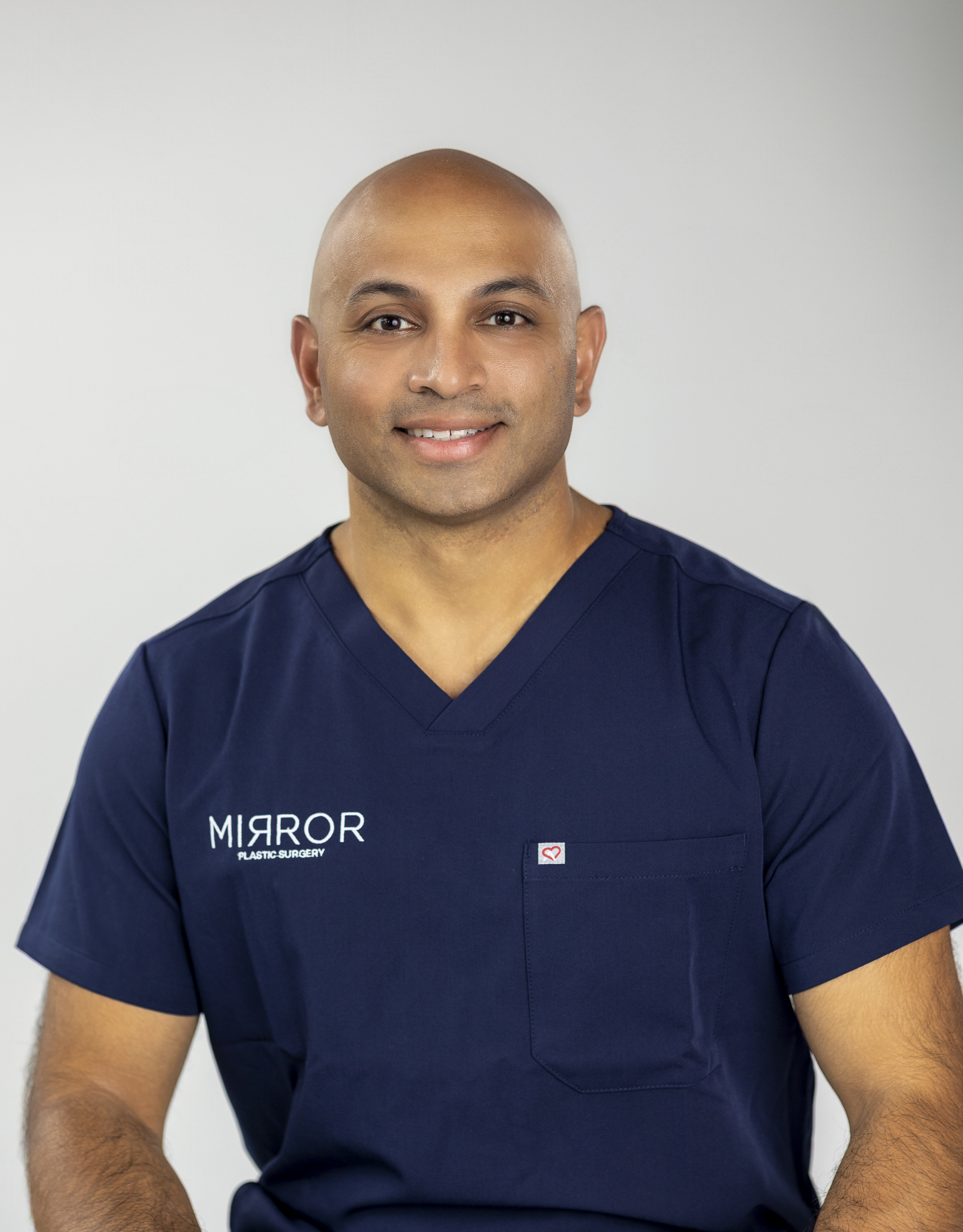
Experience the anatomy-first approach at Mirror Plastic Surgery with a comprehensive evaluation from Dr. Akash in St. Petersburg, Florida, where every surgical plan is tailored to your individual structure.
Frequently Asked Questions
Are hip dips a sign of being overweight or out of shape?
Hip dips are a normal skeletal feature present in all human anatomies. Their visibility depends on the distance between the iliac crest and greater trochanter, pelvic width, and femoral neck length, which are structural dimensions set by genetics. They do not reflect body weight, body fat percentage, or fitness level. People with low body fat often notice that their hip dips become more visible as subcutaneous fat decreases.
Who is a good candidate for surgical hip-dip correction?
Ideal candidates are adults in good general health who have realistic expectations, maintain a stable body weight, and are non-smokers or willing to pause tobacco use during recovery. For autologous fat transfer, enough donor fat must be available at harvest sites such as the abdomen, flanks, or thighs. Patients with deep, structurally dominant hip dips and minimal donor fat may be better suited to AlloClae adipose grafting or custom hip implants. A comprehensive consultation with anatomical assessment determines the most appropriate option for each person.
How long do the results of fat transfer to the hip dips last?
Fat that survives the initial three-to-six-month healing period integrates as permanent living tissue with its own blood supply. As noted earlier, that surviving fat is considered long term, and enriched protocols can raise retention rates to 75–85% at seven months, although individual results vary.1 Results usually remain stable for many years, but significant weight loss or gain can change the appearance of grafted fat.1 A small subset of patients choose a touch-up procedure six to twelve months after the initial grafting to address residual asymmetry or to add volume.
What is the difference between AlloClae adipose grafting and autologous fat transfer?
Autologous fat transfer uses your own fat harvested with liposuction from a donor site on your body. AlloClae is a processed allograft adipose tissue product derived from donor tissue, which removes the need for a separate liposuction harvest. AlloClae is especially helpful for patients who lack sufficient donor fat or who prefer a less invasive procedure with a lighter recovery. Both approaches aim to restore volume in the trochanteric depression using biocompatible adipose material. The right choice depends on hip dip depth, available donor fat, and individual anatomy, all of which are evaluated during consultation.
How should I prepare for a hip-dip correction consultation?
Preparation starts with gathering your medical history, current medications, supplement use, and smoking status, because these details directly affect candidacy and surgical planning. Bring reference images that reflect your aesthetic goals and use them as communication tools rather than exact targets, since results are always tailored to your anatomy. Be ready to discuss your weight history and stability, because large fluctuations after surgery can affect fat graft survival. A thorough consultation includes a physical assessment of the trochanteric region, review of all three surgical pathways, honest discussion of expected outcomes and recovery, and a clear explanation of safety protocols.
1 Results may vary from person to person. Editorial content, before and after images, and patient testimonials do not constitute a guarantee of specific results.