
Written by: Dr. Akash Chandawarkar, Board Certified Plastic Surgeon, Mirror Plastic Surgery
Key Takeaways
- Brachioplasty removes excess skin and reshapes the upper arm for adults with significant weight loss or age-related laxity that diet and exercise cannot correct.
- Results depend on precise anatomical planning, controlled skin excision, and a 12–18 month scar maturation process rather than aggressive tissue removal.
- Scars follow the natural inner-arm groove, and consistent sun protection plus silicone therapy support a smoother, less noticeable long-term appearance.
- Ideal candidates maintain stable weight, avoid nicotine, and accept a well-placed scar as the trade-off for improved arm contour and function.
- Schedule your personalized consultation with Dr. Akash at Mirror Plastic Surgery, named in America’s Best Plastic Surgeons 2025 by Newsweek for 2 years in a row, to receive a thorough anatomical assessment and a tailored arm-contouring plan.
How Brachioplasty Works and What to Expect
The upper arm’s appearance comes from several layers working together: the skin envelope, subcutaneous fat, supportive connective tissue, and underlying muscle. Aging-related collagen and elastin loss, repeated weight fluctuations, major weight loss, and genetics all influence whether an arm has true skin redundancy or mainly a volume or fat-distribution issue. Exercise improves muscle tone but cannot remove a stretched skin envelope that has lost elasticity.
Brachioplasty is a body-contouring procedure, not a weight-loss method, and suits patients whose main problem is significant skin laxity rather than isolated fat. Patients who maintain stable weight, protect scars from sun exposure, and follow consistent scar-care routines generally achieve the best long-term outcomes.1 The procedure removes loose skin but cannot stop future aging or major weight changes, so arm contour can still evolve over time.1
Why Surgeon Expertise Shapes Natural Arm Contours
Natural arm contours after brachioplasty come from individualized anatomical assessment, controlled skin excision, and layered closure, not from removing as much tissue as possible. Overly aggressive skin excision increases the risk of injury to major motor nerves including the median, ulnar, and radial nerves and can place excessive tension on deeper structures. Effective brachioplasty prioritizes contouring with restraint and nerve-aware planning over maximal tissue removal.
Dr. Akash at Mirror Plastic Surgery brings a training background that directly supports this approach. A Harvard Medical School graduate with honors, he completed a seven-year integrated plastic and reconstructive surgery residency at Johns Hopkins University, followed by an aesthetic surgery fellowship at the Manhattan Eye, Ear and Throat Hospital (MEETH), the highest level of specialization in cosmetic surgery. Mirror Plastic Surgery performs only one to two surgeries per day, so every patient receives the focused, unhurried attention that complex body-contouring requires.
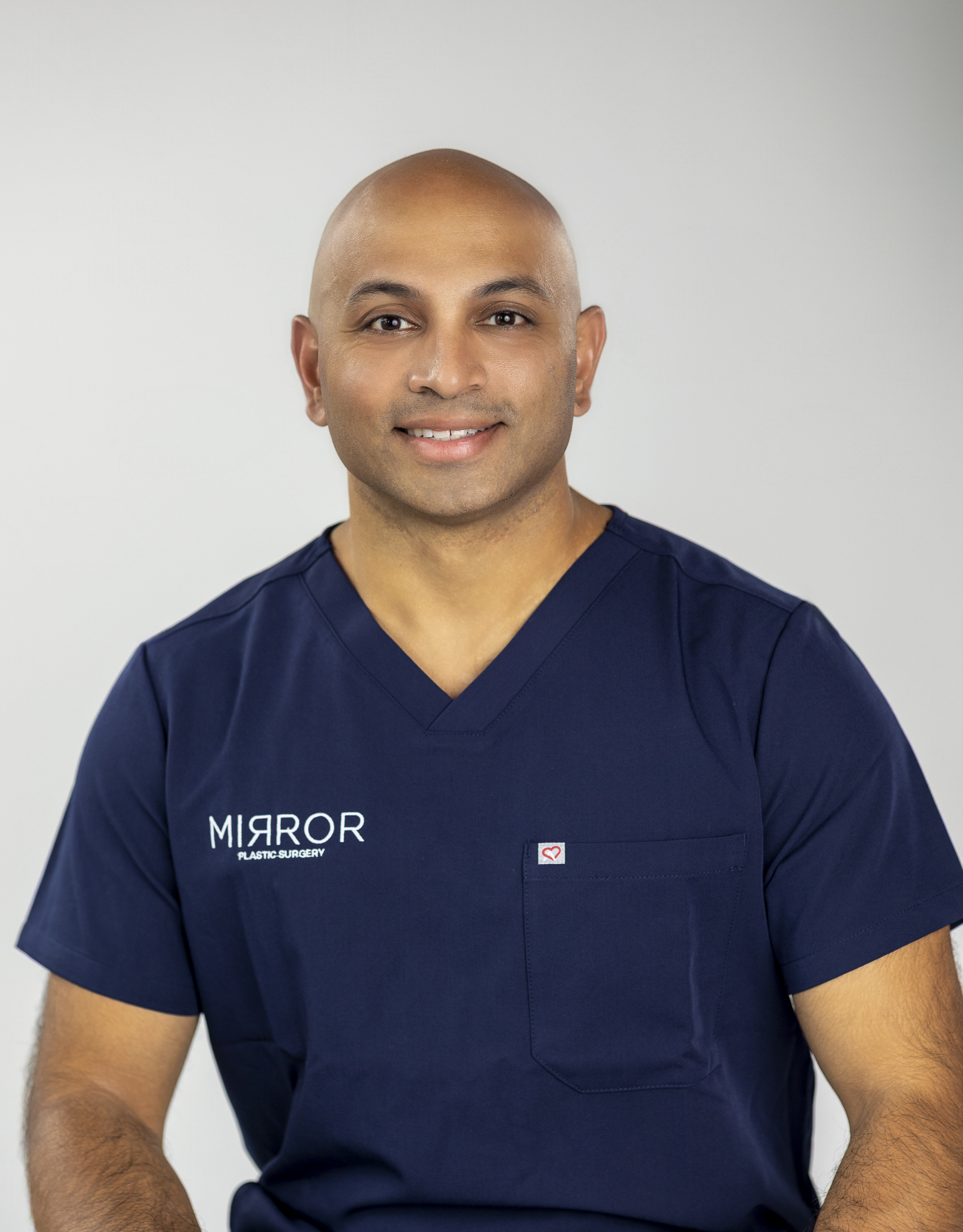
Schedule your personalized assessment with Dr. Akash to receive a thorough anatomical evaluation and a tailored arm-contouring plan.
Key Terminology for Mini, Traditional, and Extended Brachioplasty
Knowing which type of brachioplasty matches your anatomy helps you set realistic expectations about scars, contour, and recovery. The three main variations differ in incision length, scar placement, and how much laxity they address.
A mini arm lift treats mild laxity concentrated near the axilla with a limited incision hidden in the armpit crease. A traditional (standard) brachioplasty uses a longer incision along the inner arm from the axilla toward the elbow to address moderate to significant laxity. An extended brachioplasty continues the incision onto the lateral chest wall and suits patients whose laxity extends beyond the arm after major weight loss.
Scar placement is planned by marking the incision in the bicipital groove on the inner upper arm while the arm is raised to 90 degrees before surgery. This approach helps the scar settle into a less visible position when the arm rests at the side. Scar maturation follows three biological phases, inflammatory, proliferative, and remodelling, and can extend to 18 months or longer.
12–18 Month Scar Maturation Timeline
At twelve months, most biological changes are complete, though minor changes can continue until 18 to 24 months.1 In Tampa Bay’s heat and humidity, diligent sun protection plays a major role in scar quality. UV exposure on immature scars accelerates hyperpigmentation, and SPF 50+ sunscreen or protective clothing should continue throughout the full maturation period. Sweat and humidity can also affect wound hygiene in the early weeks, so compression garment use and careful incision care matter in Florida’s climate.
The following timeline outlines what to expect during each phase of scar healing and the specific care steps that support a smoother, more refined appearance over time.
| Phase | Timeframe | Appearance | Care Notes |
|---|---|---|---|
| Inflammatory | Weeks 0–2 | Red, slightly raised, tender, mild swelling | Wear compression garment 24 hours per day, keep incision clean and dry, avoid sun exposure. |
| Proliferative | Weeks 2–8 | Raised, firm, red or pink as collagen forms rapidly | Begin silicone sheets or gel once healed (typically weeks 2–4) and start daily scar massage around weeks 3–4. Apply SPF 50+ on any exposed skin. |
| Active Remodelling | Months 2–6 | Less raised, softer, redness fades, may temporarily darken or thicken between months 3–6 | Continue silicone therapy, maintain SPF 50+, and avoid overhead lifting until surgeon-cleared at 6–8 weeks. |
| Maturation | Months 6–18+ | Flat or flush with skin, pale pink, silver, or white, narrow (optimally 2–4 mm wide) | Maintain ongoing sun protection and stable weight. Consider laser therapy between months 3–6 if your surgeon recommends it. |
Patients with darker Fitzpatrick skin types IV–VI may see more persistent hyperpigmentation at 12 months compared to lighter skin tones, so scar-management plans should reflect this from the start.
How to Recognize Natural vs. Overdone Arm Lift Results
A natural-looking result stays proportional to the shoulder and torso, with smooth contour transitions and a discreet scar strategy rather than an over-pulled or sharply narrowed arm.1 The following criteria help distinguish subtle, balanced outcomes from overly tight appearances.
- Arm circumference stays proportional to shoulder width and torso size, not artificially narrowed.
- Contour transitions smoothly from axilla to elbow without step-offs or segmental tightness.
- Scar follows the natural inner-arm groove and armpit fold to minimize visibility at rest.
- Skin drapes naturally without visible tethering or distortion of deeper tissue.
- No excessive tension appears at the incision line, which predicts wider or symptomatic scarring.
- Full shoulder range of motion remains intact without pulling or restriction.
- Arm-to-torso transition looks seamless, with no irregularities at the axilla.
- The result appears as a healthier, more youthful version of the patient’s own anatomy, not obviously operated.
Who Makes a Strong Candidate and How Function Guides Planning
Strong brachioplasty candidates share several traits that support both safety and long-term contour stability. The ideal candidate maintains a stable weight for several months before surgery, because weight fluctuation afterward increases the risk of recurrent laxity. For bariatric surgery patients, the stability requirement is even more stringent, with most surgeons recommending at least three to six months of stable weight and many preferring closer to a full year.
Key candidacy and functional decision factors fall into three categories: anatomical suitability, medical readiness, and lifestyle compatibility.
Anatomically, the pinch test should confirm loose skin folds rather than fat fullness with good elasticity. This dominant driver helps determine whether brachioplasty, liposuction, or a combination makes the most sense.
Medically, candidates need weight stability as described earlier, non-smoker status or a commitment to avoid all nicotine for four to six weeks before and after surgery, and overall good health without uncontrolled conditions that impair wound healing.
From a lifestyle perspective, candidates accept a permanent inner-arm scar as the trade-off for contour improvement and understand the recovery limits. Side-sleeping is restricted in the early postoperative weeks, so patients plan to sleep on their back with arms elevated on pillows. Overhead reaching and lifting above shoulder level remain limited for several weeks, which requires planning for work and home tasks. Functional problems such as chafing, rashes, or hygiene difficulties from excess skin may also support medical documentation for partial insurance review.
Surgical Options and When Non-Surgical Treatments Fit
A mini arm lift uses a single curved incision hidden in the armpit crease and produces the least visible scar among arm-lift techniques. This option works only when laxity truly stays confined to the upper arm. When laxity extends toward the elbow, a limited lift can leave the lower arm lax and may lead to revision surgery within one to two years.
Traditional brachioplasty treats moderate to significant laxity along the inner arm. Extended brachioplasty adds a lateral chest component for post-massive-weight-loss patients whose laxity continues into the axilla and side chest. Radiofrequency, laser, and other non-surgical tightening technologies may help mild laxity but cannot match surgical correction in significantly deflated or hanging arms. Non-surgical modalities such as Thermage, Renuvion, and BodyTite suit only very mild laxity and produce modest, less predictable results that do not correct moderate or severe excess skin.
Discuss your specific anatomy and goals with Dr. Akash to determine which technique, or combination of techniques, will deliver the most natural result.
Common Misconceptions and Realistic Trade-offs
Several persistent myths can skew expectations before surgery. First, tighter does not mean better. An over-tight brachioplasty appearance often comes from excessive tension, scar tethering of deeper tissue, or imbalance between removal zones and transition zones. These issues complicate revision and can compromise long-term function.
Second, invisible scars do not exist with this procedure. Brachioplasty scars can be among the most visible of any cosmetic surgery because there is nowhere to hide them on the upper arms. The realistic goal is a well-placed, well-matured scar, not a scar-free arm.
Third, early results never represent the final outcome. The picture closest to the final brachioplasty result usually appears around month 12, though some scars continue to refine into the extended maturation period.1 Evaluating outcomes at six weeks or even six months gives an incomplete picture.
Temporary numbness or tingling along the inner arm is common in the early weeks as small sensory nerves recover from stretching or bruising during dissection. Persistent injury to the medial antebrachial cutaneous nerve can occur, but a small area of permanent reduced sensitivity near the scar does not affect arm strength or function.
Frequently Asked Questions
What does a brachioplasty scar look like at one year?
At twelve months, a well-managed brachioplasty scar is typically flat or flush with the surrounding skin, pale pink to silvery white in color, soft in texture, and narrow, optimally two to four millimeters wide. It runs along the inner arm where natural shadow helps camouflage it when the arms rest at the sides. Patients with darker skin tones may see more residual pigmentation at this stage, which often continues to fade through the later maturation period. Scar quality reflects genetics, skin tone, smoking history, sun exposure, and consistency of silicone therapy and massage throughout recovery.
How is pain managed after brachioplasty, and how long does it last?
Brachioplasty pain is usually moderate and feels like a tight, aching sensation along the inner arms rather than sharp surgical pain. Most patients use prescription pain medication for only three to five days, then switch to scheduled acetaminophen and NSAIDs. Because the upper arm muscles are not surgically disturbed, many patients find recovery less painful than expected. Postoperative discomfort generally decreases significantly by weeks three to six, although swelling and a sense of tightness can temporarily return with increased activity even after the six-week mark.
Does age alone determine brachioplasty candidacy?
Age does not serve as the main determinant of candidacy. Surgeons focus on skin quality, the amount and location of laxity, fat distribution, arm circumference, shoulder-to-torso balance, overall health, and weight stability. A 35-year-old after significant weight loss may be a stronger candidate than a 55-year-old with mild, localized softness. The key clinical assessment is the pinch test. If skin on the underside of the upper arm hangs in loose folds that do not retract, surgical excision is the appropriate intervention. If the skin snaps back and the arm feels full, excess fat rather than laxity may be the primary concern, and liposuction or non-surgical options may be more appropriate.
What credentials should I look for when evaluating a brachioplasty surgeon?
Board certification by the American Board of Plastic Surgery provides the baseline credential, because it requires completion of an accredited plastic surgery residency and passage of written and oral examinations. Beyond certification, fellowship training in aesthetic surgery, such as the MEETH program, offers advanced, focused experience in body contouring beyond residency. Hospital privileges in plastic surgery matter because they indicate peer-reviewed credentialing and provide a safety net for rare complications. Ask specifically about the surgeon’s approach to scar placement, tension management, and nerve preservation, since these technical decisions directly influence whether results look natural or overdone. A surgeon who spends adequate consultation time explaining anatomy, realistic timelines, and trade-offs, rather than rushing to a treatment plan, signals the kind of individualized care that produces proportional, lasting outcomes.
How long after brachioplasty can I sleep on my side, and when can I return to exercise?
Side-sleeping is typically restricted for the first few weeks after brachioplasty to avoid pressure on the incisions and to keep the arms elevated for swelling control. Most patients sleep on their back with arms supported on pillows during this period. Light walking starts the day of surgery to promote circulation. Return to desk work is usually possible within one to two weeks once patients no longer need narcotic pain medication. Light cardiovascular activity often begins around four to six weeks. Upper-body weight training and resistance exercises are typically restricted for the first four to six weeks after brachioplasty, with overhead reaching limited for about four weeks. Explicit surgeon clearance is essential, because premature loading can widen the scar and compromise the contour.
Making an Informed Decision About Brachioplasty
Natural brachioplasty results come from precise anatomical planning, appropriate technique selection, nerve-aware dissection, and the extended maturation timeline discussed earlier, not from maximal tightening or a single dramatic before-and-after photograph. Candidates who enter surgery at a stable weight, commit to scar-care protocols, and protect healing tissue from Tampa Bay’s sun and humidity give themselves the strongest foundation for a proportional, long-lasting outcome. Choosing a surgeon whose training spans both reconstructive depth and aesthetic refinement, and whose practice philosophy prioritizes safety and function before aesthetics, remains the most consequential step in that process.
Mirror Plastic Surgery’s concierge model means Dr. Akash dedicates up to an hour to each initial consultation and performs a thorough top-to-bottom anatomical assessment before making any recommendation. That unhurried evaluation is where natural results begin.
Book your consultation with Dr. Akash and take the first step toward an evidence-based, safety-first arm-contouring plan tailored to your anatomy and goals.
1 Results may vary from person to person. Editorial content, before and after images, and patient testimonials do not constitute a guarantee of specific results.